Week - 2 - Explicit and Implicit Analysis
F(u)= `u 3 + 9 u 2 + 4 u`
`k(u)= (df)/(du) = 3u2+18u+4`
Explicit Analysis
Three equal load increments (or steps) of ∆F = 1 is considered
u = Displacement, f= Internal Force, F0 External Force and k= Stiffness
Incremental displacements or incremental externally applied forces are represented as ∆u or ∆F,
respectively. Use is made of the relationship ∆F = k∆
Step 1:
u0 = 0
k(u0)= 4
∆F = 1
∆u1 = ∆F/k(u0) = 1/4
u1 = u0 + ∆u1 = 0+1/4 = 0.25
fint= (0.25)3+9(0.25)2+4(0.25) = 1.578
Step 2:
k(u1)= 3(0.25)2+18(0.25)+4= 8.68
∆F = 1
∆u2 = ∆F/k(u1) = 0.11
u2 = u1 + ∆u2 = 0.36
Step 3:
k(u2)= 3(0.36)2+18(0.36)+4 = 10.86
∆F = 1
∆u3 = ∆F/k(u2) = 0.092
u3 = u2 + ∆u3 = 0.45
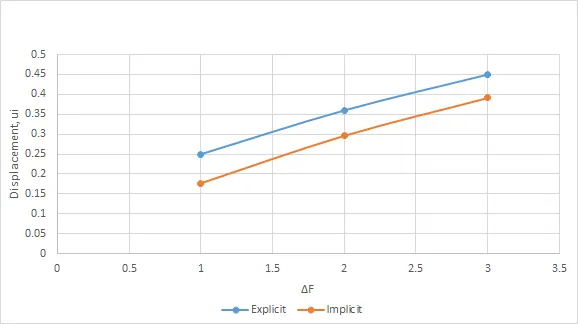
| Step i | ∆Fi | ∆ui | ui | Fext | fint | fint-Fext =R |
| 1 | 1 | 0.25 | 0.25 | 1.0 | 1.57 | 0.57 |
| 2 | 1 | 0.11 | 0.36 | 2.0 | 2.65 | 0.65 |
| 3 | 1 | 0.092 | 0.45 | 3.0 | 3.71 | 0.71 |
Implicit Analysis
Step 1
u0 = 0.0, ⇒ k(u0) = 0.25, ∆F = 1, ∆u1 = ∆F/k(u0) = 0.25, u1 = u0 + ∆u1 = 0.25
Check the residual, Fext = ∆F = 1, fint = (u1)3+ 9(u1)2+ 4u1= 1.57 R(0) = fint − Fext = 0.57
R(0)> 10−2 ⇒ Newton-Raphson iterations are necessary.
Calculate the correction to u1 = u1(0)
δu(1) = −[k(u1(0)]-1 R(0) = -(8.68)-1 (0.57) = - 0.0656
⇒ The updated value of u1(1) = u0(1) + δu(1) = 0.25 + (−0.0656) = 0.1844
Check the residual again, Fext = 1, fint = (u1(1))3+ 9(u1(1))2+ 4u1(1) = 1.04
R(1) = fint − Fext = 0.04
R(1) > 10−2 ⇒ another Newton-Raphson iteration is necessary.
Calculate the new total correction to u1 = u0(1)
δu(2) = δu(1) − [k(u1)1)]−1R(1) =
−0.0656 − (7.42)−1 x 0.04 = - 0.070
The updated value of u1(2) = u1(0) + δu(2) = 0.25 + (−0.070) = 0.18
Check the residual, Fext = 1, fint = = (u1(2))3+ 9(u1(2))2+ 4u1(2) = 1.017
R(2) = fint − Fext = 0.017
R(2)> 10−2 ⇒ another Newton-Raphson iteration is necessary.
Calculate the new total correction to u1 = u0(1)
δu(3) = δu(2) − [k(u1)2)]−1R(2) =
−0.070 − (7.33)−1 x 0.017 = - 0.0723
The updated value of u1(3) = u1(0) + δu(3) = 0.25 + (−0.0723) = 0.17768
Check the residual, Fext = 1, fint = = (u1(3))3+ 9(u1(3))2+ 4u1(3) = 1.0004
R(2) = fint − Fext = 0.0004
R(2)> 10−2 ⇒ No Further iterations are necessary.
Final Value of u1 = 0.17768
Step 2
k(u1) = 3u2+18u+4 = 7.29, ∆F = 1, ∆u2 = ∆F/k(u1) = 1/7.29 = 0.137
u2 = u1 + ∆u2 = 0.31468
Check the residual, Fext = ∆F = 1, fint = (u2)3+ 9(u2)2+ 4u2 = 2.1810
R(0) = fint − Fext = 0.1810
R(0)> 10−2 ⇒ Newton-Raphson iterations are necessary.
Calculate the correction to u2 = u2(0)
δu(1) = −[k(u2(0))]−1R(0) = −9.9613−1 x (0.1810) = - 0.0181
⇒ The updated value of u2(1) = u2(0) + δu(1) = 0.314 + (−0.0181) = 0.2965
Check the residual again, Fext = 1, fint =(u2(1))3+ 9(u2(1))2+ 4u2(1) =2.0032
R(1) = fint − Fext = 0.0032
R(1)< 10−2 ⇒ No iteration required
Final Vlaue of u2 = u2(1)= 0.2965
Step 3
k(u2) = 3u2+18u+4 = 9.6007 , ∆F = 1, ∆u3 = ∆F/k(u2) = 1/9.6007 = 0.1041
u3 = u2 + ∆u3 = 0.4006
Check the residual, Fext = ∆F = 1, fint = (u3)3+ 9(u3)2+ 4u3 = 3.1110
R(0) = fint − Fext = 0.1110
R(0)> 10−2 ⇒ Newton-Raphson iterations are necessary.
Calculate the correction to u3 = u3(0)
δu(1) = −[k(u3(0))]−1R(0) = −11.6922−1 x (0.1110) = - 0.00949
⇒ The updated value of u3(1) = u3(0) + δu(1) = 0.4006 + (−0.00949) = 0.3911
Check the residual again, Fext = 1, fint =(u3(1))3+ 9(u3(1))2+ 4u3(1) = 3.0008
R(1) = fint − Fext = 0.0008
R(1)> 10−2 ⇒ No iteration required
Final Value of u3 = u3(1)= 0.3911
| Step i | ∆Fi | ui | Fext | fint | fint-Fext =R |
| 1 | 1 | 0.17768 | 1.0 | 1.0004 | 0.0004 |
| 2 | 1 | 0.2965 | 2.0 | 2.0032 | 0.0032 |
| 3 | 1 | 0.3911 | 3.0 | 3.008 | 0.0080 |