Week - 8 Mass Scaling
Objective :- In this challaenge, we have to Use mass scaling to reduce the runtime of a model and ensure the stability of mass scaling. The hard limit on mass scaling is 8% and stability should be completely intact. This means that two simulations, one with mass scaling and one without should behave exactly the same way. The submission should contain the trials for mass scaling and the data generated henceforth. Both the DT2MS and TSSFAC parameters should be optimized.
A histogram should be plotted to compare the runtime with mass scaling trials. Finally, the student has to run the same model using implicit solver with necessary changes and compare implicit and explicit runtime.
Procedure :-
- Import the given keyword file into LS-prepost
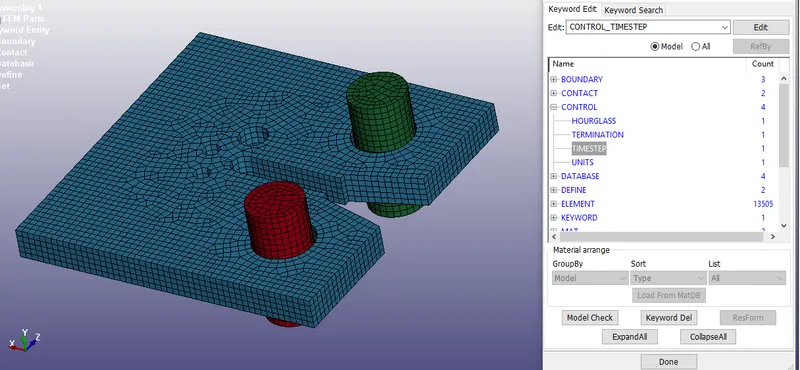
CASE 1 : Explicit Analysis with mass scaling
important parameters in Timestep
DT2MS:=Time step size for mass scaled solutions
TSSFAC:=Scale factor for computed time step. (Default =0.9. If high explosives are used, the default is lowered to 0.67).
DTINIT:=Initial time step size:
Iteration 1 :- DT2MS = -3.5e-5 and TSSFAC = 0.9
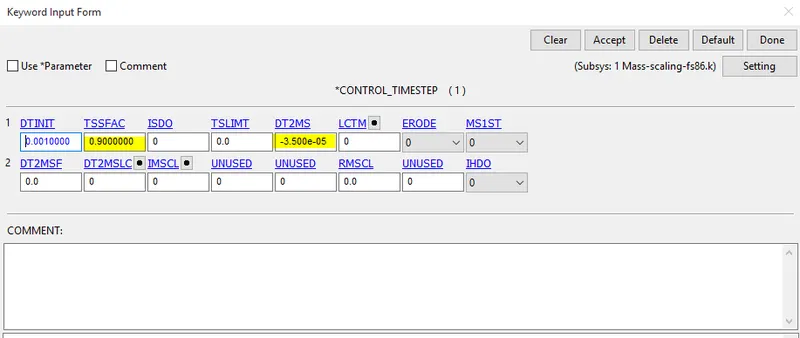
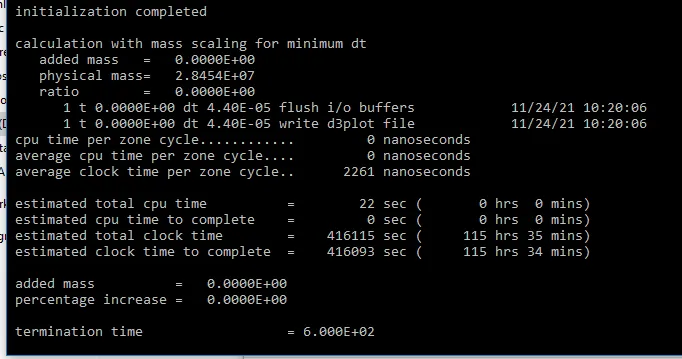
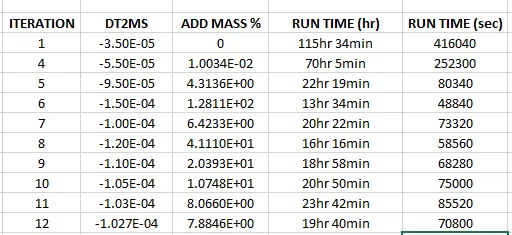
There is no mass added with given DT2MS = -3.5e-5 & TSSFAC = 0.9 and Computational time is 115hrs 34min
Iteration 2 :- DT2MS = -3.5e-5 and TSSFAC = 0.8
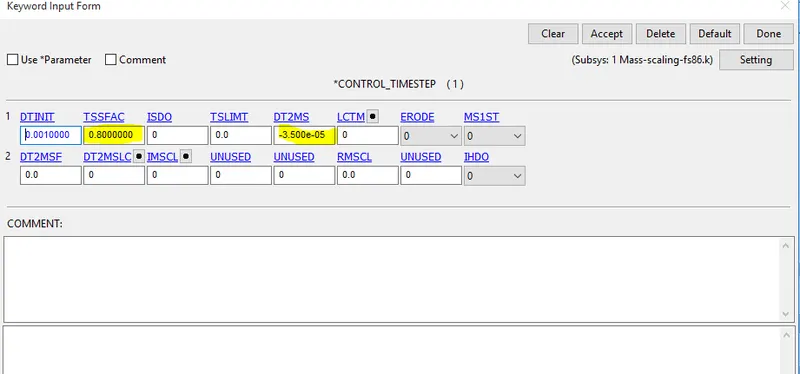
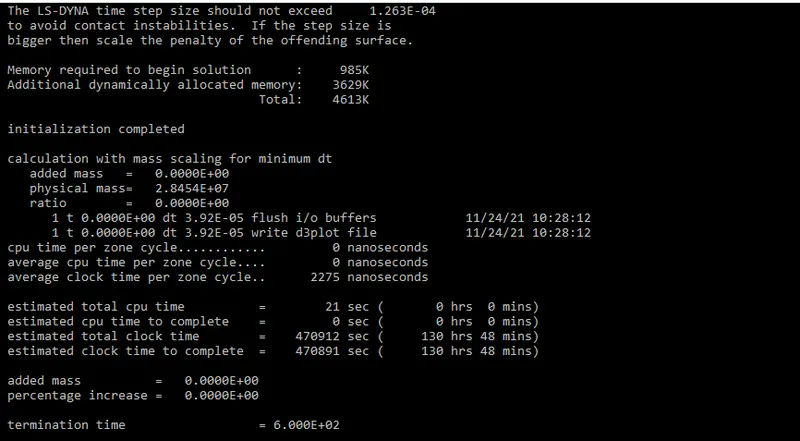
There is no mass added with given DT2MS = -3.5e-5 & TSSFAC = 0.8 and Computational time is 130hrs 48min
Iteration 3:- DT2MS = -3.5e-5 and TSSFAC = 0.7
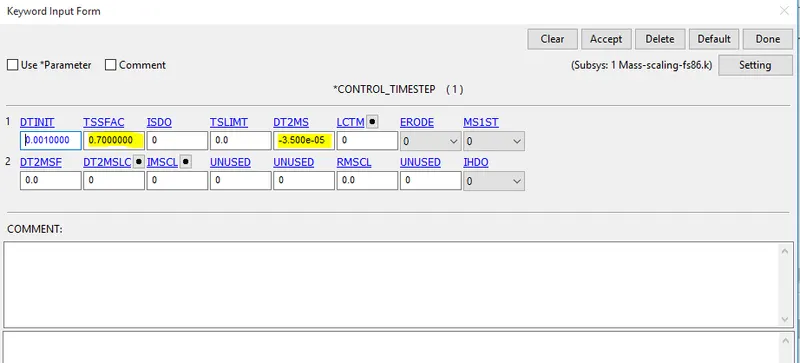
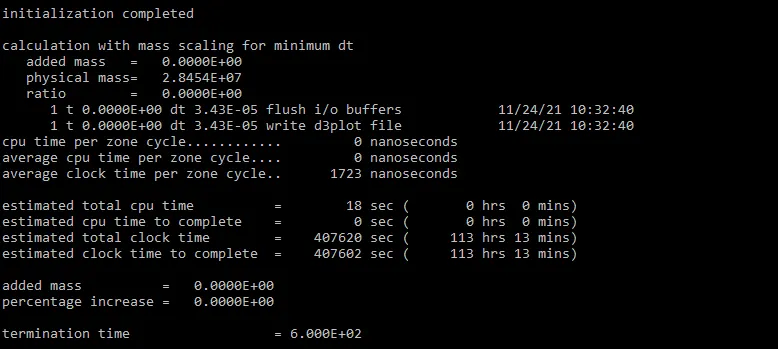
There is no mass added with given DT2MS = -3.5e-5 & TSSFAC = 0.7 and Computational time is 113hrs 13min
Iteration 4:- DT2MS = -5.5e-5 and TSSFAC = 0.9
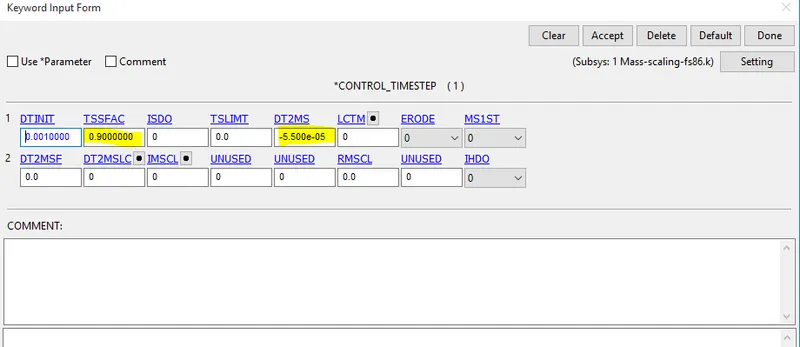
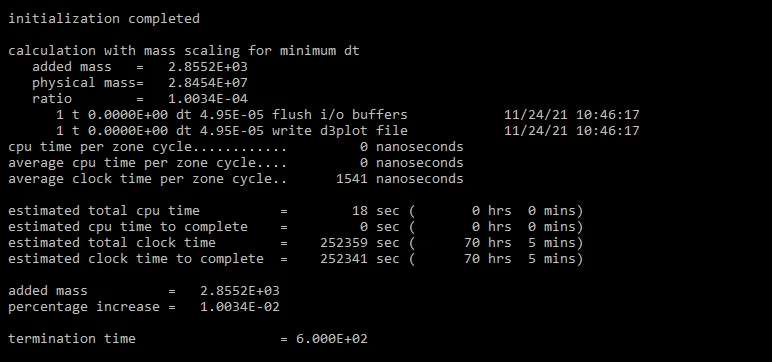
- Compared to Iteration1 Computational time decreases drastically to 70hrs 5min from 115hrs 34min.
Iteration 5:- DT2MS = -9.5e-5 and TSSFAC = 0.9
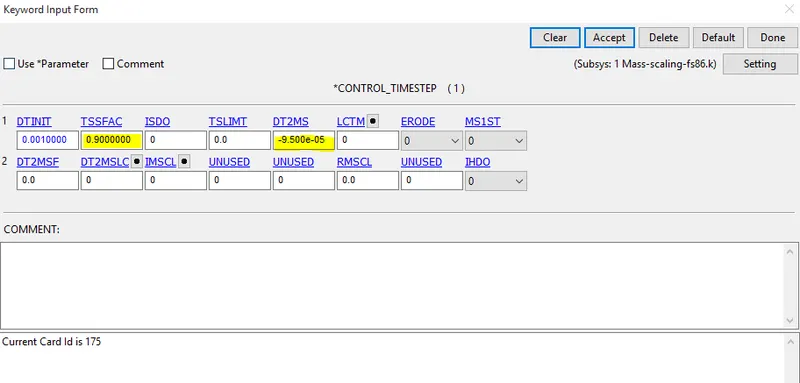
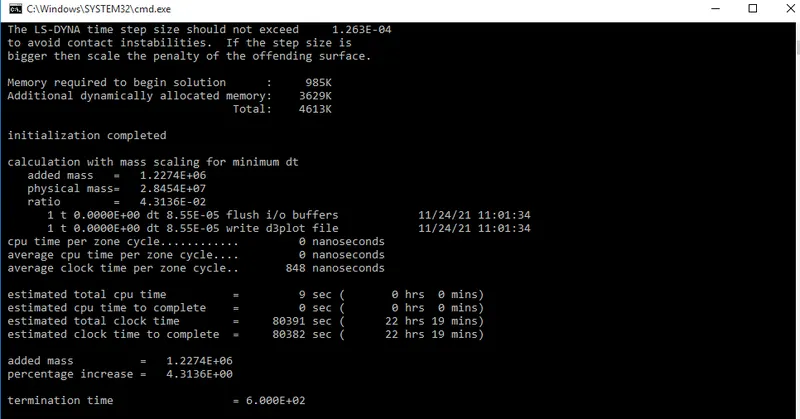
Iteration 6:- DT2MS = -1.5e-4 and TSSFAC = 0.9
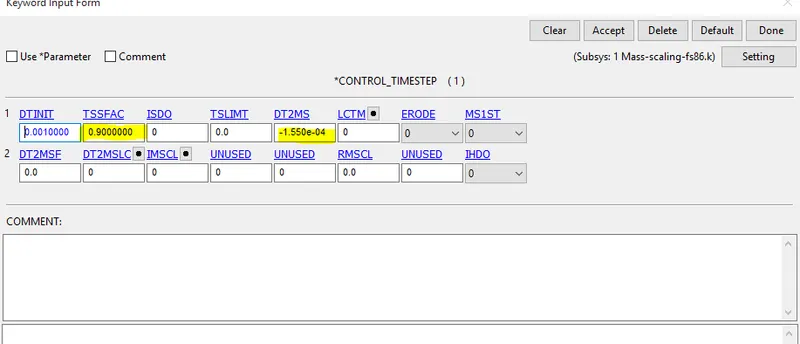
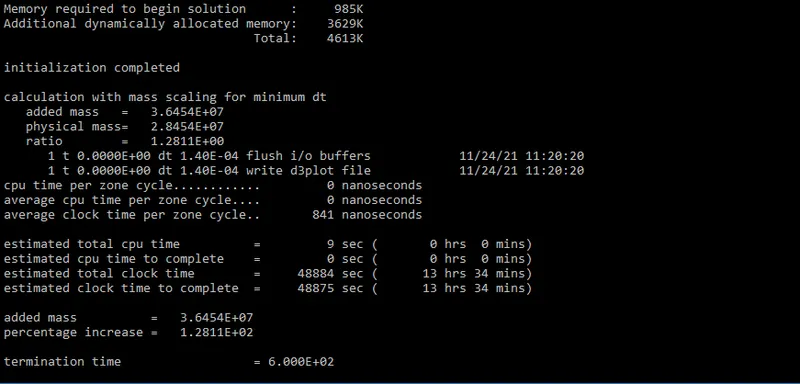
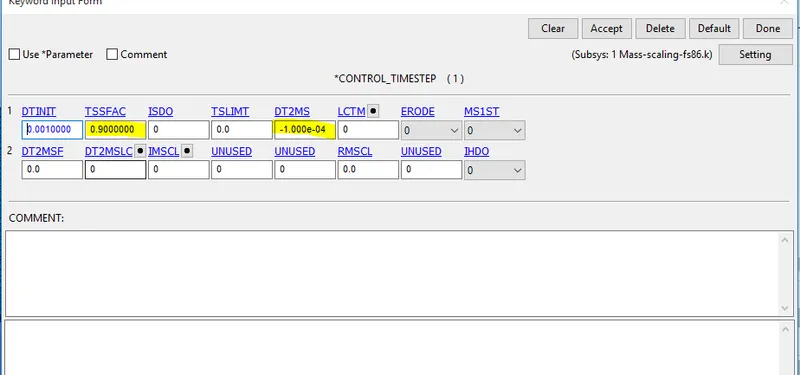
Iteration 7:- DT2MS = -1.0e-4 and TSSFAC = 0.9
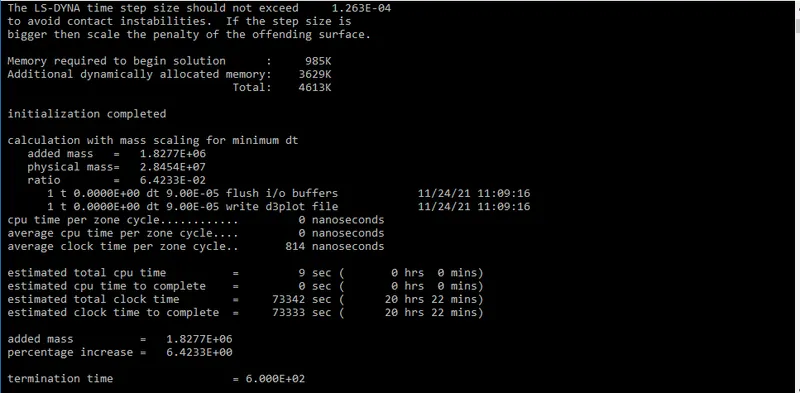
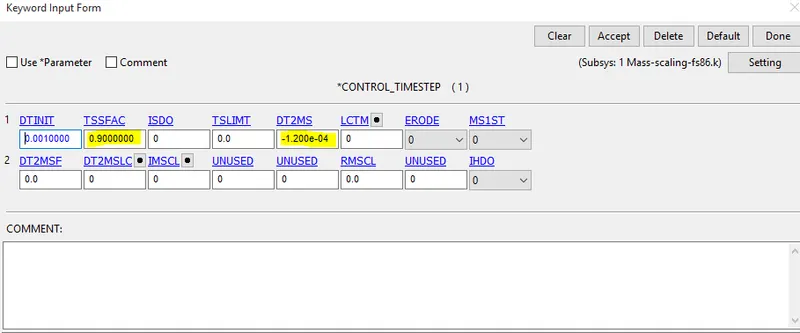
Iteration 8:- DT2MS = -1.2e-4 and TSSFAC = 0.9
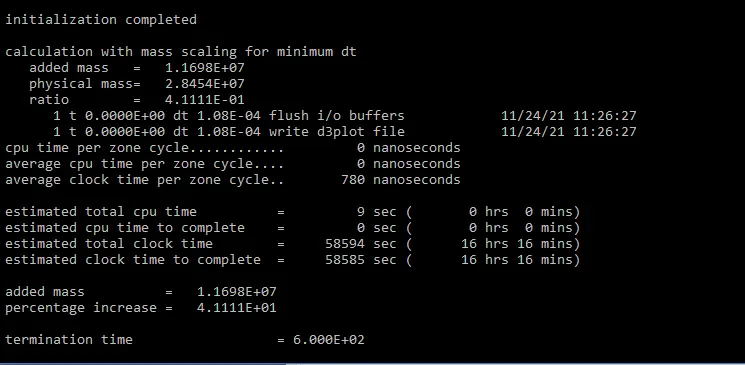
Iteration 9:- DT2MS = -1.1e-4 and TSSFAC = 0.9
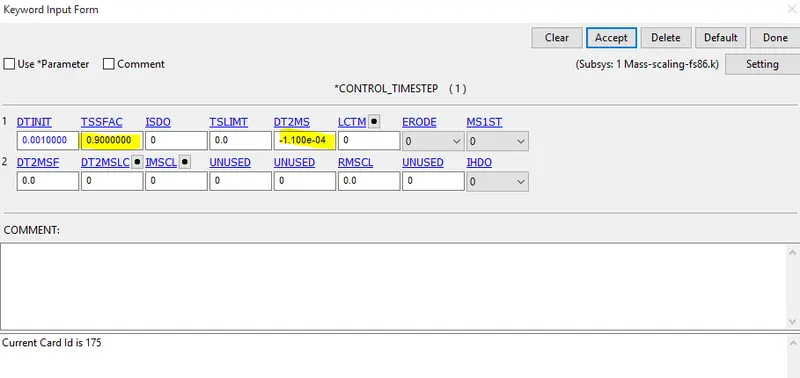
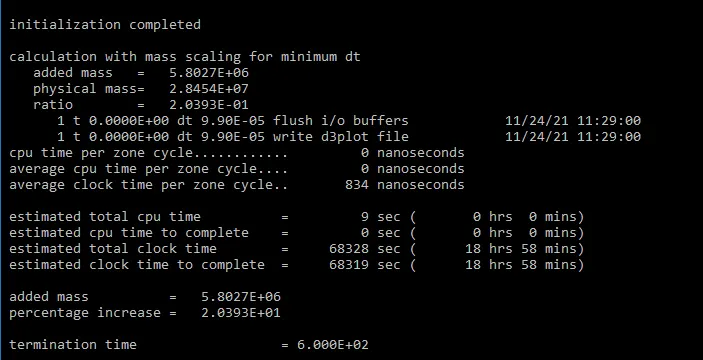
Iteration 10:- DT2MS = -1.05e-4 and TSSFAC = 0.9
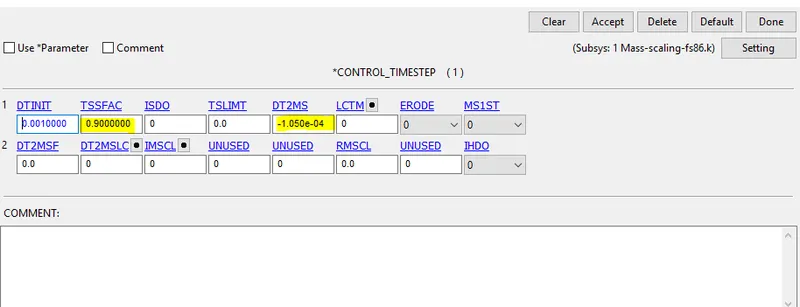
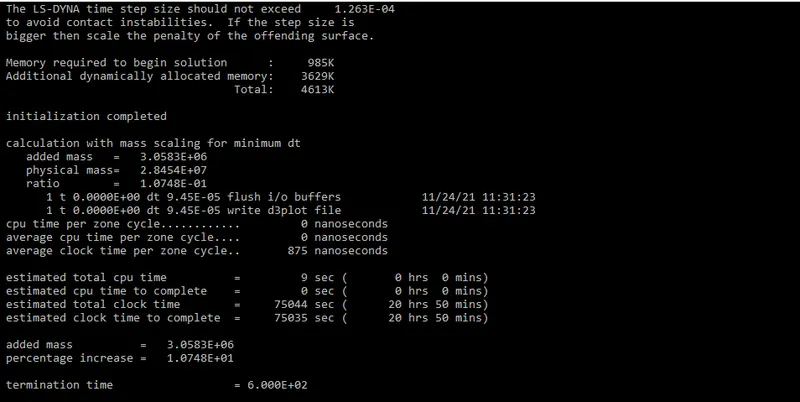
Iteration 11:- DT2MS = -1.03e-4 and TSSFAC = 0.9
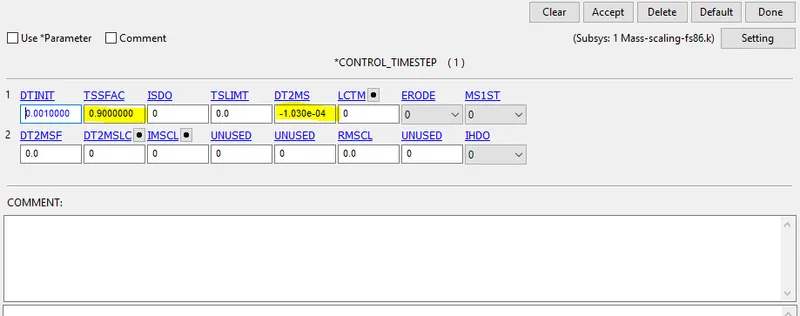
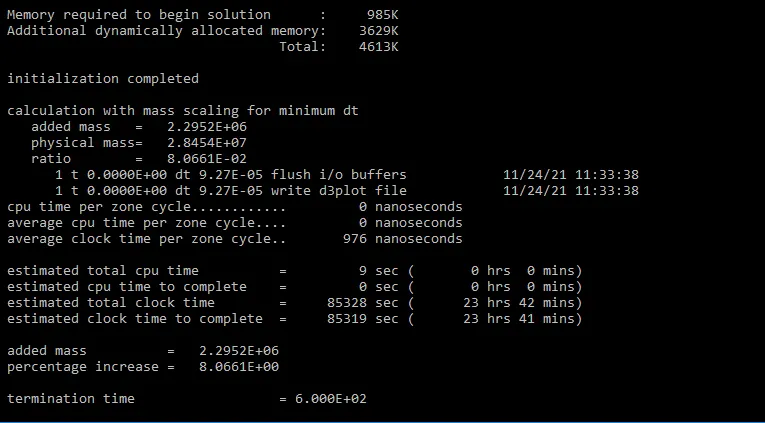
Iteration 12:- DT2MS = -1.027e-4 and TSSFAC = 0.9
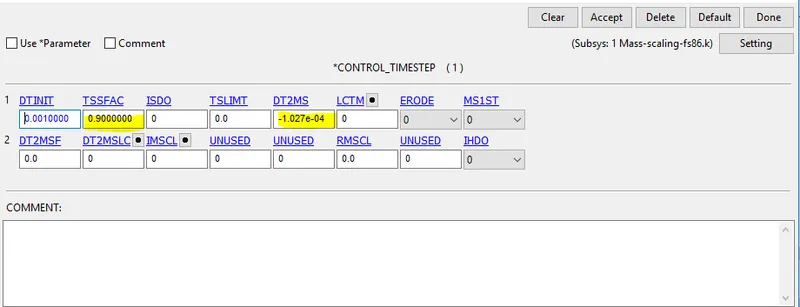
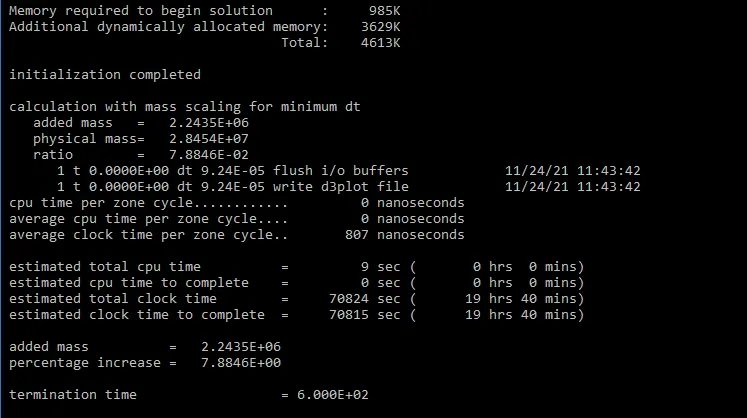
Iteration 13:- DT2MS = -1.027e-4 and TSSFAC = 0.8
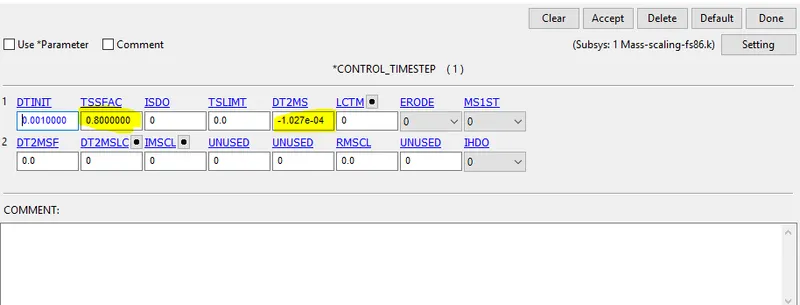
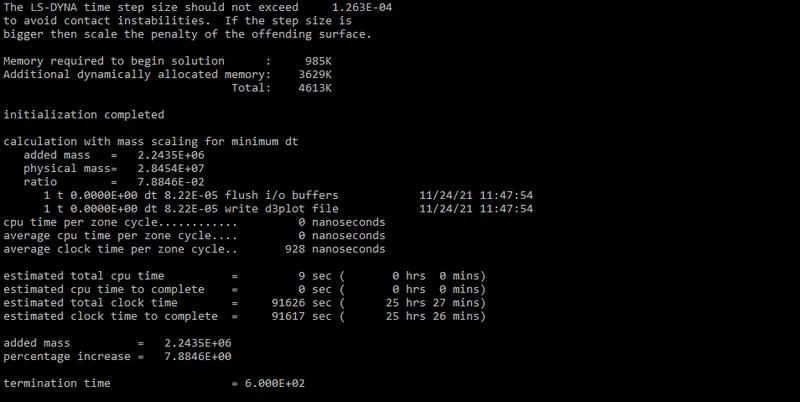
Iteration 14:- DT2MS = -1.027e-4 and TSSFAC = 0.7
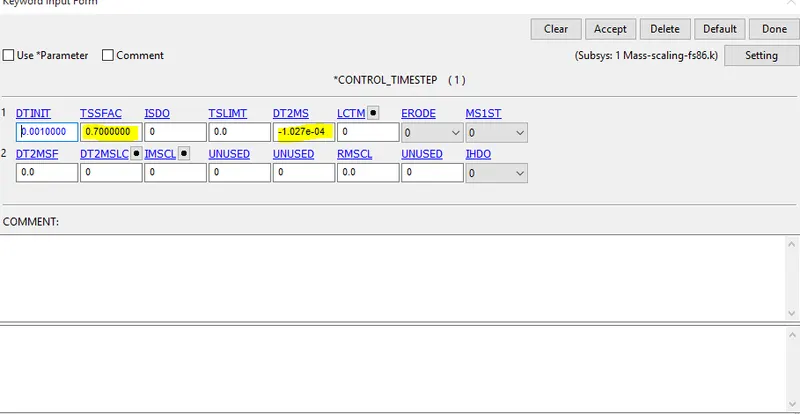
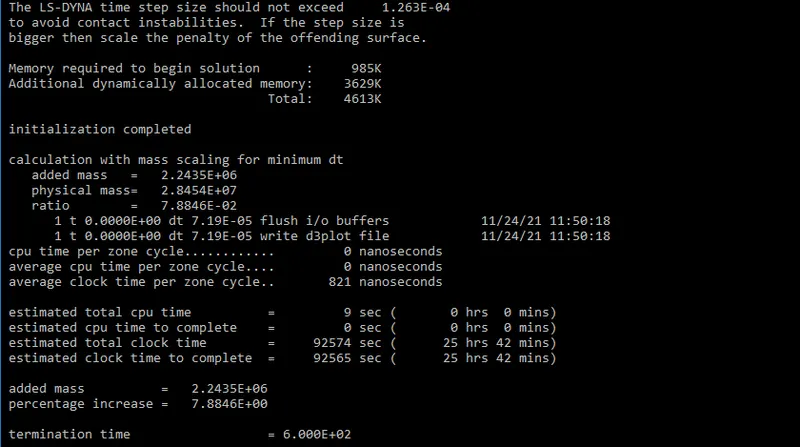
TSSFAC = 0.9
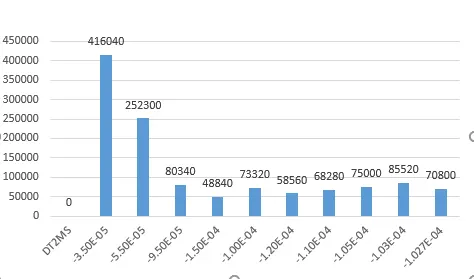
Run time(sec) vs DT2MS
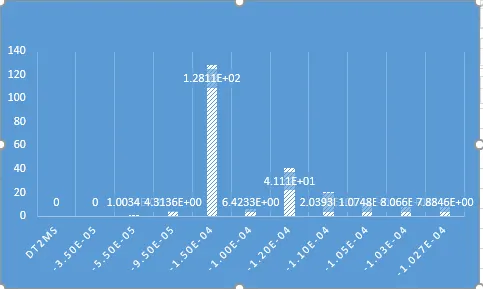
Add mass% vs DT2MS
- From the above graphs it is observe that run time required to complete the simulation for DT2MS -3.5 is more compared to remaining all DT2MS values.
- DT2MS = -1.5E-4, complete the simulation in less time compared to remaining all DT2MS values but Add mass% is Exceeds the limit (128%) in this case.
- DT2MS = -1.027E-4 , This value add mass in permisable limit (7.9%)
CASE 2 : Explicit Analysis with out mass scaling
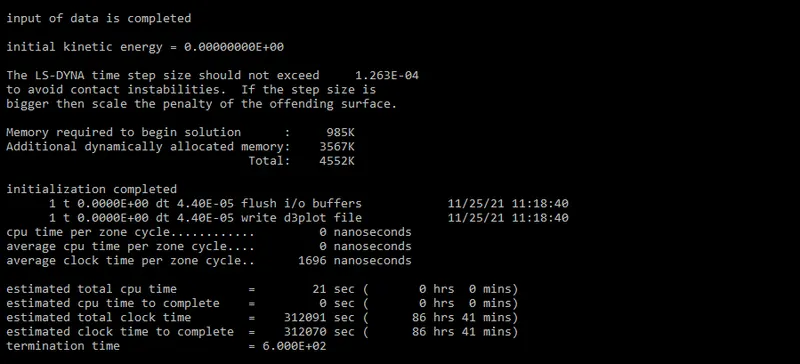
- From the above image, computational time is 86hr 41min for Explicit Analysis with out mass scaling.
CASE 3: Implicit Analysis with mass scaling
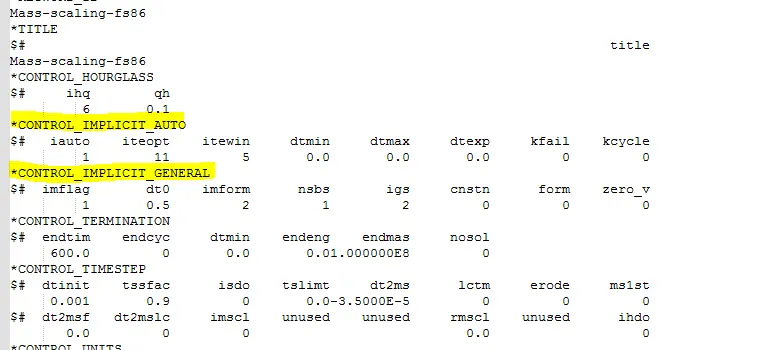
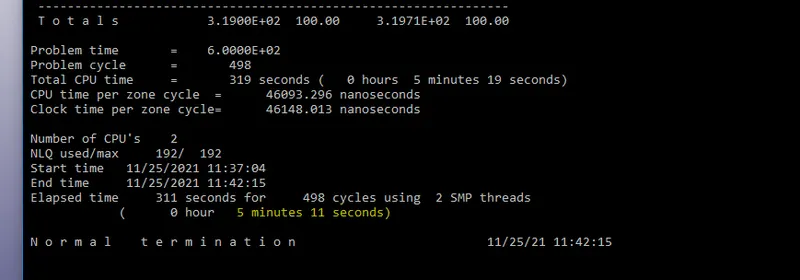
- In implicit analysis, time taken for complete the simulation is 5min 11sec
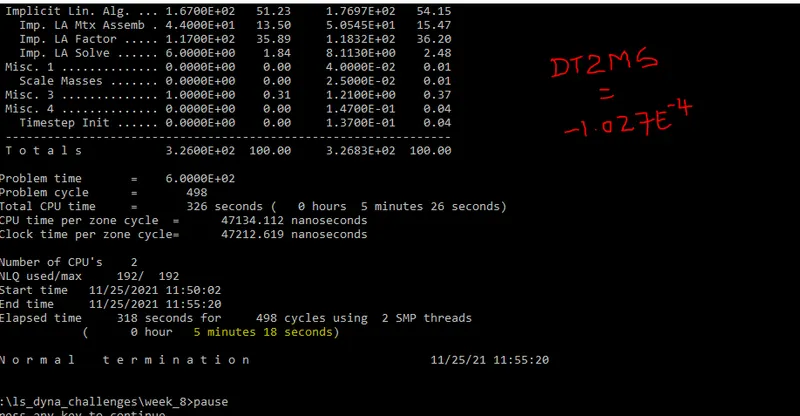
compare implicit and explicit runtime
| DT2MS | RUN TIME | |
| -3.5 E-5 | EXPLICIT | 115hr34min |
| IMPLICIT | 5 min 11 sec | |
| -1.027 E-4 | EXPLICIT | 19hr 40min |
| IMPLICIT | 5 min 18 sec |
- compared to explicit analysis for the vales of DT2MS = -3.5E-5 & -1.027E-4,Implicit analysis takes very very less time.
Conclusion
- By considering The hard limit on mass scaling is 8%, the optimized value of DT2MS = -1.027E-4 and TSSFAC = 0.9 with lowest possible time required for simulation is 19hr 40min.
- Added mass and percentage mass increase doesn't depend on TSSFAC value
- Reducing TSSFAC value causes increase in computional time
- Explicit analysis without mass scaling takes 86hrs 41min to complete this simulation, if we use mass scaling within permissible limit (8%) we can complete this simulation within 19hrs 40min, which is very less time compared to Explicit analysis without mass scaling (86hrs 41min)
- No mass is added in implicit analysis even though control_timestep card attached
- The values of DT2MS and TSSFAC doesn't effect the simulation time for implicit analysis
- From all the above results we can say that mass scalaing is used only for explicit analysis.