Week - 8 Mass Scaling
AIM:
(a)To utilise the mass scaling method and determine its effect on runtime of the given model.
(b) Determine the difference in Runtime for explicit and implicit simulation.
Explanation:
In order to obtain a large timestep, non-physical mass is added to a given structure in the simulation.
But we know that, `F = m*a`, so addition of mass will result in larger force generation in the system. To avoid such cases, the simulation needs to be calibrated in such a way that the effect of added non-physical masss is insignificant.
Selective mass scaling was utilised to artificially increase material density of the given parts. DT2MS was altered manually in CONTROL_TIMESTEP to invoke mass scaling in the simulation. When DT2MS is set to a negative number, mass is only applied to elements whose timestep would be smaller than |DT2MS|. The timestep of these elements is equal to |DT2MS| when mass is added to them.
The timestep, will be the same for an infinite number of combinations of TSSFAC and DT2MS, but the additional mass will be different for each of those combinations. The more the increased mass, the larger the |DT2MS| as we know that `TSSFAC*DT2MS = constant.` TSSFAC*|DT2MS|=const.
Case -1: No Mass Scalling included in the numerical simulation.
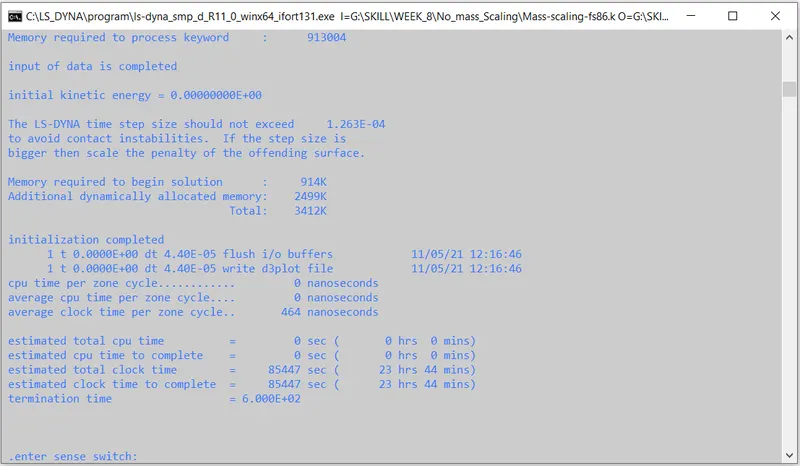
From the figure, it was determined that without mass scaling the estimated time to solve the problem was 85447 sec i.e. 23hr and 44 min.
Case -2: Mass Scalling included in the numerical simulation.
DT2MS was set to be `= -3.5 e^-5`with TSSFAC =0.9. resulted in no addition of mass and the time taken increased to 209285 sec i.e. 58hr and 8 min.
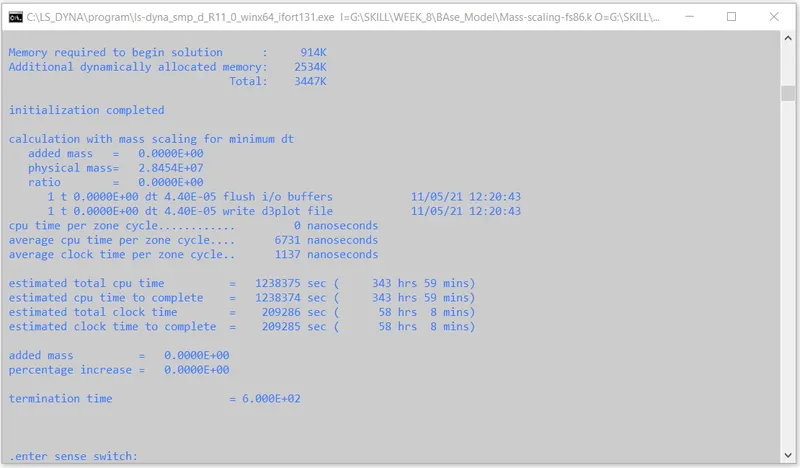
Similarly, multiple values were tested and the results are displayed in the table.
When TSSFAC = 0.9 :
|
SI. No. |
DT2MS |
Mass Added |
Mass Scaled % |
TSSFAC |
Runtime (sec) |
Runtime (hr.) |
|
1 |
0 |
0 |
0 |
0.9 |
85447 |
23hr and 44 min |
|
2 |
-1.1e-4 |
5.8027E+6 |
2.0393E+01 |
0.9 |
34159 |
9hr and 29min |
|
3 |
-1.03e-4 |
2.295E+6 |
8.066E-00 |
0.9 |
70608 |
19hr and 36min |
|
4 |
-1.02e-4 |
2.1276E+6 |
7.4771E-00 |
0.9 |
42780 |
11hr and 53min |
|
5 |
-1.0101e-4 |
1.9733E+6 |
6.9349E-00 |
0.9 |
48599 |
13hr and 29min |
|
6 |
-1.01e-4 |
1.9718E+6 |
6.9297E-00 |
0.9 |
37203 |
10hr and 20min |
|
7 |
-1.0e-4 |
1.8277E+6 |
6.423E-00 |
0.9 |
38181 |
10hr and 36min |
|
8 |
-9.0e-5 |
7.808E+5 |
2.7443E-00 |
0.9 |
46969 |
13hr and 02min |
|
9 |
-8.0e-5 |
2.4003E+5 |
8.435E-1 |
0.9 |
46969 |
13hr and 02min |
|
10 |
-7.0e-5 |
4.0678E+4 |
1.429E-1 |
0.9 |
67532 |
18hr and 45min |
|
11 |
-6.5e-5 |
1.6462E+4 |
5.785E-2 |
0.9 |
57808 |
16hr and 03min |
|
12 |
-6.0e-5 |
6.4667E+3 |
2.272E-2 |
0.9 |
62626 |
17hr and 23min |
|
13 |
-5.5e-5 |
2.8552E+3 |
1.0034E-2 |
0.9 |
69421 |
19hr and 17min |
|
14 |
-5.0e-5 |
3.75E+2 |
1.317E-3 |
0.9 |
76363 |
21hr and 12min |
|
15 |
-4.5e-5 |
0 |
0 |
0.9 |
79225 |
22hr and 00min |
|
16 |
-4.0e-5 |
0 |
0 |
0.9 |
76779 |
21hr and 19 min |
When TSSFAC = 0.8 :
|
SI. No. |
DT2MS |
Mass Added |
Mass Scaled % |
TSSFAC |
Runtime (hr.) |
|
1 |
0 |
0 |
0 |
0.8 |
23hr and 44 min |
|
2 |
-1.1e-4 |
5.8027E+6 |
2.0393E+01 |
0.8 |
10hr and 50min |
|
3 |
-1.03e-4 |
2.295E+6 |
8.066E-00 |
0.8 |
14hr and 20min |
|
4 |
-1.02e-4 |
2.1276E+6 |
7.4771E-00 |
0.8 |
14hr and 28min |
|
5 |
-1.0101e-4 |
1.9733E+6 |
6.9349E-00 |
0.8 |
11hr and 48min |
|
6 |
-1.01e-4 |
1.9718E+6 |
6.9297E-00 |
0.8 |
11hr and 37min |
|
7 |
-1.0e-4 |
1.8277E+6 |
6.423E-00 |
0.8 |
14hr and 43min |
|
8 |
-9.0e-5 |
7.808E+5 |
2.7443E-00 |
0.8 |
16hr and 24min |
|
9 |
-8.0e-5 |
2.4003E+5 |
8.435E-1 |
0.8 |
14hr and 40min |
|
10 |
-7.0e-5 |
4.0678E+4 |
1.429E-1 |
0.8 |
19hr and 45min |
|
11 |
-6.5e-5 |
1.6462E+4 |
5.785E-2 |
0.8 |
22hr and 08min |
|
12 |
-6.0e-5 |
6.4667E+3 |
2.272E-2 |
0.8 |
23hr and 02min |
|
13 |
-5.5e-5 |
2.8552E+3 |
1.0034E-2 |
0.8 |
30hr and 18min |
|
14 |
-5.0e-5 |
3.75E+2 |
1.317E-3 |
0.8 |
26hr and 53min |
|
15 |
-4.5e-5 |
0 |
0 |
0.8 |
22hr and 49min |
|
16 |
-4.0e-5 |
0 |
0 |
0.8 |
30hr and 34 min |
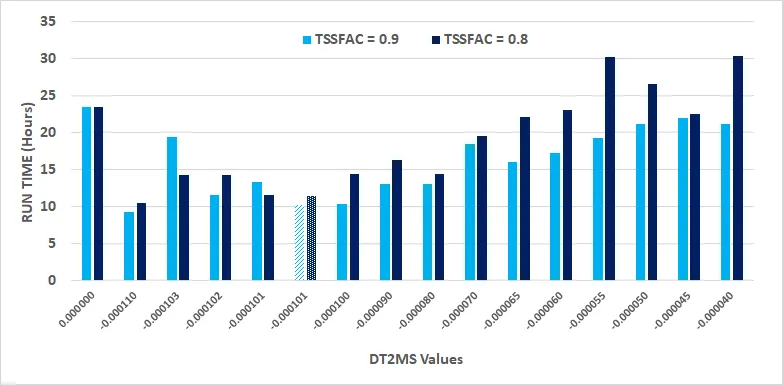
Histogram Comparision
Implicit Analysis
For simulating the given model using Implicit analysis, we need to include the following keywords:
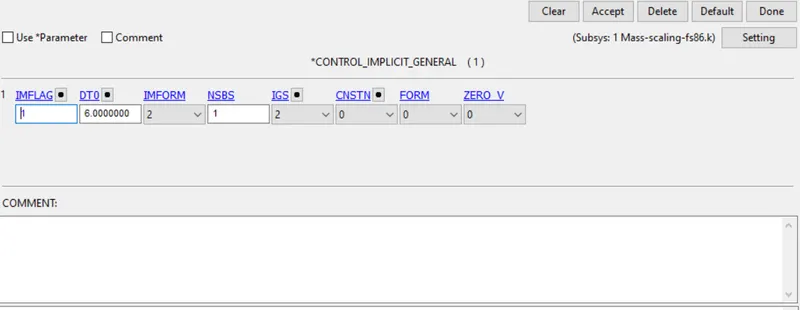
1. Control_Implicit_General
The implicit/explicit switching flag was activated using IMFLAG = 1 so that the simulation runs using the Implicit Analysis Technique.
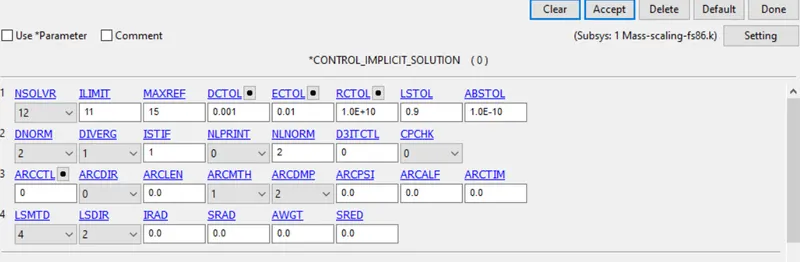
2. Control_Implicit_Solution
Implicit Solution card was activated to define the solution method for Implicit analysis.
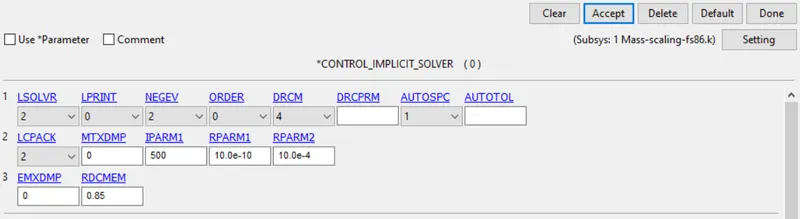
3. Control_Implicit_Solver
Implicit Solver card was utilised to define the linear equation solver to carry out the stiffness matrix inversions.
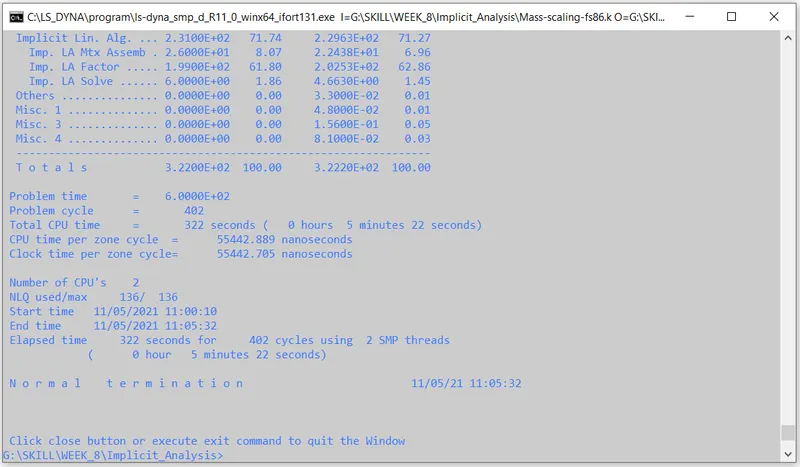
Implicit Analysis result
It was determined that the implicit analysis method took about 5min and 22 sec to solve the given problem.
Conclusion
- By varying the DT2MS value, the mass scaling pergentage was about 6.92% with TSSFAC = 0.9.
- It was determined that TSSFAC value didnt had any effect on mass scaling and with reduced mass scaling, the solving time increased. Thus, no further test was carried out to determine the effect oflower TSSFAC values.
- A comparision between implicit and explicit analysis was carried out and it was determined that the minimum time taken by explicit analysis tosolve the problem was 10hr and 20min where as the implicit analysis took about 5 min and 22 sec to solve the problem. This can be attributed to the fact that constant timestep formulation with large time step was utilised to solve using implicit analysis.