Week - 3 Drop test Challenge
Aim: To simulate a drop test of a mobile dummy model on a rigid surface.
Explanation:
Dimension System: kg/mm/ms
Element Formulation: Since the aim was to simply simulate the drop of a model, the mobile device and the rigid surface was modelled with solid elements using fully integrated S/R solid ELFORM -2.
Material Model: The mobile specimen was modelled using the MAT_PIECEWISE_LINEAR_PLASTICITY material model and mechanical properties of stainless steel were defined for the model using load curves to define the plasticity properties.
Since no deformation is expected in the impacting surface, MAT_RIGID was utilised to model the surface with standard steel properties.
Contact: Standard Automatic _Surface_To_Surface contact was utilised to simulate the impact of the body with Mobile as slave surface and the surface as the master surface.
Velocity: Initial Velocity was defined using a node-set ID of the test specimen and an impact velocity of 10m/s, was defined. ( considering drop due to gravitational force).
Control: Termination time of 3ms was defined and it was found to be sufficient to complete the drop event.
Database: GLSTAT, MATSUM, RCFORCE was defined in the ASCII to obtain the Energy exchange taking place during the impact event.
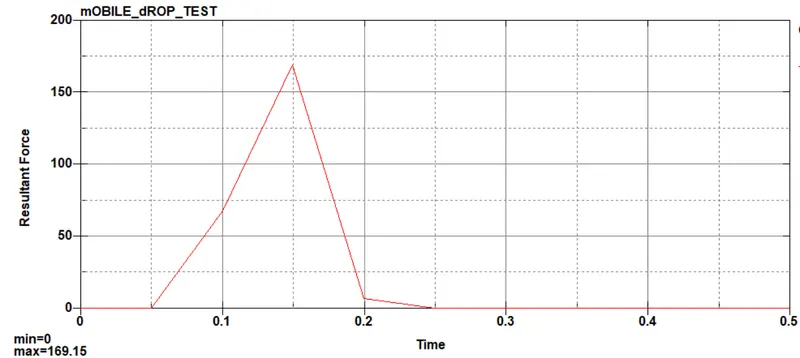
RCFORCE: to obtain the contact force between the two bodies, RCFORCE in the ASCII was defined and a maximum force of 169.15 KN was obtained.
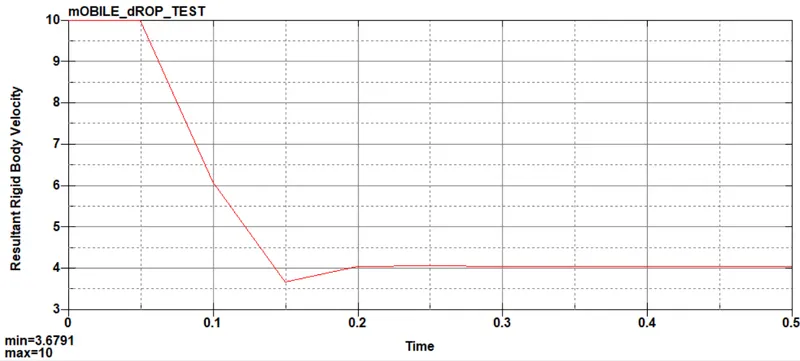
Residual Velocity of the Body: at 0.15ms the impact velocity was the least of about 3.67m/s. After the impact, the mobile started rebounding from the rigid surface.
Von Mises Stress Contour
In the initial impact condition, the maximum stress occurs at the initial phase of the simulation at 0.99ms. The maximum stress distribution is towards the impact region whereas the region away from the impact domain remains unaffected at the given time period. The stress waves travel gradually to the other end and finally decays down as the body rebounds after impacting the surface. 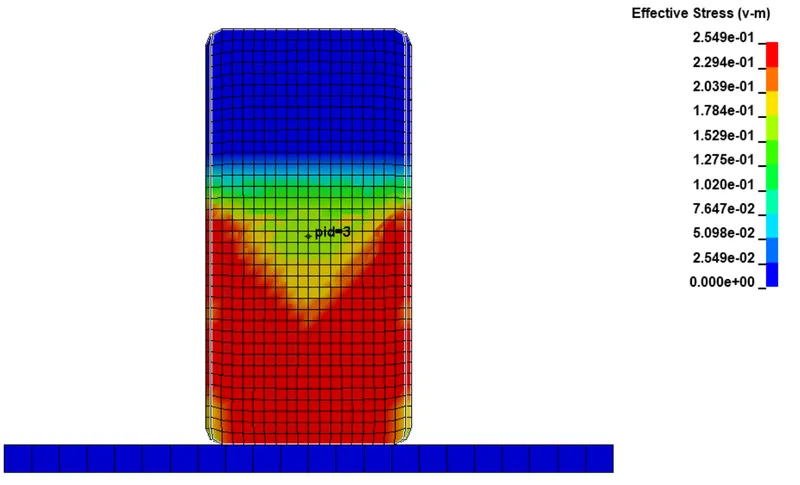
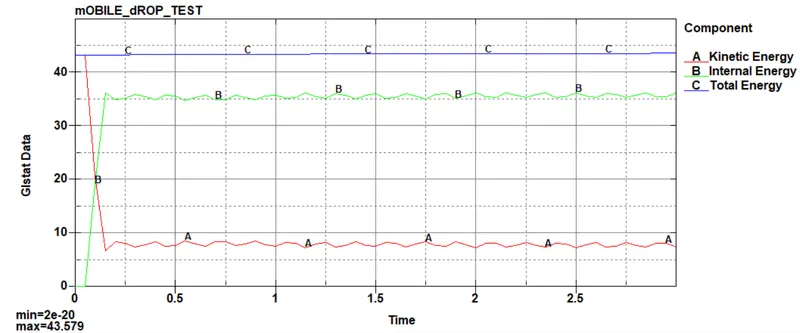
System Energy: to determine the stability of the analysis, the energy of the system was studied. it was determined that the total energy of the system was about 43.579 KN-mm, which was equal to the internal energy and kinetic energy of the system given by 36.2 KN-mm and 7.2KN-mm respectively. Thus, signifying that the energy of the system remains conserved between two bodies and there are negligible losses in the form of hourglass energy and slippage.
Maximum Stress: Maximum stress of 147 MPa was obtained in the z-direction, which is below the yield point. Thus, no plastic deformation was evident from the simulation, which agrees with the fact that the impacting load was within the elastic limit and no deformation was observed.
CONCLUSION
The simulation of a mobile phone drop on a rigid surface was carried out under the gravitational force. stainless steel material properties were defined for the mobile body to simply demonstrate the capability of simulating the drop test of a device.
Since the impact loading was within the elastic limit, no permanent deformation was observed and in the energy balance study, the summation of internal energy and kinetic energy resulted in the total energy of the system signifying higher stability and efficient modelling.
*The simulation file has been attached.