Week - 8 Mass Scaling
AIM: The main objective of this week is to make use of the mass scaling technique to reduce the run time of the total simulation and also do a implicit analysis on the model and compare the run time of the model.
PROCEDURE:
STEP 1: First import the model and run the simulation without doing any changes to it.
Now note the run time and mass scaling percentage for the run.
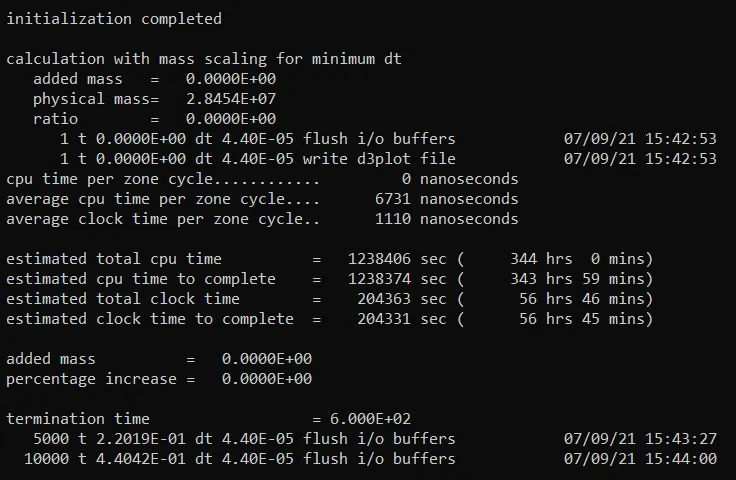
STEP 2: Now increase the time step to -5.5e-05 and run the simulation.
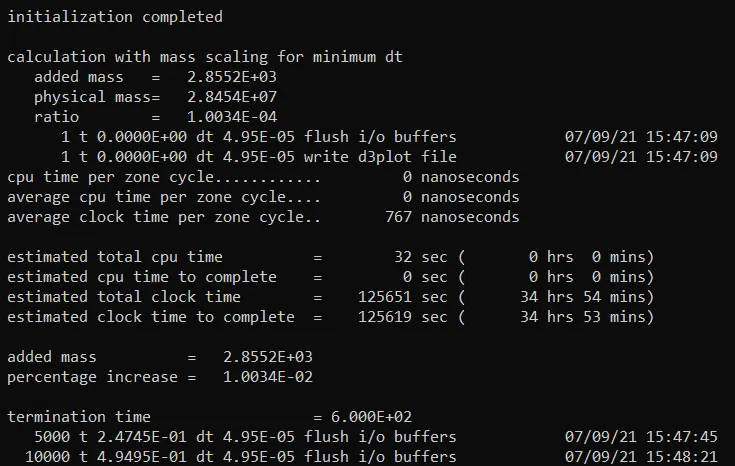
STEP 3: Now increase the time step to -7.5e-05 and run the simulation.
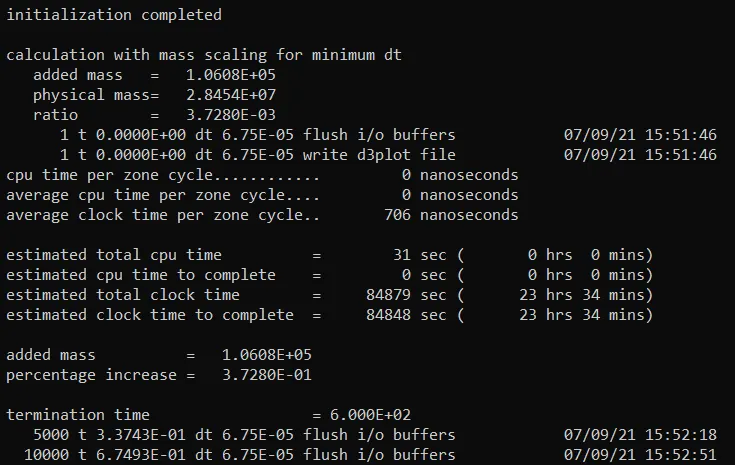
STEP 4:Now increase the time step to -8.5e-05 and run the simulation.
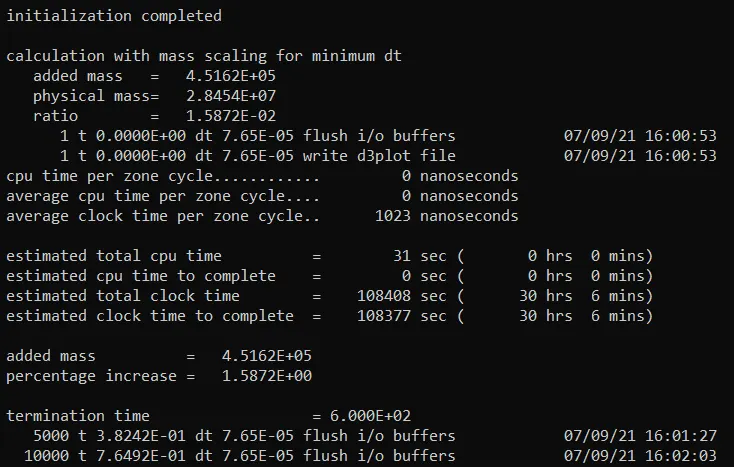
STEP 5:Now increase the time step to -9.5e-05 and run the simulation.
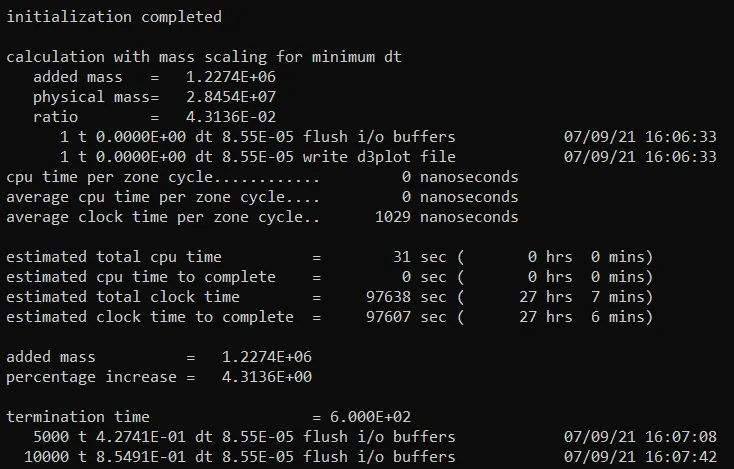
STEP 6:Now increase the time step to -9.9e-05 and run the simulation.
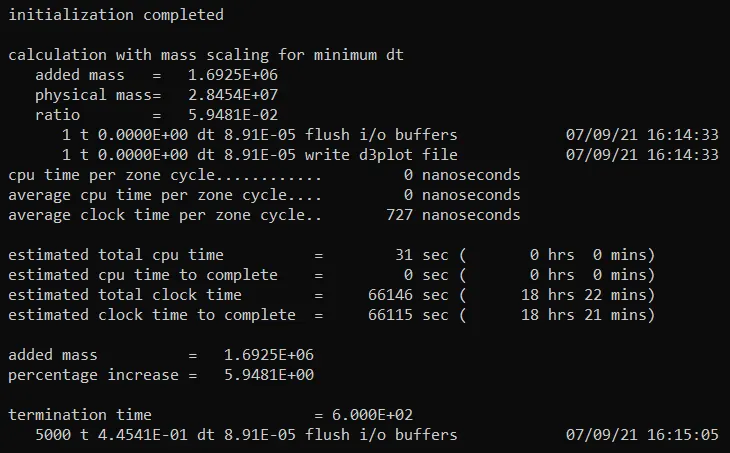
STEP 7:Now increase the time step to -1.02e-04 and run the simulation.
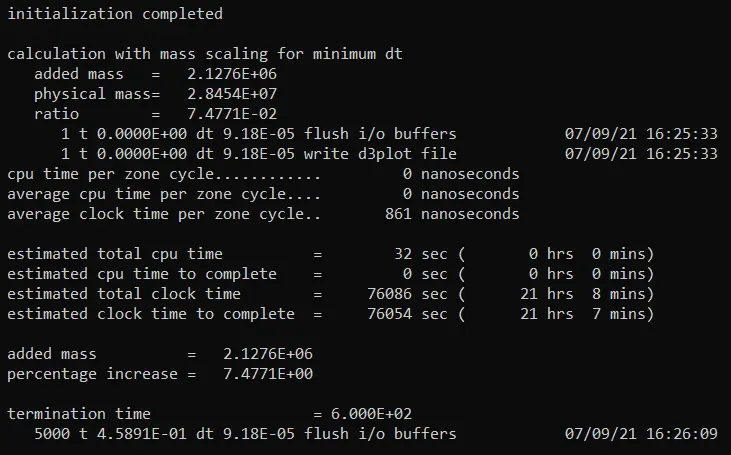
STEP 8:Now increase the time step to -1.03e-04 and run the simulation.
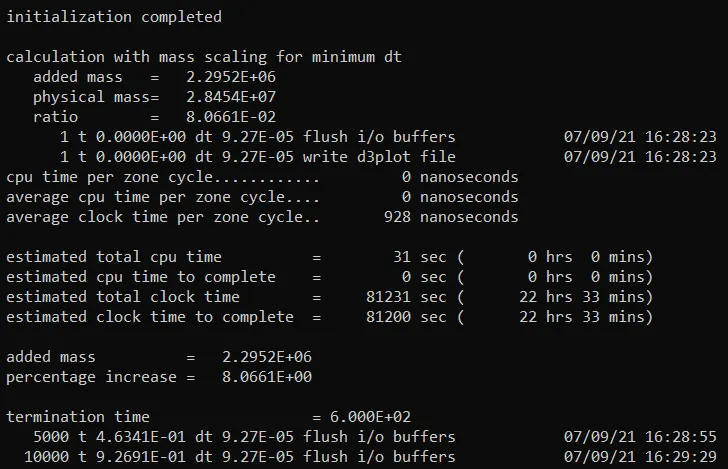
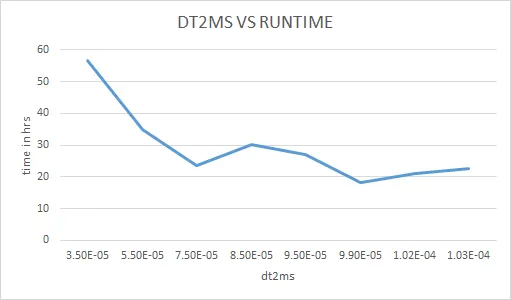
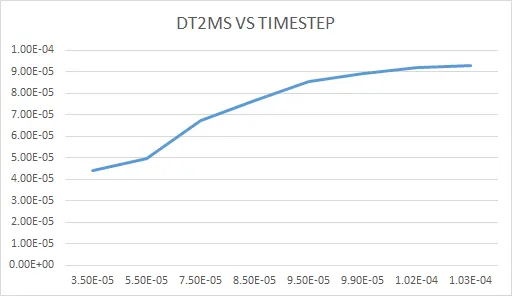
Now you can see that the total mass percentage increase is about 8% and hence stop the minimum time step increase in that level.Now you can see that every time you increase the minimum time step there is particular amount of mass that is added to your system but that total percentage increase should not exceed more than 10% and also you could see that in each case the time step is increasing and hence the total time of the simulation may reduce.The estimated clock time may not show the exact time but it will show you the range of the runtime.
| DT2MS | TSSFAC | ADDED MASS | PERCENTAGE INCREASE | TOTAL TIME | TIME STEP |
| 3.50E-05 | 0.9 | 0 | 0 | 204331 | 4.40E-05 |
| 5.50E-05 | 0.9 | 2855 | 0.01 | 125619 | 4.95E-05 |
| 7.50E-05 | 0.9 | 10608 | 0.372 | 84848 | 6.75E-05 |
| 8.50E-05 | 0.9 | 451620 | 1.587 | 108377 | 7.65E-05 |
| 9.50E-05 | 0.9 | 1227400 | 4.313 | 97607 | 8.55E-05 |
| 9.90E-05 | 0.9 | 1692500 | 5.94 | 66115 | 8.91E-05 |
| 1.02E-04 | 0.9 | 2127600 | 7.47 | 76054 | 9.18E-05 |
| 1.03E-04 | 0.9 | 2295200 | 8.06 | 81200 | 9.27E-05 |
Now change the value of tssfac and keep the dt2ms value as constant and see the change in run time.Since changing of tssfac might change the time step value but not the mass addition.
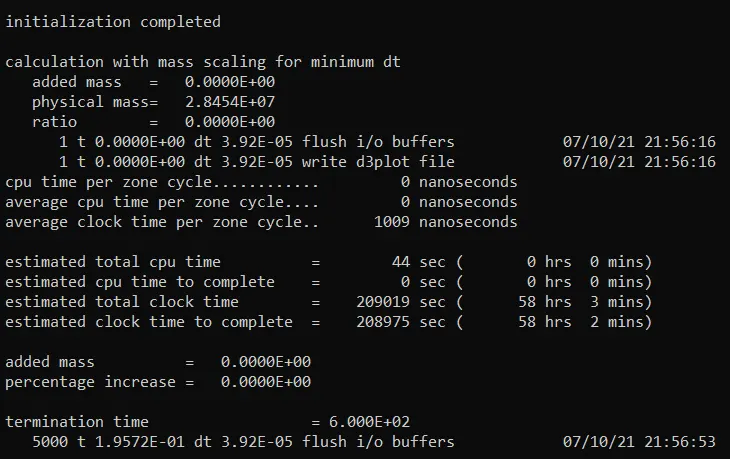
STEP 9: Now open the given k file and change the tssfac to .8 and run the simulation.
STEP 10: Now change the tssfac to .7 and run the simulation.
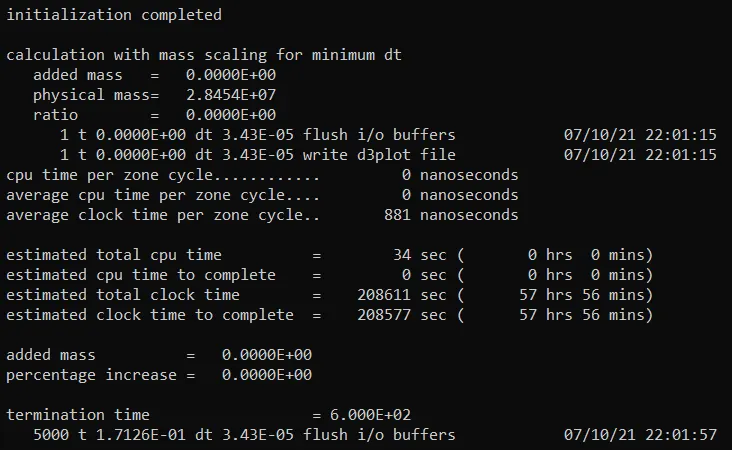
STEP 10: Now change the tssfac to .6 and run the simulation.
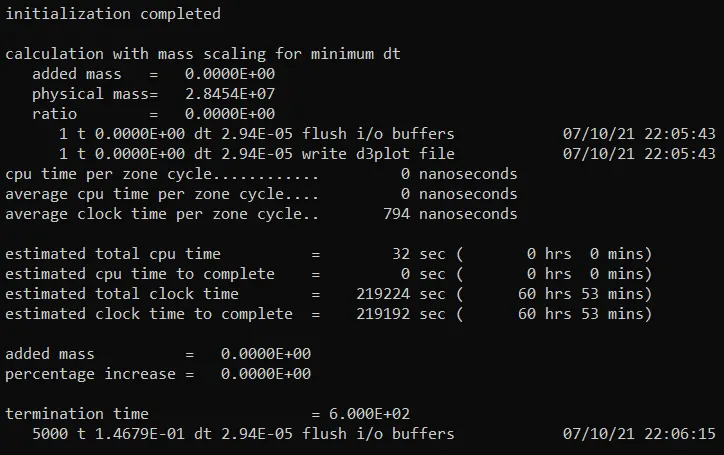
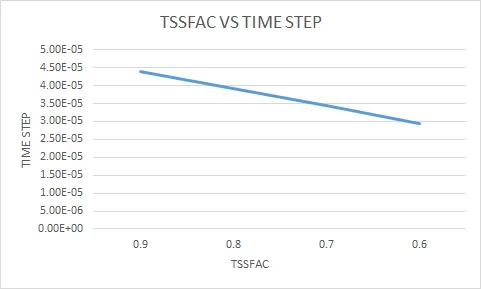
Now you can see that there is no change in mass percentage and the time step has increased on increasing the time step factor.Thus you can control the time step by just changing the tssfac without adding any mass. The typical tssfac value ranges between .6 to .9
| DT2MS | TSSFAC | TOTAL TIME | TIME STEP |
| 3.50E-05 | 0.9 | 204331 | 4.40E-05 |
| 3.50E-05 | 0.8 | 208975 | 3.92E-05 |
| 3.50E-05 | 0.7 | 208577 | 3.43E-05 |
| 3.50E-05 | 0.6 | 219192 | 2.94E-05 |
Now with the same k file try to run the simulation in implicit method.
With all other cards(*MATERIAL, *SECTION,*CONTACT, *CURVE) as default except CONTROL cards, there made some changes accordingly to perform implicit analysis.
Using *CONTROL_IMPLICIT_GENERAL card, implicit analysis is activated with IMFLAG=1 and with initial timestep as 1 (i.e.DTO=1).
Using *CONTROL_IMPLICIT_AUTO card with IAUTO=1, the timestep size is automatically adjusted.
Using *CONTROL_IMPLICIT_SOLUTION card, the implicit analysis is used to choose between linear and non-linear analysis. Using *CONTROL_IMPLICIT_SOLVER card, where the stiffness matrix invesion takes
place, LSOLVR=2 is used to solve the simulation with single precision which consequently saves run time rather than going for double precision solver.
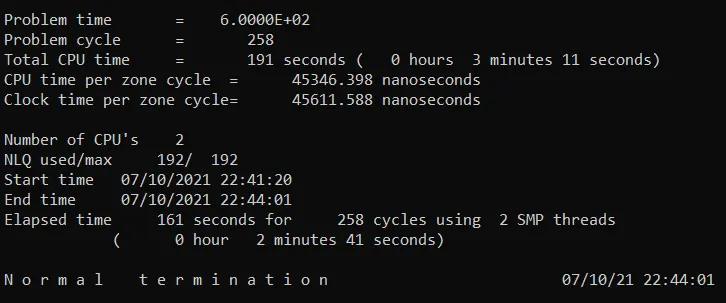
As you can see that with implicit analysis the total time taken for the analysis is just less than 3 min and hence there is a huge save in the run time between the explicit and implicit analysis.
Conclusion: Thus the dt2ms can be altered to reduce the run time of the simulation but it cannot be changed much as the mass added percentage should not be more than 10% as it would lead to false result and the tssfac can be changed to increase th time step and reduce the run time of the simulation.