Mass Scaling
AIM:-
To Use mass scaling to reduce the runtime of a model and ensure the stability of mass scaling And Compare the Runtime With Implicit And Explicit.
INTRODUCTION TO TIMESTEP:-
In the context of FEA Analysis, the time step is the time required for a shock wave to propagate across the smallest distance of the element. A run is a single model simulation and it starts at time zero and continues till the user-defined endpoint is reached. The basic time unit in the run is the time step.
The Time Step is Calculated by
`DeltaT=(L/C)`
where
`DeltaT`- Scaling Factor
L- Smallest element length
`C=sqrt(E/rho)`
E-Youngs Modulus Of the Material
`rho=`Density of the Material
The time step is directly dependent on the length of the element and inversely proportional to the speed of sound of material. The speed of sound of the material is dependent on both material modulus and density of the material. So, if the material is stiffer (higher modulus of elasticity), the speed of sound increases resulting in a lower solution time step.
- In LS-Dyna the Time Step is defined by DT2MS Parameter From Control_Timestep
- When DT2MS is less than zero, LS-DYNA adds a mass of each element whose timestep is below abs(DT2MS) such that the element's updated DT is equal to abs(DT2MS).
- When DT2MS is greater than zero, LS-DYNA adds mass to elements whose DT is below abs(DT2MS) and "removes" mass from elements whose DT is greater than zero.
- DT2MS>0 is seldom used while DTM2<0 is frequently used for overcoming the smallest computed timestep.
- Generally, DT2MS>0 can be neglected as they don't cause an effect in the Timestep so DT2MS <0 is taken care of.
PROCEDURE:-
Case-1:Without Mass scaling:-
1.A simple Keyword file is Imported and the Model is verified using Model info
2. The Given Model has meshed with solid elements.
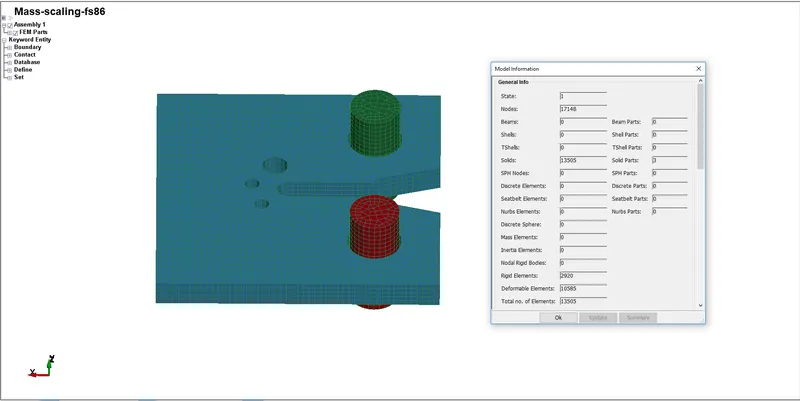
3.All Properties Of materials and Termination Time And Boundary Conditions Are Predefined in Kg, m, Sec.
4.The Control_Timstep card which is used to add mass is deleted to View the Behaviour of the Model Without Mass scaling.
5. The Termination Time Is Given as 600 sec.
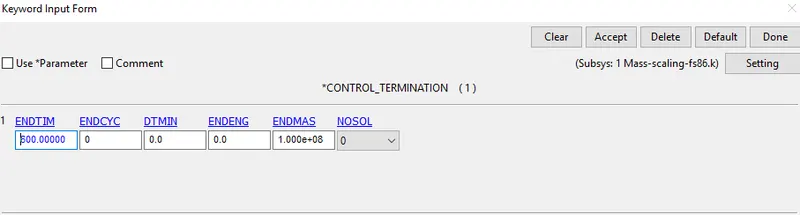
6.The Keyword is Saved and Simulated using LS Dyna Manager
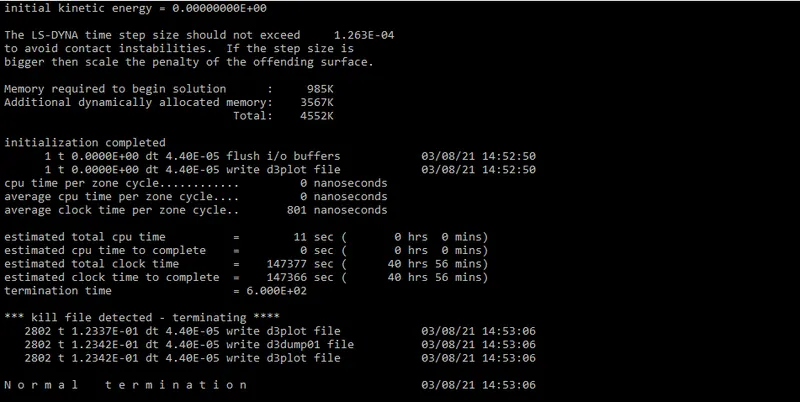
From The image, we can see that The estimated Time mentioned is 147366 sec Which is 40hrs 56mins which is quite long for a Simulation to happen, for reducing this Time Mass is added to the elements which Inturn increases the Speed of The Time Step.
Case-2:With Mass scaling:-
1.Control_Timestep card Is added to the Keyword with DT2MS -3.500E-05
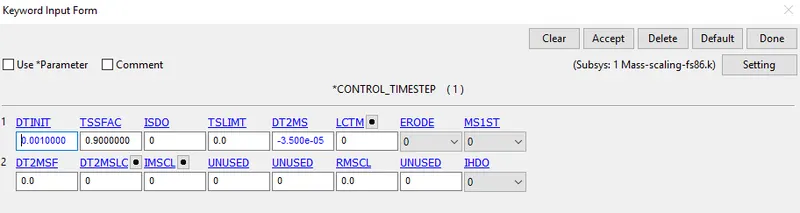
2. An Important Parameter TSSFAC which is Known as scale Factor is Used as a factor of safety, as the DT2MS value is Multiplied with TSSFAC and that value is the Minimum Value that the Solver will take as the Safety value. The TSSFAC value Should be less than 1
3.The Keyword is Saved and Simulated using LS Dyna Manager
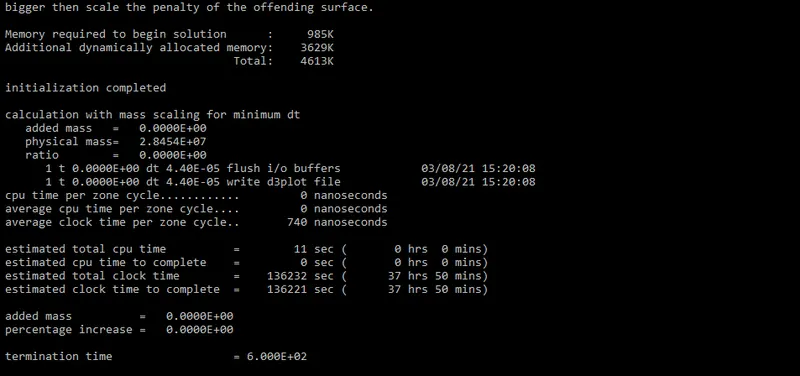
4.From The Image we can see that the Time taken to complete is reduced compared with the previous state
5.As for this Input value There is no mass added to the elements as the Added mass and Percentage of mass Increase is in 0.
The DT2MS value Can be Increased Till the Percentage of mass reaches 8% After that adding mass will cause a Change in Inertia in the Model
1.With Timestep -6.500E-05:-
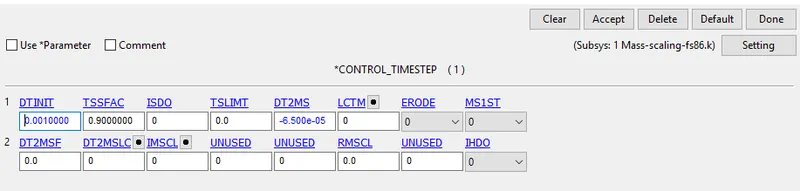
1.Change the DT2MS As -6.500E-05 and Run the simulation with the scale factor of 0.9
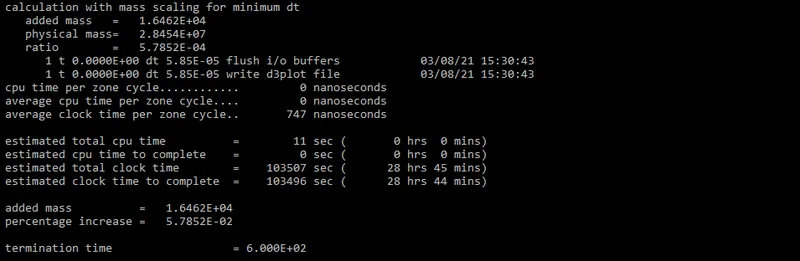
3.The Time Taken For solving is decreasing gradually after an Increase in Mass scaling
4. The percentage of mass added is 0.0578%, so Further Mass can be added.
2.With Timestep -8.000E-05:-
1.Change the DT2MS As -8.000E-05 and Run the simulation with the scale factor of 0.9
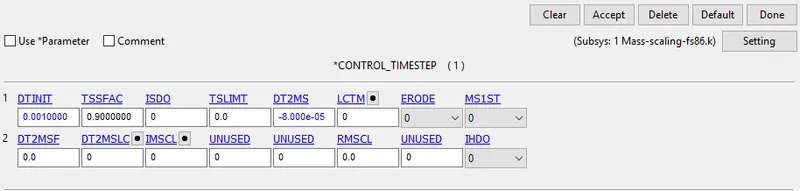
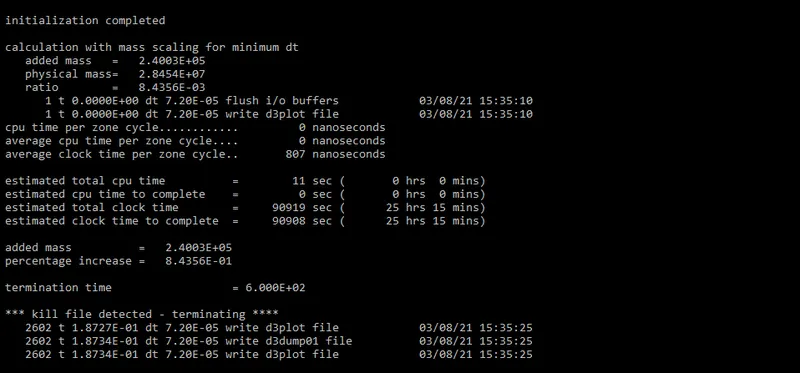
2. The percentage of mass added is 0.84%, so Further Mass can be added.
3.With Timestep -9.000E-05:-
1.Change the DT2MS As -9.000E-05 and Run the simulation with the scale factor of 0.9.
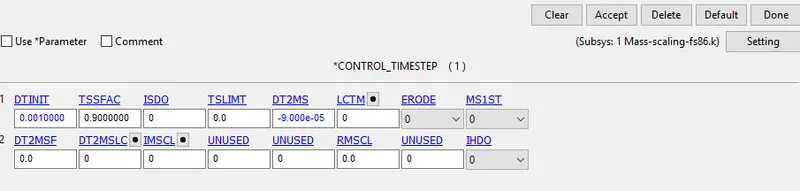
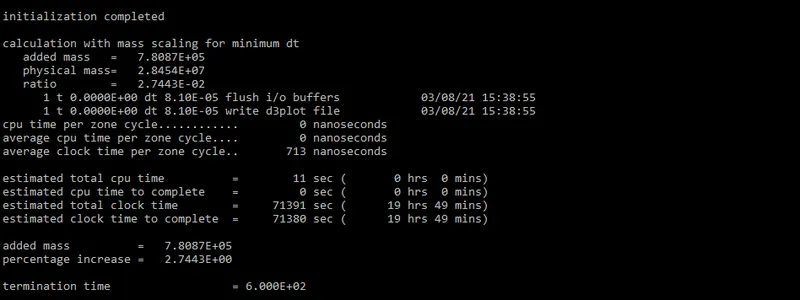
2. The percentage of mass added is 2.7%, so Further Mass can be added.
4.With Timestep -1.000E-04:-
1.Change the DT2MS As -1.000E-04 and Run the simulation with the scale factor of 0.9.
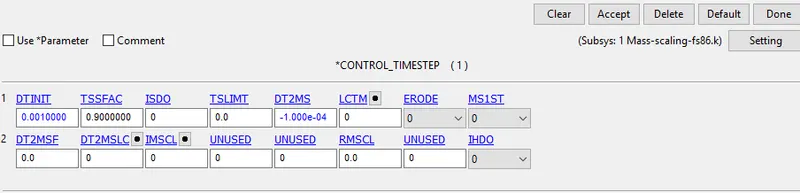
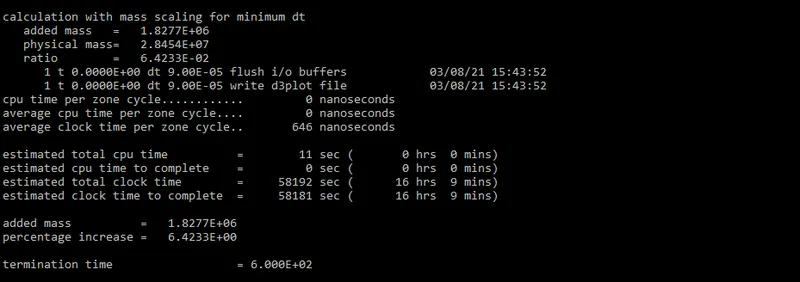
2. The percentage of mass added is 6.4%, so Further Mass can be added.
5.With Timestep -1.020E-04:-
1.Change the DT2MS As -1.020E-04 and Run the simulation with the scale factor of 0.9.
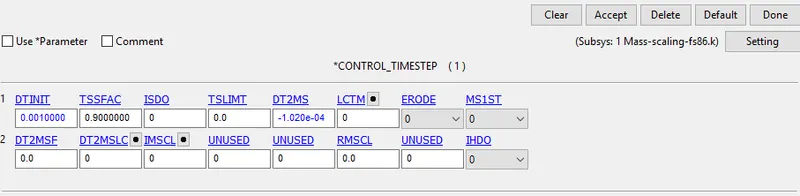
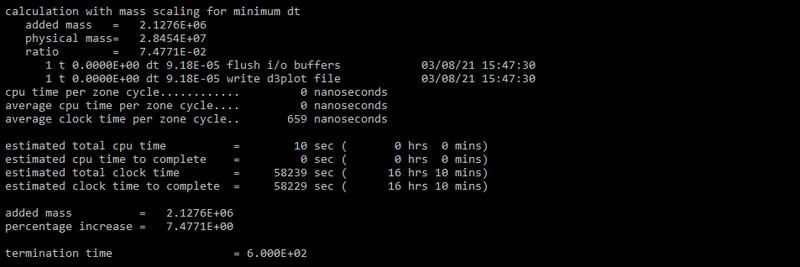
2. The percentage of mass added is 7.4%, so Further Mass can be added.
6.With Timestep -1.030E-04:-
1.Change the DT2MS As -1.030E-04 and Run the simulation with the scale factor of 0.9
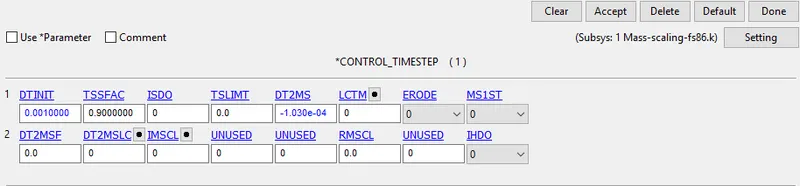
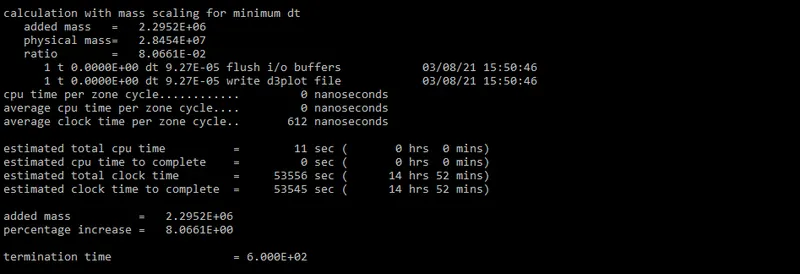
2. The percentage of mass added is 8.06%, As it may be Slightly unstable For safety issues Considerably less value is taken. For eg Change the DT2MS value as -1.028E-04 and run The Simulation
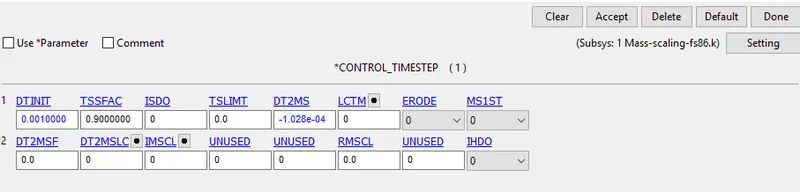
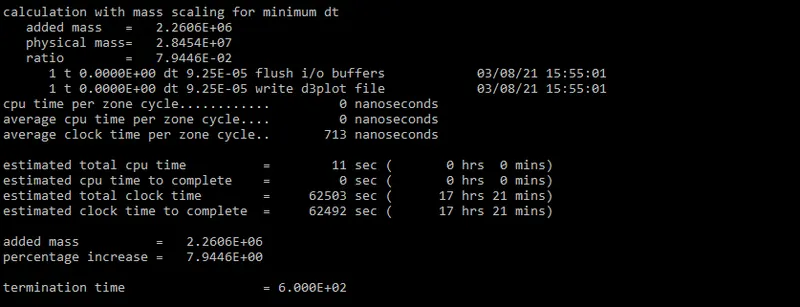
As the Percentage of mass added is 7.9%, Which is Comparitively less than 8% and the Solution will be quite stable as same.
Either or values can be used here, that doesn't result in Drastical change in the solution
The Mass scaling can be done by altering even By TSSFAC values, The TSSFAC value will generally range between 0.5 to 0.9. But these 0.5,0.6 small values are used for blast explosives. As the run simulation time is pretty less in the case of TSSFAC =0.9 we can take that to reduce our run time. That will scales down our time step to a lower value than the dt2ms we input, so the stability will be ensured by the TSSFAC value. Reducing the TSSFAC will increase our runtime.
| DT2MS | PERCENTAGE OF MASS | RUN TIME(Hours) | RUN TIME(sec) |
| -3.500E-05 | 0.0 | 37.50 | 136221 |
| -6.500E-05 | 0.057 | 28.44 | 103496 |
| -8.000E-05 | 0.84 | 25.15 | 90908 |
| -9.000E-05 | 2.7 | 19.49 | 71380 |
| -1.000E-04 | 6.4 | 16.9 | 58181 |
| -1.020E-04 | 7.4 | 16.10 | 58229 |
| -1.028E-04 | 7.9 | 17.21 | 62492 |
| -1.030E-04 | 8.06 | 14.52 | 53545 |
The Computational Time Which the Solver Shows is not true in nature As it may Solve within that time or it may take more.
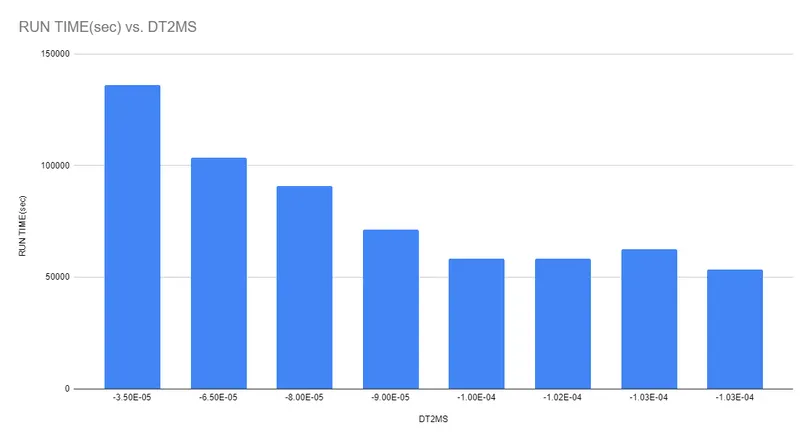
From the chart, we can see the Time decreases when the mass is added, For the 0.9 scale factor, 1.028E-04 is the optimum value of mass scaling for the steady Simulation.
As the percentage of mass added is 7.9%
Mass Scaling For Implicit Solution:-
As the LS-Dyna is explicit software in General, Some Control cards must be defined For switching to Implicit
1.Control_implicit_Auto:-
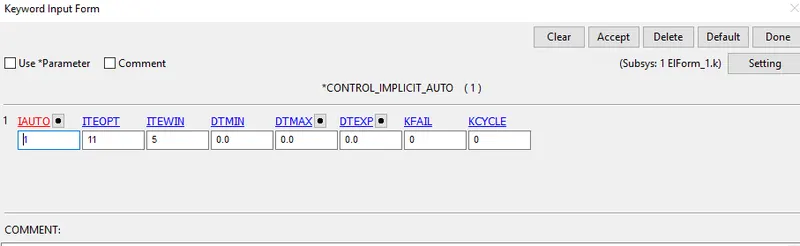
CONTROL_IMPLICIT_AUTO card is used for automatic time step control during implicit analysis. Input value for Automatic time step control flag = IAUTO = 1.
2.Control_Implicit_General:-
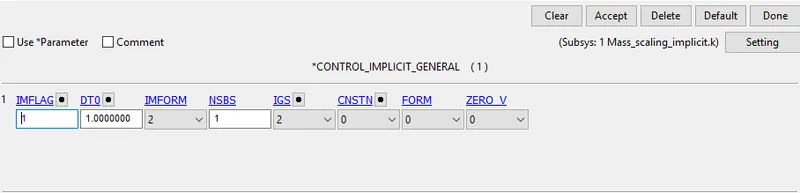
CONTROL_IMPLICIT_GENERAL card is used to activate implicit analysis and define associated control parameters. This keyword is required for all implicit analyses.
The input value for IMFLAG=Implicit/Explicit switching flag = 1 (implicit analysis)
DT0=Initial time step size for implicit analysis = 1.
3.Control_Implicit_Solution:-
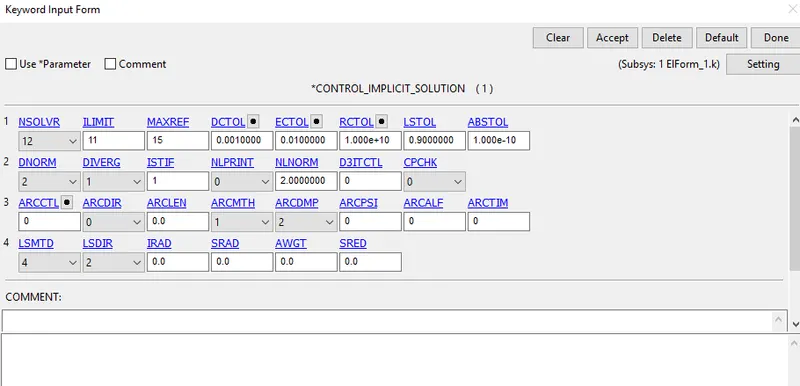
CONTROL_IMPLICIT_SOLUTION card is used to specify whether a linear or nonlinear solution is desired. The default values are set as it is in the card.
4.Contol_Implicit_Solver:-
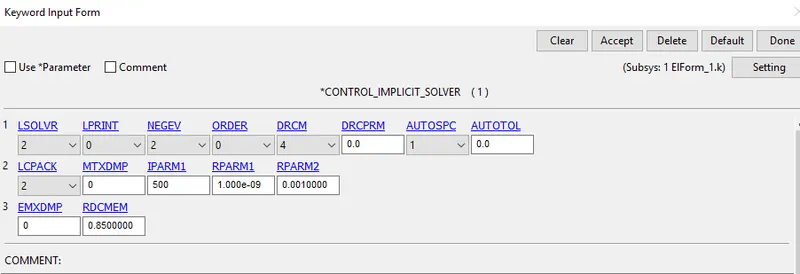
CONTROL_IMPLICIT_SOLVER card is used for implicit calculation.
The Termination Time Is Given as 600 sec.
STEP-1:-
DT2MS -3.500E-05 is Given with TSSFAC 0.9
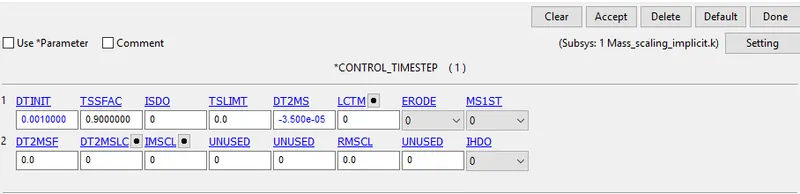
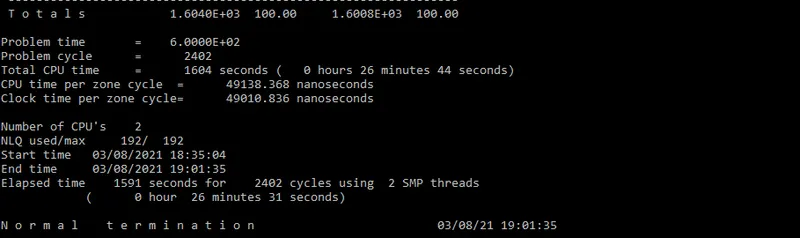
The Keyword is Saved and Simulated using LS Dyna Manager
Step-2:-
DT2MS -1.028E-04 is Given With TSSFAC=0.9
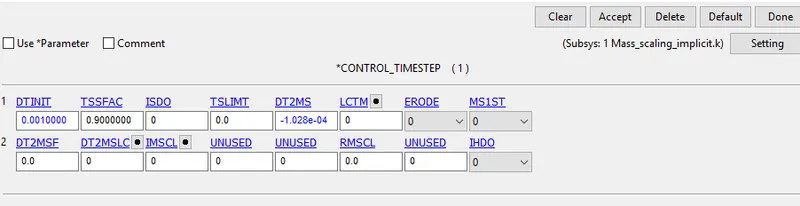
The Keyword is Saved and Simulated using LS Dyna Manager
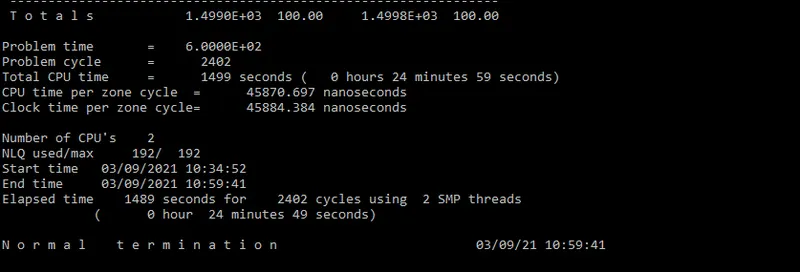
The runtime required to complete the simulation for DT2MS = -3.5E-5 is 26 mins 44 sec and for DT2MS = -1.028E-4 is 24 mins 59 sec. The percentage increase in mass is not reported.
The Factor DT2MS and TSSFAC don't affect Implicit Analysis as the Implicit analysis doesn't use a Physical Time Factor.
| TRIAL | DT2MS |
RUN TIME(sec) EXPLICIT |
RUN TIME(sec) IMPLICIT |
| 1 | -3.500E-05 | 136221 | 1604 |
| 2 | -1.028E-04 | 62492 | 1499 |
From the table, it is observed that the runtime required to complete the simulation varies drastically for different values of DT2MS using explicit analysis whereas for implicit analysis the variation in runtime for different values of DT2MS is negligible. Hence the parameters like DT2MS and TSSFAC do not affect the runtime of implicit.
CONCLUSION:-
1. The objective of mass scaling is achieved for the given model by varying the values ofDT2MS and TSSFAC using the trial and error method.
2. By considering the hard limit on mass scaling being 8%, the optimized value of DT2MS = -1.028E-4 and TSSFAC= 0.9 with the lowest possible runtime required to complete the simulation is 17 hrs 21 mins.
3. The values of DT2MS and TSSFAC do not affect the runtime required to complete the simulation for implicit analysis.
4. The Scale factor Don't affect the Stability of the Simulation it Affects the DT2MS To perform abrupt changes