Week - 8 Mass Scaling
MASS SCALING IN LS-DYNA
AIM:
- To reduce the runtime required to run the analysis of the given model using mass scaling technique and stability has to be completely intact.
- To plot a histogram to compare the runtime with mass scaling trials.
- To optimize both the DT and TSSFAC parameters.
- To run the same model using implicit solver with necessary changes and compare implicit and explicit runtime.
Note: The hard limit on mass scaling is 8%.
INTRODUCTION:
Mass-scaling is a term that is used for the process of scaling the element’s mass in explicit simulations to adjust its timestep. The primary motivation is to change the global compute timestep which is limited by the Courant’s stability criteria.
LS-DYNA allows two different types of mass-scaling using the DT2MS parameter from *CONTROL_TIMESTEP with the default set to no mass-scaling.
When DT2MS is less than zero, LS-DYNA adds mass of each element whose timestep is below abs (DT2MS) such that the element’s updated DT is equal to abs (DT2MS).
When DT2MS is greater than zero, LS-DYNA adds mass to elements whose DT is below abs (DT2MS) and “removes” mass from elements whose DT is greater than zero.
DT2MS>0 is seldom used while DTM2<0 is frequently used for overcoming the smallest computed timestep.
Care must be taken when using DT2MS<0 to ensure that the added mass does not have an adverse effect on the simulation accuracy. It is common practice to limit the percentage of added mass to less than 5% (at part level) in dynamic simulations. LS-DYNA outputs the percentage of added mass at component level which is a better indicator of amount of added mass due to mass-scaling.
PROCEDURE:
In this project, the runtime has to be reduced using mass scaling technique by varying the values of DT2MS and TSSFAC with percentage increase of mass within 8% using Explicit and Implicit analysis.
Explicit Analysis:
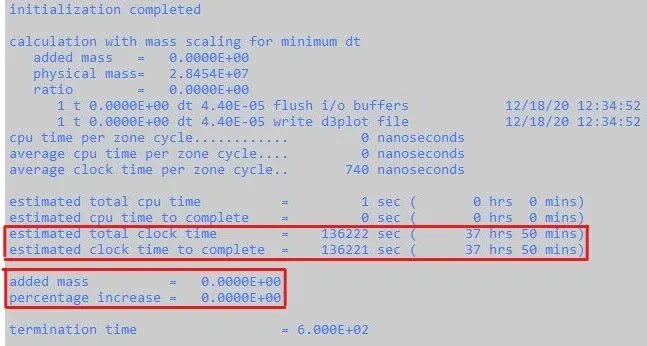
The given simulation file is made to run by keeping the given values for DT2MS = -3.5E-5 and TSSFAC = 0.9 to know the computational time required to run the simulation.
Trial 1: DT2MS = -3.5E-5
TSSFAC= 0.9
TSSFAC = 0.8
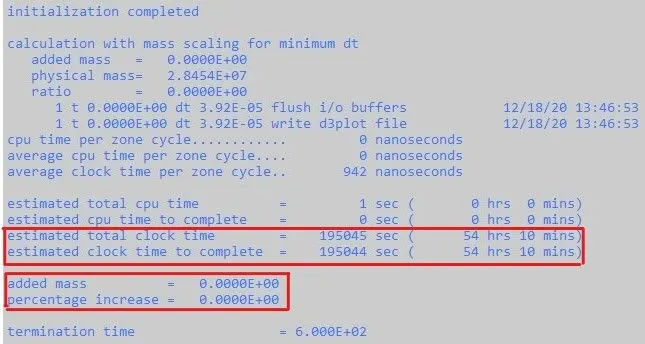
For, DT2MS = -3.5E-5, the estimated clock time to complete the simulation for TSSFAC= 0.9 is 37 hrs 50 mins whereas for TSSFAC= 0.8 is 54 hrs 10 mins. The percentage increase in mass for both TSSFAC equal to 0.9 and 0.8 is 0.
Trial 2: DT2MS = -5.5E-5
TSSFAC= 0.9 TSSFAC= 0.8
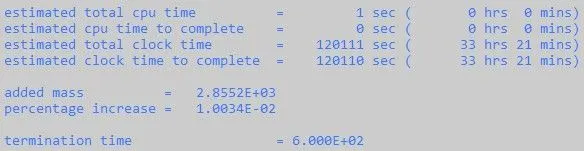
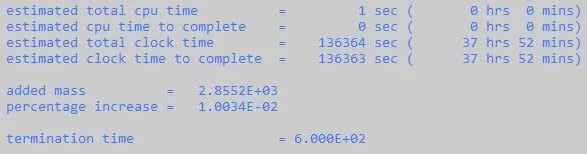
For, DT2MS = -5.5E-5, the estimated clock time to complete the simulation for TSSFAC= 0.9 is 33 hrs 21 mins whereas for TSSFAC= 0.8 is 37 hrs 52 mins. The percentage increase in mass for both TSSFAC equal to 0.9 and 0.8 is 0.010034%.
Trial 3: DT2MS = -7.5E-5
TSSFAC= 0.9 TSSFAC= 0.8
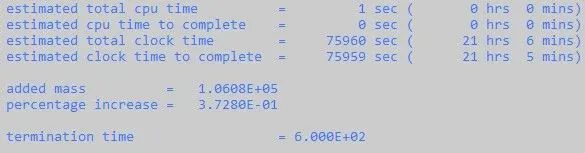
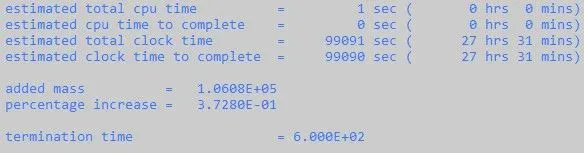
For, DT2MS = -7.5E-5, the estimated clock time to complete the simulation for TSSFAC= 0.9 is 21 hrs 5 mins whereas for TSSFAC= 0.8 is 27 hrs 31 mins. The percentage increase in mass for both TSSFAC equal to 0.9 and 0.8 is 0.3728%. The runtime has reduced whereas the % increase in mass has increased compared to trial 2.
Trial 4: DT2MS = -9.5E-5
TSSFAC= 0.9 TSSFAC= 0.8
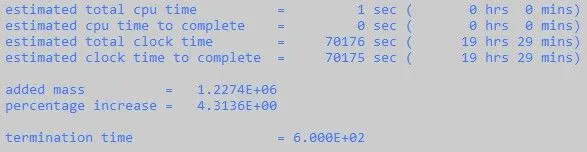
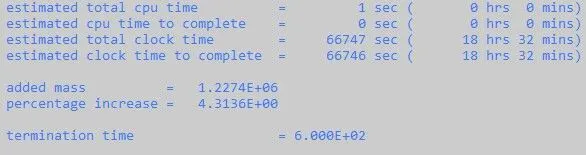
For, DT2MS = -9.5E-5, the estimated clock time to complete the simulation for TSSFAC= 0.9 is 19 hrs 29 mins whereas for TSSFAC= 0.8 is 18 hrs 32 mins. The percentage increase in mass for both TSSFAC equal to 0.9 and 0.8 is 4.3136%. The runtime has reduced whereas the % increase in mass has increased compared to trial 3. The iteration for DT2MS value is continued till the percentage increase in mass is within the hard limit of 8%.
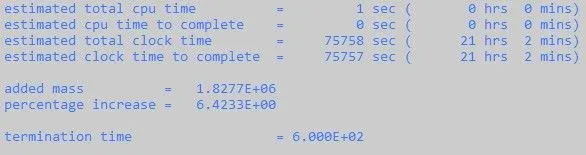
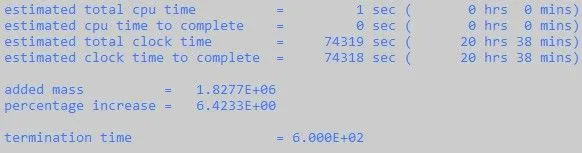
Trial 5: DT2MS = -1.0E-4
TSSFAC= 0.9 TSSFAC= 0.8
Trial 6: DT2MS = -1.1E-4
TSSFAC= 0.9 TSSFAC= 0.8
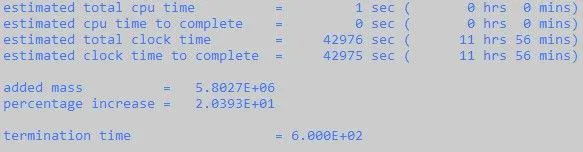
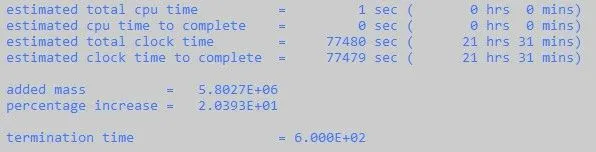
For, DT2MS = -1.1E-4, the estimated clock time to complete the simulation for TSSFAC= 0.9 is reduced to 11 hrs 56 mins whereas the percentage increase in mass is 20.393% which is beyond the acceptable limit. Hence, the iteration is continued to get the optimized value of DT2MS till the percentage increase in mass is within the acceptable limit of 8%.
Trial 7: DT2MS = -1.08E-4
TSSFAC= 0.9 TSSFAC= 0.8
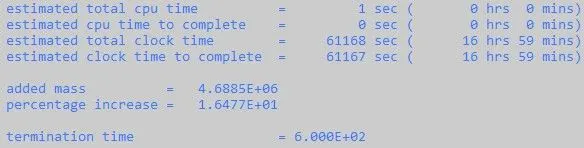
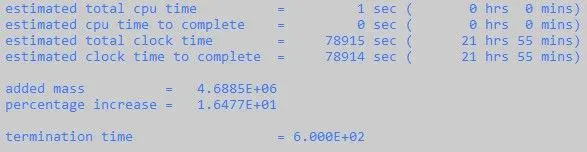
Trial 8: DT2MS = -1.06E-4
TSSFAC= 0.9 TSSFAC= 0.8
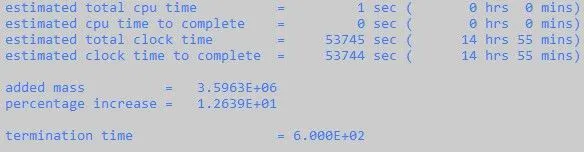
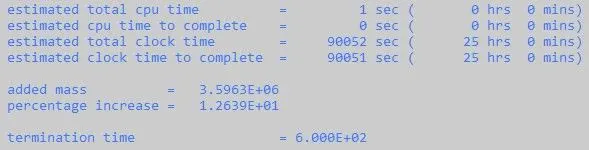
Trial 9: DT2MS = -1.04E-4
TSSFAC= 0.9 TSSFAC= 0.8
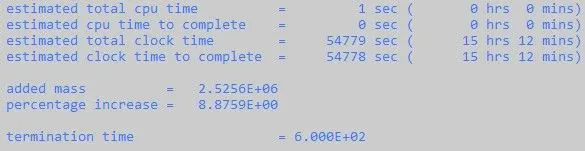
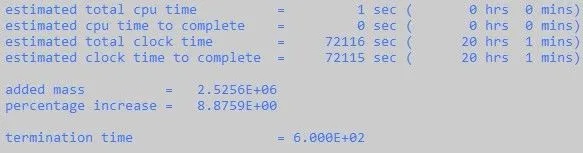
Trial 10: DT2MS = -1.02E-4
TSSFAC= 0.9 TSSFAC= 0.8
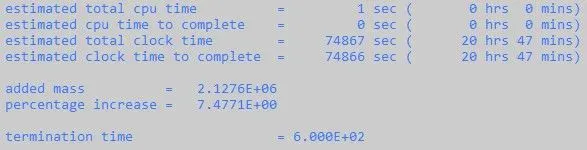
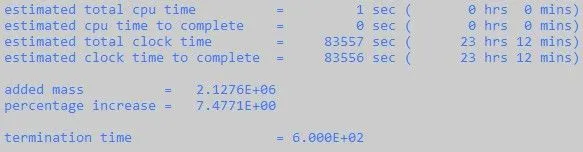
For, DT2MS = -1.02E-4, the percentage increase in mass for both TSSFAC equal to 0.9 and 0.8 is 7.4771% which is within the acceptable limit but the iteration is continued to optimize the value of DT2MS to get a lowest possible runtime.
Trial 11: DT2MS = -1.022E-4
TSSFAC= 0.9 TSSFAC= 0.8
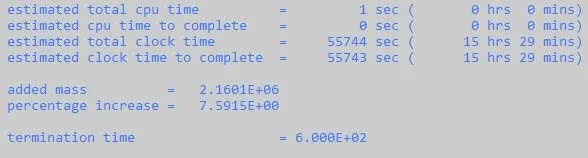
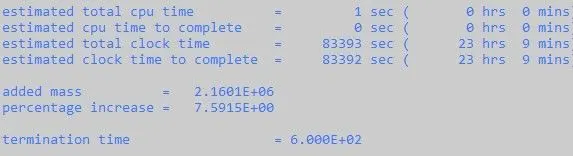
Trial 12: DT2MS = -1.024E-4
TSSFAC= 0.9 TSSFAC= 0.8
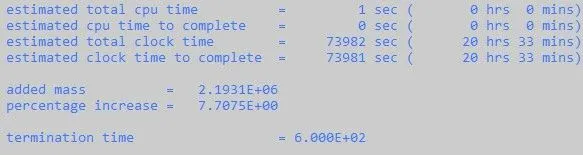
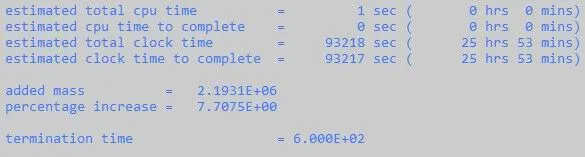
Trial 13: DT2MS = -1.026E-4
TSSFAC= 0.9 TSSFAC= 0.8
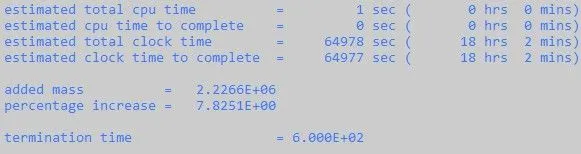
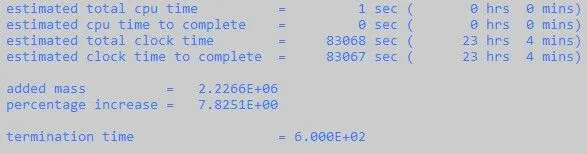
Trial 14: DT2MS = -1.028E-4
TSSFAC= 0.9 TSSFAC= 0.8
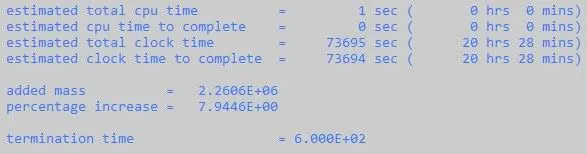
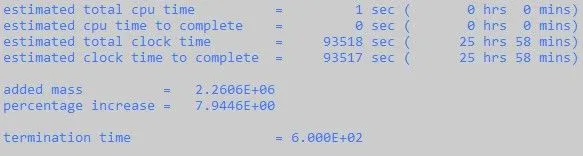
Trial 15: DT2MS = -1.0282E-4
TSSFAC= 0.9 TSSFAC= 0.8
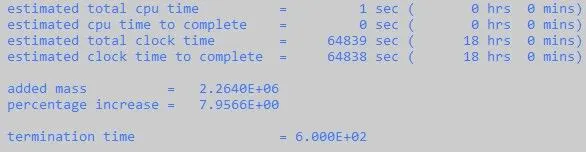
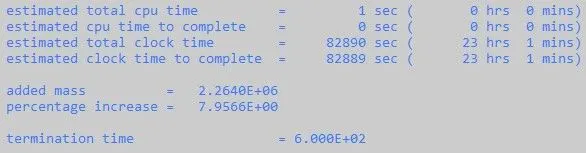
Trial 16: DT2MS = -1.0284E-4
TSSFAC= 0.9 TSSFAC= 0.8
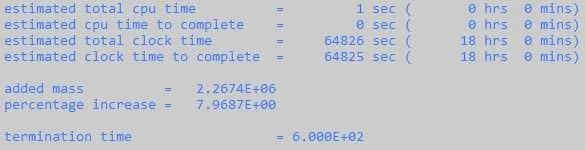
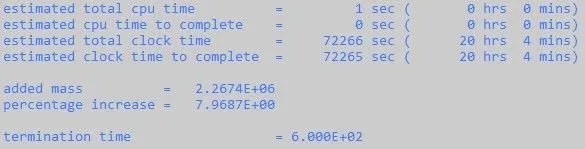
Trial 17: DT2MS = -1.0286E-4
TSSFAC= 0.9 TSSFAC= 0.8
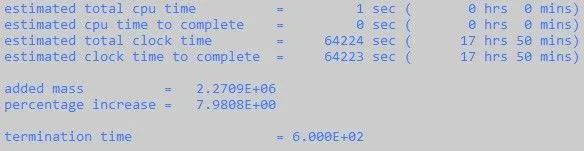
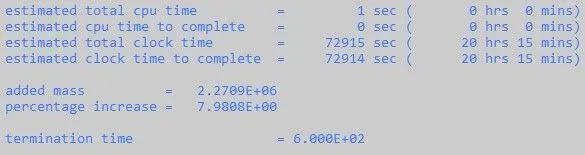
Trial 18: DT2MS = -1.0288E-4
TSSFAC= 0.9 TSSFAC= 0.8
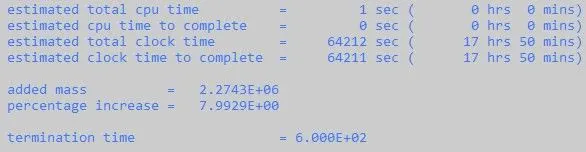
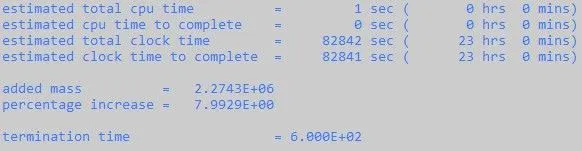
Trial 19: DT2MS = -1.0290E-4
TSSFAC= 0.9 TSSFAC= 0.8
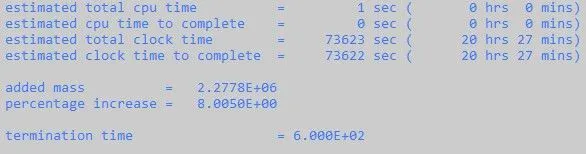
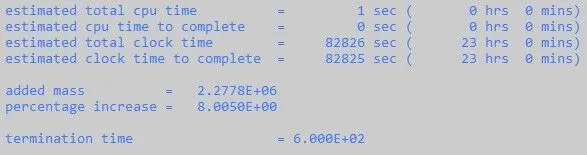
Trial 20: DT2MS = -1.0289E-4
TSSFAC= 0.9 TSSFAC= 0.8
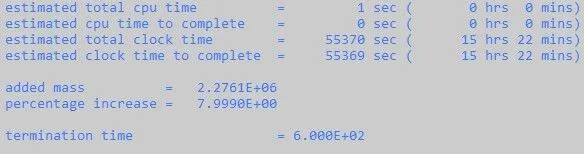
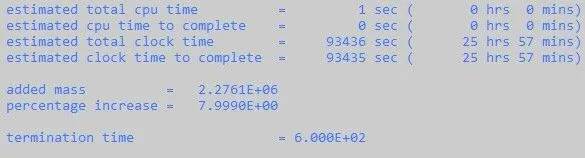
For, DT2MS = -1.0289E-4, the estimated clock time to complete the simulation for TSSFAC= 0.9 is 15 hrs 22 mins whereas for TSSFAC= 0.8 is 25 hrs 57 mins. The percentage increase in mass for both TSSFAC equal to 0.9 and 0.8 is 7.9990%. Hence the value of percentage increase in mass is optimized within the acceptable limit of 8%.
Implicit Analysis:
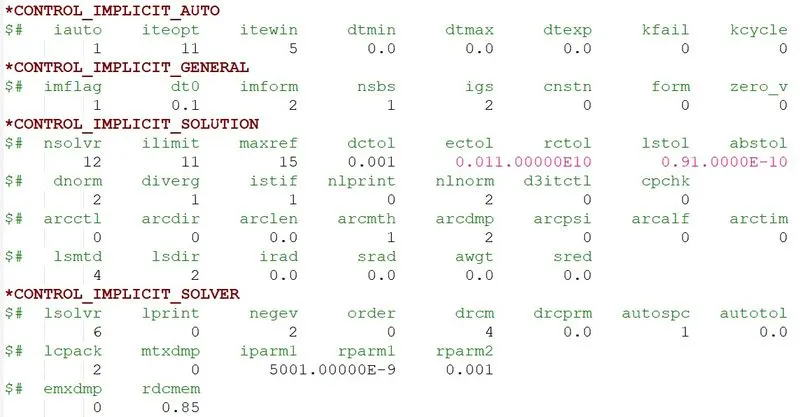
For implicit analysis, keywords like CONTROL_IMPLICIT_AUTO, CONTROL_IMPLICIT_GENERAL, CONTROL_IMPLICIT_SOLUTION and CONTROL_IMPLICIT_SOLVER are added with necessary inputs to the given keyword file.
The keyword file is made to run for two trials i.e. (1) DT2MS= -3.5E-5 and TSSFAC= 0.9, (2) DT2MS= -1.0289E-4 and TSSFAC= 0.9 to check the runtime required to complete the simulation.
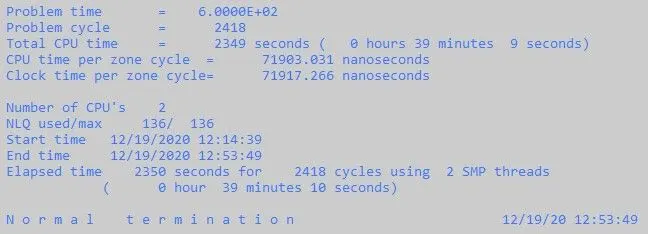
Trial 1:
DT2MS = -3.5E-5 and TSSFAC= 0.9
Trial 2:
DT2MS = -1.0289E-4 and TSSFAC= 0.9
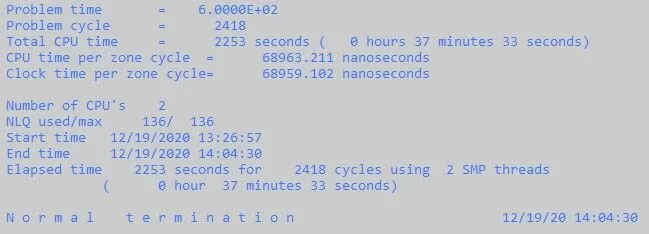
The runtime required to complete the simulation for DT2MS = -3.5E-5 is 39 mins 10 sec and for DT2MS = -1.0289E-4 is 37 mins 33 sec. The percentage increase in mass is not reported.
RESULTS AND DISCUSSION:
Explicit Analysis:
Histogram:
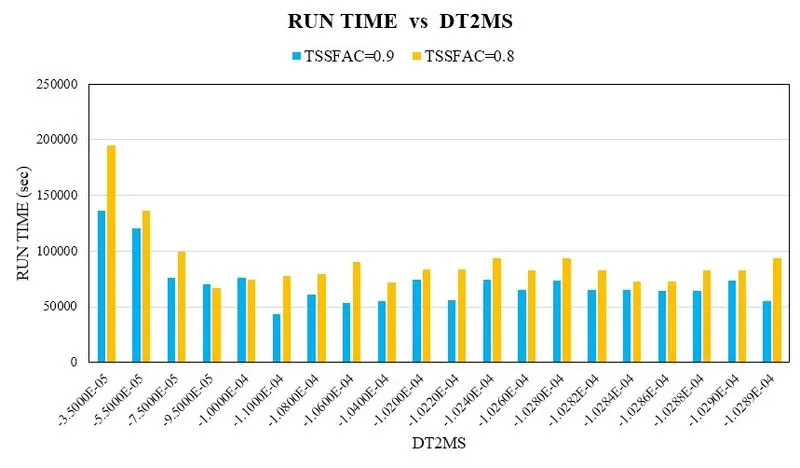
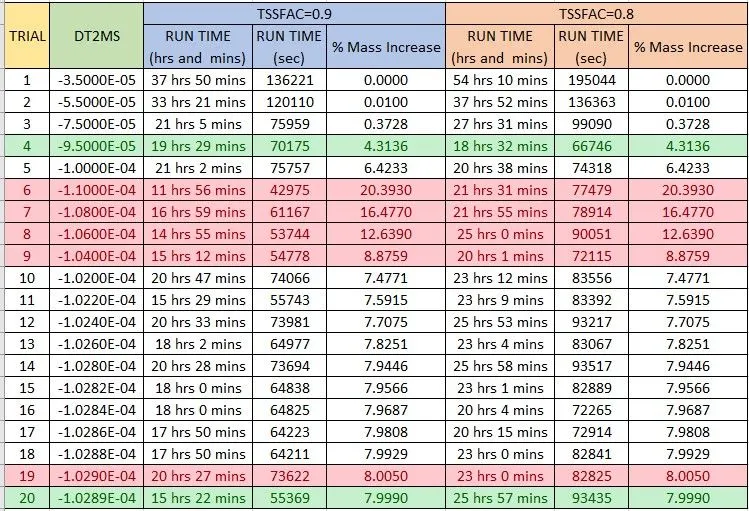
From the graph, it is observed that the runtime required to complete the simulation for DT2MS = -3.5E-5 is more compared to DT2MS = -1.1E-4 whereas the percentage increase in mass is beyond the hard limit of 8% for DT2MS = -1.1E-4. Hence, the optimum value of DT2MS is -1.0289E-04 which has an estimated runtime of 15 hrs 22 mins.
The runtime required to complete the simulation for all the iteration with TSSFAC=0.8 is not stable as compared to TSSFAC=0.9. Hence the ideal value for TSSFAC is 0.9 for this simulation.
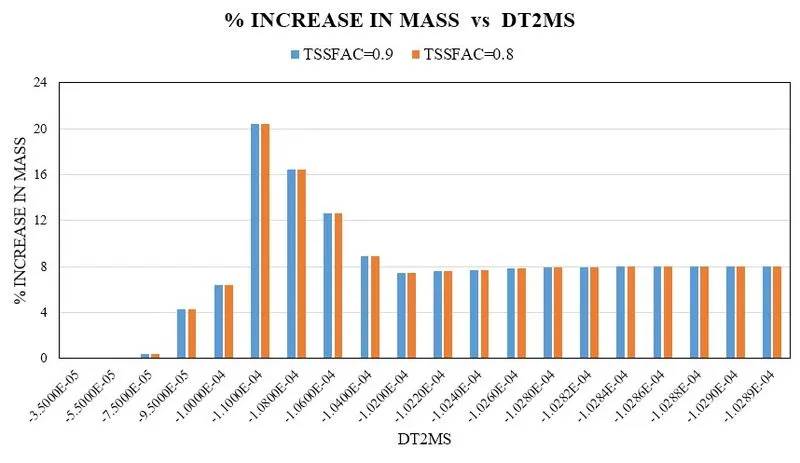
From the graph, it is observed that the percentage increase in mass for TSSFAC equal to 0.9 and 0.8 is constant for all the values of DT2MS. The percentage increase in mass increases as the value of DT2MS is increased and reaches an optimum value of 7.999% for DT2MS = -1.0289E-4 which is within the hard limit of 8%.
Implicit Analysis:
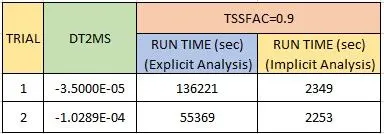
From the table it is observed that the rutime required to complete the simulation varies drastically for different values of DT2MS using explicit analysis whereas for implicit analysis the variation in runtime for different values of DT2MS is negligible. Hence the parameters like DT2MS and TSSFAC does not affect the runtime of implicit analysis.
CONCLUSION:
- The objective of mass scaling is achieved for the given model by varying the values of DT2MS and TSSFAC using trial and error method.
- By considering the hard limit on mass scaling being 8%, the optimized value of DT2MS = -1.0289E-4 and TSSFAC= 0.9 with lowest possible runtime required to complete the simulation is 15 hrs 22 mins.
- The values of DT2MS and TSSFAC does not affect the runtime required to complete the simulation for implicit analysis.
- Learned the concept of mass scaling and its necessity in explicit analysis.