Week - 8 Mass Scaling
AIM:-
To compare the run time using explicit and implicit mass scaling to reduce the run time of a model and ensure the stability of mass scaling by using LS-Dyna.
PROCEDURE:-
CASE1:- Mass Scaling for Explicit method.
1. Import the keyword file in Ls-prepost.
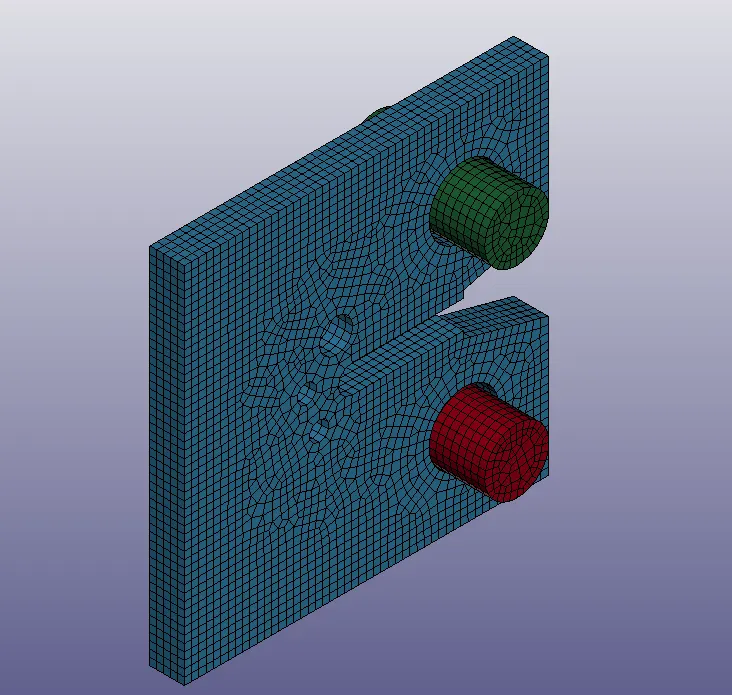
2. The given model meshed with solid elements.
3. Termination time is given as 600 ms.
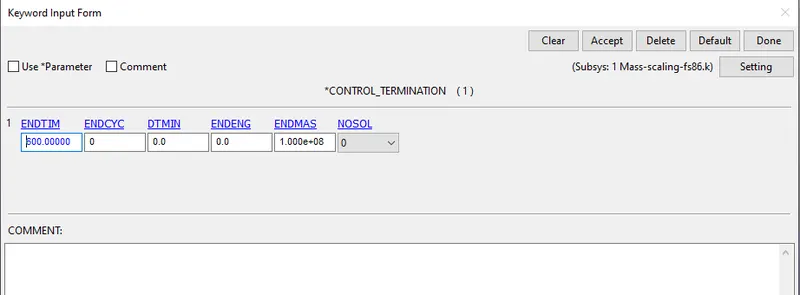
4. In the control Time step card DT2MS is -3.500E-05 and Run the simulation with a scale factor is 0.9 as shown below.
1.With Time-Step -3.500e-05
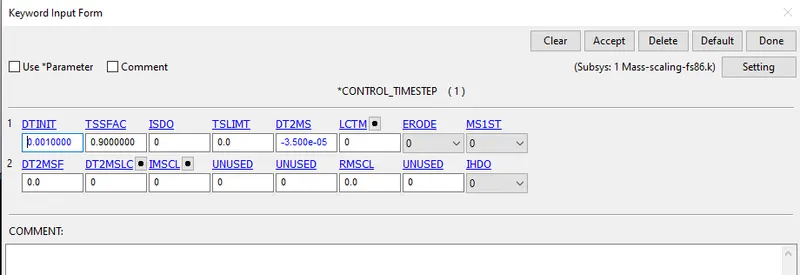
1. Here an important parameter TSSFAC or scale factor, is used as a factor of safety because the DT2MS value is multiplied by TSSFAC, and the result is the minimum value that the solver will accept as the safety values. The value of the TSSFAC should be less than 1
2. Save the keyword file and run the simulation by using LS-Run.
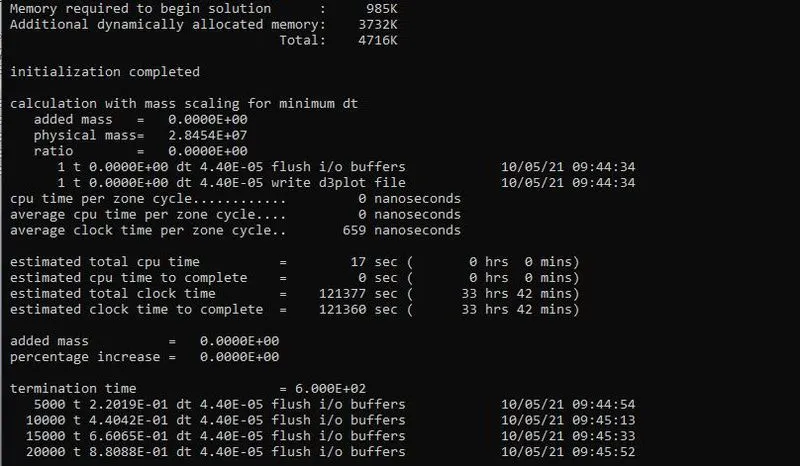
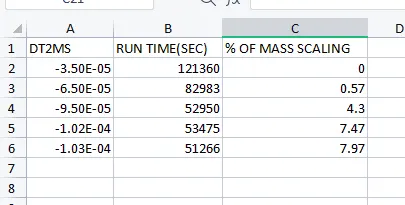
3. From the above image see the estimated time it is 121360 sec that means 33hrs 42min. It has taken more simulation time.
4. There is no added mass and percentage increase because it is 0 from the above image.
5. It is possible to increase the DT2MS value until the mass percentage reaches 8%.The model inertia will be change as a result of the addition of mass.
2. With Time Step -6.500e-05
1.Change the DT2MS value -3.500e-05 to -6.500e-05 in control time step.
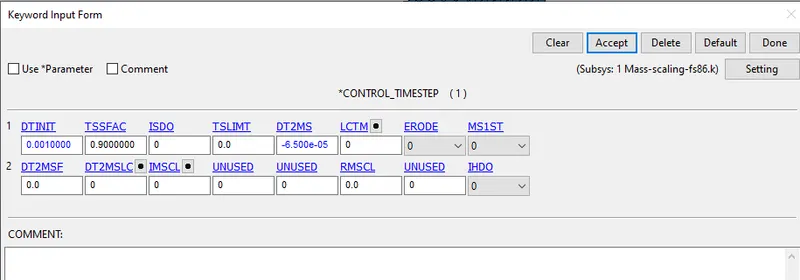
2. Save the keyword file and run the simulation in LS-run.
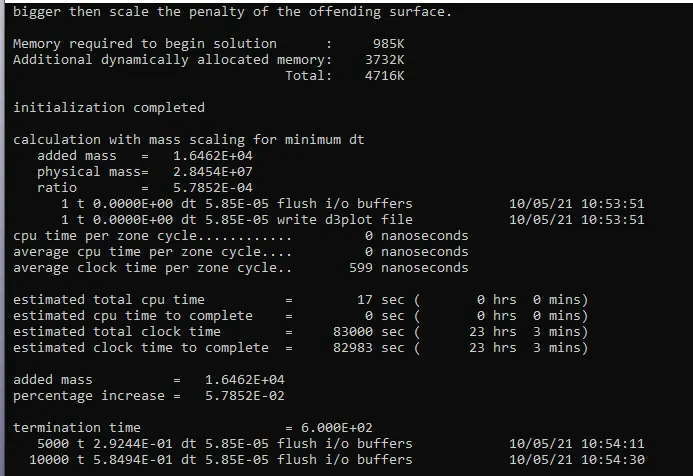
3. From the above image estimated time step will be decreased compared to the previous.
4. The percentage of mass added is 0.578% we cannot get the required percentage so increase the DT2MS value.
3. With Time Step -9.500e-05
1. Change the DT2MS value -6.500e-05 to -9.500e-05 in control Time Step.
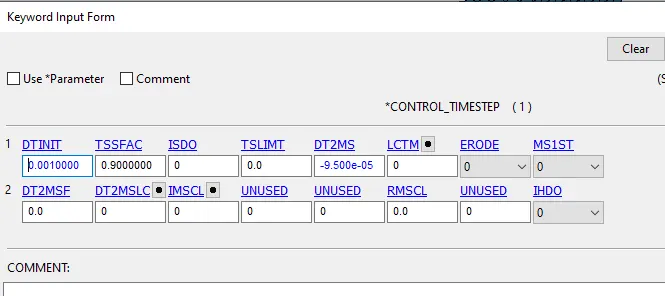
2. Save the keyword file and run the simulation in LS-run.
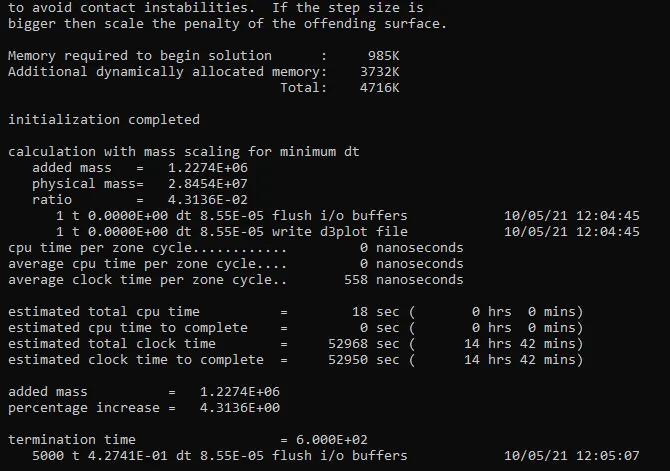
3. From the above image estimated time step will be decreased compared to the previous.
4. The percentage of mass added is 4.3% we cannot get the required percentage so increase the DT2MS value.
4. With Time Step -10.500e-05
1. Change the DT2MS value -9.500e-05 to -1.020e-04 in control Time Step.
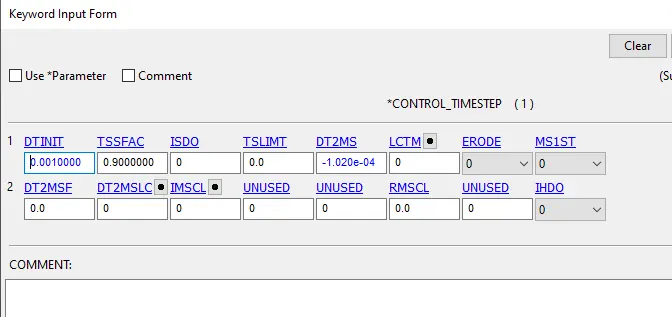
2. Save the keyword file and run the simulation in Ls-Run.
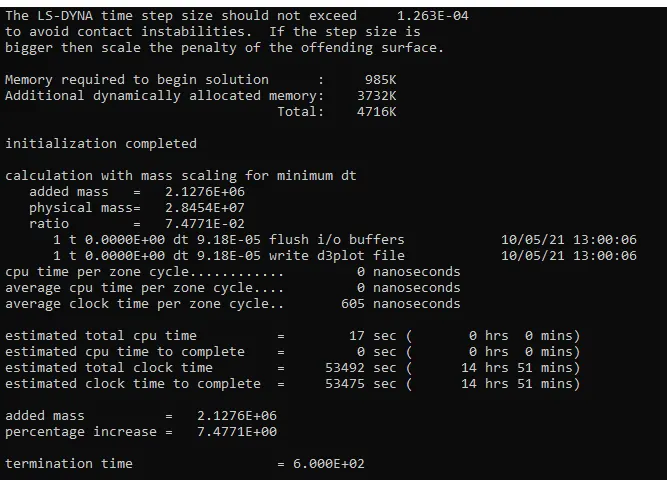
3. From the above image estimated time step will be decreased compared to the previous.
4. The percentage of mass added is 7.4% we cannot get the required percentage so increase the DT2MS value.
5.With Time Step -10.500e-05
1.Change the DT2MS value -1.020e-04 to -1.028-04 in control Time Step.
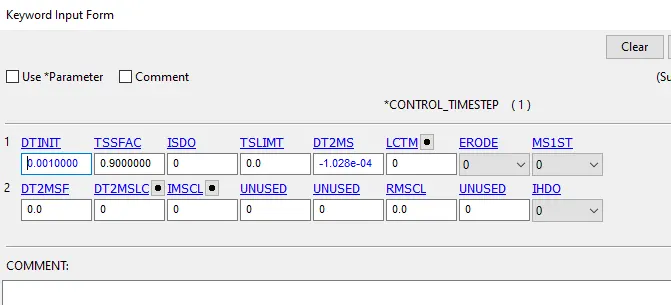
2. Save the keyword file and run the simulation in Ls-Run.
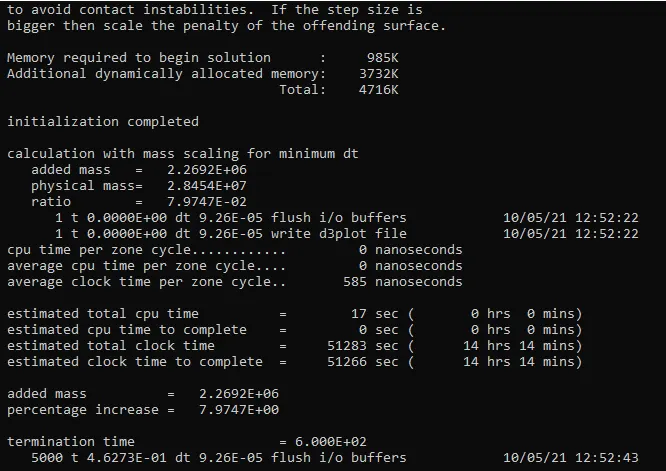
3. From the above image estimated time step will be decreased compared to the previous.
4. The percentage of mass added is 7.97% we cannot get the required percentage so increase the DT2MS value.
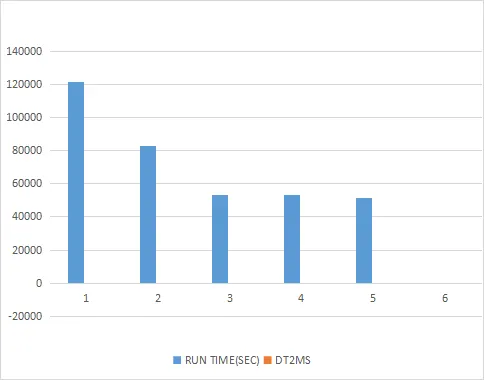
Take all values and plot the Runtime vs DT2MS as shown below.
CASE2:-Mass Scaling in Implicit Method.
First, create the implicit card in the control as shown below.
1. Implicit Auto
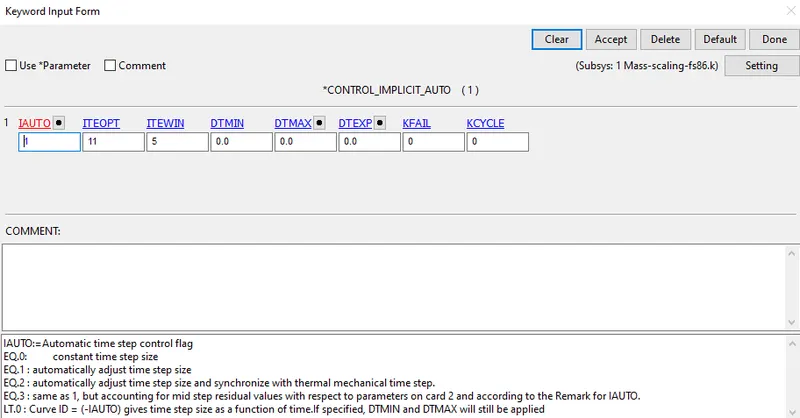
In the above image Automatic time step control flag (IAUTO) is set to 1 which means automatically adjust time step.
2. Implicit General:-
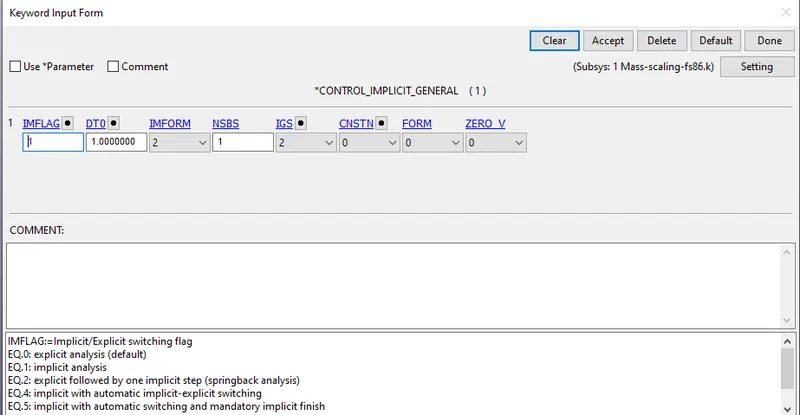
(IMFLAG) implicit /explicit switching flag set to 1 which means implicit analysis.
(DTO) initial time step size for implicit analysis is 1.
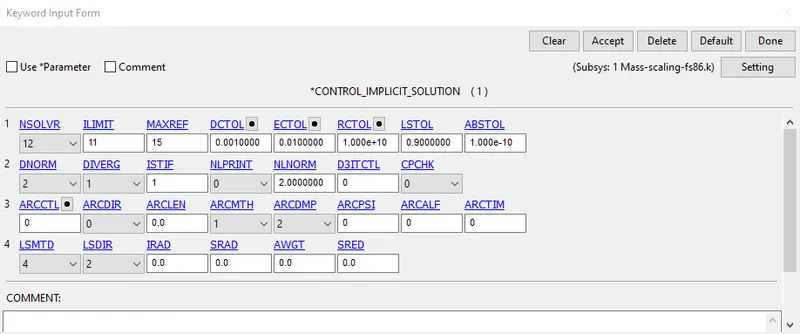
3. Implicit solution
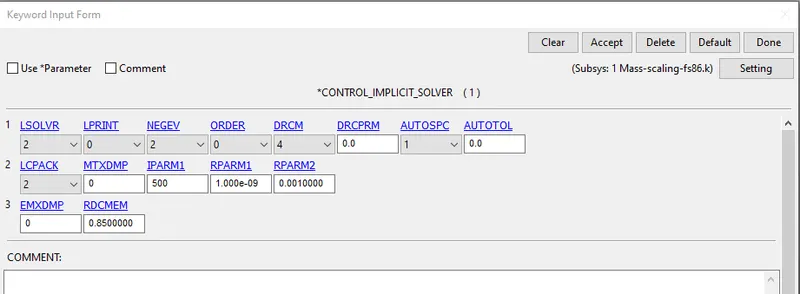
4. Implicit Solver
STEP 1:-
DT2MS -3.500E-05 is Given with TSSFAC 0.9
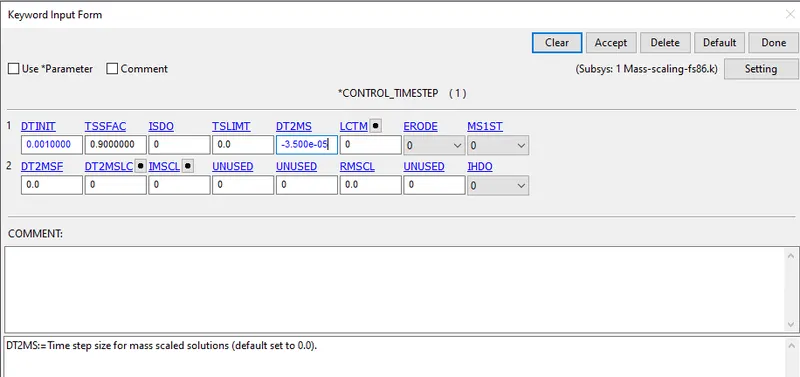
Save the keyword file and run the simulation in LS-Dyna.
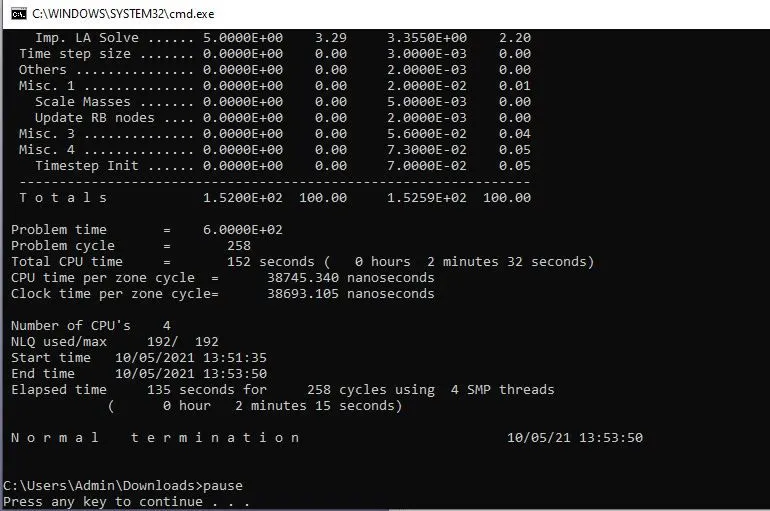
STEP2:-
DT2MS -1.028E-04 is Given With TSSFAC=0.9
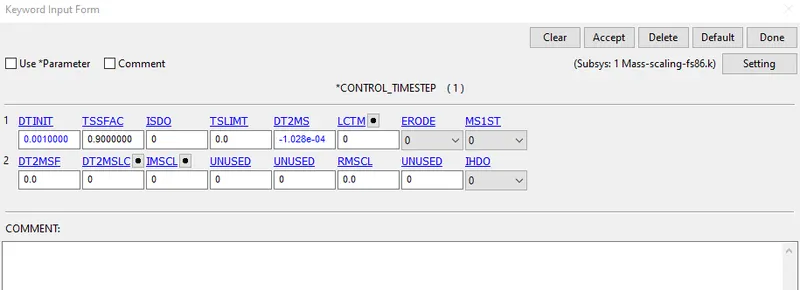
Save the keyword file and run the simulation in Ls-Run.
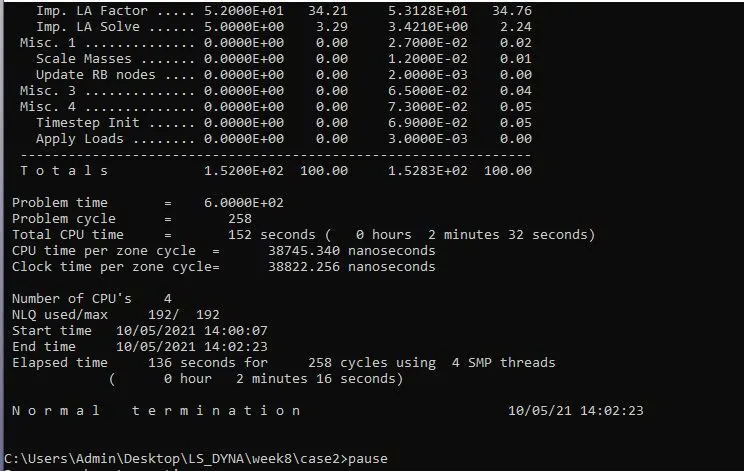
The runtime required to complete the simulation for DT2MS = -3.5E-5 is 2 mins 15 sec and for DT2MS = -1.028E-4 is 2 mins 16sec. The percentage increase in mass is not reported.
The Factor DT2MS and TSSFAC don't affect Implicit Analysis as the Implicit analysis doesn't use a Physical Time Factor.
| steps | DT2MS |
Run Time(sec) Explicit Method |
Run Time(sec) Implicit Method |
| 1 | -3.500e-05 | 121360 | 135 |
| 2 | -1.028e-04 | 51266 | 136 |