Week - 8 Mass Scaling
Aim:
The aime of this challenge is to understand the effect of mass scaling on the simulation run time as well as the difference between the explicit and implicit analyses in terms of run time. For checking mass scaling effect, the parameters dt2ms and tssfac in the *CONTROL_TIMESTEP card have been modified.
Explanation:
For the challenge a .k file named the "Mass-scaling-fs86.k" was provided. The model contained a plate connected to 2 pins, out of which one pin is fixed in X, Y and Z translational motions. The other pin was fixed in X and Y tranlational motions and given the velocity in Z direction.
The part, material, termination, hourglass and database keywords were already provided. The only variables were to be the dt2ms and tssfac parameters in the *CONTROL_TIMESTEP card.
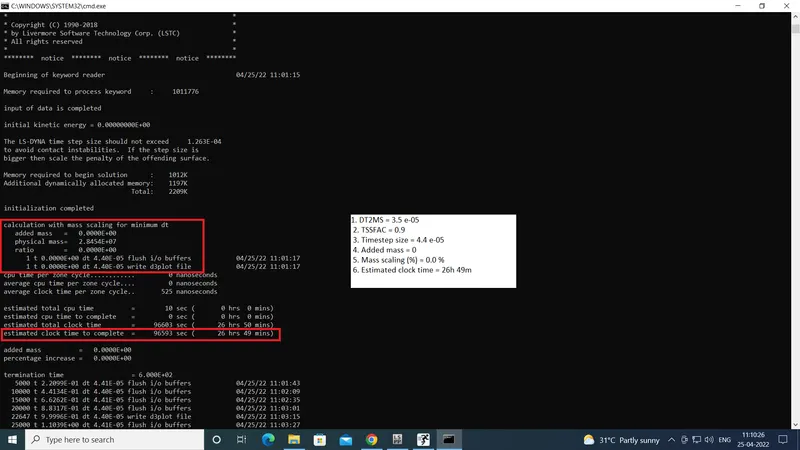
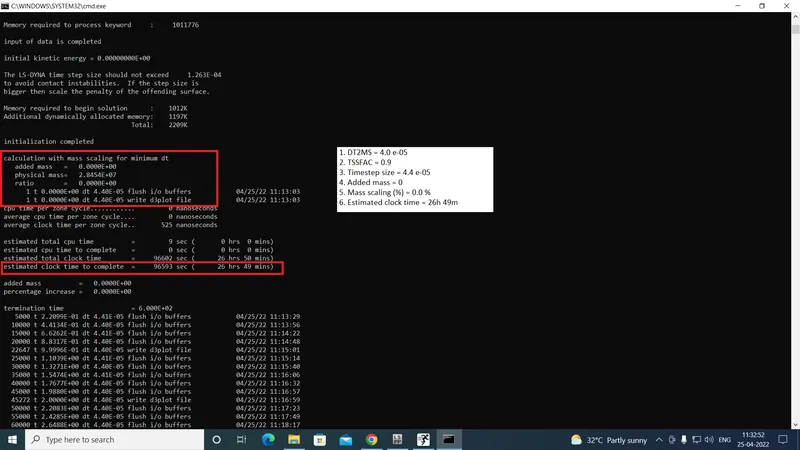
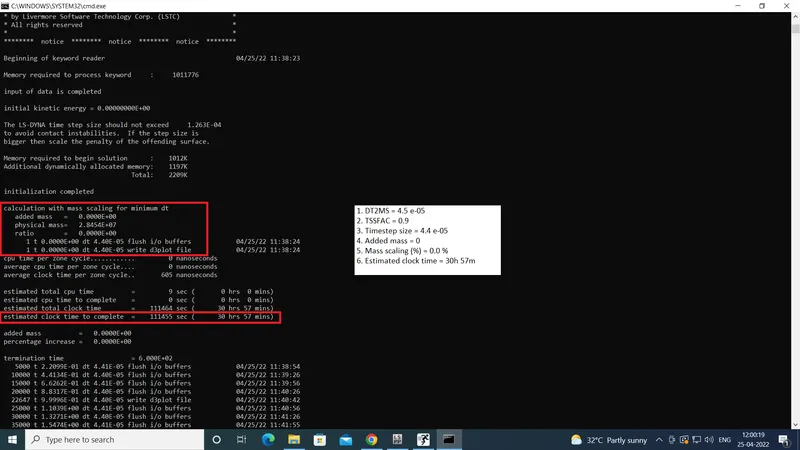
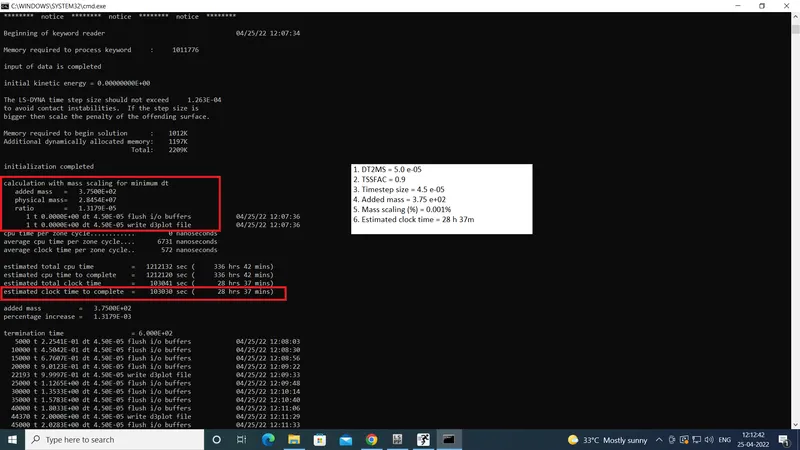
Initially, the tssfac was kept as 0.9 and the dt2ms was varied. Initial dt2ms was -3.5 e-05. The negative sign indicates the minimum size of the time step. While the negative sign was provied in the analysis, here, in the table and the plot, only the positive figures have been provided for ease of comparison.
The changes in dt2ms and the resultant changes in simulation parameters are given below:
For TSSFAC = 0.9
|
Trial |
DT2MS |
Timestep |
Estimated clock time |
Added mass |
Physical mass |
Mass scaling ratio |
Mass scaling % |
|
1 |
3.5E-05 |
4.40E-05 |
26h 50m |
0.0000E+00 |
2.8454E+07 |
0.0000E+00 |
0.000 |
|
2 |
4.0E-05 |
4.40E-05 |
26h 50m |
0.0000E+00 |
2.8454E+07 |
0.0000E+00 |
0.000 |
|
3 |
4.5E-05 |
4.40E-05 |
30h 57m |
0.0000E+00 |
2.8454E+07 |
0.0000E+00 |
0.000 |
|
4 |
5.0E-05 |
4.50E-05 |
28h 37m |
3.7500E+02 |
2.8454E+07 |
1.3179E-05 |
0.001 |
|
5 |
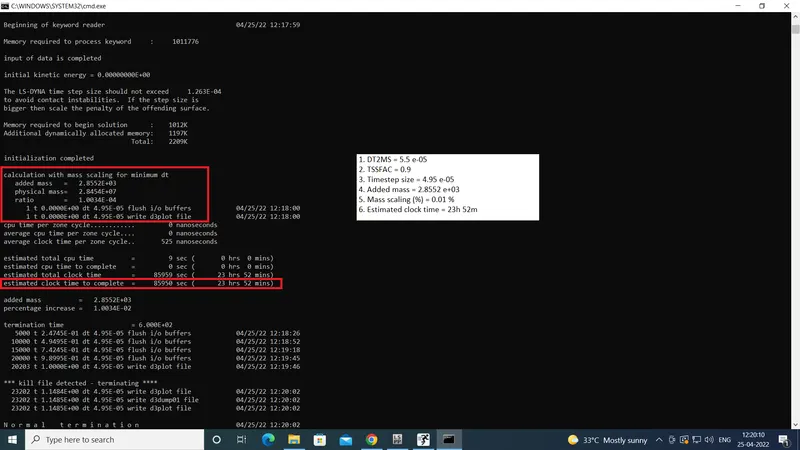
5.5E-05 |
4.95E-05 |
23h 52m |
2.8552E+03 |
2.8454E+07 |
1.0034E-04 |
0.010 |
|
6 |
6.5E-05 |
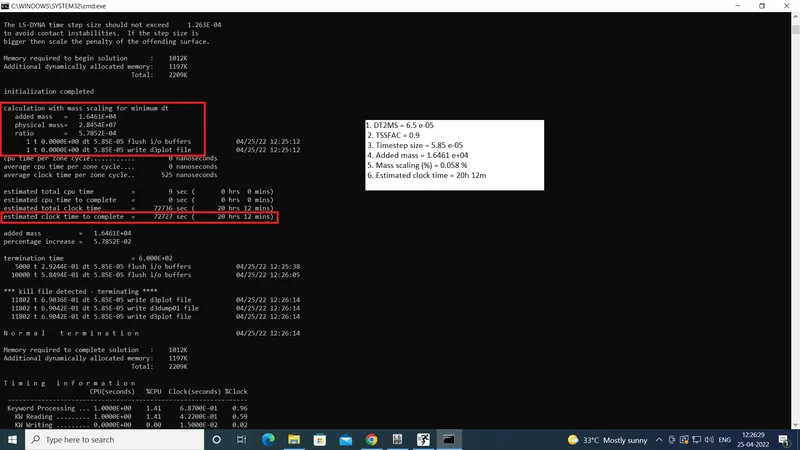
5.85E-05 |
20h 12m |
1.6461E+04 |
2.8454E+07 |
5.7852E-04 |
0.058 |
|
7 |
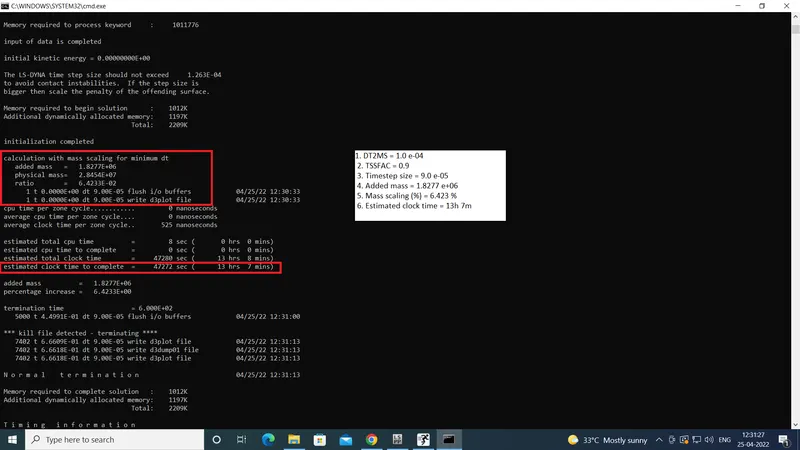
1.0E-04 |
9.00E-05 |
13h 8m |
1.8277E+06 |
2.8454E+07 |
6.4233E-02 |
6.423 |
|
8 |
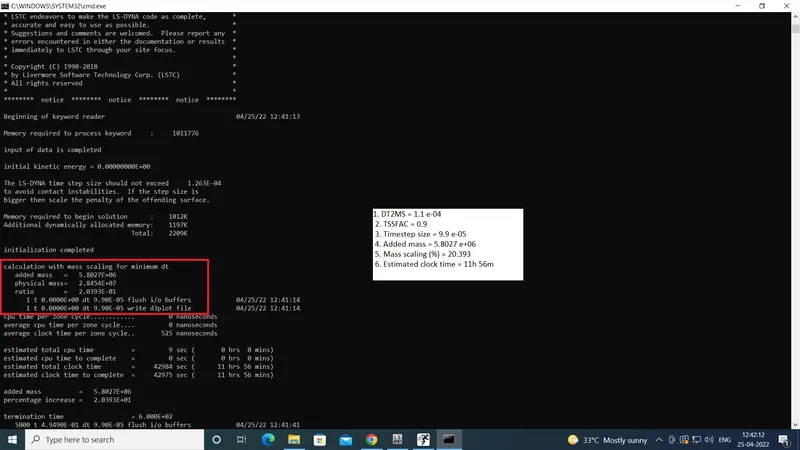
1.1E-04 |
9.90E-05 |
11h 56m |
5.8027E+06 |
2.8454E+07 |
2.0393E-01 |
20.393 |
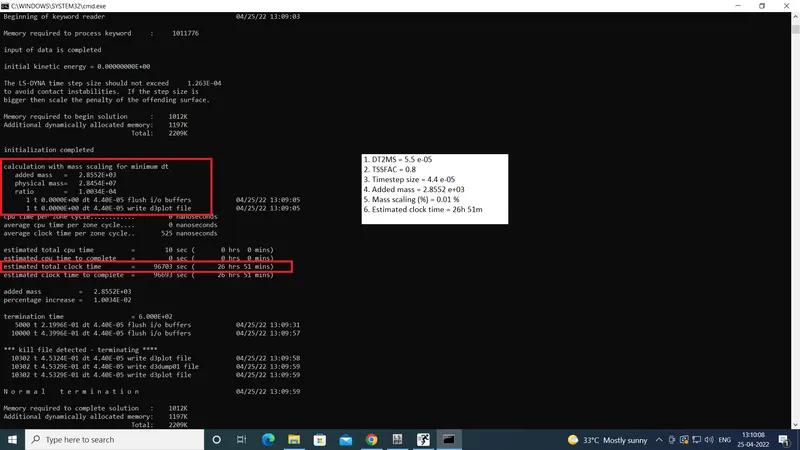
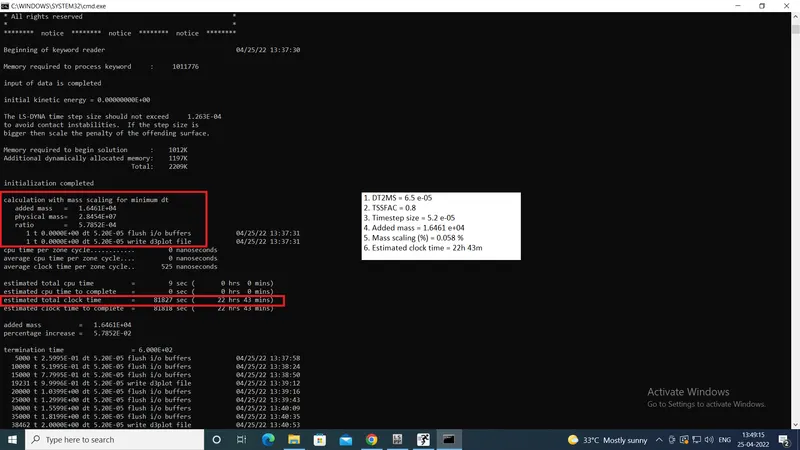
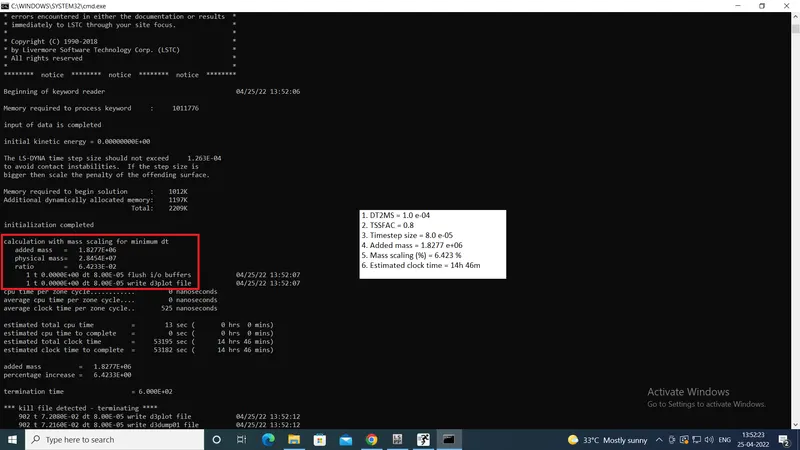
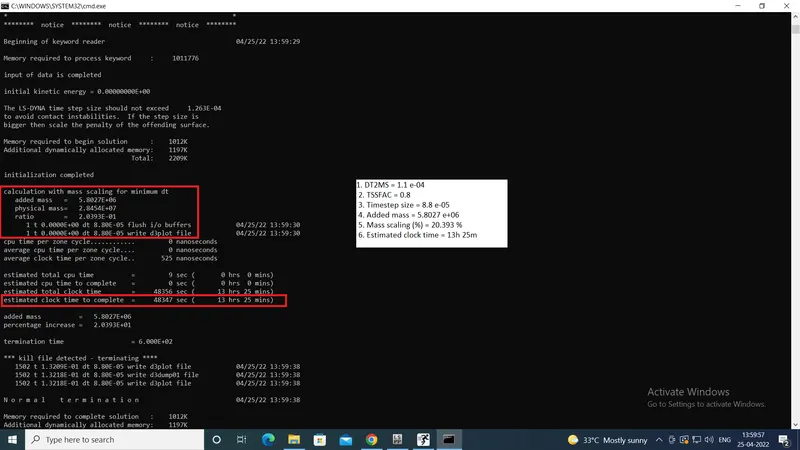
After this the tssfac values were changed to 0.8 for the same dt2ms values. The results are given in following table:
For TSSFAC = 0.8
|
Trial |
DT2MS |
Timestep |
Estimated clock time |
Added mass |
Physical mass |
Mass scaling ratio |
Mass scaling % |
|
1 |
3.5E-05 |
3.92E-05 |
30h 34m |
0.0000E+00 |
2.8454E+07 |
0.0000E+00 |
0.000 |
|
2 |
4.0E-05 |
3.92E-05 |
30h 11m |
0.0000E+00 |
2.8454E+07 |
0.0000E+00 |
0.000 |
|
3 |
4.5E-05 |
3.92E-05 |
30h 11m |
0.0000E+00 |
2.8454E+07 |
0.0000E+00 |
0.000 |
|
4 |
5.0E-05 |
4.00E-05 |
29h 32m |
3.7500E+02 |
2.8454E+07 |
1.3179E-05 |
0.001 |
|
5 |
5.5E-05 |
4.40E-05 |
26h 51m |
2.8552E+03 |
2.8454E+07 |
1.0034E-04 |
0.010 |
|
6 |
6.5E-05 |
5.20E-05 |
22h 43m |
1.6461E+04 |
2.8454E+07 |
5.7852E-04 |
0.058 |
|
7 |
1.0E-04 |
8.00E-05 |
14h 46m |
1.8277E+06 |
2.8454E+07 |
6.4233E-02 |
6.423 |
|
8 |
1.1E-04 |
8.80E-05 |
13h 25m |
5.8027E+06 |
2.8454E+07 |
2.0393E-01 |
20.393 |
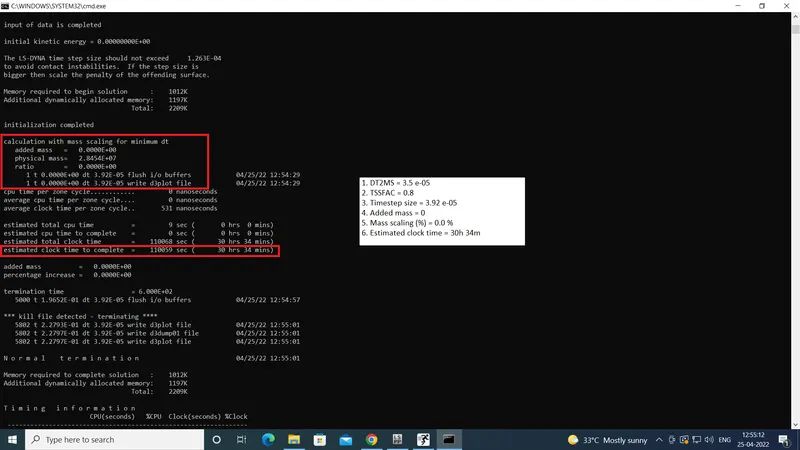
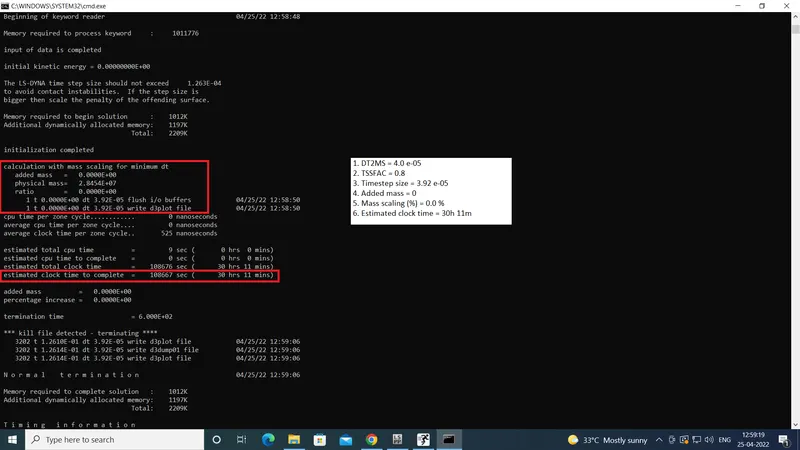
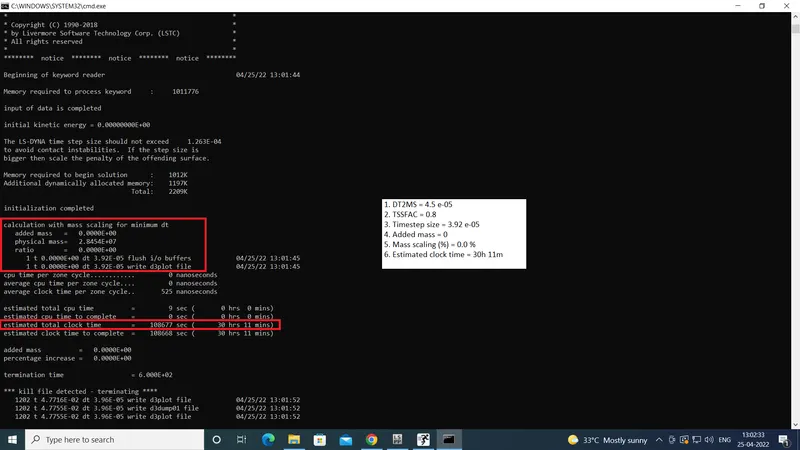
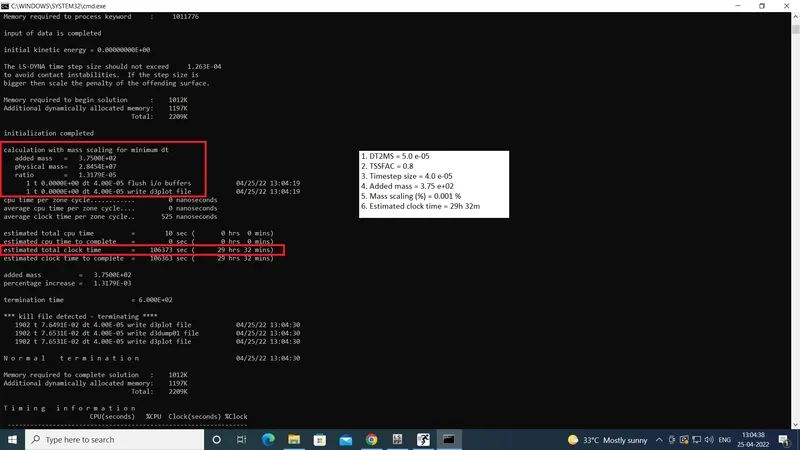
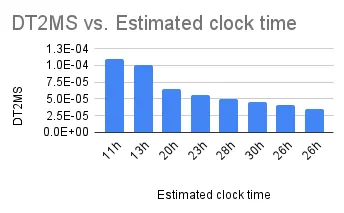
The histograms for different dt2ms vs. expected run time are provided below:
For TSSFAC=0.9
For TSSFAC = 0.8
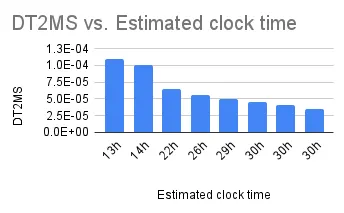
From both the above graphs, it is clear that the run time of the simulation decreased with the increase in the value of dt2ms. By the end of the 7th trial, the run time reduced by more than half the initial value. Thus the use of mass scaling has significantly increased the time step and reduced the run time of the simulation.
While the effect is similar when the tssfac is changed to 0.8, the size of the timestep is lower, as dt2ms value is getting multiplied by 0.8 instead of 0.9 like earlier. Interestingly, the valus of mass added and mass scaling ratio remain the same as they were when tssfac=0.9.
As the time step is lower when tssfac is 0.8, the total run time is also more than it was when tssfac was 0.9.
Comparing explicit and implicit analyses:
The run time for explicit analysis with dt2ms of 1.0e-04 and tssfac of 0.9 is 13 hours and 8 minutes as shown in the table.
For performing the implict analysis, in the *CONTROL card the *CONTROL_IMPLICIT_GENERAL was used and the value of IMFLAG was changed to 1. *CONTROL_INPLICIT_AUTO was used with default parameters to automatically control the timestep. *CONTROL_IMPLICIT_SOLUTION with default parameters was also used.
*CONTROL_TIMESTEP keyword was deleted for the implicit analysis. All the other parameters of the model were kept unchanged.
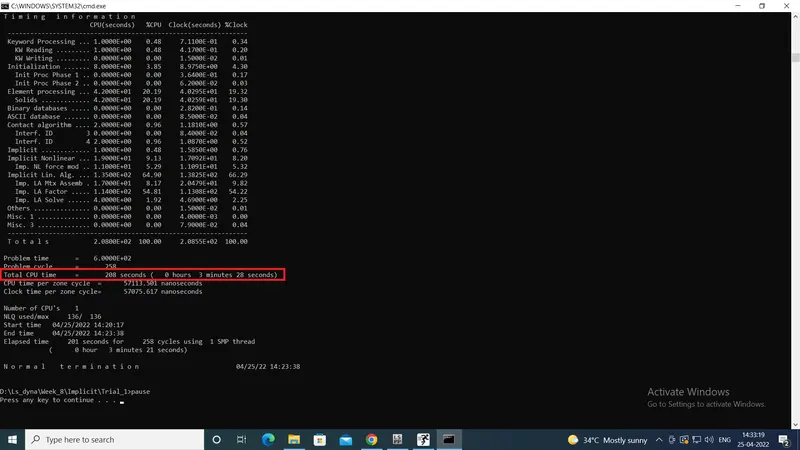
The simulation ran smoothly with normal termination with the run time of 3 minutes 28 seconds.
| Explicit analysis | Implicit analysis | |
| Total run time | 13 hours 8 minutes | 3 minutes 28 seconds |
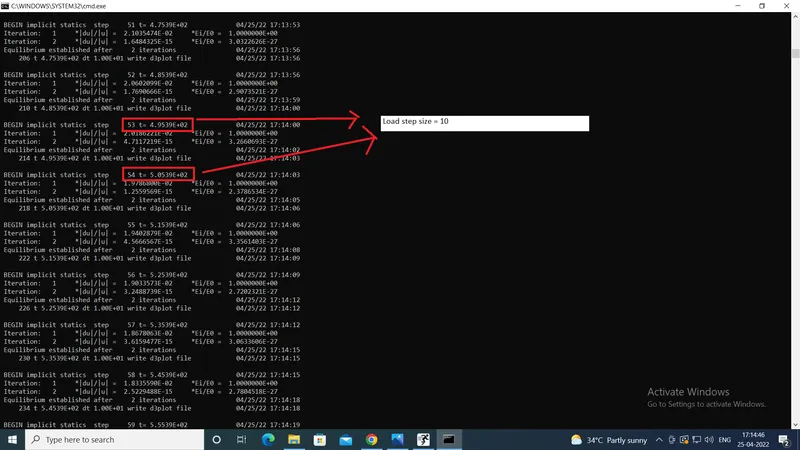
| Size of timestep or loadstep | 9.9 e-05 | 10 |
Thus the implicit method took significantly lower time to complete the simulation.
Conclusion:
The challenge demonstrated the effect of mass scaling on the simulation run time. The run time decreased significantly with increase in the value of dt2ms, which increased the size of the time step. However the time step scale factor (tssfac) also affected the run time. When it was lowered to 0.8, the size of the time step decreased and the run time was more than when tssfac was 0.9. Although it was still significantly lower than the run time without mass scaling.
Thus in explicit analyses with very long run times, the mass scaling can be effectively used to reduce the run time, as long as the mass scaling ratio remains within the acceptable range.
But the same problem was solved within 3 minutes and 28 seconds, when the implicit method was used. This is because, the implicit method does not make use of timestep. As a result, it can use bigger loadsteps to complete the analysis in short time. Thus this challenge has proved the utility of implicit method to solve explicit problems, which take very long time to solve.
Thus it needs to remembered that implicit method should be used to solve very long explicit problems, albeit by ensuring sufficiently small loadstep to ensure stable solution.