Week 8: Literature review RANS derivation and analysis
AIM :
Apply reynold's decomposition to the NS equations and come up with the expression for reynold's stress.
- Explain your understanding of the terms reynold's stress
- What is turbulent viscosity? How is it different from molecular viscosity
Let us know what is Reynold's decomposition
In fluid dynamics and turbulence theory, Reynolds decomposition is a mathematical technique used to separate the expectation value of a quantity from its fluctuations.

The Reynolds-averaged Navier-Stokes equations (or RANS equations) are time-averaged equations of motion for fluid flow. The idea behind the equations is Reynolds decomposition, whereby an instantaneous quantity is decomposed into its time-averaged and fluctuating quantities, an idea first proposed by Osbome Reynolds The RANS equations are primarily used to describe turbulent flows Ther equations can be used with approximations based on knowledge of the properties of flow turbulence to give approximate time-averaged solutions to the Navier-Stokes equations.
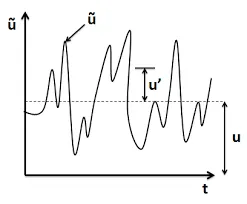
Expression for reynold's stress
Assume a flow v with a time scale T. Let τ denote a time scale τ << T. We can then
write for each component of the velocity
where by definition
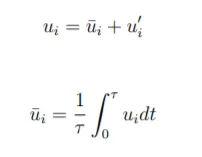 Eq 1
Eq 1
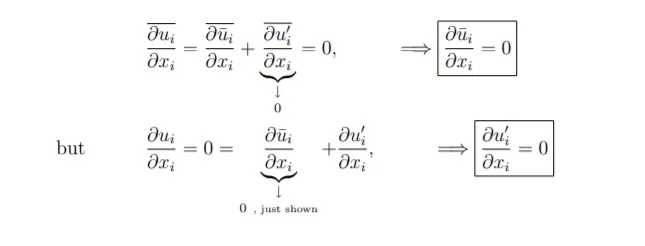
It immediately follows that 
ubstitute Eq. (1) into continuity and average over τ ,
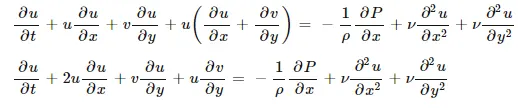
Substitute Eq. (1) into the momentum equations and take ( )
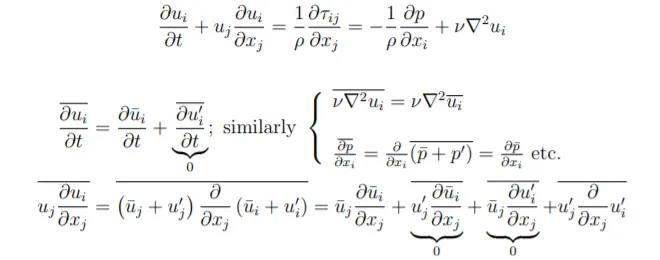
but from continuity we have
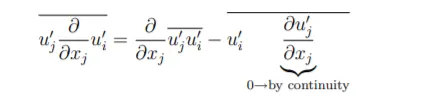
and thus we finally obtain
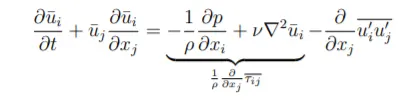
Reynolds averaged N-S equation:
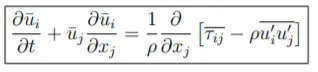
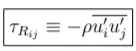
Reynolds stress:
- Explain your understanding of the terms reynold's stress
In this section we will investigate the effect of the turbulence on the mean flow. It will be assumed that the
turbulent spectrum has reached a steady state so that the turbulence can be regarded as fully developed.
For example, fully developed turbulent pipe flow would have the same statistical properties at any axial
location in the pipe.
the Reynolds stress is the component of the total stress tensor in a fluid obtained from the averaging operation over the Navier–Stokes equations to account for turbulent fluctuations in fluid momentum.
We wish to identify the mechanism by which the unsteady motions in the turbulence effect the mean
motions. To do so the fluid velocities, stresses and pressures are subdivided into mean, time-averaged
quantities denoted by an overbar and unsteady components with zero time averages denoted by a prime:
ui = ui + u , p = pi + p
What is turbulent viscosity? How is it different from molecular viscosity?
Turbulent viscosity
In fluid dynamics, the Reynolds stress is the component of the total stress tensor in a fluid obtained from the averaging operation over the Navier-Stokes equations to account for turbulent fluctuations in fluid momentum. The velocity field of a flow can be split into a mean part and a fluctuating part using Reynolds decomposition. We write
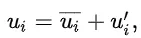
with u(x, t) being the flow velocity vector having components , in the coordinate direction denoting the components of the coordinate vector (x). The mean velocities u, are determined by either time averaging, spatial averaging or ensemble averaging, depending on the flow under study. Further udenotes the fluctuating (turbulence) part of the velocity.
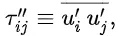
We consider a homogeneous fluid, whose density p is taken to be a constant. For such a fluid, the components of the Reynolds stress tensor are defined as
Molecular Viscosity (eddy viscosity)
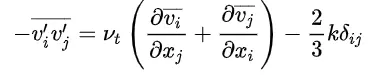
Joseph Valentin Boussinesq was the first to attack the closure problem, by introducing the concept of eddy viscosity. In 1877 Boussines proposed relating the turbulence stresses to the mean flow to close the system of equations. Here the Boussinesa hypothesis is applied to model the Reynolds stress term. Note that a new proportionality constant > 0, the turbulence eddy viscosity, has been introduced Models of this type are known as eddy viscosity models or EVM'
At a molecular level, viscosity is a result the interaction between the different molecules in a fluid. This can be also understood as friction between the molecules in the fluid. Just like in the case of friction between moving solids, viscosity will determine the energy required to make a fluid flow.
CONCLUSION
1. The RANS derivation and analysis was conduced.
2. We get to know about turbulent viscosity & molecular viscosity.