Week 9 - FVM Literature Review
What is Finite Volume Method(FVM) ?
A finite volume method (FVM) discretization is based upon an integral form of the PDE to be solved (e.g. conservation of mass, momentum, or energy). The PDE is written in a form which can be solved for a given finite volume (or cell). The computational domain is discretized into finite volumes and then for every volume the governing equations are solved. The resulting system of equations usually involves fluxes of the conserved variable, and thus the calculation of fluxes is very important in FVM. The basic advantage of this method over FDM is it does not require the use of structured grids, and the effort to convert the given mesh in to structured numerical grid internally is completely avoided. As with FDM, the resulting approximate solution is a discrete, but the variables are typically placed at cell centers rather than at nodal points. This is not always true, as there are also face-centered finite volume methods. In any case, the values of field variables at non-storage locations (e.g. vertices) are obtained using interpolation.
The major differences between FDM & FVM ?
Finite Difference Method – FDM
- Mostly for defined geometries which could be represented by structured grids
- I feel this method is a subset of finite element method as it works mainly for structured spatial discretization. Which means, the problems solved by finite difference method could be solved using finite element method, but the converse is not necessarily true.
- One of the deviations in the case of FDM would come from approximating the higher order terms in Taylor’s series which is used to linearize the PDE. This is called as truncation error.
- Other important differentiating factor of FDM compared to FVM is that it is based on the differential form of governing equations. FVM are based on the integral form or weak formulation
need for interpolation schemes and flux limiters in FVM.
Finite Volume Method – FVM
- The properties are calculated for every cell instead of a node
- Based on the integral form of conservation laws and can handle discontinuities in solutions. In simple terms, what comes in, must go out.
- FVM approximates the value of the integral on the reference cell
- Efficient in solving fluid flow problems
- Like FEM, lot of established and theoretically proven subroutines are in place for FVM which can be directly implemented in your code.
Need for interpolation schemes and flux limiters in FVM.
Interpolation schemes
The approximation of surface and volume intergals may requried the value for variables at location other thn the computational nodes of the CV. Value of thes location are using the interpolation method.
The interpolation scheams are classfied into
- Upward interpolation
- linear interpolation
- Quadic interpolation for the kinematics solvers
Upward interpolation
In this scheam valve of the upstream cell should be defined. It is used in convection types problems the upwind interpolation for approximating the value of variable and the east face of a control volume is given by
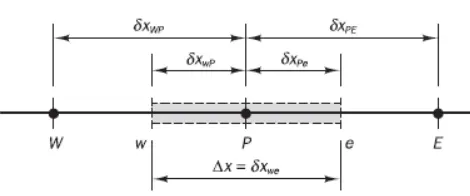
This interpolation scheme is equivalent to forward difference method are backward difference in method depending on the flow direction
linear interpolation
In this scheme approximate value of the variable at the centre of the control volume are obtained by the linear interpolation of the value from the to nearest computational note that is upstream or downstream
It is more simple and widely used
in The interpolotation is equivalent to the use of a central differencing in formula of the first order derivative and and this came is also termed as Central difference scheme
Quadic interpolation
It is approximated the value of variable at the centre of a CV by by that a control pollution of the value and 3 nearest computational node
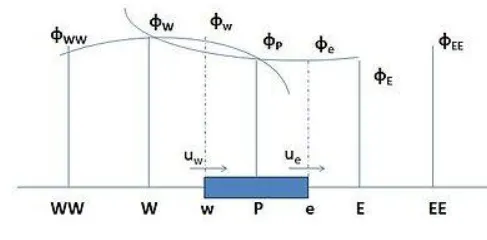
In the figure you can understand the nodes are in the 3 ways
fluxlimiters.
when we are calculating Gradients the values should be the bounded they cannot be jumped . if if have a shock flow problem there will be a huge discontiniuty , so the gradient will have a huge value .so we use flux value
Flux limiter functions are used to find tune the higher order and lower order scheme in such a way that resulting scheme gives a higher order in this month the region of the floor and maintenance of first order accuracy in the vincinity of the shocks and discontinuous
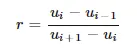
1st oredr is low flux
higest order is high flux
Finally The final volume method is really powerful approach to solve this CFD problem with the help of a proper interpretation scheme and a great use of flux limiters in case of any discontinuous present we can solve wide range of CFD problem.