Week 8: Literature review - RANS derivation and analysis
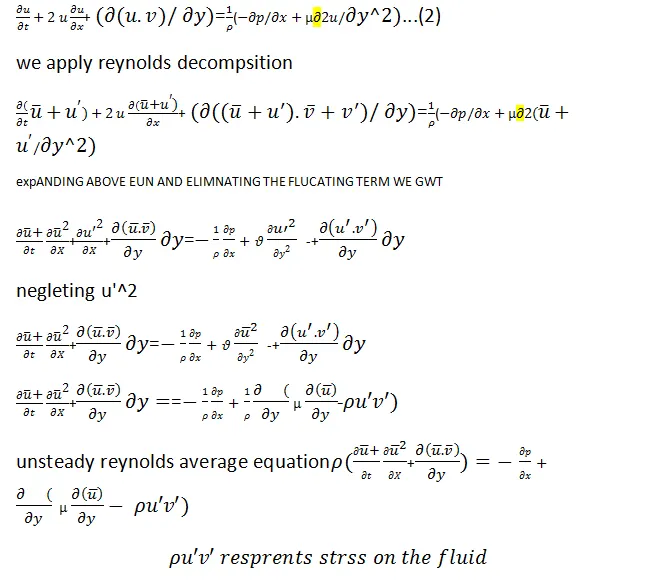
Aim-Application of reynolds decompositin to the navier stroke equation and the coming with expression for reynolds stress.
Objectives-Understanding terms of Reynolds stress and the turblent viscosity and the molecular viscosity.
Theroy-
Turbulent flow, type of fluid (gas or liquid) flow in which the fluid undergoes irregular fluctuations, or mixing, in contrast to laminar flow, in which the fluid moves in smooth paths or layers. In turbulent flow the speed of the fluid at a point is continuously undergoing changes in both magnitude and direction. The flow of wind and rivers is generally turbulent in this sense.Common examples of turbulent flow are blood flow in arteries, oil transport in pipelines, lava flow, atmosphere and ocean currents, the flow through pumps and turbines, and the flow in boat wakes and around aircraft-wing tips.Turbulence is caused by excessive kinetic energy in parts of a fluid flow, which overcomes the damping effect of the fluid's viscosity dturbulence is commonly realized in low viscosity fluid.The onset of turbulence can be predicted by the dimensionless Reynolds number, the ratio of kinetic energy to viscous damping in a fluid flow.
Reynolds number-
The Reynolds number is the ratio of interial force to viscous force. The Reynolds number is a dimensionless number used to categorize the fluids systems in which the effect of viscosity is important in controlling the velocities or the flow pattern of a fluid. Mathematically, the Reynolds number, NRe, is defined as
1.Laminar flow – R < 2000
2.Critical flow – R > 2000 and R < 4000
3.Turbulent flow – R > 4000
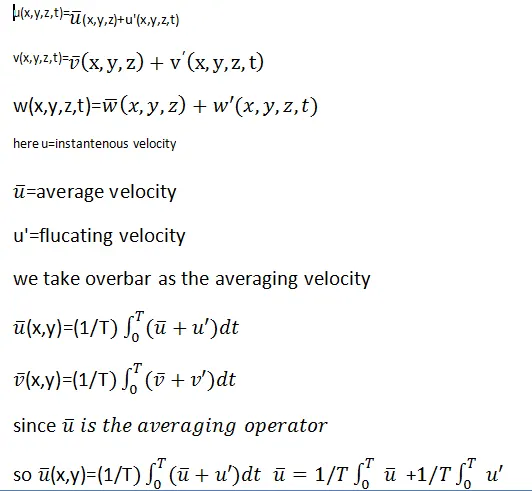
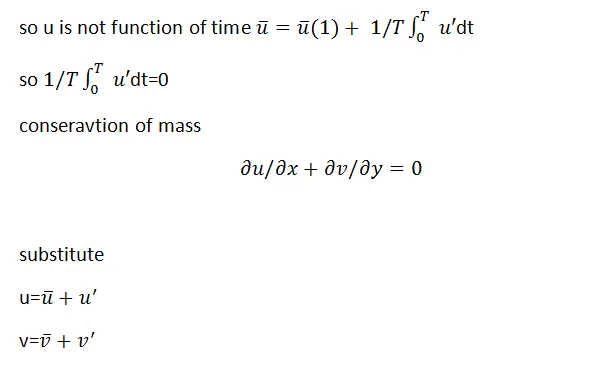
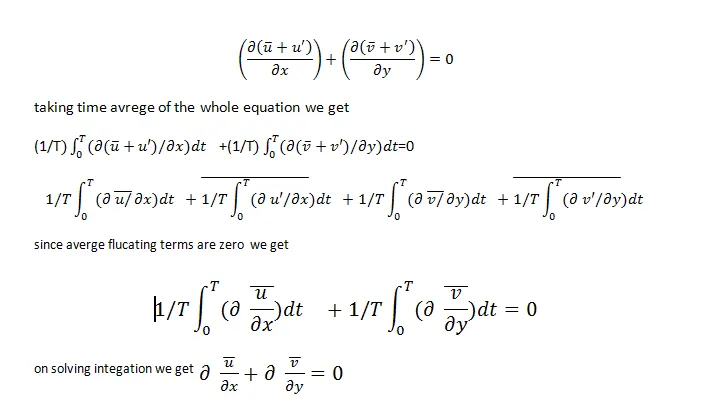
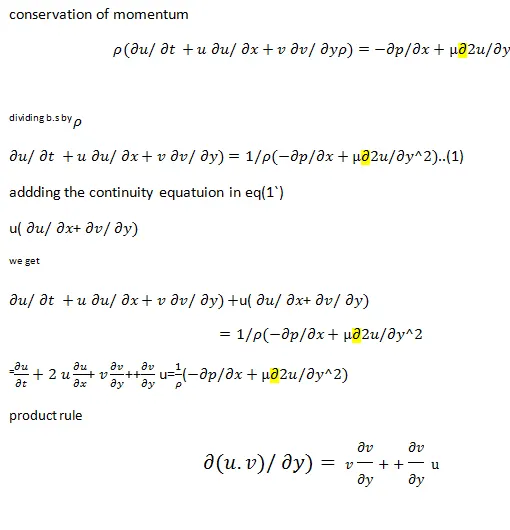
The Reynolds-averaged Navier–Stokes equations (RANS equations)- are time-averaged equations of motion for fluid flow. The idea behind the equations is Reynolds decomposition, whereby an instantaneous quantity is decomposed into its time-averaged and fluctuating quantities.
Difference between Turblent viscocity and the molecular viscocity
Tutblent viscocity is function of flucation in velocity terms due to the randomness or disordes in thye flow.
its the flow property and it depends flow domians such as reynolds number and velocity .due to presence of eddies the flow will be not smooth and its diffcult to measure.its dominat in the turblent flow regimes with high reynolds number.
Molecular viscocity-
Molecular viscocity is fluid property its resitsnce offered to movement of one layer over other layer.its linear and easy to measure and its sfluid property and is indepedent of geometry and its dominat in the laminar flow where reynolds number is lowand is chaeractersied with smooth flow.The velocity of the flow is low and mplecular viscocity depoends on the thickness of the fluid.
sa
sa