Week 8: Literature review RANS derivation and analysis
- Literature review RANS derivation and analysis
- Objective -Apply the Reynolds decomposition to the Navier-Stokes equation to find the expression for the Reynolds stress. Also understand the difference between turbulent viscosity and molecular velocity.
- Introduction
- Reynolds number: The Reynolds number is the ratio of the inertial and viscous forces of a liquid undergoing relative internal motion due to different liquid velocities, known as the boundary layer for interfaces such as the inside of a pipe.
- Reynolds Decomposition: - Reynolds Decomposition is a mathematical technique that splits the flow variables into principal and variation components.
- Fluid flow type:-
- Fluid flow can be divided into three types-
Laminar
Transition
Turbulent - The type of flow can be determined using the Reynolds number. increase. A low Reynolds number corresponds to laminar flow, where the flow is ordered and parameters such as pressure and velocity remain constant. A high Reynolds number corresponds to a turbulent flow, where the flow is chaotic and fluctuating in parameters.
- Literature Review
-
Turbulance modeling:- Turbulance modeling is used to calculate Reynolds strain time period and Turbulent viscosity. The effect of turbulence may be modelled the usage of a way called as Direct Numerical Simulation(DNS) which involes in solving Navier-Stokes equation over turbulent time step. but the turbulent time step could be very small as a result computational cellular length is required to solve. consequently turbulence version is used to seize the impact of turbulence in coarse length.
3 different turbulence models used are:-
1. Reynold Averaged Navier Stokes equation (RANS)
2. Large eddy simulation (LES )
- Reynold Averaged Navier Stokes equation (RANS)
- The Reynolds-averaged Navier–Stokes equations (RANS equations) are time-averaged equations of motion for fluid waft.
- The idea behind the equations is Reynolds decomposition, wherein an immediate quantity is decomposed into its time-averaged and fluctuating quantities, an idea first proposed by using Osborne Reynolds.
- The RANS equations are usually used to explain turbulent flows.
- Those equations may be used with approximations based on understanding of the homes of flow turbulence to offer approximate time-averaged answers to the Navier–Stokes equations.
- For a stationary waft of an incompressible Newtonian fluid, those equations can be written in Einstein notation in Cartesian coordinates as:

- Reynolds decomposition is the basic tool required for the derivation of RANS.
- Let, the mean of the fluctuating quantity is equal to zero
where ,(x ,y , z) is the position vector.

- In fluid dynamics Reynolds operators are regularly encountered in models of turbulent flows, particularly the Reynolds-averaged Navier–Stokes equations, wherein the average is usually taken over the fluid float under the institution of time translations.
- The properties of Reynolds operators are useful inside the derivation of the RANS equations. using those properties, the Navier–Stokes equations of motion, expressed in tensor notation, are (for an incompressible Newtonian fluid):


 is a vector representing external forces.

The momentum equation can also be written as,


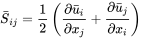 is the mean rate of strain tensor.
- Finally, considering the fact that integration in time eliminates the time dependence of the resultant terms, the time by-product have to be eliminated, leaving,

- Equation of reynolds stress is given by,

Splitting each instantaneous quantity into its averaged and fluctuating components yields,


- Reynolds stress
-
Reynolds shear stress is the function of product of turbulent viscosity and velocity gradient.
Reynolds stress :- Reynolds stress is a component of stress tensor in fluid which is obtained by averaging operation over the Navier Stokes eqn used to account for turbulent fluctuation within the fluid momentum.
- Reynolds stress closures for RANS equations are attractive because they take away the need for an eddy viscosity, but the ensuing equations are drastically more complicated than those of -equation closures.
- The Reynolds pressure model (RSM) is the most elaborate turbulence version in (U)RANS turbulence models.
- Abandoning the isotropic eddy-viscosity hypothesis, the RSM closes the Reynolds-averaged Navier-Stokes equations by using solving delivery equations for the Reynolds stresses, together with an equation for the dissipation rate.
- Because of this five additional delivery equations are required in second flows an seven extra shipping equations must be solved in 3-D.
- RSM can display higher performance involving the subsequent varieties of flows:
- free shear flows with robust anisotropy, like a robust swirl aspect, such as flows in rotating fluids,
- Flows with sudden changes inside the suggest strain price,
- Flows where the pressure fields are complicated and reproduce the anisotropic nature of turbulence itself.
- Flows with sturdy streamline curvature, secondary flows, and Buoyancy flows.
- All of these are based totally on a higher diploma of universality with the aid of considering each Reynolds strain tensor.
- What is turbulent viscosity? How is it different from molecular viscosity?
- The turbulent transfer of momentum via eddies creates internal fluid friction. it is the essential concept of the way we define viscosity in turbulent waft, i.e. internal fluid resistance. Eddy viscosity explains what reasons inner friction.
- Molecular viscosity is the delivery of mass movement momentum totally via the random motions of person molecules not moving collectively in coherent organizations. Molecular viscosity has similarities in laminar waft to eddy viscosity in a turbulent waft.
- Is a resistance to the motion of 1 layer of fluid over an adjecent of fluid.
- It is linear and is straightforward to degree.
- It is a fluid belongings and is independant of geometry.
- It's far dominat in laminar float regims wherein the Reynolds range is low.
- The velocity of waft is usually & the molecular viscosity relies upon on the thickness of the fluid.
- Eddy Viscosity (Turbulent Viscosity) is an imaginary concept, it does not exist as the molecular viscosity which is a nicely-described shipping coefficient as said by the Kinetic theory.
- The Turbulence viscosity hypothesis became posed for making the things less difficult, within the experience that the turbulent Reynolds stresses are simplified to be proportional to the gradients of the mean pace, as takes place in Newtonian laminar flows with the viscous stresses. but, the numerical methods stemming from this simplification (together with RANS) are low time ingesting and may be used hugely.
- Turbulent viscosity is a feature of fluctuations in speed term and is encouraged through randomness or disorderlines influx.
- It's far non-linear and tough to estimate.
- It's far dependent on glide domain names such velocity , Reynolds wide variety and isn't a fluid belongings.
- It's far dominant in turbulent waft regimes with high Reynolds number.
- The drift speed is high and turbulent viscosity rely upon the speed & flow situations of the fluid.