Week 8: Literature review - RANS derivation and analysis
Aim:
To derive the Reynolds Averaged Navir Stokes(RANS) Equations.
Objective:
To find the expressions for reynolds stress by applying Reynolds decomposition to the Navier-Stokes equations. Also understanding the difference between the turbulent viscosity and molecular velocity.
Introduction:
1. Turbulent Flow
Turbulent flow is a type of fluid flow in which the fluid undergoes irregular fluctuations, or mixing, in contrast to laminar flow, in which the fluid moves in smooth paths or layers.. in turbulent flow, the speed of the fluid at a point is continuously changing in both magnitude and direction. The flow of wind and rivers is generally turbulent in this sense, even if the currents are gentle. The air or water swirls and eddies while its overall bulk moves along a specific direction.
There are several challenges that we need to overcome to model an accurate turbulent flow-
- Unsteady aperiodic motion.
- Fluid properties exhibit random spatial variations.
- Strong dependence on initial conditions.
- Contains a wide range of scales(eddies).
2. Navier-Stokes Equation
The Navier-Stokes equations describe the motion of fluids, through the conservation of mass, momentum, and energy.
The equations are non-linear, which creates a continuous spectrum of different flow features. this spectrum contains very large integral scales and very small dissipation scales. The simultaneous representation of both large and small scales makes for a very large computational problem.
Current computational resources limit the number of small features that can be accurately simulated. Therefore, there is a need to approximate the Navier-Stokes equations on a computational grid using discrete physical points or basic functions.
RANS:
The Reynolds-averaged Navier–Stokes equations (RANS equations) are time-averaged equations of motion for fluid flow The idea behind the equations is Reynolds decomposition, whereby an instantaneous quantity is decomposed into its time-averaged and fluctuating quantities, an idea first proposed by Osborne Reynolds The RANS equations are primarily used to describe turbulent flows. These equations can be used with approximations based on knowledge of the properties of flow turbulence to give approximate time-averaged solutions to the Navier-Stokes equations.
Governing Boundary layer equations:
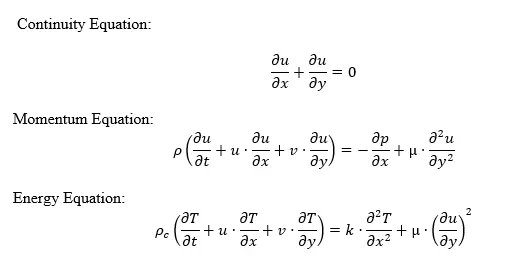
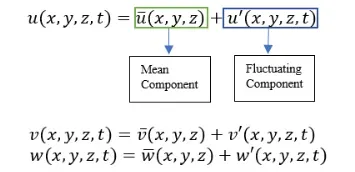
Reynolds Decomposition:
Reynolds decomposition is a mathematical technique used to separate the mean value of quantity from its fluctuations.
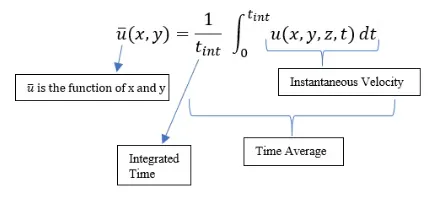
Time Averaged Quantity
Integrating quantities which doesn't changes with time
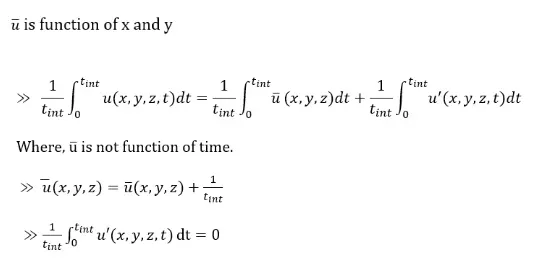
We integrate fluctuating terms for longer time period then the fluctuation tend to zero.
Continuity Equation
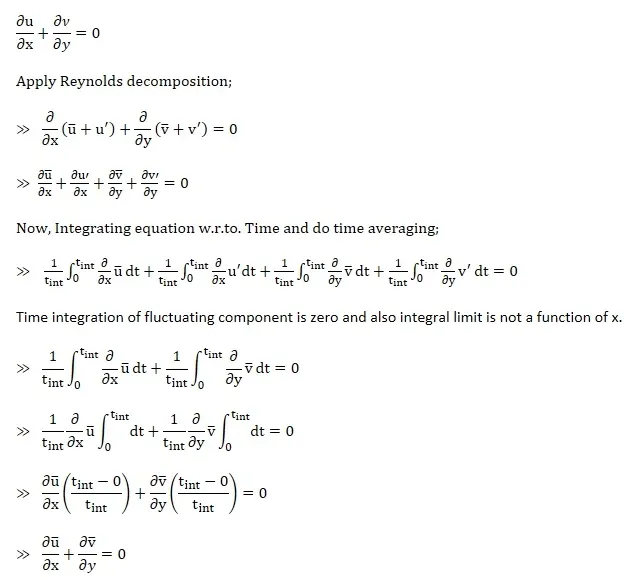
Hence, continuity equation is satisfied by the the reynolds decomposition.
Momentum Equation
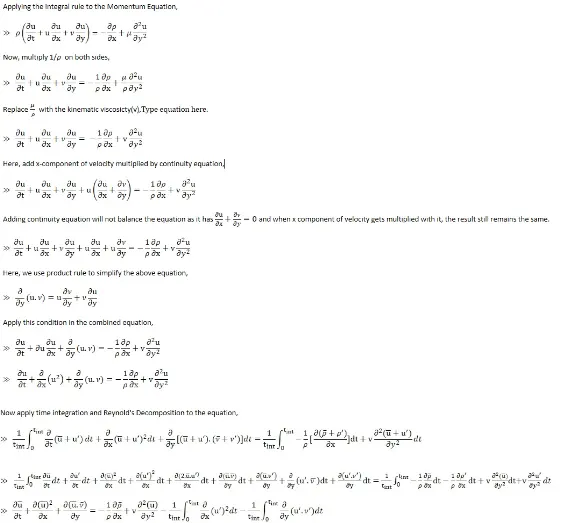
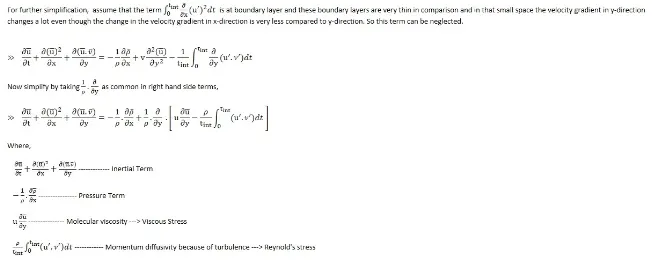
Reynold's stress is the component of the total stress tensor in a fluid obtained from the averaging operation over the Navier-Stokes equation to account for turbulent fluctuations in fluid momentum. This stress offers a significant effects of the complex interactions in the turbulent flows.In turbulent flow the Reynolds stresses are usually large compared to viscous stresses. Reynolds stress provides the averaged effect of turbulent convection, which is highly diffusive. Reynolds stress tensor in the RANS equations represents a combination of mixing due to turbulent fluctuation and smoothing by averaging.
The turbulent viscosity hypothesis assumes that the Reynolds stresses can be related to the mean velocity gradients and turbulent viscosity by gradient diffusion hypothesis, in a manner analogous to the relationship between the stress and strain tensors in laminar Newtonian flow. The turbulent viscosity is not homogeneous i.e. it varies in space. It is however assumed to be isentropic. It is same in all directions.
It is a resistance to the movement of one layer of fluid over the adjacent layer. It is linear and easy to measure. It is always independent of geometry. Molecular viscosity is the transport of mass motion momentum by random motions of individual molecules not moving together in coherent groups. Moleculer viscosity is analogous in laminar flow to eddy viscosity in turbulent flow.
The turbulent viscosity is an imaginary concept but the molecular viscosity is a dynamic viscosity that is present in real fluids. Molecular viscosity depends on the properties of fluid but the turbulent viscosity depends on the fluid flow. Turbulent viscosity is dominant in regions with high Reynolds Number whereas molecular velocity is dominant in the regions with low Reynolds number.Molecular Viscosity is linear and hence easy to measure.
Conclusion:
We have derived the equation for Reynolds stress using reynold's decomposition to the NS equations.