Week 8 - Challenge 2 - Base Bracket Design
WEEK 8 CHALLENGE 2
AIM
- To create a base bracket plastic component through the given class-A surface.
- To perform draft analysis on the model.
THEORY
With plastic injection molding, it is important to design for manufacturability. To do this, every step of the process must be taken into consideration. A draft angle will help avoid most of these issues.
A draft angle is a slant that is applied to each side of most features of an injection molded part. The angle, which is positioned to run toward the direction of a mold’s pull and parting line, helps with releasing the part from the mold.
When developing parts for plastic injection molding, applying draft (or a taper) to the faces of the part is critical to improving the moldability of the part. Without it, parts run the risk of poor cosmetic finishes, and may bend, break, or warp due to molding stresses caused by the plastic cooling. Equally important, an absence of draft may prevent parts from ejecting from the mold, damaging not only the parts, but possibly the mold itself.
Draft analysis is a method of checking the draft angle on various faces of a part with a particular direction. Designers of plastic parts and mold tooling manufacturers can use the Draft Analysis tool to check the correct application of draft to the faces of their part. With draft analysis, they can verify draft angles, examine angle changes within a face, as well as locate parting lines, injection, and ejection surfaces in parts.
TOOLS USED
- Point
- Point - Direction Line
- Point - Point Line
- Intersect
- Bisecting Line
- Plane
- Fill
- Axis System
- Extract
- Boundary
- Extrapolate
- Trim
- Offset
- Split
- Edge Fillet
- Sweep
- Join
- Close Surface
- Publication
- Feature Draft Analysis
PART IMAGES OF DRAFT ANALYSIS
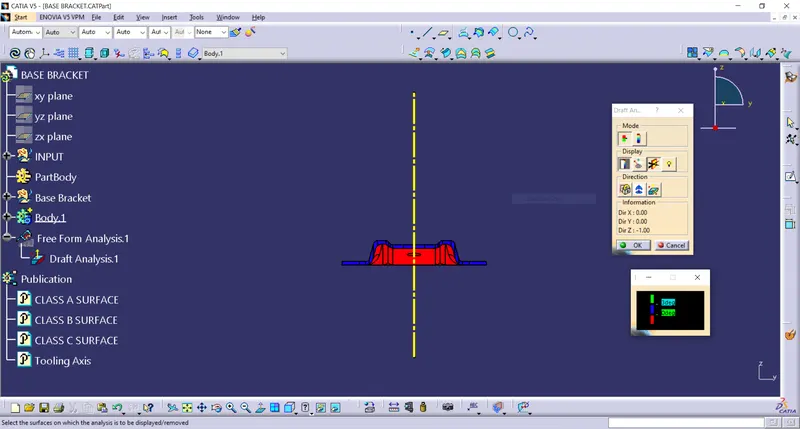
- Front View :
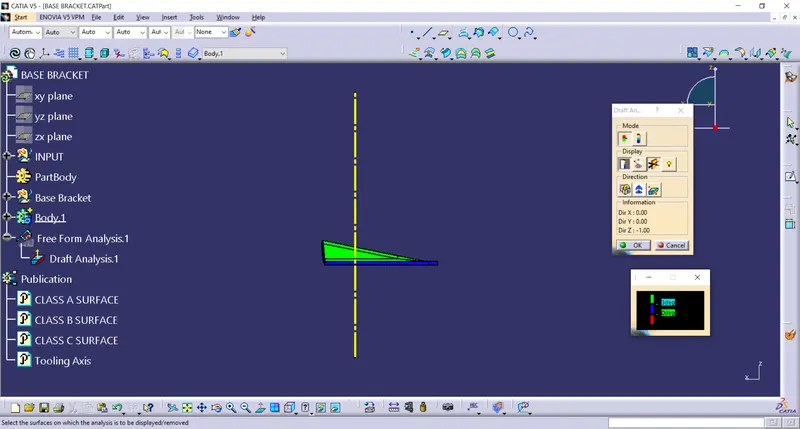
- Side View :
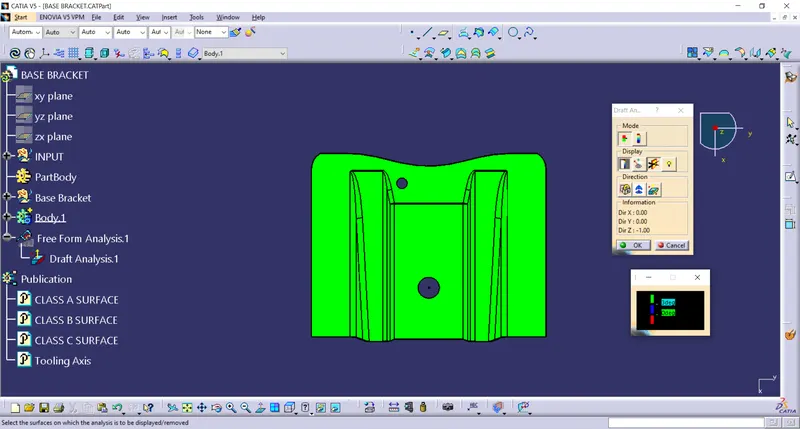
- Top View :
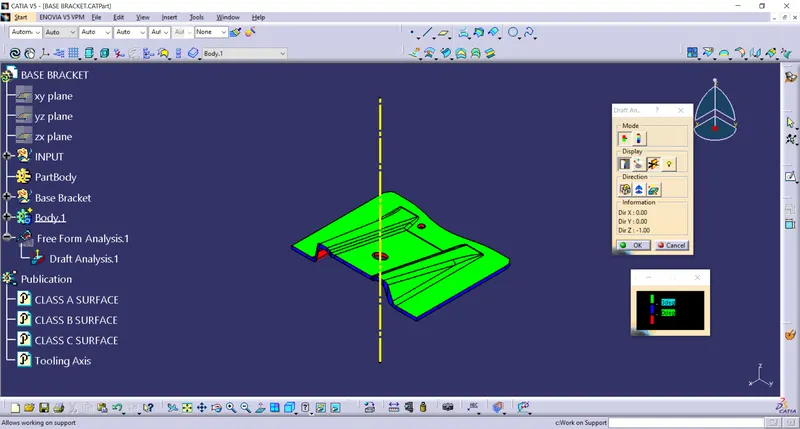
- Isometric View :
CONCLUSION
- Plastic base bracket component created through the given class-A surface.
- Draft analysis performed on the model.
- Model cleared the draft analysis.