Week 7 State of charge estimation
AIM: To simulate the differnet test cases from harness dashboard and explain how BMS implements coulomb counting for SOC estimation.
THEORY:
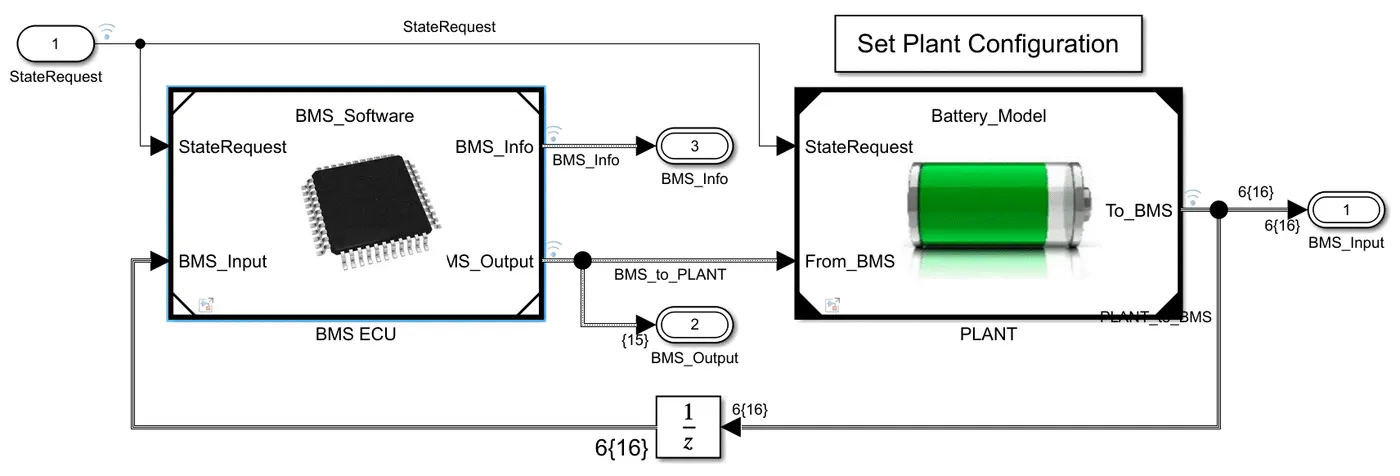
The model can be used to mimic diverse usage cycles and environmental conditions to evaluate a systems response to a potentially unsafe condition. For instance, voltage, current, or temperature outside the recommended limits. The vehicle is run for a while and then stops to charge. Once the vehicle and battery are at rest and charging, the cell balancing cycle kicks in. To maintain the battery pack within recommended electrical and thermal limits, the model given above can be used to test different conditions.
BMS ECU: This represents the software and controls part of the model, showing how cell balancing is done, SOC is estimated, and response to different states.
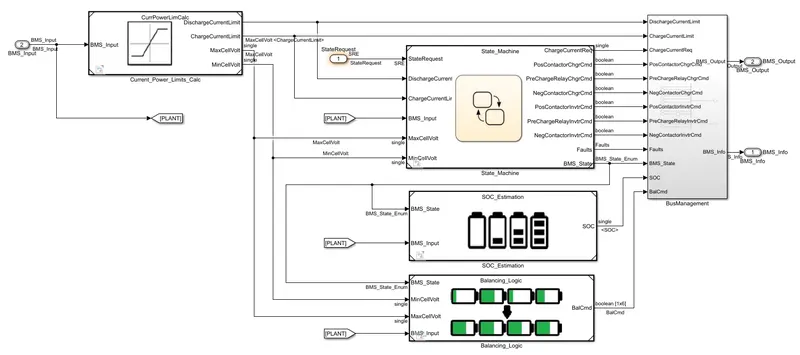
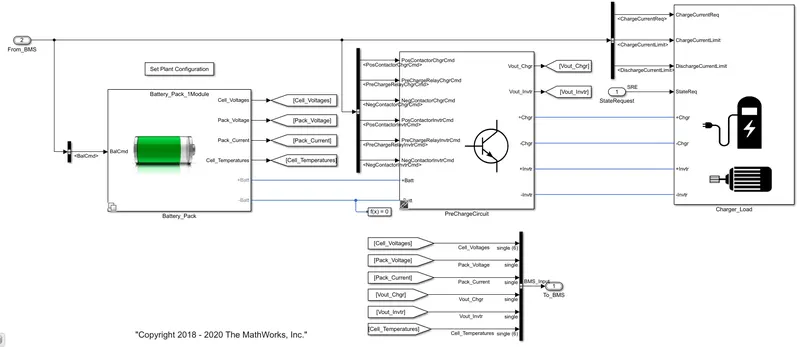
PLANT: This model epresents the hardware part of the model, with the battery pack, precharge circuit, and charger.
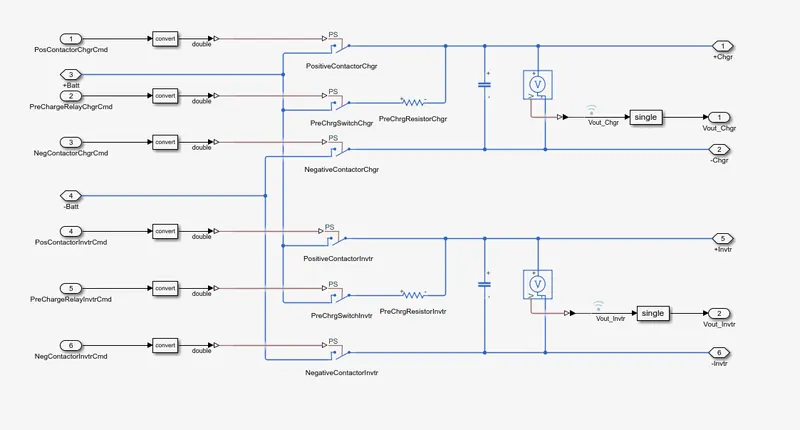
PRECHARGE CIRCUIT MODEL:
TESTING HARNESS DASHBOARD:
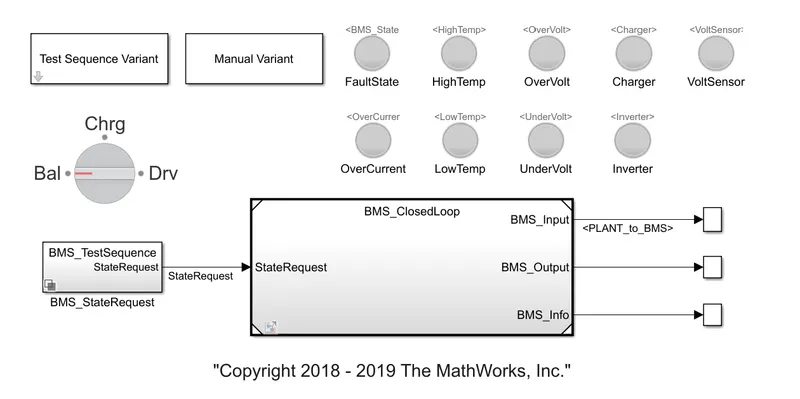
TEST SEQUENCE CASES:
From the test sequence variants, choose the test case as 1 to simulate the first case:
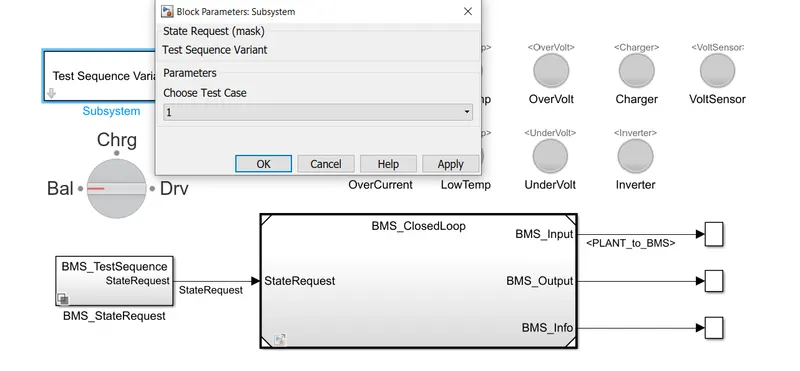
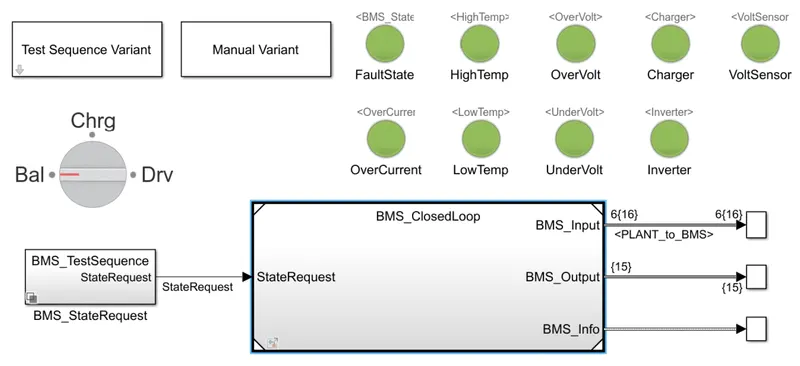
Results:
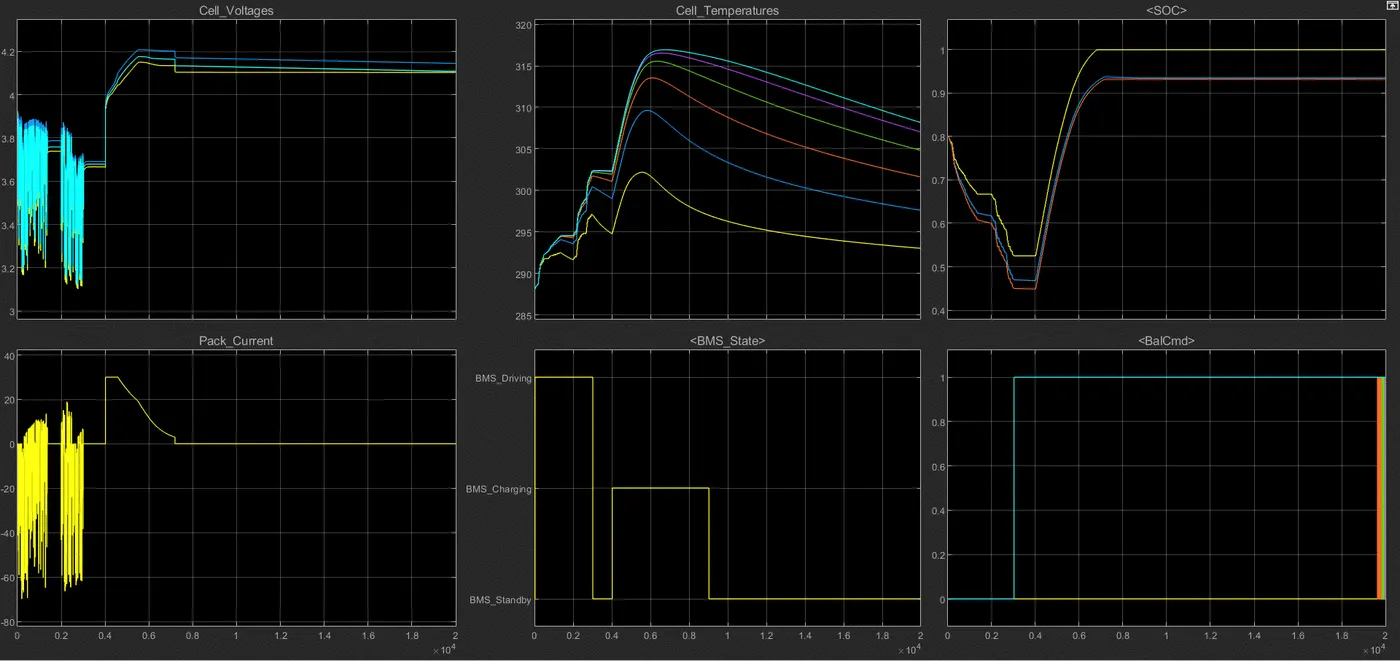
- From the BMS state plot, notice that the battery is in driving mode for first 3000 secs, the next 1000 secs BMS has come to a standby. This will generally happen when the vehicle has come to a stop for a long time.
- From 4000 to 9000 seconds, i.e for the next 5000 seconds, the BMS is for charging and then BMS continues to be in standby for the remaining 11,000 seconds
- Notice that the cell voltage fluctuate between 3.1 and 3.9 voltage for the first 3000 seconds indicating that the vehicle is in driving mode.
- Then the SOC increases indicating that the battery is charging. From 4000 to 4600sec, the charging is constant current and then the remaining is Constant voltage. During CC the SOC increases much more quickly, and then slows down during CV as a precaution mechanism to avoid charging past the voltage limit.
- The SOC graph shows the estimation of SOC through different methods, with yellow corresponding to coulomb counting, blue for Unscented Kalman Filter (UKF), and orange for Extended Kalman Filter (EKF). Both Kalman filter methods are evidently more accurate than coulomb counting due to their ability to account for voltage information (the difference between OCV and (sum of) voltage drops)
TEST CASE 3: Battery charging only mode:
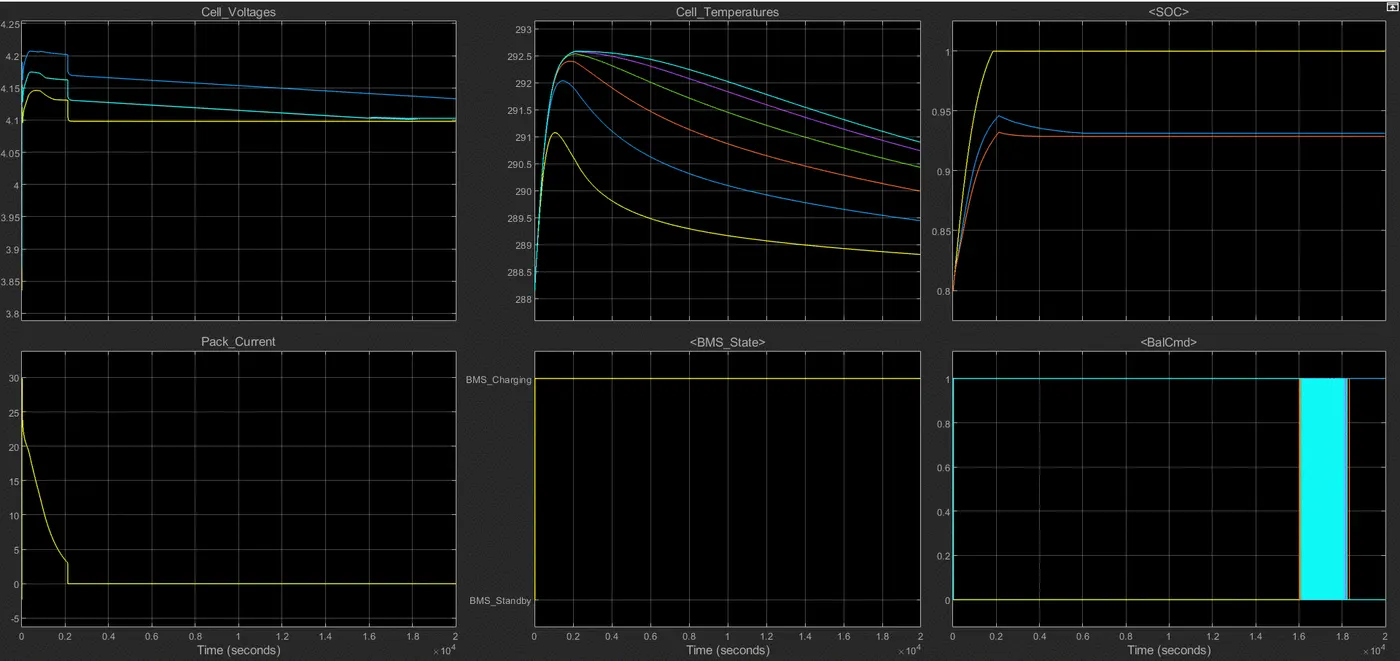
RESULTS:
- Since the battery is only in charging mode, the sudden influx of current from 0 to 30A is seen within the first 5 seconds.
- Extended Kalman Filter has outperformed Unscented Kalman Filter by a little margin, while Coulomb counting method for SOC approximation seems the most inaccurate one.
2) Coulomb Counting Method
Coulomb counting method is a type of book-keeping estimation method that uses battery discharging current data as input. This method permits to include some internal battery effects as self-discharge, capacity-loss and discharging efficiency.
BMS implementation of coulomb counting for SOC estimation:
The estimation of the SOC of a Li-ion battery by the developed method is based on monitoring the voltage and the current. The operation mode of the battery is recognized by the direction of the current through the battery system. When the battery is in an open circuit mode, the battery current is zero and compensation of self-discharge losses will be considered. The information needed to perform the monitoring are the measurement of the battery voltage and the current flowing through it. Coulomb counter is used to track the SOC when the battery is charging, discharging, and self-discharging.
Simple Flowchart for Coulomb Counting: