Week 7 State of charge estimation
Week 7 State of charge estimation
Objective 1:Simulate the 3 test cases from harness dashboard and write a detailed report on the results
Solution:
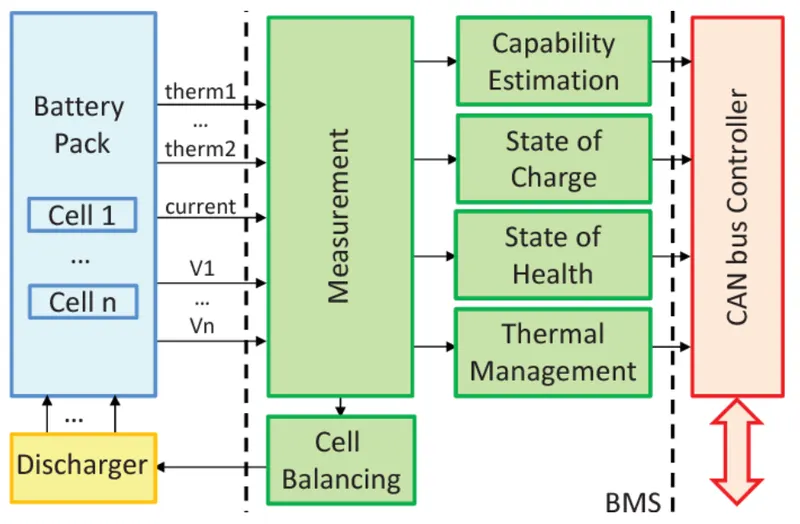
The below flow chart gives the Implementation of BMS for a Battery Pack
The below flow chart gives the information of BMS working in coordination with the battery pack. The inputs to the BMS from the battery pack will be mainly the Current , Voltage and Temperatures. And based on the inputs obatined from the battery pack the BMS will be giving the otputs as SOC, SOH,Themal Management and Capability of total battery pack.
All the BMS outputs are given to CAN bus controller to communicate with the Dash board of the vehicle or to the user and also with the charger and others.
Here cell balancing is also implemented to make sure the maximum batttery pack is fully utilized to its full charging and discharging capacity.
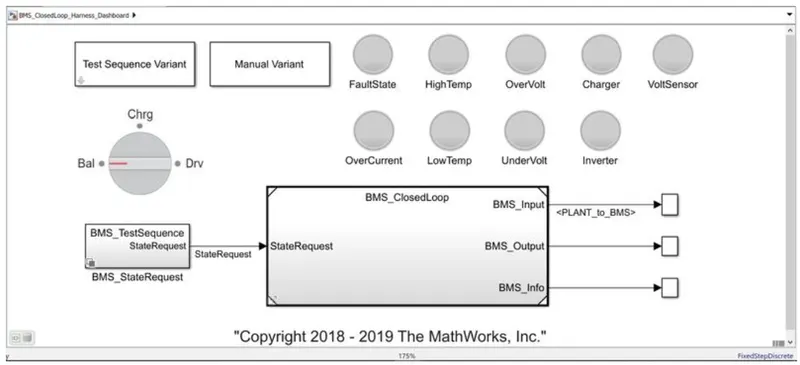
This is how the BMS is implemented in the MATLAB along with the battery pack
This is how BMS is modelled inside from the susbsytem of BMS ECU
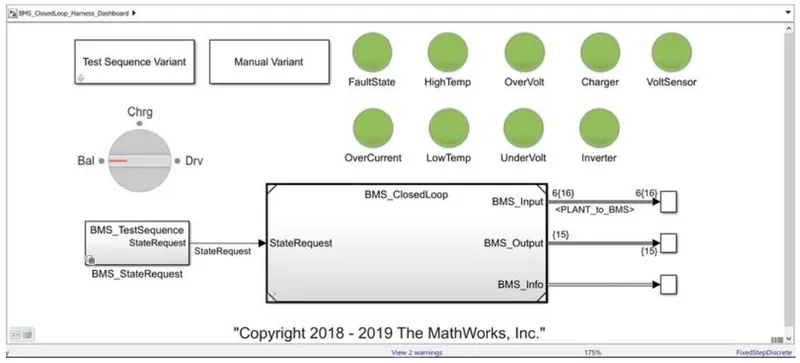
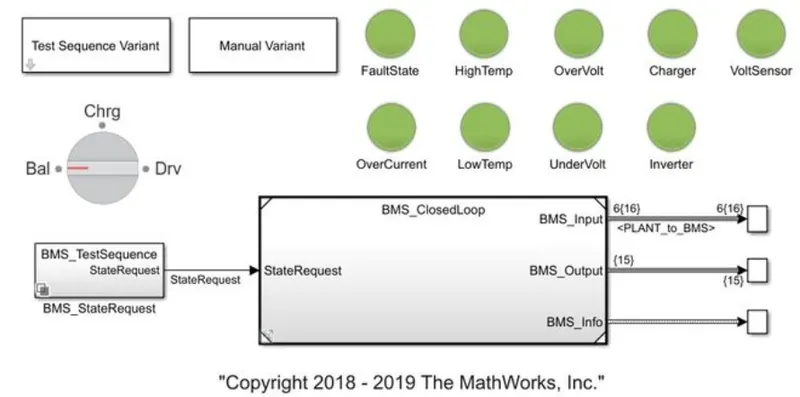
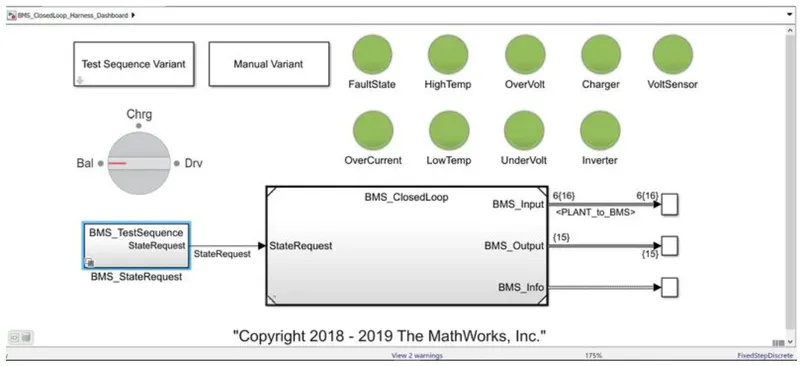
From the above MATLAB model we are Simulating 3 test cases from harness dashboard to find out the fault condition in BMS. And the below image shows the dash board where we can get the information related to the faults like over voltage, under voltage,high temperatue, over current and inverter related faults. If there is any fault condition the indicators will turn to red colour otherwise it shows the green indication means there is no fault and the system is safe.
we can also know the information like the battery pack is in which condition at present moment like the mode of operation called Balancing mode, Charging mode and Discharging mode .
From the Test Sequence Variant we can implement the three Test conditions.
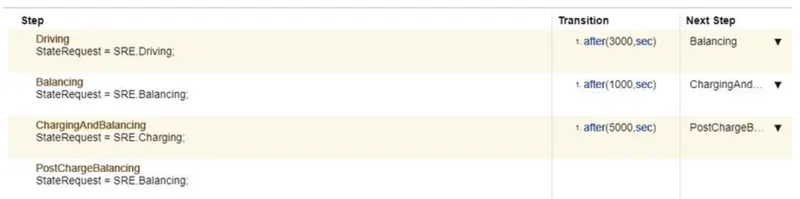
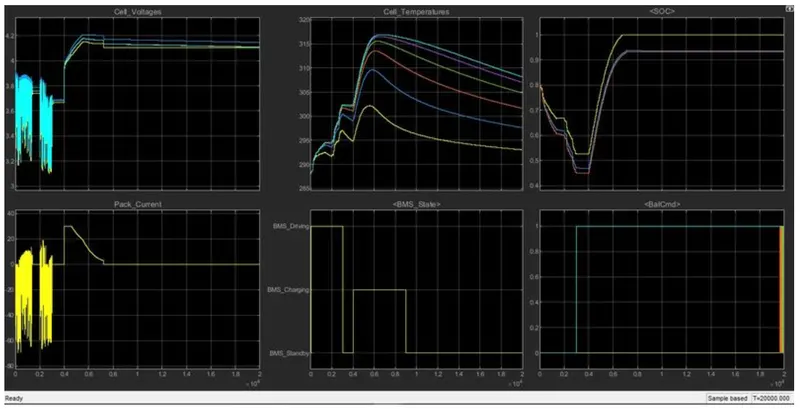
Test case 1: Discharging,Charging and Balancing / At BMS Level Test Condition For Both Driving & Charging
From the results of Cell Voltages and Pack Current
we can observe the constant current (CC) and constant voltage (CV) characteristics of a battery pack. Initially the cell voltage is around 3.8V and the cell current is zero when the battery is fully discharged.
At time instant of 0.4sec the cell voltage is gradually increased from 3.8 to 4.2V at this same instant of time the peak current of cell increased from 0 to 30A and it is constant till 0.5sec this phase of cell is called a CC Mode and then it gradually reduces to zero at 0.7sec
At time 0.5sec the cell voltages are increased to 4.2V and then became constant from 0.7sec till the end of simulation time or till is completely charged this phase is called constant voltage CV Mode. usually the CV mode takes longer time period than the CC mode.
Generally cell manufacturers design the CC Mode till the cell reaches 80% of its full capacity and from there the remaining 20% will be considered as CV Mode.
Output Results Comparision of BMS State condition with Cell Voltages, Pack Current, Cell Temperatures, SOC and Cell Balancing
1)Discharging Mode / BMS Driving : At time instant 0 to 0.4 sec
Cell voltages reduced from 4.2V to 3.7V
Pack current reduced to 0
SOC is initially is of 80% and reduced to 30%
Cell temperatures increased from initial 289.15 to 300k and difference in increase is 20k
Cell Balancing is idle in this time period.
2)Charging Mode / BMS Charging : At time instant 0.4 to 0.9sec
Cell voltages are constant from 4.2V this is called CV Mode
Pack current increased from 0 to 30A and reached its full capacity and then after reduces to zero in this CV Mode.
SOC is initially is of 30% at this stage and increased to 100% or 1 to its full capacity.
Cell temperatures increased from initial 300 to 315k and difference in increase is 15k and gradually reduced because the cells are fully charged.
Cell Balancing is operating in this time period to ensure the maximum capacity reached by all the cells while charging in equal mode of operation.
Result of SOC
As we can observe the SOC is estimated using different methods like
1)Coulomb counting : From the result the yellow graph showing this method where the SOC reached to 100% at time 0.7sec
2)UKF Kalman Filter: SOC Estimation from this method is 93%
3)EKF Kalman Filter : SOC Estimation from this method is 93%
Both the Kalman Filter methods are overlapping each other and giving the output result of SOC Estimation same as 93%.
Hence there is no fault observed from the dash board where all the indication is green.
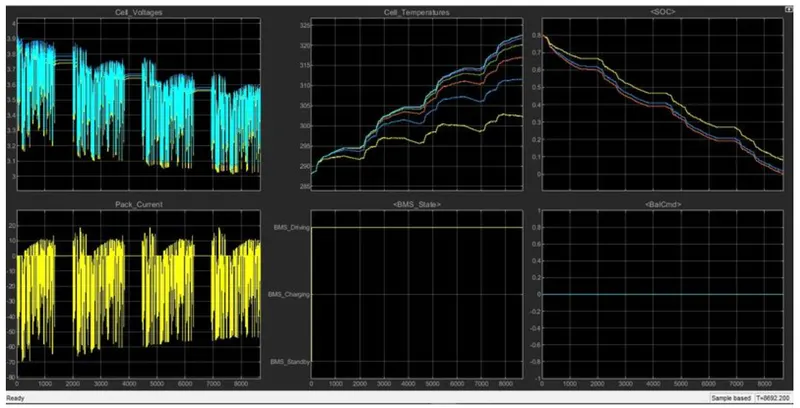
Test case 2: Disharging and No Balancing / At BMS Level Test Condition For Driving
Output Results Comparision of BMS State condition with Cell Voltages, Pack Current, Cell Temperatures, SOC and Cell Balancing
1)Discharging Mode / BMS Driving : At time instant 0 till the end of simulation
Cell voltages reduced from initial 4v
Pack current reduced to 0
SOC is initially is of 80% and reduced to 0%
Cell temperatures increased from initial 289.15 to a maximum recorded as 323k and difference in increase is 33k this increase is different and comparatively less with the maximum recorded as 323k for other output graphs.
Cell Balancing is idle in this time period.
Hence there is no fault observed from the dash board where all the indication is green.
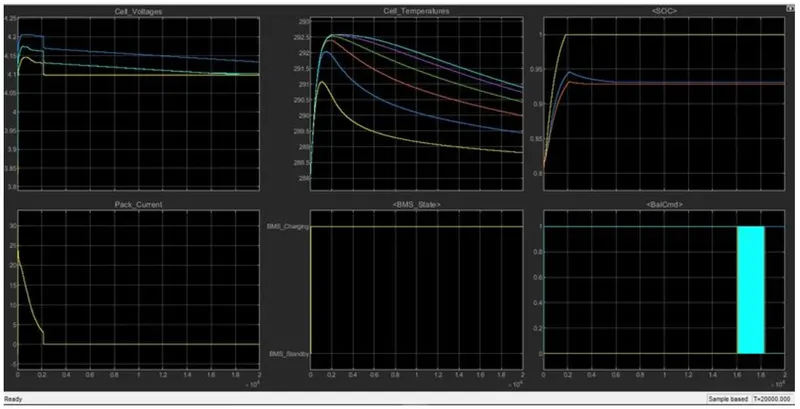
Test case 3: Charging and Balancing / At BMS Level Test Condition For Charging
Output Results Comparision of BMS State condition with Cell Voltages, Pack Current, Cell Temperatures, SOC and Cell Balancing
1)Charging Mode / BMS Charging : At time instant 0 till the end of simulation
Cell Voltages and Pack Current Combine:
we can observe the constant current (CC) and constant voltage (CV) characteristics of a battery pack. From Initially time period of 0 sec the cell current increased to 30A and the cell voltages also gradually reached to 4.2V this phase of operation is called constant current or CC Mode.
At time instant of 0.2sec the cell voltages are gradually becomes constant till the end of the full charging voltage capacity of battery pack and at this time instant the current is gradually reduced to 0. So, this mode of operation is called constant voltage or CV Mode of operation.
Generally cell manufacturers design the CC Mode till the cell reaches 80% of its full capacity and from there the remaining 20% will be considered as CV Mode.
SOC(%)
SOC is initially is of 80% at time instant of 0.2 sec this is increased to 100% or 1 to its full capacity with variation in different SOC Estimation methods.
As we can observe the SOC is estimated using different methods like
1)Coulomb counting : From the result the yellow graph showing this method where the SOC reached to 100% at time 0.2sec
2)UKF Kalman Filter: SOC Estimation from this method is 93%
3)EKF Kalman Filter : SOC Estimation from this method is 93%
Both the Kalman Filter methods are overlapping each other and giving the output result of SOC Estimation same as 93%.
Cell Temperatures:
Cell temperatures increased from initial 288 to a maximum recoded as 292.5 with difference in temperature rise is recorded with other cell teperature ectimation graphs.
Cell Balancing is operating in this time period to ensure the maximum capacity reached by all the cells while charging in equal mode of operation and at time period of 1.8 sec the cell balancing is cutoff.
CONCLUSION:
As per the objectives the BMS Model is tested with 3 cases and the results are analysed in detail and also the coulomb counting is implemented and designed using MATLAB blocks which is used to estimate the SOC.
Objective 2:.What is coulomb counting? Refer to the above model and explain how BMS implements coulomb counting for SOC estimation ?
Hint :(Download the file from the link and go to SOC estimation model-ECU block)
Solution:
Coulomb Counting Method. The Coulomb counting method measures the discharging current of a battery and integrates the discharging current over time in order to estimate SOC. Coulomb counting method is done to estimate the , which is estimated from the discharging current, , and previously estimated SOC values.
The State of Charge Estimating Methods for Battery
The SOC is one of the most important parameters for batteries, but its definition presents many different issues [5]. In general, the SOC of a battery is defined as the ratio of its current capacity () to the nominal capacity (). The nominal capacity is given by the manufacturer and represents the maximum amount of charge that can be stored in the battery. The SOC can be defined as follows:
`SOC(𝑡) = 𝑄 (𝑡) / 𝑄𝑛 .`
The various mathematical methods of estimation are classified according to methodology. The classification of these SOC estimation methods is different in the various literatures. However, some literatures [5, 7] allow a division into the following four categories.(i)Direct measurement: this method uses physical battery properties, such as the voltage and impedance of the battery.(ii)Book-keeping estimation: this method uses discharging current as the input and integrates the discharging current over time to calculate the SOC.(iii)Adaptive systems: the adaptive systems are self-designing and can automatically adjust the SOC for different discharging conditions. Various new adaptive systems for SOC estimation have been developed.(iv)Hybrid methods: the hybrid models benefit from the advantages of each SOC estimation method and allow a globally optimal estimation performance. The literature shows that the hybrid methods generally produce good estimation of SOC, compared to individual methods.
2. Overview of SOC Estimating Mathematical Methods
2.1. Direct Measurement
Direct measurement methods refer to some physical battery properties such as the terminal voltage and impedance. Many different direct methods have been employed: open circuit voltage method, terminal voltage method, impedance measurement method, and impedance spectroscopy method.
2.1.1. Open Circuit Voltage Method
There is approximately a linear relationship between the SOC of the lead-acid battery and its open circuit voltage (OCV) given by
`𝑉OC (𝑡) = 𝑎1 × SOC (𝑡) + 𝑎0,`
where is the SOC of the battery at , is the battery terminal voltage when SOC = 0%, and is obtained from knowing the value of and at SOC = 100%. By the estimation of the SOC is equivalent to the estimation of its OCV . The OCV method based on the OCV of batteries is proportional to the SOC when they are disconnected from the loads for a period longer than two hours. However, such a long disconnection time may be too long to be implemented for battery.
Unlike the lead-acid battery, the Li-ion battery does not have a linear relationship between the OCV and SOC A typical relationship of Li-ion battery between SOC and OCV is shown in Figure 1 The OCV relationship with SOC was determined from applying a pulse load on the Li-ion battery, then allowing the battery to reach equilibrium.
The relationship between the OCV and SOC cannot be exactly the same for all batteries. Because the conventional OCV-SOC differs among batteries, there is a problem in that the relationship of the OCV-SOC should be measured to estimate accurately the SOC. proposed a modified OCV-SOC relationship based on the conventional OCV-SOC. The SOC and the capacity of a lithium-ion battery are estimated using the dual extended Kalman filter with the proposed method.
2.1.2. Terminal Voltage Method
The terminal voltage method is based on the terminal voltage drops because of the internal impedances when the battery is discharging, so the electromotive force (EMF) of battery is proportional to the terminal voltage. Since the EMF of battery is approximately linear proportional to the SOC, the terminal voltage of battery is also approximately linear proportional to the SOC. The terminal voltage method has been employed at different discharge currents and temperatures. But at the end of battery discharge, the estimated error of terminal voltage method is large, because the terminal voltage of battery suddenly drops at the end of discharge.
3. Book-Keeping Estimation.
Book-keeping estimation method uses battery discharging current data as input. This method permits to include some internal battery effects as self-discharge, capacity-loss, and discharging efficiency.Two kinds of book-keeping estimation methods have been employed: Coulomb counting method and modified Coulomb counting method.
3.2.1. Coulomb Counting Method
The Coulomb counting method measures the discharging current of a battery and integrates the discharging current over time in order to estimate SOC [20]. Coulomb counting method is done to estimate the , which is estimated from the discharging current, , and previously estimated SOC values, . SOC is calculated by the following equation:
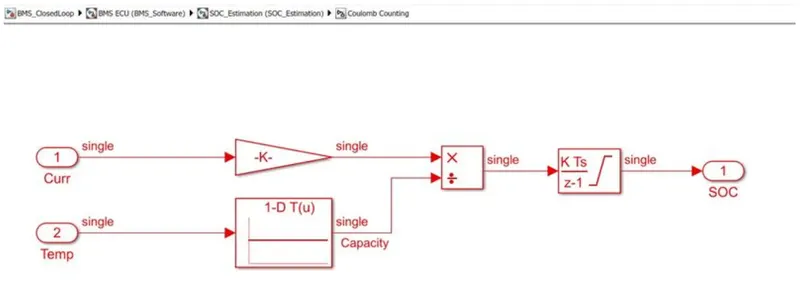
`SOC (𝑡) = SOC (𝑡−1) + 𝐼 (𝑡) / 𝑄𝑛 * Δ𝑡.`
But there are several factors that affect the accuracy of Coulomb counting method including temperature, battery history, discharge current, and cycle life [20].
3.2.2. Modified Coulomb Counting Method
To improve the Coulomb counting method, a new technique called modified Coulomb counting method is proposed. The modified Coulomb counting method uses the corrected current to improve the accuracy of estimation.
The corrected current is the function of discharging current. There is a quadratic relationship between the corrected current and discharging current of battery. By practice of experimental data, corrected current is calculated by the following form:
`𝐼𝑐 (𝑡) = 𝑘2𝐼(𝑡) 2 + 𝑘1𝐼 (𝑡) + 𝑘0`
where , and are constant values obtained from the practice experimental data.
In modified Coulomb counting method, SOC is calculated by the following equation:
`SOC(𝑡) = SOC(𝑡−1) + 𝐼𝑐 (𝑡) / 𝑄𝑛 * Δ𝑡.`
The experimental results show that the accuracy of the modified Coulomb counting method is superior to the conventional Coulomb counting method.
Fuzzy Logic Method
Fuzzy logic method provides a powerful means of modeling nonlinear and complex systems. In a practical method of estimating SOC of battery system has been developed and tested for several systems. The method involves the use of fuzzy logic models to analyze data obtained by impedance spectroscopy and/or Coulomb counting methods.In a fuzzy logic-based SOC estimation method has been developed for lithium-ion batteries for potential use in portable defibrillators. The ac impedance and voltage recovery measurements have been made which are used as the input parameters for the fuzzy logic model.
Presented an estimation system which can select features in data base to develop fuzzy logic models for both available capacity and SOC estimation, simply by measuring the impedance at three frequencies. In the SOC is estimated by an improved Coulomb metric method, and the time-dependent variation is compensated by using a learning system. The learning system tunes the Coulomb metric method in such a way that the estimation process remains error free from the time-dependent variation. The proposed learning system uses the fuzzy logic models, which is not used for estimation of SOC but performs as a component of learning system.
Kalman Filter
Using real-time measurement road data to estimate the SOC of battery would normally be difficult or expensive to measure. In application of the Kalman filter method is shown to provide verifiable estimations of SOC for the battery via the real-time state estimation.
Presented a Kalman filter based SOC estimation method for lithium-ion batteries. Experimental results validate the effectiveness of Kalman filter during the online application. Presented an extended Kalman filter (EKF) to estimate the concentrations of the main chemical species which are averaged on the thickness of the active material in order to obtain the SOC of the battery, by using the terminal current and voltage measurements.
Based on unscented Kalman filter (UKF) theory and a comprehensive battery model, a novel SOC estimation method is proposed .The results show that UKF method is superior to extended Kalman filter method in SOC estimation for battery.Presented an adaptive UKF method to estimate SOC of a lithium-ion battery for battery electric vehicles. The adaptive adjustment of the noise covariance in the SOC estimation process is implemented by an idea of covariance matching in the UKF context.
3.4. Hybrid Methods
The object of hybrid models is to benefit from the advantages of each method and obtain a globally optimal estimating performance. Since the information contained in the individual estimating method is limited, hybrid method can maximize the available information, integrate individual model information, and make the best use of the advantages of multiple estimating methods thus improving the estimation accuracy. The literatures show that the hybrid methods generally produce good SOC estimating results compared to individual methods. The hybrid methods combine different approaches such as direct measurement method and book-keeping estimation method.
Coulomb Counting and EMF Combination
A new SOC estimation method that combines direct measurement method with the battery EMF measurement during the equilibrium state and book-keeping estimation with Coulomb counting method during the discharge state has been developed and implemented in a real-time estimation system.
Any battery will lose capacity during cycling. In order to calculate SOC and remaining run-time (RRT) accurately and to improve the SOC estimation system capability to cope with the aging effect, a simple Qmax adaptation algorithm is introduced. In this algorithm the stable conditions of the charge state are exploited in order to adapt Qmax with the aging effect.
This paper has proved that the Qmax adaptation algorithm can improve the SOC and RRT estimation accuracy even for a fresh battery. Since a battery loses capacity during cycling, it is concluded that the Qmax adaptation algorithm will increase substantially the SOC and the RRT estimation accuracy.
Coulomb Counting and Kalman Filter Combination
Proposed a new SOC estimation method, denoted as “KalmanAh method,” which uses the Kalman filter method to correct for the initial value used in the Coulomb counting method. In KalmanAh method, the Kalman filter method is used to make the approximate initial value converge to its real value. Then the Coulomb counting method is applied to estimate the SOC for the long working time. The SOC estimation error is 2.5% when compared with the real SOC obtained from a discharge test. This compares favorably with an estimation error of 11.4% when using Coulomb counting method.
Per - Unit System and EKF Combination
Kim and Cho [39] described the application of an EKF combined with a per-unit (PU) system to the identification of suitable battery model parameters for the high accuracy SOC estimation of a lithium-ion degraded battery. To apply the battery model parameters varied by the aging effect, based on the PU system, the absolute values of the parameters in the equivalent circuit model in addition to the terminal voltage and current are converted into dimensionless values relative to a set of base value. The converted values are applied to dynamic and measurement models in the EKF algorithm.
The Future of SOC Estimation
Since the energy storage systems have been highlighted in portable electronics and hybrid electric vehicle applications, the estimate accuracy of SOC becomes increasingly important. In recent years, many scholars have done a lot of research on SOC estimation. The estimate accuracy has improved constantly, and it can be expected that intense research and development efforts are already on track. In order to further improve SOC estimates, combined with some literatures, anticipated improvements for the further research include the following areas.(i)Do further research on the hybrid methods, such as combining direct measurement method and book-keeping estimation method to achieve good results in online SOC estimation.(ii)The existing estimation method should be put into use in various kinds of batteries. Do further research on the practical universal application of the methods.(iii)Deepen further research on improve the SOC estimation system capability to cope with the aging effect of battery.(iv)Study on more novel artificial intelligence methods and improving their training algorithms to achieve the estimate accuracy of SOC. In addition, new methods on complex terrain are the focus of future research.(v)To further improve the estimating performance of the neural network method, the optimal search methods for the optimal number of neurons in hidden layer need to be investigated and integrated in the neural network method.(vi)Do further research on the adaptive parameter estimation. The models have the ability to automatically adapt to various kinds of batteries, various discharging conditions, and the different aged batteries.(vii)Establish the more accurate evaluation system and the standard for measurement of performance of SOC estimation method.