Week 7 State of charge estimation
State of Charge
The state of charge (SOC) of a cell denotes the capacity that is currently available as a function of the rated capacity. The value of the SOC varies between 0% and 100%. If the SOC is 100%, then the cell is said to be fully charged, whereas a SOC of 0% indicates that the cell is completely discharged. In practical applications, the SOC is not allowed to go beyond 50% and therefore the cell is recharged when the SOC reaches 50%. Similarly, as a cell starts aging, the maximum SOC starts decreasing. This means that for an aged cell, a 100% SOC would be equivalent to a 75%–80% SOC of a new cell.
What is coulomb counting?
Coulomb counting is a technique used to track the State of Charge of a battery pack. It works by integrating the active flowing current (measured in amps) over time to derive the total sum of energy entering or leaving the battery pack. This produces a capacity that is typically measured in Amp-hours.
To determine available capacity, coulomb counting relies on the integration of the current drawn from and supplied to a battery over time, 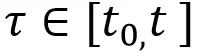 as given by

where I is the current and η is the efficiency during charge and discharge operations. Coulomb counting is advantageous in terms of a simple structure and its ease of implementation. However, some problems make it difficult to accurately estimate battery SOC by coulomb counting. Because battery capacity and efficiency are significantly influenced by operating temperature and current direction, these factors should be considered to correct for battery SOC. Sensor accuracy is also important because accumulated errors can lead to a drift in the estimated battery SOC. Furthermore, one of the main problems in coulomb counting is that it is necessary to calibrate the initial battery SOC. In several applications, the initialization involves rest and the initial SOC is estimated based on the voltage inversion method described next.
How BMS implements coulomb counting for SOC estimation?
Algorithm
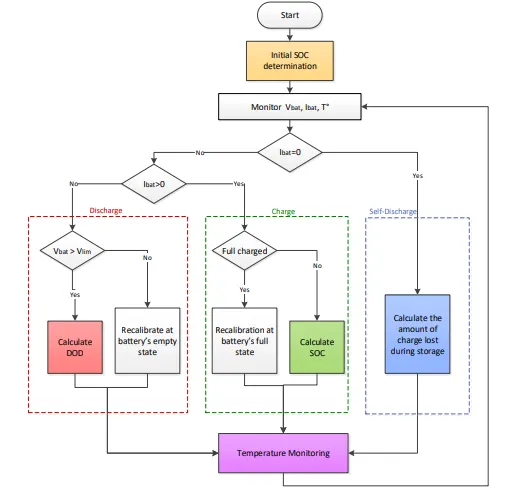
The adopted Coulomb-counting algorithm for SOC estimation was implemented on a hardware platform. The monitoring functions include the measurement of battery voltage and the current flowing through it by the 10 bits Analog to Digital Converter.
The battery parameters detection is one of the most important issues in the control and management of a BMS. It includes cell voltage measurement and current detection. Estimation of SOC and other battery states imposes high requirements on cell voltage precision. The diagram presented in Fig below shows the connection of the different modules to the data acquisition system.
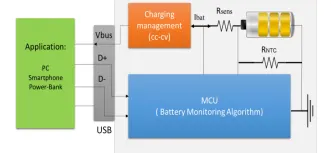
In order to measure the voltage and the current with which the battery is charged or discharged, a sensing resistor Rsens is placed in series with the battery. The battery voltage Vbat is obtained by measuring the voltage across it. The difference between the voltages at the two terminals of the resistor will derive the current value bat I through the sensing resistance. This resistance, which allows the current sensing in the battery gauge, should not be too high in order to avoid power dissipation during the charging at a constant current of 1C-rate, but it should still be enough so that the analog/digital converter in the microcontroller can detect a voltage variation across it, which corresponds eventually to a 10 mA current, in order to detect the end of charging. In our case, a 10-bit converter is used to detect a voltage variation of 1mV. A 0.1 Ohms resistance can detect a current of 10 mA (for U = 1mV) and does not dissipate too much power while charging the maximum current value (P=100mW). The transmission of the battery's electrical parameters is ensured by a USB connection between the multimedia application and the microcontroller. The ambient temperature is measured using a negative temperature coefficient resistor RNTC. This thermistor is biased by the IO of the MCU and connected close to the battery.
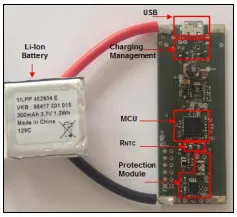
To validate the developed algorithm, some tests were achieved using a test card developed in the company IntelliBatteries. It consists of five main parts which are shown in Fig.10:
> The charging management ensuring cv-cc procedure.
> The MCU contains the programmable card PIC18F.
> The NTC resistor that indicates the external ambient temperature
> The protection module protects the battery against overload, voltage drops, and power surges.
> The USB connection ensures both the charging process and the data transmission from the multimedia application to the MCU.
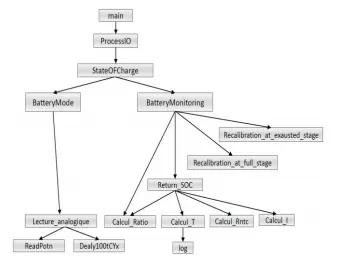
The monitoring algorithm is then implemented with embedded C language on the MCU.
The callgraph of implementation of the Coulomb-counting Method is given below.
An improved Coulomb-counting method for the SOC estimation for Li-ion batteries has been presented. This algorithm has allowed the system to operate in safe conditions by respecting the secure operating area of the Li-ion batteries in charge and discharge modes. In order
to enhance the SOC estimation accuracy, we have proposed a SOC-OCV model as a piecewise linear relationship composed of eight segments. This contribution has allowed overcoming the disadvantage of the uncertainty of the initial SOC value. Also, a recalibration at both full and empty states of the battery has been carried out, based on updating the amount of the releasable capacity. The recalibration has contributed to decreasing cumulative errors caused by the inaccuracy of sensors. These improvements added to the Coulomb-counting algorithm have enhanced the SOC estimation accuracy. Moreover, we have put forward an adaptation procedure of the calculated value of SOC using a weighting coefficient determined respecting various temperature ranges.
CONCLUSION
There are several factors that affect the accuracy of the Coulomb counting method including temperature, battery history, discharge current, and cycle life.
In the above sections, Coulomb counting is explained and its implementation in BMS for SOC estimation is described.