Week 7 State of charge estimation
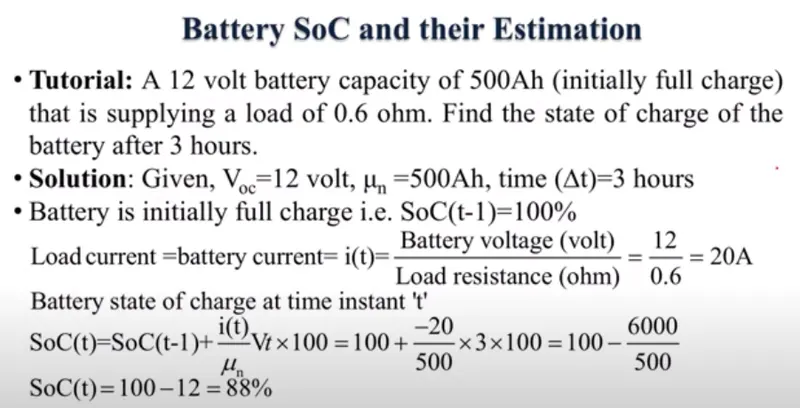
Q) What is coulomb counting? How BMS implements coulomb counting for SOC estimation?
ans -
Rising crude oil prices and worldwide awareness of environmental issues have resulted in increased development of energy storage systems. The battery is one of the most attractive energy storage systems because of its high efficiency and low pollution
. There are several kinds of batteries currently being used in industry: lead-acid battery, Ni-MH battery, Ni-Cd battery, and Li-ion battery. The battery has the advantages of high working cell voltage, low pollution, low self-discharge rate, and high power density. Batteries are used commonly for portable utilities, hybrid electric vehicles, and industrial applications.
SOC estimation is a fundamental challenge for battery use. The SOC of a battery, which is used to describe its remaining capacity, is a very important parameter for a control strategy.
As the SOC is an important parameter, which reflects the battery performance, so accurate estimation of the SOC can not only protect battery, prevent overdischarge, and improve the battery life but also allow the application to make rational control strategies to save energy . However, a battery is a chemical energy storage source, and this chemical energy cannot be directly accessed. This issue makes the estimation of the SOC of a battery difficult
Accurate estimation of the SOC remains very complex and is difficult to implement, because battery models are limited and there are parametric uncertainties . Many examples of poor accuracy and reliability of the estimation of the SOC are found in practice.
review on existing mathematical methods used in SOC estimation and further identifies possible developments in the future.
Definition and Classification of SOC Estimation
The SOC is one of the most important parameters for batteries, but its definition presents many different issues . In general, the SOC of a battery is defined as the ratio of its current capacity () to the nominal capacity (). The nominal capacity is given by the manufacturer and represents the maximum amount of charge that can be stored in the battery. The SOC can be defined as follows:
The various mathematical methods of estimation are classified according to methodology. The classification of these SOC estimation methods is different in the various literatures. However, some literatures allow a division into the following four categories.
(i)Direct measurement: this method uses physical battery properties, such as the voltage and impedance of the battery.
(ii)Book-keeping estimation: this method uses discharging current as the input and integrates the discharging current over time to calculate the SOC.
(iii)Adaptive systems: the adaptive systems are self-designing and can automatically adjust the SOC for different discharging conditions. Various new adaptive systems for SOC estimation have been developed.
(iv)Hybrid methods: the hybrid models benefit from the advantages of each SOC estimation method and allow a globally optimal estimation performance. The literature shows that the hybrid methods generally produce good estimation of SOC, compared to individual methods.
Table 1 presents the specific SOC estimation methods in view of the methodology. The applications of specific SOC estimation methods in battery management system (BMS) are consequentially different.
The State of Charge Estimating Methods for Battery: A Review
|
||||||||||||||||||||||||||||||
Overview of SOC Estimating Mathematical Methods
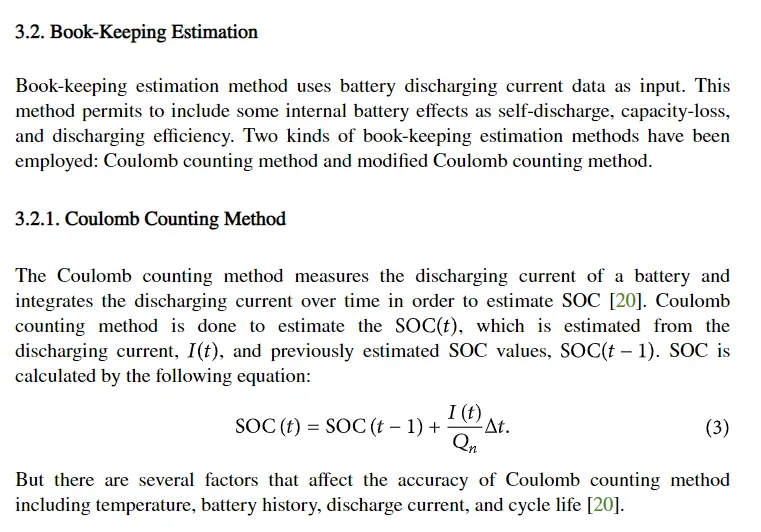
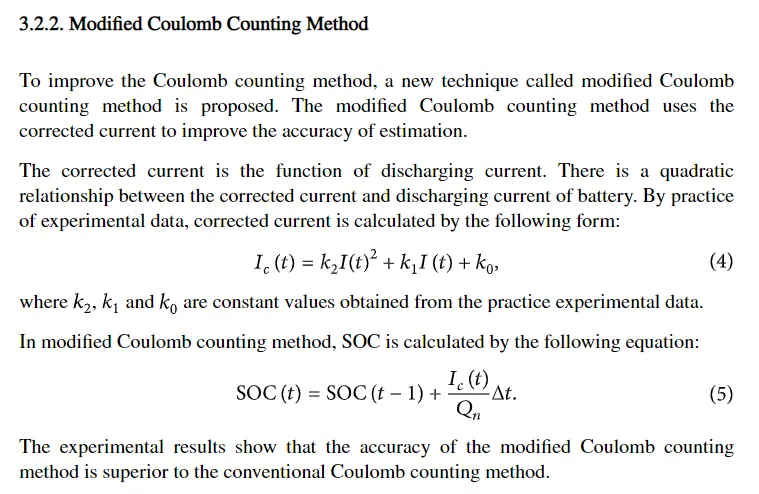
we will see Hybrid Methods
The object of hybrid models is to benefit from the advantages of each method and obtain a globally optimal estimating performance. Since the information contained in the individual estimating method is limited, hybrid method can maximize the available information, integrate individual model information, and make the best use of the advantages of multiple estimating methods thus improving the estimation accuracy.
The literatures show that the hybrid methods generally produce good SOC estimating results compared to individual methods . The hybrid methods combine different approaches such as direct measurement method and book-keeping estimation method.
Coulomb Counting and EMF Combination
A new SOC estimation method that combines direct measurement method with the battery EMF measurement during the equilibrium state and book-keeping estimation with Coulomb counting method during the discharge state has been developed and implemented in a real-time estimation system .
Any battery will lose capacity during cycling. In order to calculate SOC and remaining run-time (RRT) accurately and to improve the SOC estimation system capability to cope with the aging effect, a simple Qmax adaptation algorithm is introduced. In this algorithm the stable conditions of the charge state are exploited in order to adapt Qmax with the aging effect.
This paper has proved that the Qmax adaptation algorithm can improve the SOC and RRT estimation accuracy even for a fresh battery. Since a battery loses capacity during cycling, it is concluded that the Qmax adaptation algorithm will increase substantially the SOC and the RRT estimation accuracy.
Coulomb Counting and Kalman Filter Combination
Wang et al. proposed a new SOC estimation method, denoted as “KalmanAh method,” which uses the Kalman filter method to correct for the initial value used in the Coulomb counting method. In KalmanAh method, the Kalman filter method is used to make the approximate initial value converge to its real value. Then the Coulomb counting method is applied to estimate the SOC for the long working time. The SOC estimation error is 2.5% when compared with the real SOC obtained from a discharge test. This compares favorably with an estimation error of 11.4% when using Coulomb counting method.
Per-Unit System and EKF Combination
Kim and Cho [39] described the application of an EKF combined with a per-unit (PU) system to the identification of suitable battery model parameters for the high accuracy SOC estimation of a lithium-ion degraded battery. To apply the battery model parameters varied by the aging effect, based on the PU system, the absolute values of the parameters in the equivalent circuit model in addition to the terminal voltage and current are converted into dimensionless values relative to a set of base value. The converted values are applied to dynamic and measurement models in the EKF algorithm.
The Future of SOC Estimation
Since the energy storage systems have been highlighted in portable electronics and hybrid electric vehicle applications, the estimate accuracy of SOC becomes increasingly important. In recent years, many scholars have done a lot of research on SOC estimation. The estimate accuracy has improved constantly, and it can be expected that intense research and development efforts are already on track. In order to further improve SOC estimates, combined with some literatures, anticipated improvements for the further research include the following areas.(i)Do further research on the hybrid methods, such as combining direct measurement method and book-keeping estimation method to achieve good results in online SOC estimation.(ii)The existing estimation method should be put into use in various kinds of batteries. Do further research on the practical universal application of the methods.(iii)Deepen further research on improve the SOC estimation system capability to cope with the aging effect of battery.(iv)Study on more novel artificial intelligence methods and improving their training algorithms to achieve the estimate accuracy of SOC. In addition, new methods on complex terrain are the focus of future research.(v)To further improve the estimating performance of the neural network method, the optimal search methods for the optimal number of neurons in hidden layer need to be investigated and integrated in the neural network method.(vi)Do further research on the adaptive parameter estimation. The models have the ability to automatically adapt to various kinds of batteries, various discharging conditions, and the different aged batteries.(vii)Establish the more accurate evaluation system and the standard for measurement of performance of SOC estimation method.
for more info visit
https://www.hindawi.com/journals/isrn/2013/953792/
.......................................................................................................................................
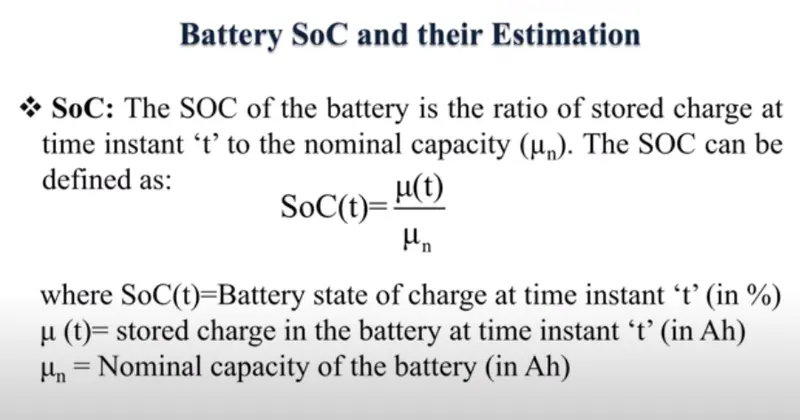
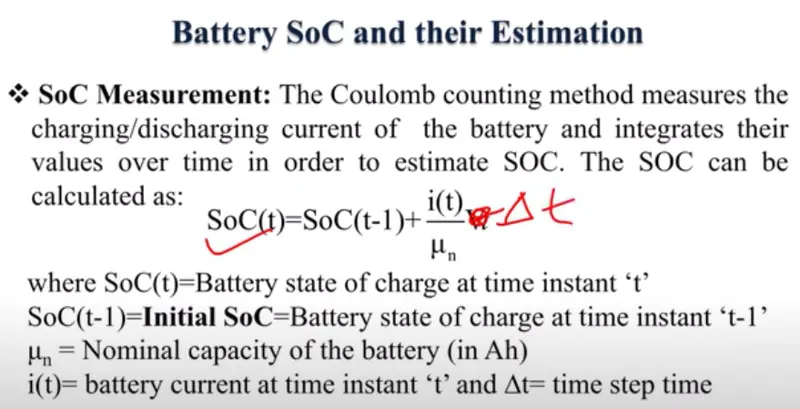
youtube.com/watch?v=svElMZ-7uqM&ab_channel=Dr.RajeevKumarChauhan
https://www.youtube.com/watch?v=rOwcxFErcvQ&ab_channel=StaflSystems
BMS implements coulomb counting for SOC estimation?
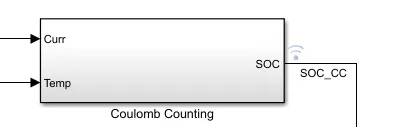
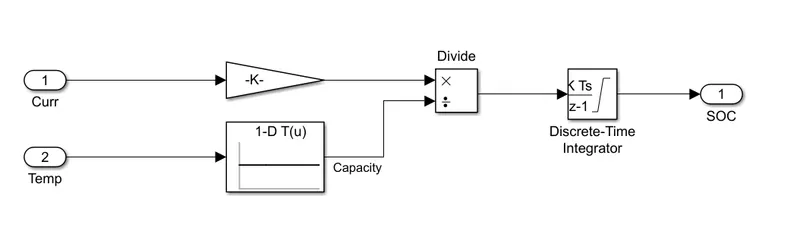
inside of a Simulink model of battery management system. In this model SOC is estimated with different methods — Kalman filter and coulomb counting. Coulomb counting method is taking pack current values and making it current consumption per hour (gain) and divided by capacity values, which is given by a look up table to show variation of capacity with temperature. Further values are integrated to estimate charge.
 https://www.youtube.com/watch?v=rOwcxFErcvQ&ab_channel=StaflSystems
we see what is columb counting method and also various methods that is used to check soc we look in matlab simulink project how it is implemented (columb counting).