Week 7 State of charge estimation
AIM : Simulate the 3 test cases from harness dashboard and write a detailed report on the results
the below figure is of harness dashbord of LITHIUM ION BATTERY MANAGEMENT SYSTEM.
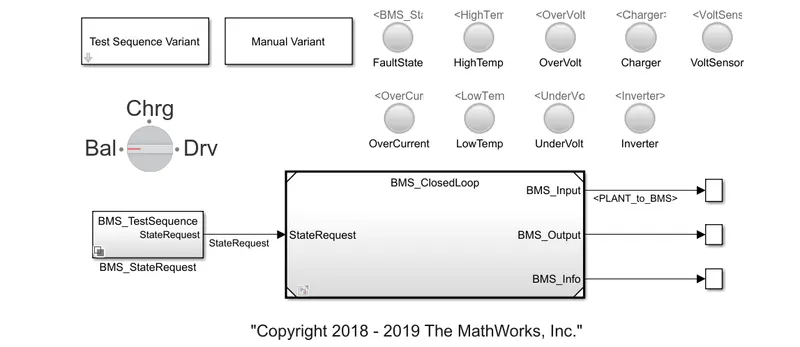
CASE 1
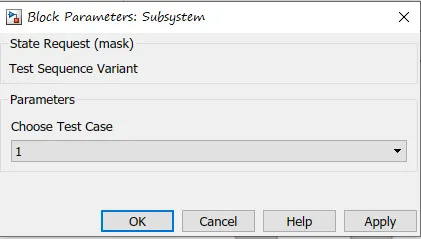
here we are selecting 1st in the test sequence variatant and running .
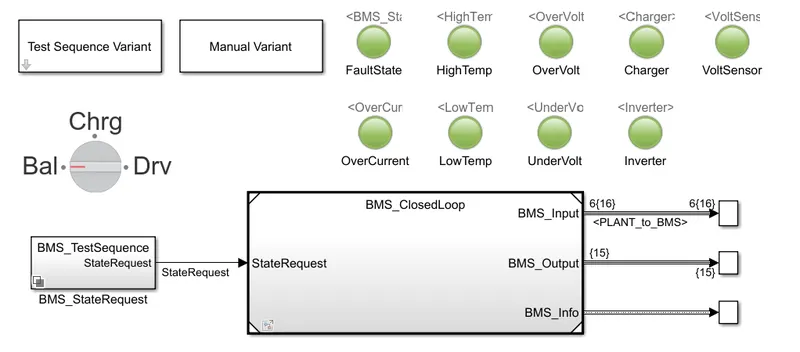
here the model is run for 20000sec with no errors found in battery. and the light are turned green.
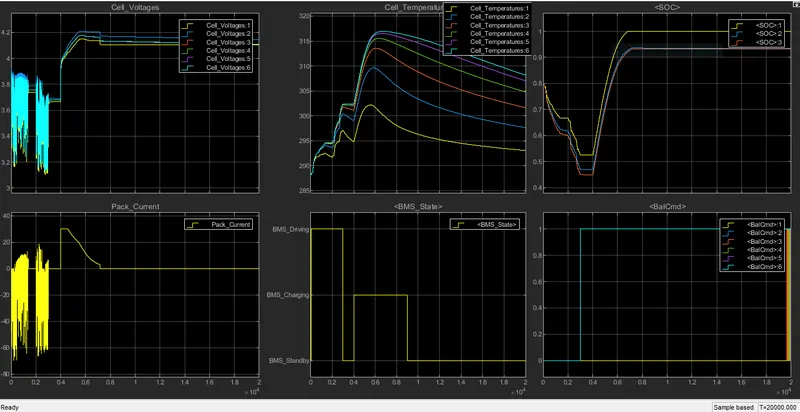
in cell voltage block the curent is around 3.9v which for 0 to 0.4 timing this is while BMS driving condition but whene the charging is happining after 0.4 the voltage is increasing this is because the charging is done at higher voltage then the voltage it is suppling while running.
in BMS block while constant driving is done for 0 to 0.4 the cell temperature is increasing different battery are showing different due to the arrsangementthe lowest temp and the highest temp should not have be same every because thecell with higher temp will affect with its capicity this shound be avoided.as the BMS is in standby mode the temperature is dropping due to no work load on the battery.
the state of charge SOC oft the battery is decreasing while 0 to 0.4 this is due to vehical driving if the vehical will be in driving the SOC will be decrease and while the soc is increasing after 0.4 due to charging of the battery and rema constant at the standby mode.
we can see the fluctuation in current is going in negative direction this shows that there is regeneration is happning at the negative part.and while the vehical is charging rthe current remain constant.
BMS block shows the first the vehical is running in charging mode till 0.4 then till 0.9 it is at charging mode and then it is stand by mode.
we cAN see the graph for balancing for different cells.
CASE 2
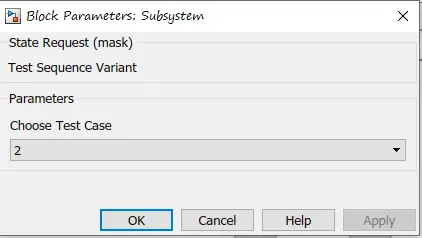
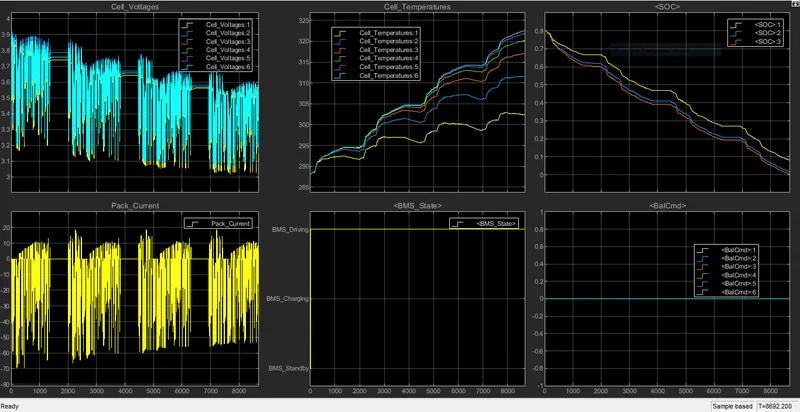
here we can see that the voltage is continiously dropping with the fluctuation . temperature is increasing continoously current is also showing continious fluctuation and isa in negative also why this the BMS state is also in driving mode and constant balaning this is due to continious running of the vehichal.
this is because the SOC was continiously dropping due to continiously driving and at a point of around 8800 sec and dint run further, the SOC becomes 0% and if SOC gets 0% the vehical does not get time to change the mode in charging so now the vehical is at standby mode.
CASE 3
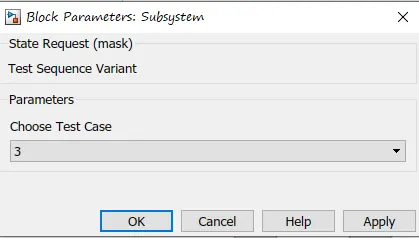
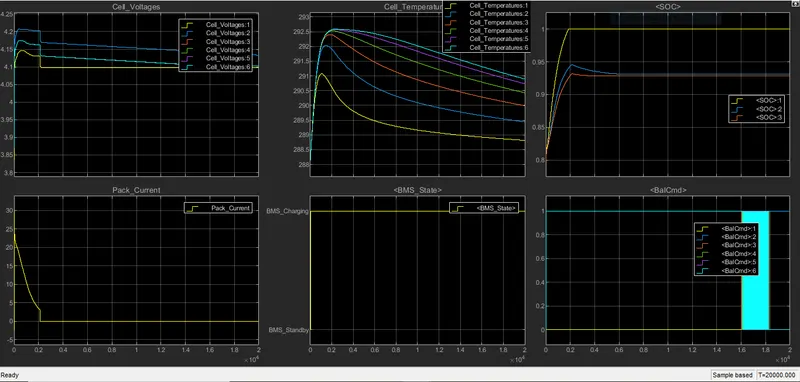
as the vehical is only charging there is not much fluctuation involtage due o which current is also getting 0 and not in negative becaue there is not region braking.
now in SOC the increasing which is charging and at a point the soc becomes 100% which is unlikely means the soc is calculated with column counting method which is most inaccurate one.
while other are calculated using extended kalman filter EKF and Unscented Kalman filter UKF .
the temperature is seems to be moderated because in previous graph we saw temp to be reached around 310.
while the vehical is charging the balancing is done at 1.6 to 1.8 of the battery.
2.What is coulomb counting?
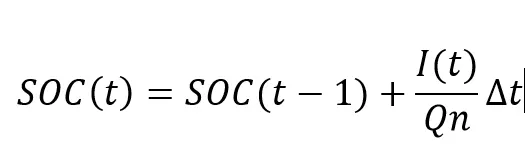
Coulomb counting is a technique used to track the State of Charge of a battery pack. It works by integrating the active flowing current (measured in amps) over time to derive the total sum of energy entering or leaving the battery pack. This produces a capacity that is typically measured in Amp-hours.
the below equation shows the calculation of SOC..
The modified method of coulomb counting is

Where, K are the constant value.

the BATTERY MANAGEMENT SYSTEM IS
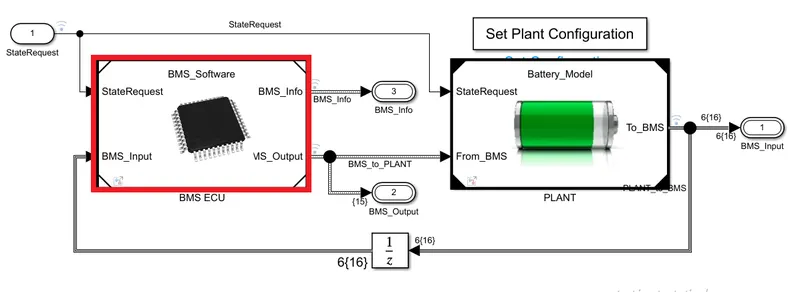
in the above figure BMS ECU is responsible for calculating of SOC .
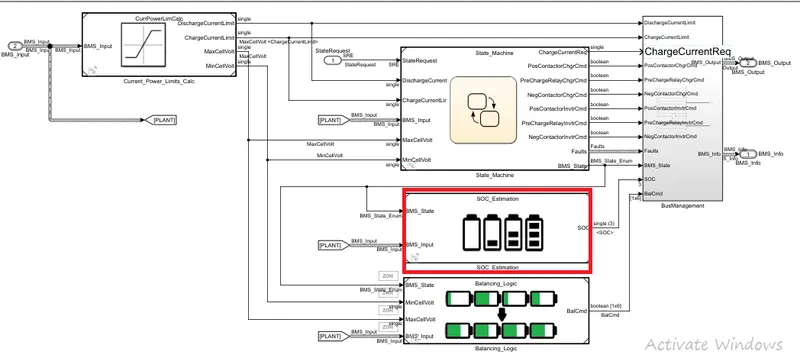
inside BMS bloce we we can see SOC block.
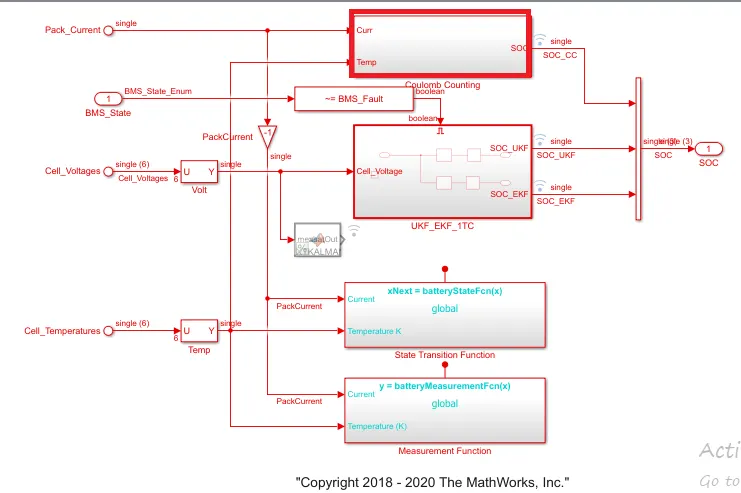
inside the SOC block there is colomb counting block.
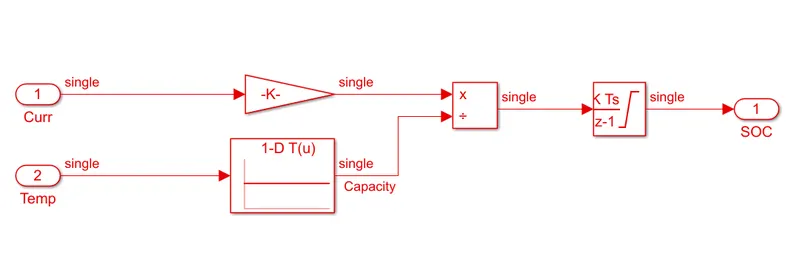
here two inputs are take as current and temperature signal, current is given to gain block and temp is to look up table further current is divided and given to
Discrete-time integration or accumulation block which gives SOC.