State Of Charge Estimation
Aim:
Brief about coulomb counting and how BMS implements coulomb counting for SOC estimation.
Theory:
State Of Charge estimation is a key factor for correct and safe battery management, particularly for the development of the Battery Management System (BMS). In general, the SOC of a battery is defined as the ratio of its current capacity to the nominal capacity. The nominal capacity is given by the manufacturer and represents the maximum amount of charge that can be stored in the battery.
`SOC=(Q (t))/ (Q (n))`
The various mathematical methods of estimation are classified according to methodology. The classification of SOC is done into the following four categories. We will also study about the BATTERY-TECHNOLOGY in general. This concept will also be useful for us if we see some examples in MATLAB and HEV.
- Direct measurement:this method uses physical battery properties, such as the voltage and impedance of the battery. Many different direct methods have been employed: open circuit voltage method, terminal voltage method, impedance measurement method, and impedance spectroscopy method.
- Book-keeping estimation:this method uses discharging current as the input and integrates the discharging current over time to calculate the SOC. This method permits to include some internal battery effects as self-discharge, capacity-loss, and discharging efficiency. Two kinds of book-keeping estimation methods have been employed: Coulomb counting methodand modified Coulomb counting method.
- Adaptive systems:the adaptive systems are self-designing and can automatically adjust the SOC for different discharging conditions. Various new adaptive systems for SOC estimation have been developed.
- Hybrid methods:the hybrid models benefit from the advantages of each SOC estimation method and allow a globally optimal estimation performance. The literature shows that the hybrid methods generally produce good estimation of SOC, compared to individual methods.
Model:
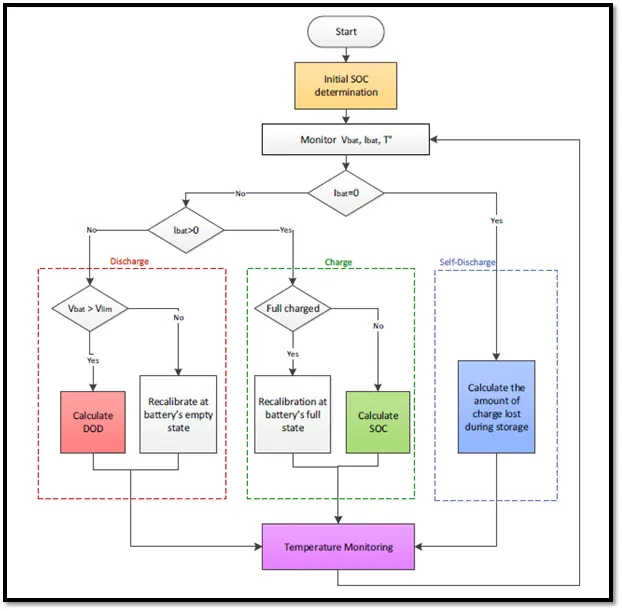
Coulomb Counting Method:
The Coulomb counting method measures the discharging current of a battery and integrates the current over time in order to estimate SOC. Coulomb counting method is done to estimate the SOC(t) , which is estimated from the discharging current, I(t) , and previously estimated SOC values, SOC(t-1) . SOC is calculated by the following equation:
`SOC(t)=SOC(t−1)+I(t)Q(n)*ΔT`
But there are several factors that affect the accuracy of Coulomb counting method including temperature, battery history, discharge current, and cycle life.
Modified Coulomb Counting Method:
To improve the Coulomb counting method, a new technique called modified Coulomb counting method is proposed. The modified Coulomb counting method uses the corrected current to improve the accuracy of estimation.
The corrected current is the function of discharging current. There is a quadratic relationship between the corrected current and discharging current of battery. By practice of experimental data, corrected current is calculated by the following form:
`I_c(t)=k2*I(t)2+k1*I(t)+k0`
where ,
`k2`, `k1` and `k0` are constant values obtained from the practice experimental data.
In modified Coulomb counting method, SOC is calculated by the following equation:
`SOC(t)=SOC(t−1)+I_c(t)*Q(n)*ΔT`
The accuracy of the modified Coulomb counting method is superior to the conventional Coulomb counting method.
Initial SOC determination: - Several studies have been conducted to remedy to the problem of accurate estimation of the initial SOC. The most common technique is to use a bijective OCV-SOC function that relates the open circuit voltage to its corresponding SOC value. This curve is actually determined experimentally by the OCV test by applying a pulse load on the Li-ion battery, then the battery reach an equilibrium where the voltage is extracted in every 5% of Depth Of Discharge (DOD)
Charge Mode:-
The typical charge procedure of a Li-ion battery consists of constant-current constant voltage (CC-CV) process,
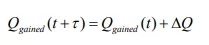
Thus, the variation of the state of charge gained in this same operating period is
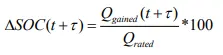
By accumulating the previous state of charge indication and the obtained one, we can have the instantaneous value of SOC,

the value of DOD is updated in every charging operation in order to get it back in every switching to discharging mode,

Discharge Mode:-
When the current bat I is negative, then the battery is in the discharging mode. In this mode, the Coulomb counter is presented by `Q_(lost)` , which represents the amount of charges losses in the operating period `T`,
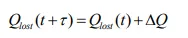
The value of DOD is calculated according to,

Self-Discharge Mode:-
At the battery storage periods, considering that Li-ion batteries reach 5% rate of self-discharge per month, the amount of charge losses per hour is calculated; this amount is designed by the constant, `Q/H`. Then, the quantity of charge dissipated in this phase `Q_(oc)` is calculated, representing the cumulative losses during the storage hours.
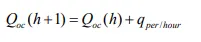
where,
h is the hour of storage.
Implementation in BMS:-
The adopted coulomb counting algorithm for SOC estimation was implemented on hardware platform. Monitoring functions include the measurement of the battery voltage
Battery parameters detection is one of the most important issues in control and management of a battery management system. It includes cell voltage measurement, current detection and temperature detection. Estimation of SOC and other battery states imposes high requirements on cell voltage precision. In order to measure the voltage and the current with which the battery is charged or discharged, a resistor is placed in series with the battery. The voltage value is obtained by a measure of the voltage across the battery, and a difference between the voltages at the two terminals of the resistor will derive the current value, knowing the value of the resistance.
This resistance, which allows the current sensing in the battery gauge, should not be too high in order to avoid power dissipation during the charging at a constant current of 1A, but it should be still enough so that the analog/digital converter in the microcontroller can detect a voltage variation across it, which corresponds eventually to a 10 mA current, in order to detect the end of charging. In our case, a 10-bit converter is used to detect a voltage variation of 1mV. A 0.1 Ohms resistance would detect a current of 10mA (U = 1mV) and does not dissipate too much power while charging the maximum current value (P = 100mW).
The Future of SOC Estimation
Since the energy storage systems have been highlighted in portable electronics and hybrid electric vehicle applications, the estimate accuracy of SOC becomes increasingly important. In recent years, many scholars have done a lot of research on SOC estimation. The estimate accuracy has improved constantly, and it can be expected that intense research and development efforts are already on track. In order to further improve SOC estimates, combined with some literatures, anticipated improvements for the further research include the following areas.
(i) Do further research on the hybrid methods, such as combining direct measurement method and book-keeping estimation method to achieve good results in online SOC estimation.
(ii) The existing estimation method should be put into use in various kinds of batteries. Do further research on the practical universal application of the methods.
(iii)Deepen further research on improve the SOC estimation system capability to cope with the aging effect of battery.
(iv) Study on more novel artificial intelligence methods and improving their training algorithms to achieve the estimate accuracy of SOC. In addition, new methods on complex terrain are the focus of future research.
(v) To further improve the estimating performance of the neural network method, the optimal search methods for the optimal number of neurons in hidden layer need to be investigated and integrated in the neural network method.
(vi) Do further research on the adaptive parameter estimation. The models have the ability to automatically adapt to various kinds of batteries, various discharging conditions, and the different aged batteries.
(vii) Establish the more accurate evaluation system and the standard for measurement of performance of SOC estimation method.
Conclusion:
This paper presented a review on estimating of battery SOC under different discharging conditions. Four categories of estimating mathematical methods, which have their own characteristics, were discussed. Papers were selected to emphasize the diversity of estimating mathematical methods. Some of these methods have good performances at fixed discharging current condition, while others perform better in varied discharging current condition. It is difficult to evaluate the performance of various methods, as the existing applications were in different discharging condition and different size of battery. The developments of various SOC estimate methods are expected to be valuable in battery applications such as BMS in hybrid electric vehicles. Based on the development history of SOC estimation, the future development directions of SOC estimating are proposed in the end.