Week 7 State of charge estimation
What is coulomb counting? How BMS implements coulomb counting for SOC estimation?
Definition and Classification of SOC Estimation
The soc is one of the most important parameters for batteries, but its definition presents many different issues. In general, the SOC of a battery is defined as the ratio of its current capacity to the nominal capacity. The nominal capacity is given by the manufacturer and represents the maximum amount of charge that can be stored in the battery. The SOC can be defined as follows:
The various mathematical methods of estimation are classified according to methodology. The classification of these SOC estimation methods is different in the various literatures. However, some literatures allow a division into the following four categories.
(i) Direct measurement: this method uses physical battery properties, such as the voltage and impedance of the battery.
(ii) Book-keeping estimation: this method uses discharging current as the input and integrates the dischargin current over time to calculate the SOC
(iii) Adaptive systems: the adaptive systems are self-designing and can automatically adjust the SOC for different discharging conditions. Various new adaptive systems for SOC estimation have been developed.
(iv) Hybrid methods: the hybrid models benefit from the advantages of each SOC estimation method and allow a globally optimal estimation performance. The literature shows that the hybrid methods generally produce good estimation of SOC, compared to individual methods.
The applications of specific SOC estimation methods in battery management system (BMS) are consequentially different.
Overview of SOC estimating mathematical methods
Direct measurement
Direct measurement methods refer to some physical battery properties such as the terminal voltage and method, impedance measurement method, and impedance spectroscopy method.
Open circuit method
There is approximately a linear relationship between the SOC of the lead-acid battery and its open circuit voltage (OCV) given by
Vac(t) = a1 . SOC(t) + ao
where is the SOC(t) of the battery at t.ao is the battery terminal voltage when SOC = 0%, and a is obtained from knowing the value of a,and Vac (t) at SOC = 100%. By the estimation of the SOC is equivalent to the estimation of its OCV. The OCV method based on the OCV of batteries is proportional to the SOC when they are disconnected from the loads for a period longer than two hours. However, such a long disconnection time may be too long to be implemented for battery.
Unlike the lead-acid battery, the Li-ion battery does not have a linear relationship between the OCV and SOC.A typical relationship of Li-ion battery between SOC and OCV is shown in Figure. The CV relationship with SOC was determined from applying a pulse load on the Li-ion battery, then allowing the battery to reach equilibrium.
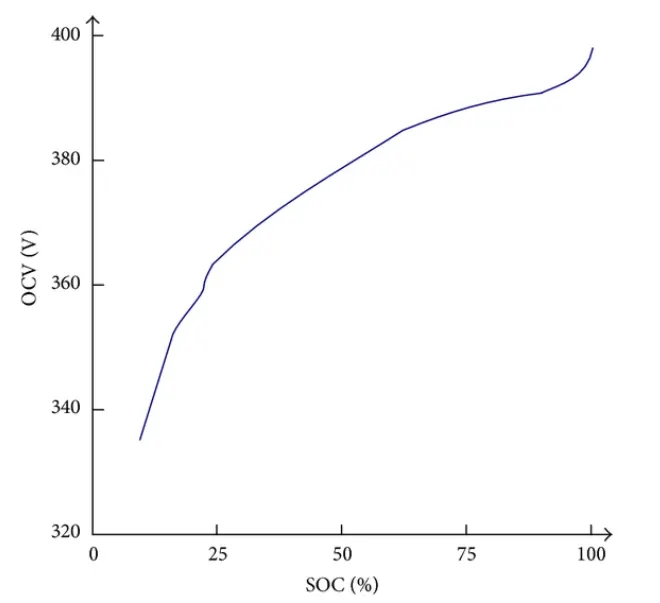
Typical relationship between SOC and OCV
The relationship between the OCV and SOC cannot be exactly the same for all batteries. Because the conventional OCV-SOC differs among batteries, there is a problem in that the relationship of the OCV-SOC should be measured to estimate accurately the SOC. The SOC and the capacity of a lithium-ion battery are estimated using the dual extended Kalman filter with the proposed method.
Terminal voltage method
The terminal voltage method is based on the terminal voltage drops because of the internal impedances when the battery is discharging, so the electromotive force (EMF) of battery is proportional to the terminal voltage. Since the EMF of battery is approximately linear proportional to the SOC, the terminal voltage of battery is also approximately linear proportional to the SOC. The terminal voltage method has been employed at different discharge currents and temperatures. But at the end of battery discharge, the estimated error of terminal voltage method is large, because the terminal voltage of battery suddenly drops at the end of discharge.
Impedance method
Among the techniques which have been employed, impedance measurements provide knowledge of several parameters, the magnitudes of which may depend on the SOC of the battery. Although the impedance parameters and their variations with SOC are not unique for all battery systems, it appears to be imperative to perform a wide range of impedance experiments for identification and use of impedance parameters for estimating the SOC of a given battery.
Impedance Spectroscopy method
The impedance spectroscopy method measures battery impedances over a wide range of ac frequencies at different charge and discharge currents. The values of the model impedances are found by least-squares fitting to measured impedance values. SOC may be indirectly inferred by measuring present battery impedances and correlating them with known impedances at various SOC levels.
Coulomb counting method
The Coulomb counting method measures the discharging current of a battery and integrates the discharging current over time in order to estimate SOC. Coulomb counting method is done to estimate the SOC(t), which is estimated from the discharging current, (t), and previously estimated SOC values, SOc(t-1).SOC is calculated by the following equation:
SOC(t) = SOC(t - 1) + I(t)/ Qn * (delta t)
But there are several factors that affect the accuracy of Coulomb counting method including temperature, battery history, discharge current, and cycle life
Modified Coulomb counting method
To improve the Coulomb counting method, a new technique called modified Coulomb counting method is proposed. The modified Coulomb counting method uses the corrected current to improve the accuräcy of estimation.
The corrected current is the function of discharging current. There is a quadratic relationship between the corrected current and discharging current of battery. By practice of experimental data, corrected current is calculated by the following form:
Ic(t) = k2I(t)^2 + k1 I (t) + ko
where, k2, k, and k are constant values obtained from the practice experimental data.
In modified Coulomb counting method, SOC is calculated by the following equation:
SOC(t) = SOC(t - 1) +I(t)/ Qn * (delta t)
The experimental results show that the accuracy of the modified Coulomb counting method is superior to the conventional Coulomb counting method.
Flow chart of Coulomb Counting Method:
RBF neural network
The RBF neural network is a useful estimation methodology for systems with incomplete information. It can be used to analyze the relationships between one major (reference) sequence and the other comparative ones in a given set. The RBF neural network has been used in SOC estimation. The method was tested with data which was from battery experiments. Results show that the operation speed and estimation accuracy of estimating model can meet the demands in practice, and the model has certain value of application.
the RBF neural network SOC estimation method uses the input data of the terminal voltage, discharging current, and temperature of battery to estimate the SOC for LiFePO4 battery under different discharging conditions. The experimental data are found to be in close agreement.
Fuzzy logic method
Fuzzy logic method provides a powerful means of modeling nonlinear and complex systems. In, a practical method of estimating SOC of battery system has been developed and tested for several systems. The method involves the use of fuzzy logic models to analyze data obtained by impedance spectroscopy and/or Coulomb counting methods. In, a fuzzy logic-based SOC estimation method has been developed for lithium-ion batteries for potential use in portable defibrillators. The ac impedance and voltage recovery measurements have been made which are used as the input parameters for the fuzzy logic model.
Singh et al. presented an estimation system which can select features in data base to develop fuzzy logic models for both available capacity and SOC estimation, simply by measuring the impedance at three frequencies. In the SOC is estimated by an improved Coulomb metric method, and the time-dependent variation is compensated by using a learning system. The learning system tunes the Coulomb metric method in such a way that the estimation process remains error free from the time-dependent variation. The proposed learning system uses the fuzzy logic models, which is not used for estimation of soc but performs as a component of learning system.
Support vector machine
The support vector machine (SVM) has been applied for classification in various domains of pattern recognition. The VM has also been applied for regression problem, even the regression problem inherently more difficult than classification problem. The VM used as a nonlinear estimation system is more robust than a least-squares estimation system because it is insensitive to small changes Hansen and Wang investigated the application of a VM to estimate the SOC of lithium-ion battery. The SVM based estimator not only removes the drawbacks of the Coulomb counting SOC estimator but also produces accurate SOC estimates.
Fuzzy neural network
Fuzzy neural network (FNN) has been used in many applications, especially in identification of unknown systems. In nonlinear system identification, FN can effectively fit the nonlinear system by calculating the optimized coefficients of the learning mechanism
Lee et al. investigated a soft computing technique for estimating battery SOC of individual batteries in a battery string. The soft computing approach uses a fusion of an FNN with B-spline membership functions and a reduced-form genetic algorithm.
Kalman Filter
Using real-time measurement road data to estimate the SOC of battery would normally be difficult or expensive to measure. In application of the Kalman filter method is shown to provide verifiable estimations of SOC for the battery via the real-time state estimation.
Yatsui and Bai presented a Kalman filter based SOC estimation
method for lithium-ion batteries. Experimental results validate the effectiveness of Kalman filter during the online application. Barbarisi et al. presented an extended Kalman filter (EKF) to estimate the concentrations of the main chemical species which are averaged on the thickness of the active material in order to obtain the SOC of the battery, by using the terminal current and voltage measurements.
Based on unscented Kalman filter (UKF) theory and a comprehensive battery model, a novel SOC estimation method is proposed in. The results show that UKF method is superior to extended Kalman filter method in SOC estimation for battery. Sun et al. presented an adaptive UKF method to estimate SOC of a lithium-ion battery for battery electric vehicles. The adaptive adjustment of the noise covariance in the SOC estimation process is implemented by an idea of covariance matching in the UKF context.
Hybrid methods
The object of hybrid models is to benefit from the advantages of each method and obtain a globally optimal estimating performance. Since the information contained in the individual estimating method is limited, hybrid method can maximize the available information, integrate individual model information, and make the best use of the advantages of multiple estimating methods thus improving the estimation accuracy. The literatures sow that the hybrid methods generally produce good SOC estimating results compared to individual methods . The hybrid methods combine different approaches such as direct measurement method and bookkeeping estimation
method.
Coulomb counting and EMF combination
A new SOC estimation method that combines direct measurement method with the battery EMF measurement during the equilibrium state and bookkeeping estimation with Coulomb counting method during the discharge state has been developed and implemented in a real-time estimation system.
Any battery will lose capacity during cycling. In order to calculate SOC and remaining run-time (RRT) accurately and to improve the SOC estimation system capability to cope with the aging effect, a simple Qmax adaptation algorithm is introduced. In this algorithm the stable conditions of the charge state are exploited in order to adapt Qmax with the aging effect.
This paper has proved that the Qmax adaptation algorithm can improve the SOC and RT estimation accuracy even for a fresh battery. Since a battery loses capacity during cycling, it is concluded that the Qmax adaptation algorithm will increase substantially the SOC and the RRT estimation accuracy.
Coulomb counting and Kalman Filter combination
Wang et al. proposed a new SOC estimation method, denoted as "KalmanAh method." which uses the Kalman filter method to correct for the initial value used in the Coulomb counting method. In KalmanAh method, the Kalman filter method is used to make the approximate initial value converge to its real value. Then the Coulomb counting method is applied to estimate the SOC for the long working time. The SOC estimation error is 2.5% when compared with the real SOC obtained from a discharge test. This compares favorably with an estimation error of 11.4% when using Coulomb counting method.
Per-unit System and EKF combination
Kim and Cho described the application of an EKF combined with a per-unit (PU) system to the identification of suitable battery model parameters for the high accuracy SOC estimation of a lithium-ion degraded battery. To apply the battery model parameters varied by the aging effect, based on the PU system, the absolute values of the parameters in the equivalent circuit model in addition to the terminal voltage and current are converted into dimensionless values relative to a set of base value. The converted values are applied to dynamic and measurement models in the EKF algorithm.
The future of SoC Estimation
Since the energy storage systems have been highlighted in portable electronics and hybrid electric vehicle applications, the estimate accuracy of SOC becomes increasingly important. In recent years, many scholars have done a lot of research on SOC estimation. The estimate accuracy has improved constantly, and it can be expected that intense research and development efforts are already on track. In order to further improve SOC estimates, combined with some literatures, anticipated improvements for the further research include the following areas.
(i)Do further research on the hybrid methods, such as combining direct measurement method and book-keeping
estimation method to achieve good results in online SOC estimation.
(ii) The existing estimation method should be put into use in various kinds of batteries. Do further research on the
practical universal application of the methods.
(iii) Deepen further research on improve the SOC estimation system capability to cope with the aging effect of battery.
(iv) Study on more novel artificial intelligence methods and improving their training algorithms to achieve the estimate accuracy of SOC. In addition, new methods on complex terrain are the focus of future research.
(v) To further improve the estimating performance of the neural network method, the optimal search methods for the optimal number of neurons in hidden layer need to be investigated and integrated in the neural network method.
(vi) Do further research on the adaptive parameter estimation. The models have the ability to automatically adapt to various kinds of batteries, various discharging conditions, and the different aged batteries.
(vi) Establish the more accurate evaluation system and the standard for measurement of performance of soc estimation method.
Conclusion:
This paper presented a review on estimating of battery SOC under different discharging conditions. Four categories of estimating mathematical methods, which have their own characteristics, were discussed. Papers were selected to emphasize the diversity of estimating mathematical methods. Some of these methods have good performances at fixed discharging current condition, while others perform better in varied discharging current condition. It is difficult to evaluate the performance of various methods, as the existing applications were in different discharging condition and different size of battery. The developments of various SOC estimate methods are expected to be valuable in battery applications such as BMS in hybrid electric vehicles. Based on the development history of SOC estimation, the future development directions of SOC estimating are proposed in the end.