Week 7 State of charge estimation
1.Simulate the 3 test cases from harness dashboard and write a detailed report on the results:
Now,at first we have to simulate 3 test cases from harness dashboard. We need to, select the harness dashboard from project file
which we downloaded with the reference link https://in.mathworks.com/matlabcentral/fileexchange/72865-design-and-test-lithium-ion-battery-management-algorithms
Fault in MATLAB BMS_Closeloop Model
The Model represents a rough idea on how the BMS reacts and gives user an idea of any fault occuring in the Battery Pack, if any.
The model here allows the user to know the error by glowing the RED Light on the dashboard.
The various defects that can occur are
Fault State
over current
High temperature
low temperature
over volatge
under voltage
charger
inverter
Volt Sensor
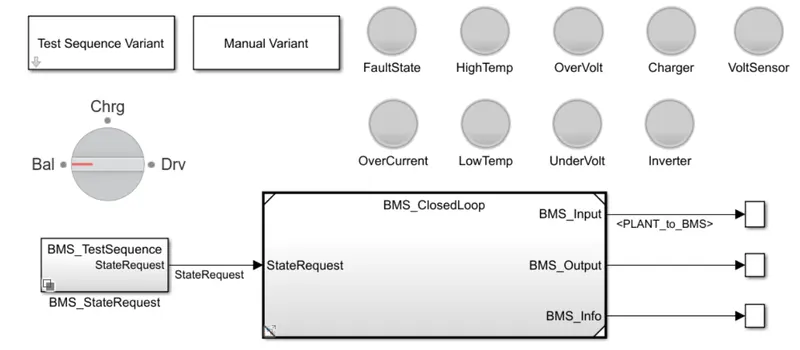
The Specifications of BMS Are highly accurate with each block given their specific function and all the blocks are inter-related with each other for better performance.
The entire model has a large number of component level and system level analysis.
A 6 cell Module is selceted as our Battery Pack for the system with each cell having 4V as their Standard cell Voltage
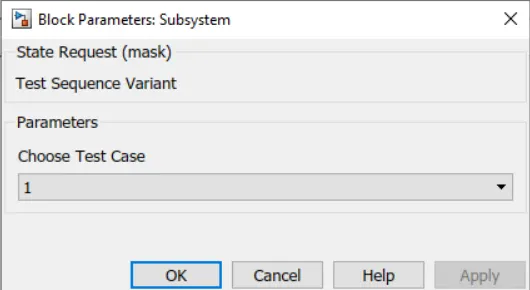
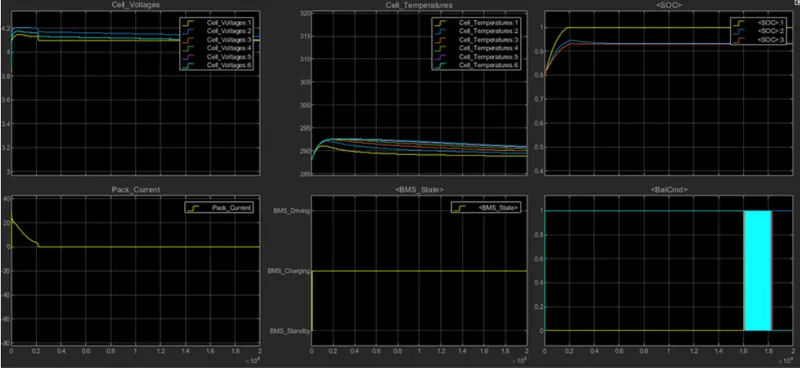
a)by running the simulation we got our first result graph:
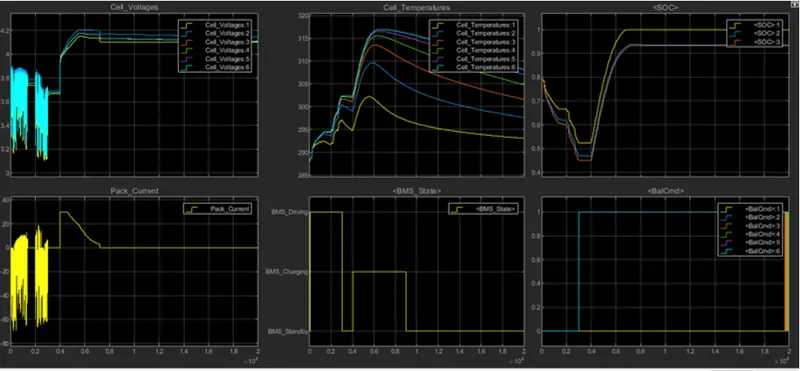
From the plot we can see the vehicle is initially in driving state and charging was done till 90%. After charging it reaches to standby mode. It can be seen in BMS state plot.Battery temperature increases in driving and charging. Battery voltage was increased to 4.2V while charging. Current plot shows the value of current supplied to vehicle while driving. SOC decreased up to 50% in driving condition and it was increased while charging.
b)after stimulation of 2nd case of test sequence variant:
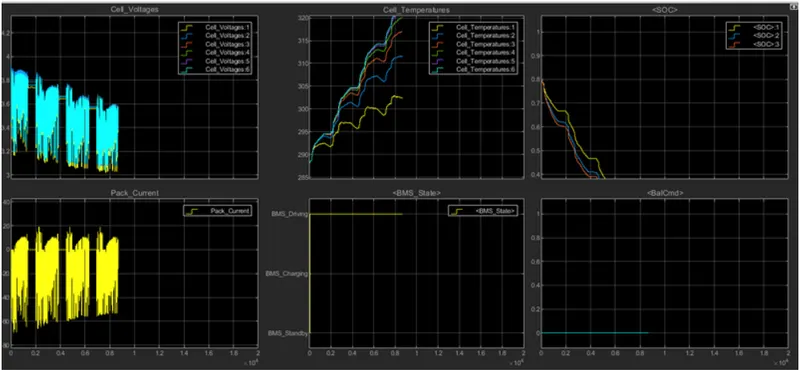
From the above graph , a fault condition occured in second case. So even after charging was started, the soc didnt increase. It continue to decrease.
c)after simulation of 3rd case of test sequence variant:
2.What is coulomb counting? Refer to the above model and explain how BMS implements coulomb counting for SOC estimation ?
coulomb counting:-
The Coulomb counting method measures the discharging current of a battery and integrates the discharging current over time in order to estimate SOC . Coulomb counting method is done to estimate the , which is estimated from the discharging current, , and previously estimated SOC values, . SOC is calculated by the following equation:
But there are several factors that affect the accuracy of Coulomb counting method including temperature, battery history, discharge current, and cycle life.
Modified Coulomb Counting Method
To improve the Coulomb counting method, a new technique called modified Coulomb counting method is proposed. The modified Coulomb counting method uses the corrected current to improve the accuracy of estimation.
The corrected current is the function of discharging current. There is a quadratic relationship between the corrected current and discharging current of battery. By practice of experimental data, corrected current is calculated by the following form:.
where are constant values obtained from the practice experimental data.
In modified Coulomb counting method, SOC is calculated by the following equation:
The experimental results show that the accuracy of the modified Coulomb counting method is superior to the conventional Coulomb counting method.
But there are several factors that affect the accuracy of Coulomb counting method including temperature, battery history, discharge current, and cycle life .
For example we can look into the project file we downloaded. A BMS system in the file is represented below.
BMS algorithm models , protects , reports the measurement from battery pack.
By Clicking on the BMS ECU we get the Subsystem
By clicking on the SOC estimation block we get.
Refer to the above model and explain how BMS implements coulomb counting for SOC estimation?
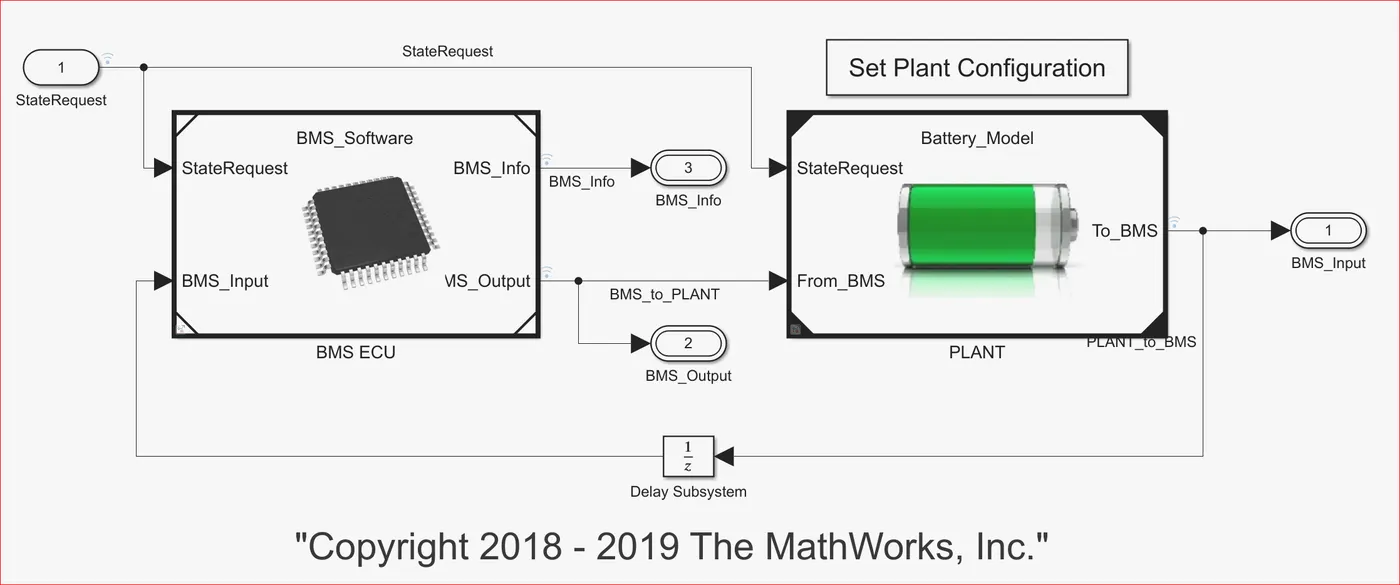
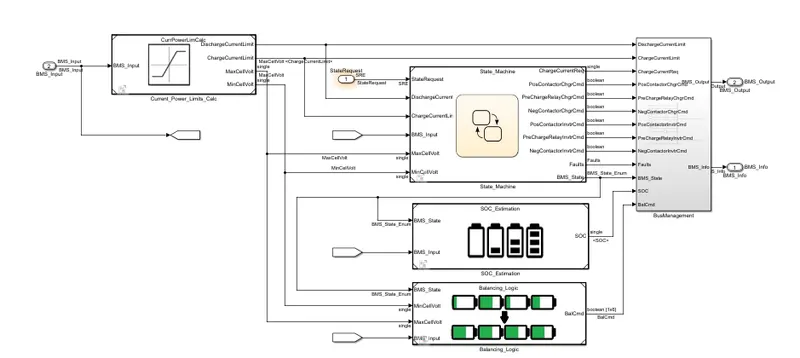
before we charge our vehicle we need an accurate Estimation of battery SOC, in the battery system we don't measure the state of charge we measure different things like battery pack current cell voltage and cell voltage which we taking signals as input from the plant.
after entering the plant block we can see the state machine, SOC estimation, and balancing logic block
in which we going to study SOC estimation.
in this SOC estimation block we can see three different techniques for the state of charge estimation. all three techniques have their own merits and limitations. the first method is columb counting and the other two are unscented(ukf) and extended Kalman filter(ekf).here we are concern with the columb counting method in coulomb counting method block
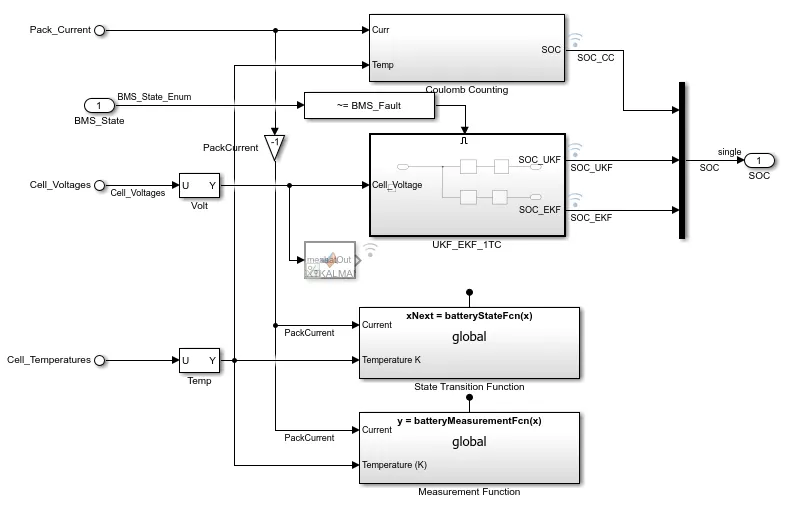
it takes two input signals such as current and temp and the current signal goes to gain block and the temp signal goes to lookup tables of battery time and current. and both the blocks are connected to the divided block and these signals are connected to the discrete-time integrator to track the charge and which finally helps to calculate the state of charge.
which consist of integrating a current and doesn't leave the cell for that here we using discrete-time integrator to give the track of the cell charge of the time the benefits of this is its simplicity and its low capitation cost and the drawbacks are an accumulation of current sensor error and its inability to recover from the wrong initial condition. from the lack of feedback from voltage measurements
A subsystem opens when we click on the Coulomb Counting
1.This system does the estimation by coulomb counting equation mentioned above.
2.Advantage of coulomb counting method is its simplicity and low computational cost.
3.Temperature and current from the battery is given as inputs.
4.Current signal is given to a gain block and temperature is given to capacity since it varies according to temperature.
5.These inputs are given for integration where current will be integrated with respect to time.
6.This outout is given to another block where it is divided by capacity.
7.Hence the SOC is estimated.