Week 7 State of charge estimation
1.Battery management system with harness dashboard:
The model for the battery management system will look like the one below,
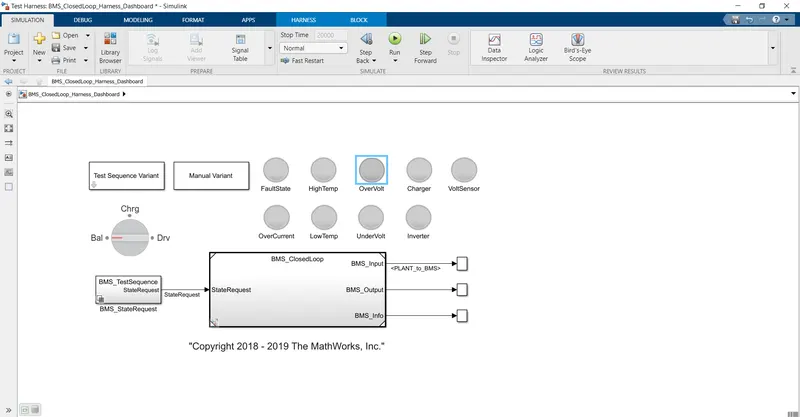
The above model is similar to the dashboard of the vechicle.The BMS closed loop block will contain the entire battery pack and the management system state machine model.It has three statea as charging,balancing and driving.The dashboard also contains led to display any fault occuring in the system.The model can be run for three test cases.
Case 1:
The first test case is driving-balancing-charging-balancing.
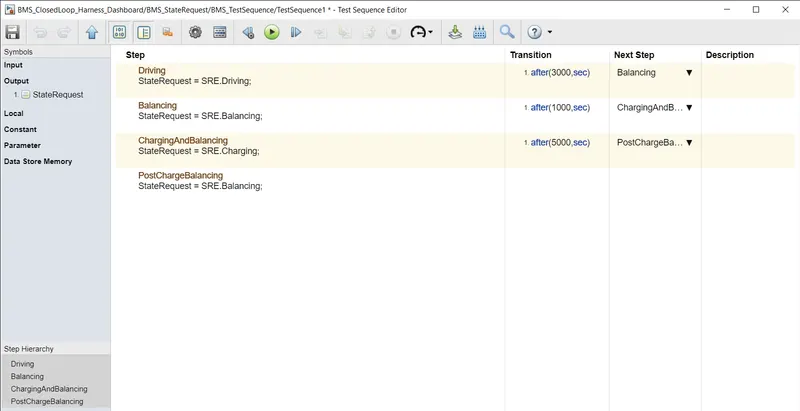
The sequence and the duration of the steps to follow is given in the above figure.After running the simulation the results obtained are,
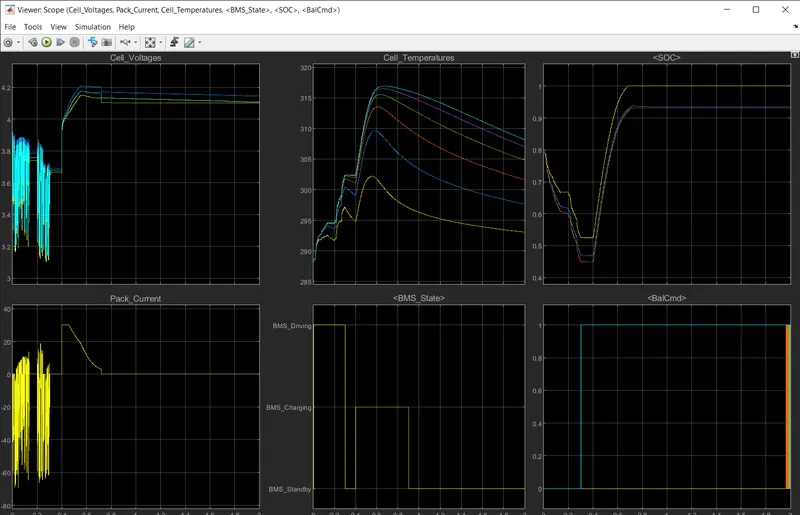
The graph one shows the voltage of the battery pack.The voltage at the start seems to fluatuate but after some time the voltage starts rising and it reaches the maximum value of 4.2V.This is because at the start of the cycle the cells are not at the same level but after sometime the balancing state is stated so it reaches the constant level.
The graph 2 shows the curent value.It also follows the same pattern of the voltage.The soc of the battery starts decreasing for the stat of the cycle as the battery is in driving condition and when it reaches the standby condition the soc reamins constant and when it reaches charging condition it starts to increase.
Case 2:
The test case 2 involves driving and charging.
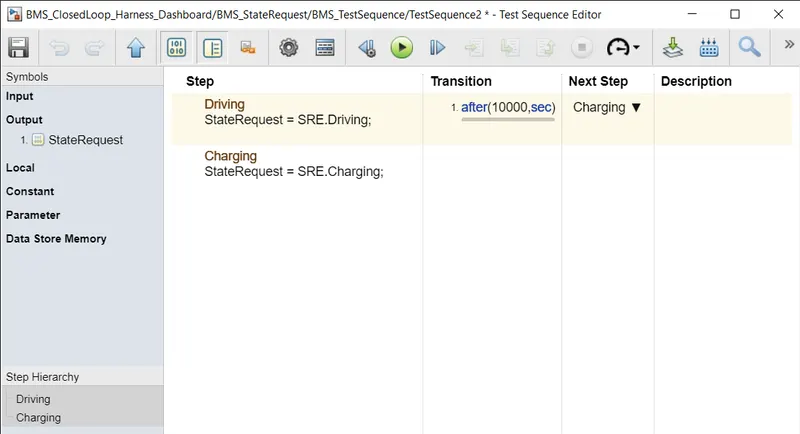
The sequence and the duration of the steps to follow is given in the above figure.After running the simulation the results obtained are,
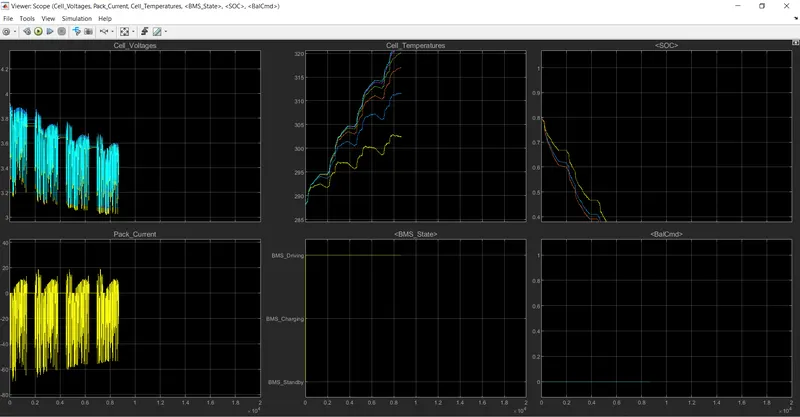
The voltage of the battery seems to fluatuate over the peak value .It has four set of such values with a constant value inbetween to achieve necessary driving condition.The soc of the battery seems to fall gradully as the battery is only in the driving condition.The temperature of the cells tend to increase which can be measured from the bms system of the cell.
Case 3:
The test case 3 involves charging,
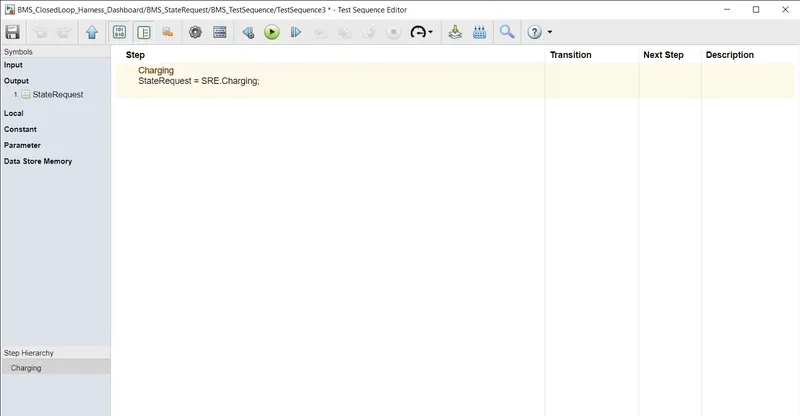
The sequence and the duration of the steps to follow is given in the above figure.After running the simulation the results obtained are,
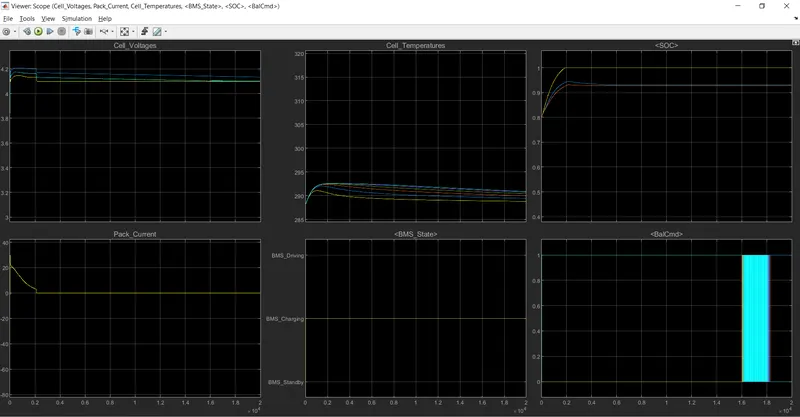
The voltage of the cell seems to be at the constant value of 4.2V as it is the maximum voltage of the cell it cannot be charged beyond it.The current remains zero as there is no discharge from the cell.The soc at the start tends to increase and after reaching the peak value it remains constant.The temperature of the cell also remains at a constant value.
2.Coulomb counting:
The Coulomb counting method measures the discharging current of a battery and integrates the discharging current over time in order to estimate SOC. Coulomb counting method is done to estimate the , which is estimated from the discharging current, , and previously estimated SOC values . SOC is calculated by the following equation:
SOC(t)=SOC(t-1)+`(I(t))/(Qn)Deltat`
But there are several factors that affect the accuracy of Coulomb counting method including temperature, battery history, discharge current, and cycle life.
Now we can see the soc estimation by the coulomb counting method in the matlab model.
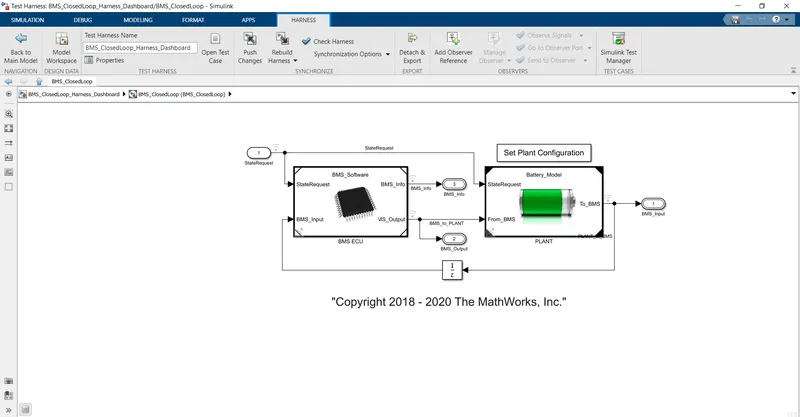
The above model is the battery management system along with the battery pack.When we look inside the BMS ecu subsystem we can find the soc estimation block,
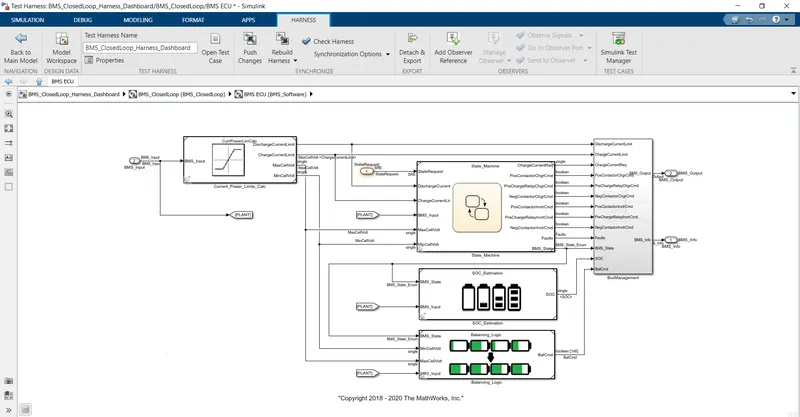
When we look inside the soc subsystem we can find the coulomb counting block inside it which is used to determine the soc,
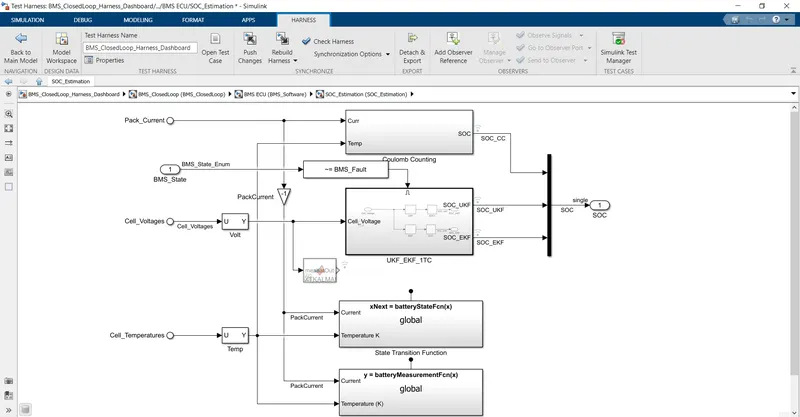
The soc estimation block has lot of other parameters to be determined but we can examine about the coluomb counting subsystem alone.
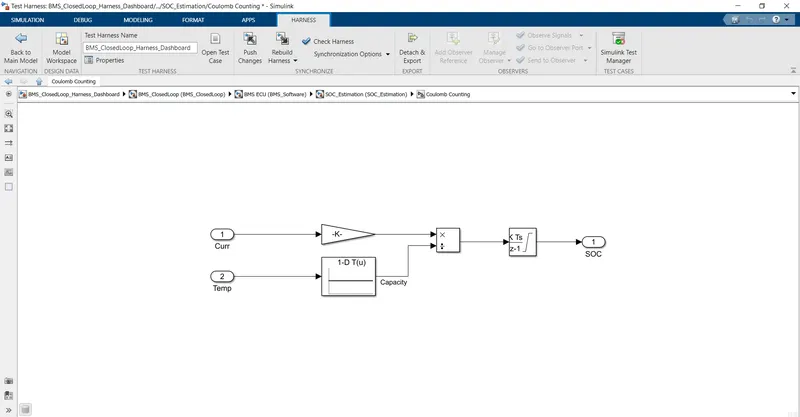
The coulomb counting subsystem will formulate the above said equation in the block.THe current and the temperature values are given as the input.The current value is multiplied with a certain gain value.The temperature value is sent through a lookup table to convert into capacity of the cell.The both values are then divided and the result is integrator to obtain the soc of the cell.