Week 7-Long Piston With Cam
Objective:
To perform transient analysis on a piston and cam mechanism model with frictionless contact, frictional contact with coeeficient 0.1 and 0.2 for a total of 3 cases. We need to find out Equivalent stress, Directional Deformation and Equivalent elastic strain.
Setup:
First step is to import the geometry and opening it into spacecalim to see if there is any abnomralities. Once loaded we open the mechanical module and renam the components as Barrel, Cam and Cam follower. Once renamed both cam and barrel are given Rigid stiffeness behviour. After that we flip the contacts and rename them based in definition. In the contact from Cam follower to barrel unselect the cylindrical part connecting to the sphere contacting the cam. After that we assign a fixed joint (Ground to body), a revolute joint to the cam surface (ground to body) and a translational joint (Body to body) to the cylindrical part in the barrel with refrence being the surface of the barrel the translation axis must be x axis. Once this is done we give a mesh of 1mm to the mating surfaces that is the sphere and the inundation in the cam. after the meshing is done going into analysis settings we give 9 steps. After selectin all 9 steps we switch on auto time stepping define by time and give initial time step as 0.1s, minimum time step as 5e-2s and 0.2s as maximum time step. Changing stabilization to constant in non-linear contact and give energy dissipation a value of 0.1 along with switching activation for sirst step to yes. After that give all the other output control except contact miscellaneous to yes. That concludes analysis settings. Then we give joint load for revolute joint and insert the values in a tabular format as following 30,60,90,120,150,180,210,240 and 270. Once the load is given go to solutions add Equivalent Elastic Stress, Equivalent Elastic Strain and Directional Deformation. After all the required solution is added solve the case.
Frictionless:
Equivalent stress:
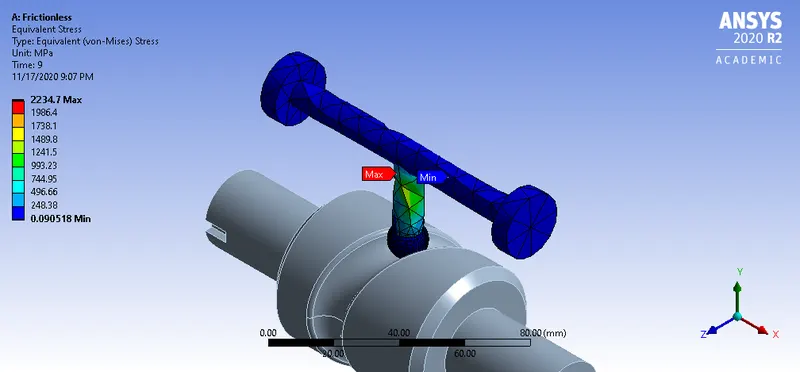
The maximum stress developed was 2234.7 MPa. The maximum point is shown in the figure.
Directional deformation:
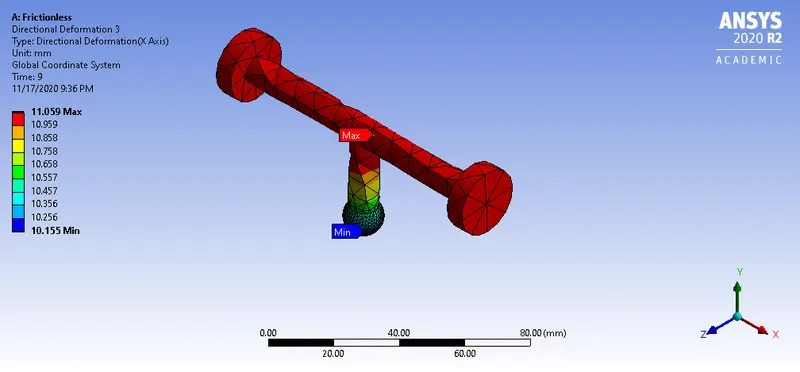
The maximum amount of deformation along x axis was 11.059 mm.
Equivalent Elastic Strain:
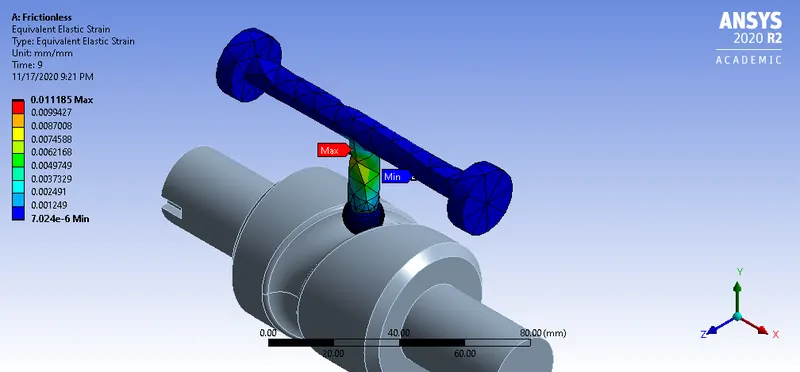
The maximum amount of strain was 0.011185 mm/mm which occured at the same point as of maximum stress.
Frictional coeeficient 0.1:
Equivalent Elastic Stress:
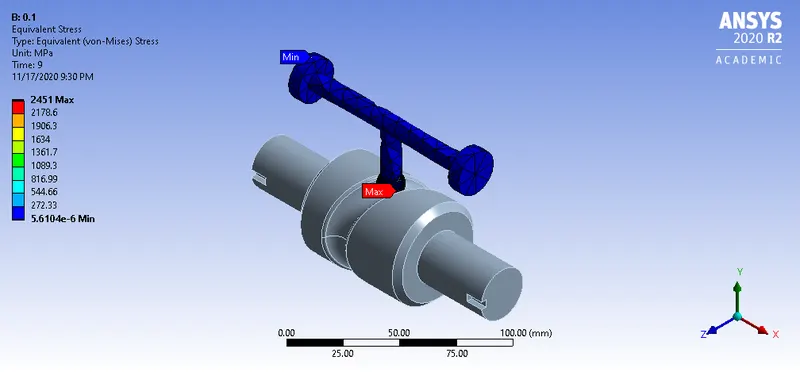
The maximum stress occured at the sphere of contact with a value of 2451 MPa.
Directional Deformation:
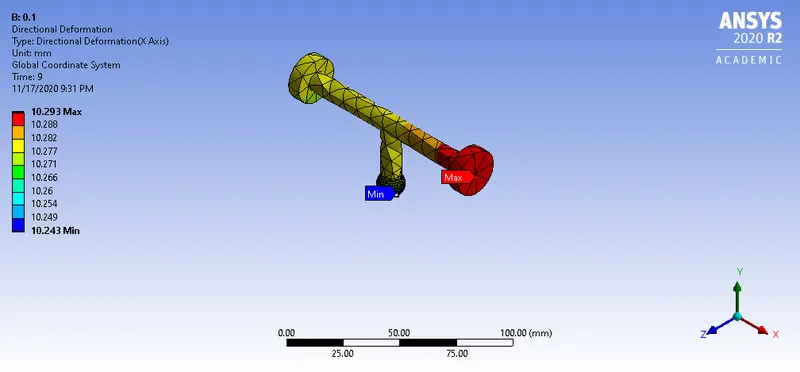
The maximum deformation occured is 10.293mm.
Equivalent Elastic Strain:
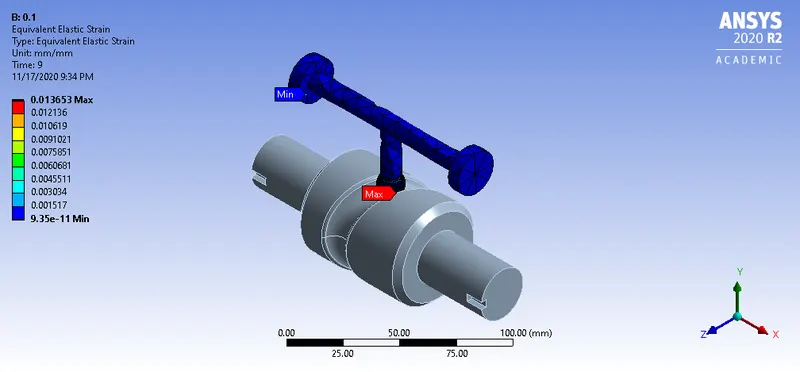
The maximum elastic strain is 0.013653 mm/mm at the same point as that of maximum stress.
Frictional coefficient 0.2:
Equivalent Elastic Stress:
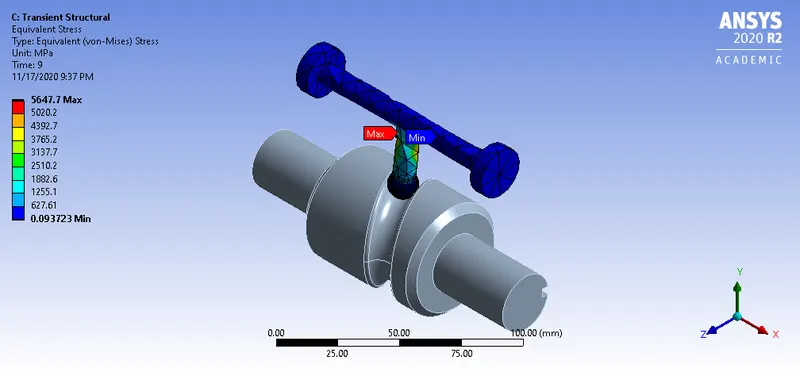
The maximum amount of stress developed is 5647.7 MPa developed at the point in the figure.
Directional Deformation:
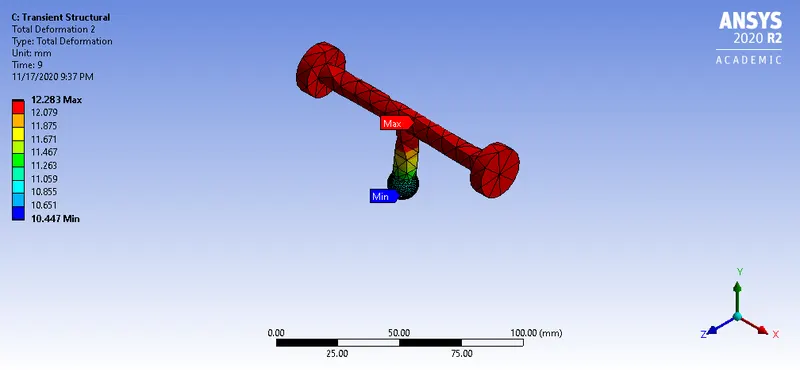
The maximum deformation occured is 12.283 mm.
Equivalent Elastic Strain:
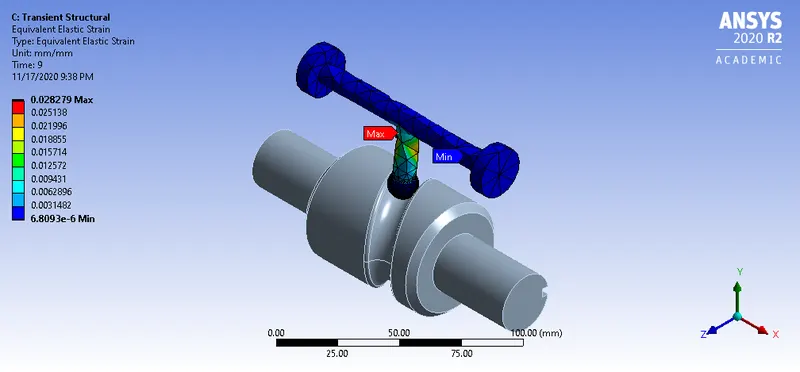
The maximum ealstic strain is 0.028279 mm/mm.
Conclusion:
| Type of contact | Frictionless | Frictional Coefficient 0.1 | Frictional Coefficient 0.2 |
| Equivalent Elastic Stress (MPa) | 2234.7 | 2451 | 5647.7 |
| Directional Deformation (mm) | 11.059 | 10.293 | 12.283 |
| Equivalent Elastic Strain (mm/mm) | 0.011185 | 0.013653 | 0.028279 |
So as expected higher stress and strain values were for the model with higher frictional coefficient.. It is interesting to note that both for frictionless and frictional coefficient 0.2 models the maximum stress and strain occured at the same point on the top of follower while for model with coefficient at 0.1 the maximum stress and strain occured at the sphere in contact with the cam. The directional deformation was most for model with coefficient 0.2 followed by frictionless and then the least deformation was shown by the model having coefficient of friction at 0.1