Week 2 Bevel Gear Challenge
Grid Dependency Test:
It is also known as Grid Independence Test. It is a form of trial and error where you reduce the sizing of the mesh and see the results until a concurrent value in the output is obtained. For example you start with a mesh sizing of 6mm and get a set of results. after that you use a mesh of 5mm and get a certain set of results different from the one we got while using 6mm. now we use a mesh size of 4mm and check the results we find out that the results are the same as that of the 5mm mesh. so we could use the 5mm or 4mm mesh and there is no reason to go below that as there is no change in the output values. this is greatly helpful as giving smaller and smaller mesh size would result in bigger load on the quipment which means an increas in computation time. The results wont always be exactly the same but when the results have negligable difference we can say that the grid is considered grid independent.
All the models have been given the same settings excluding the mesh size. Face sizing of 1.75mm was given to the contacting surfaces. The images are given in the order of 4mm, 5mm and 6mm.
Deformation:
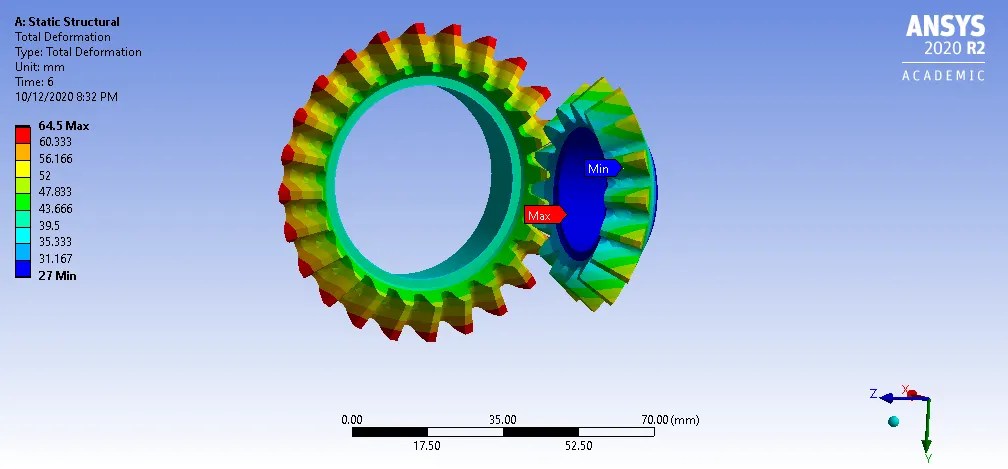
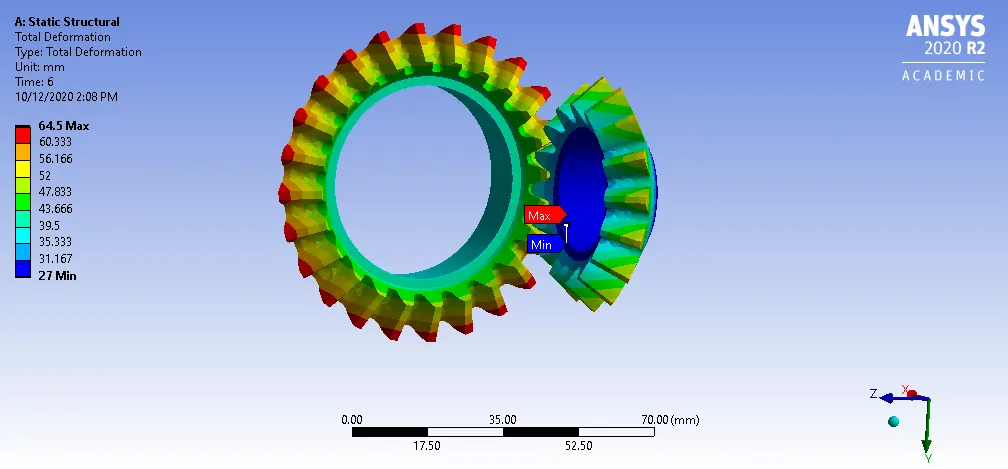
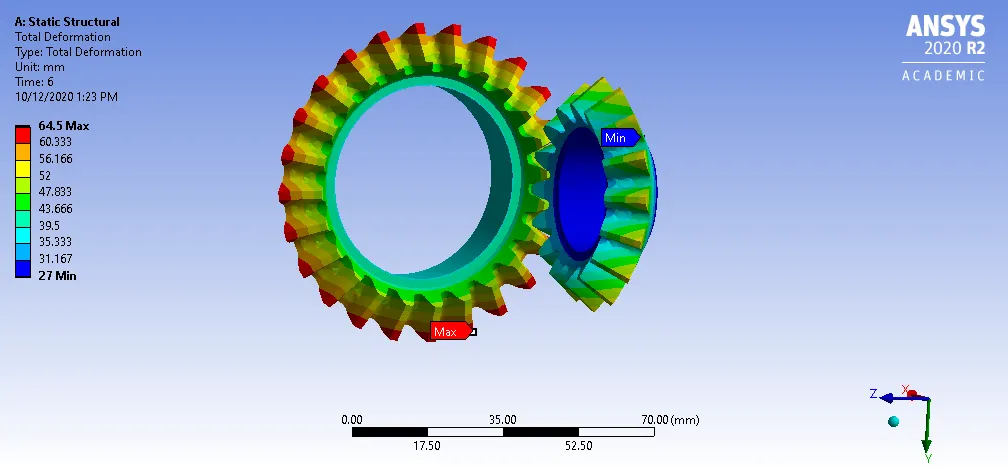
All the deformation on all mesh sizes was the same at 64.5mm. The maximum deformation occurs at the tip of the bigger gear on all mesh sizes.
Stress
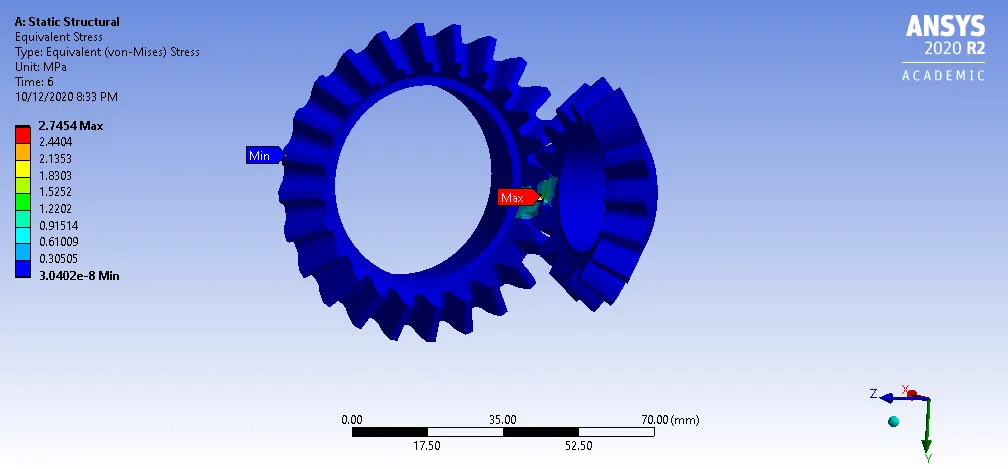
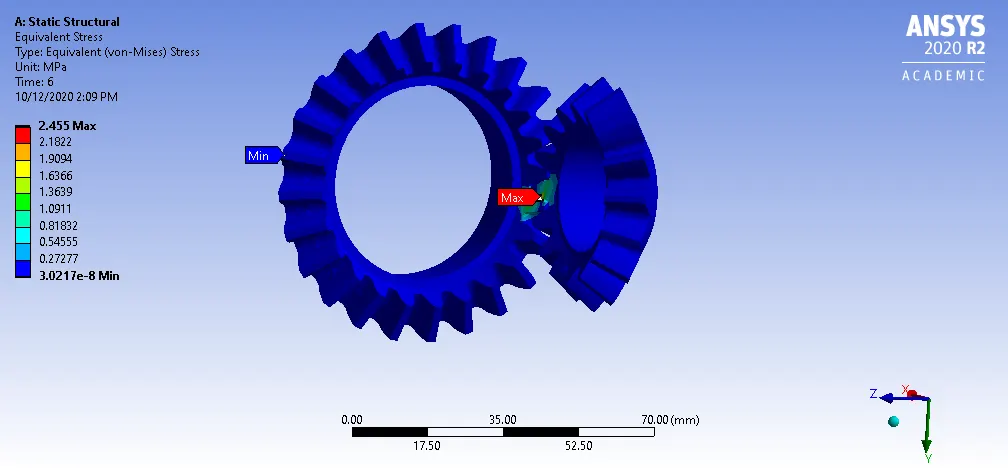
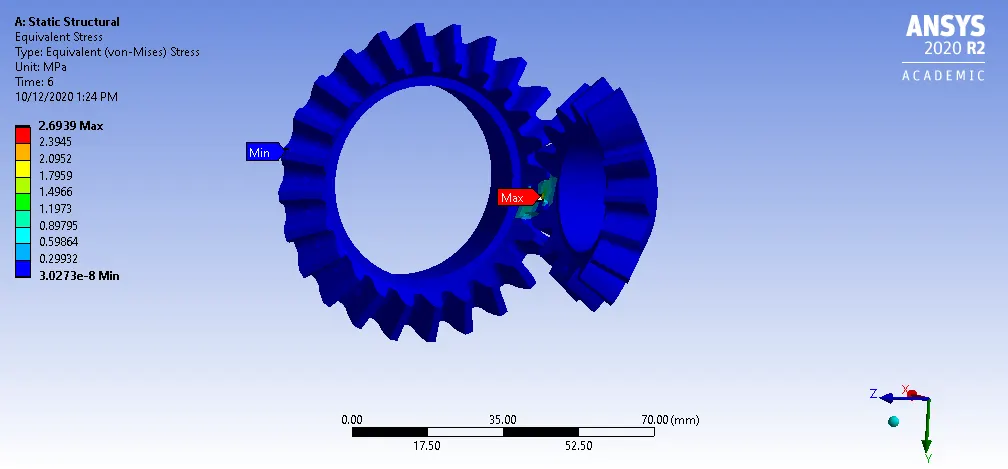
All three mesh sizes gave different results when it came to maximum stress developed although the location was the same. The mesh size of 6mm gave a maximum stress of 2.6939 MPa while the mesh size of 5mm gave a maximum stress of 5.455 MPa. Finally the mesh size of 4mm gave a maximum stress of 2.7454 MPa.
Strain
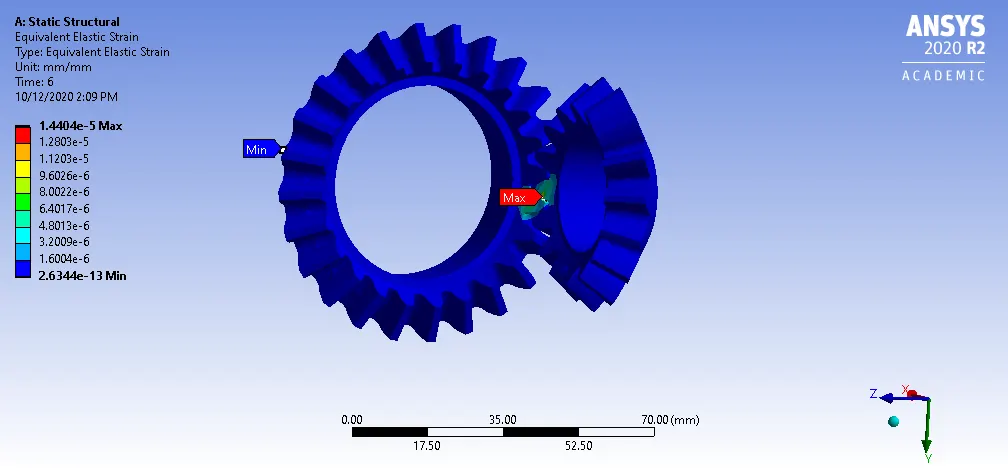
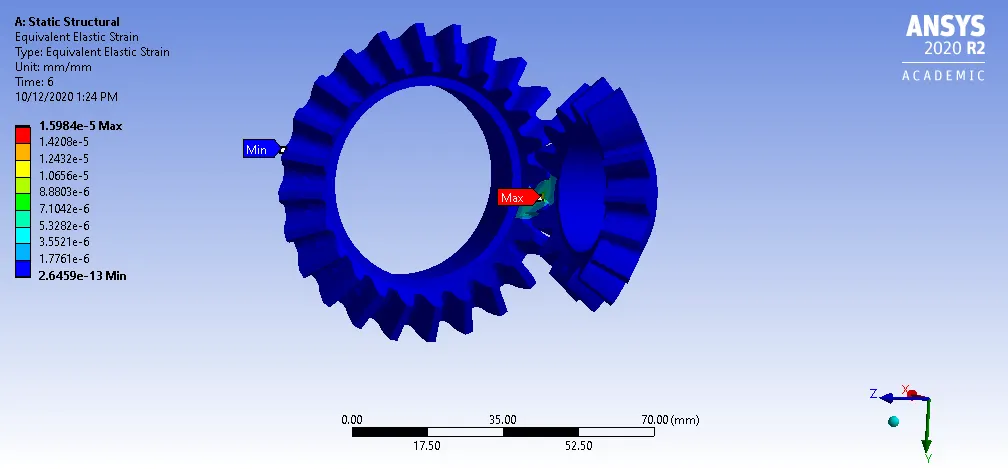
When it comes to maximum strain developed we can see a similar trend to what happened in the case of maximum stress. 4mm mesh gave the highest strain value while 5mm mesh gave the least value and 6mm mesh gave the value in the middle of both. the location of the maximum strain occured at the same point in all three cases. 4mm mesh showed maximum strain of 1.6767e-5 mm/mm, 5mm mesh showed maximum strain of 1.4404e-5 mm/mm and 6mm mesh gave maximum strain of 1.5984e-5 mm/mm.
Findings:
There is no point in looking at the deformation as they are all the same for all the mesh sizes. But looking into the stress and starin developed there is a similar trend of 4mm mesh showing the larger value followed by the 6mm mesh and lastly by the 5mm mesh. this findings does not incur to anything and in my opinion smaller mesh sizes must be used until we get a value that is almost comparable. There is a gap between the results generated by 4mm and 5mm mesh which is larger than the gap between the results of the 4mm mesh and 6mm mesh.
| MESH SIZE | 4mm | 5mm | 6mm |
| DEFORMATION (mm) | 64.5 | 64.5 | 64.5 |
| MAXIMUM STRESS (MPa) | 2.7454 | 2.455 | 2.6939 |
| MAXIMUM STRAIN (mm/mm) | 1.6767e-5 | 1.4404e-5 | 1.5984e-5 |