Week 7-Long Piston With Cam
Case Study for the Stress, Strain & Deformation of Long Piston.
Objective:
For this challenge, you will have to perform a transient analysis on a piston and cam mechanism model that has been provided to you. You need to run the analysis with Frictionless contact, Frictional with 0.1 and 0.2 as the frictional contact for a total of 3 cases. Find out the Equivalent Stress, Directional Deformation and Equivalent Elastic Strain and compare them for all the three cases. Give an inference as to why the results vary between cases.
Procedure:
Case1:
For Case 1, Static Structural Analysis is carried out on CAM & Barrel. The material for the model is Structural Steel & the Mesh size for the faces in contact is 3mm and the analysis is carried out on Ansys Workbench. The geometry of the model is imported on the Ansys Workbench for analysis.
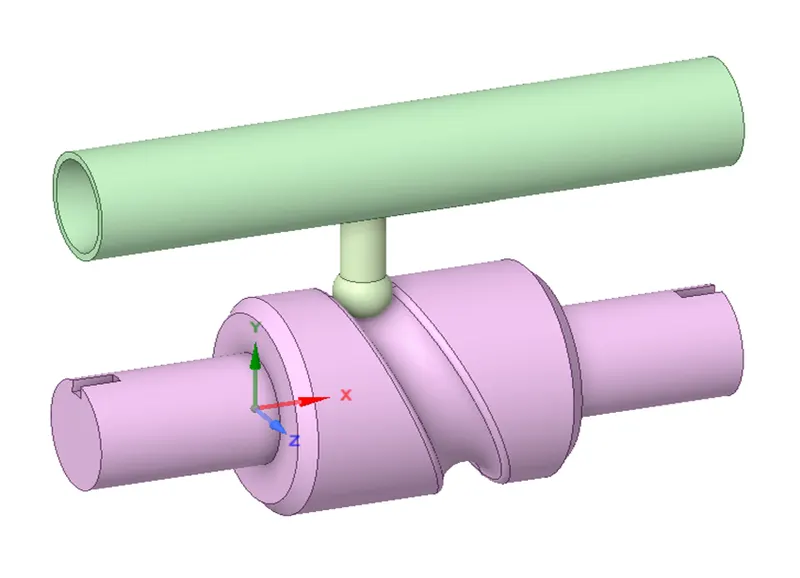
2D Geometry is extruded in the Space Claim to get the model to be imported to the ANSYS. The Extruded model is as shown in the image below:
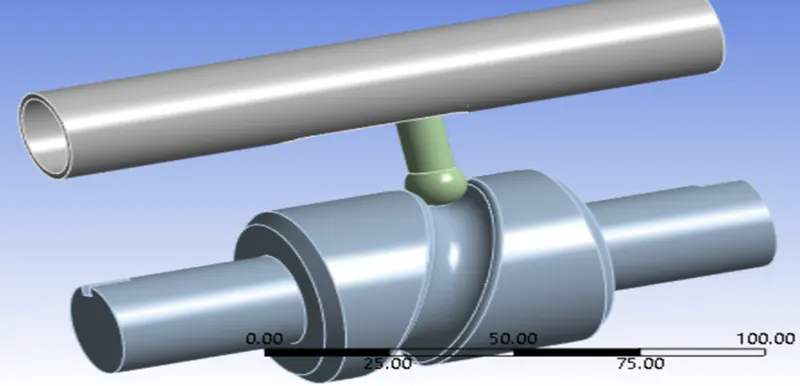
The properties of the material is stated below:
|
Density |
|
||
|
Young's Modulus |
|
||
|
Poisson's Ratio |
|
||
|
Bulk Modulus |
|
||
|
Shear Modulus |
|
The model is meshed using Ansys Mesher with an element size of 1 mm, and a patch conforming method using tetrahedrons was employed. This is done to get the best refinement within the limitation of Ansys Academic License.
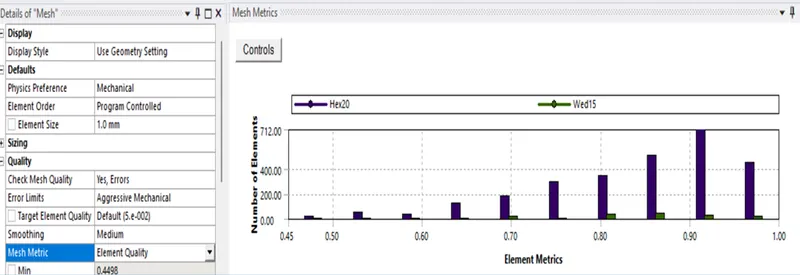
A mesh metric that identifies the elements according to their quality was employed and it can be seen that element of lowest quality are minimal. Most of the elements have very high quality in the range of 0.7-1. Hence, the mesh is of acceptable quality. The meshed model is shown in image below:
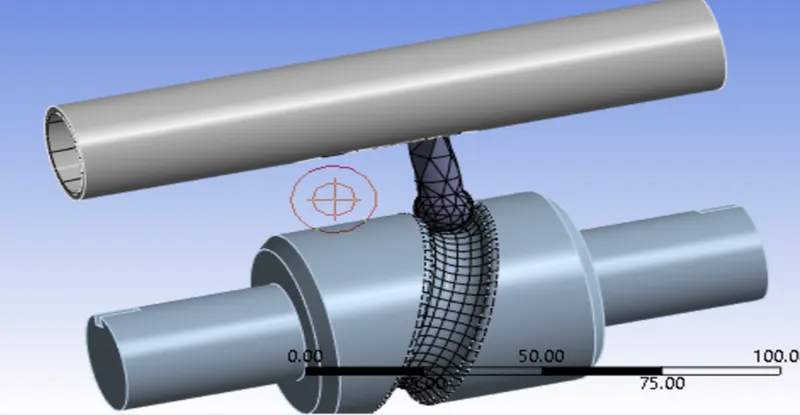
The simulation is then run with the setting keeping the contacts type as frictionless and the results are then obtained.
Case 2:
For Case 2, Static Structural Analysis is carried out on Long Piston. The contact type is kept as frictional and Co-efficient of friction as 0.1.
Case 3:
For Case 3, Static Structural Analysis is carried out on Long Piston. The contact type is kept as frictional and Co-efficient of friction as 0.2.
Results:
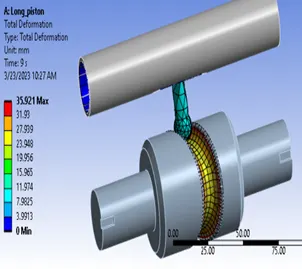
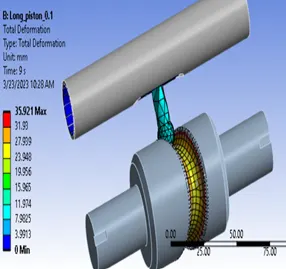
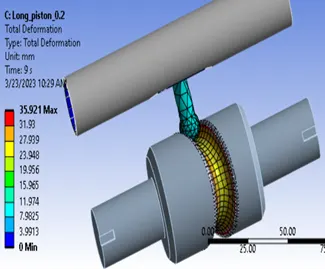
Total deformation of the 3 cases are compared.
Time [s] Minimum [mm] Maximum [mm] Average [mm]
- 0. 35.921 18.192
- 0. 35.921 18.203
- 0. 35.921 18.218
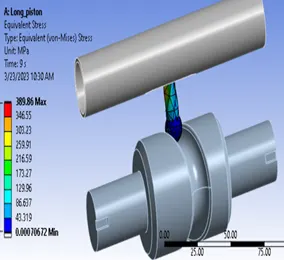
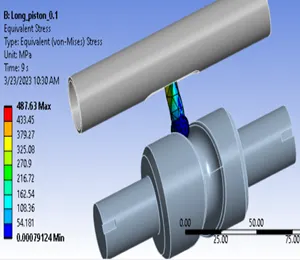
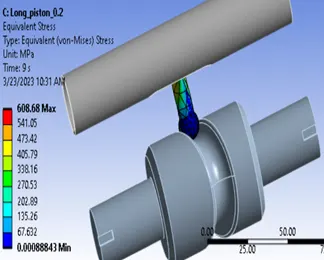
Stress of the 3 cases are compared.
Time [s] Minimum [Mpa] Maximum [Mpa] Average [Mpa]
- 7.0672e-004 389.86 25.533
- 7.9124e-004 487.63 31.565
- 8.8843e-004 608.68 40.052
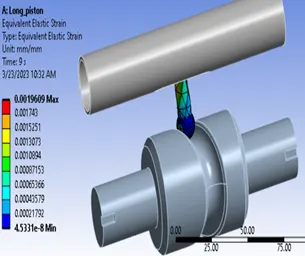
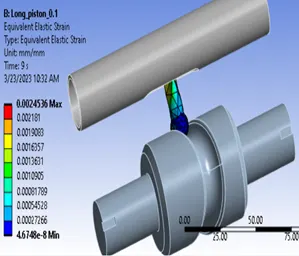
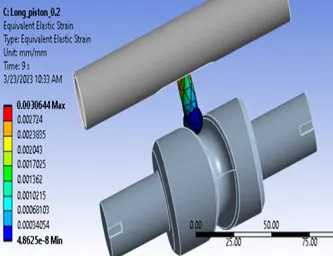
Equivalent Elastic Strain of the 3 cases are compared.
Time [s] Minimum [Mpa] Maximum [Mpa] Average [Mpa]
- 4.5331e-008 1.9609e-003 1.5905e-004
- 4.6748e-008 2.4536e-003 1.9615e-004
- 4.8625e-008 3.0644e-003 2.4839e-004
The total deformation on the model is as plotted and is shown on the plate below.
The Stress is plotted on the model and is as shown below.
The equivalent elastic strain is plotted on the plate and is as shown below.
Conclusion:
The Analysis was run succesfully, within the limits of the academic license, the simulation for the 3 cases were examined, the average stress of the 3rd case is more (i.e 40.052) than the 1st case (25.55). The average equivalent strain for the 3rd case (i.e 2.4839e-004) is more than the 1st case (i.e 1.5905e-004). Therefere the 1st case is considered to be most preferable case than 2nd and 3rd case.