Week-7 Head Impact
AIM
The aim of this project is to understand and calculate the HIC (Head Injury Coefficient) of a human head while it impacts on a car bonnet.
EXPLANATION
Pedestrian protection CAE is a part of vehicle safety engineering from a crash perspective. In a pedestrian protection analysis we look to identify and quantify the injuries that can happen to a human subject. Mainly the head ,the upper leg, lower leg are studied to understand the effect of a particular vehicle impact. This helps the designers to design more safer cars for pedestrians. Most commonly hoods of vehicles are designed so as it is safe for pedestrians even if an impact occours. These tests are usually done at lower velocity from 20-40 km/hr as most pedestrian accidents happen at these velocities.Also, most often the driver brakes before an accident so most collisions happen at low velocities. In this project we try to calculate the HIC value when a human head impacts a car hood at an angle of 45 degress relative to the hood.
CASE SETUP
Here we are provided with three keyword files to start the project. One is an industry standard child headform model developed by LSTC ,the other is a simple head moddel and the last one being the meshed hood of a car.
Here we create three simulations ,the first one is the simple head model hitting a rigidwall, the second case is the child headform model hitting a rigidwall and the last case is the child headform model hitting the hood . After the simulations the HIC values are obtained in all these cases and also compare the stress/strain and acceleration plots obtained in the last two cases.
CASE 1: Simple head model hitting a rigid wall
The simple head model model is imported into LS prepost.
*CONTROL_UNITS was used to to change the unit system to kg,mm,ms. A rigidwall is created using the create entity option.
The model was then given an intitial velocity of 32.4 km/hr or 9mm/ms using the keyword *INITIAL_VELOCITY. The velocity were given as two components so that the head strikes the rigiwall at 45 degress relative to it. So VX=-6.36 and VZ=-6.36 in our case.
The head was then given an elastic material model using the keyword *MAT_001ELASTIC and steel was then used as the material. RO=7.85e-6 , E= 200 and PR=0.32.
Using *SECTION keyword the section of the head was given as shell with ELFORM=2 and thickness =1mm.
*PART_PART keyword was used to assign the materials and the section for the simple head.
*CONTROL_TERMINATION was used to define a termination time of 7 ms. *DATABASE_EXTEND_BINARY was used with STRFLG =1 to get the strain data written to the D3plot.
*DATABSE_BINARY_D3PLOT was given with DT=0.5ms. *DATABASE_ASCII option was also used to obtain GLSTAT ,MATSUM,RWFORC,SLEOUT with DT=0.5.
CASE 2: Headform model hitting a rigidwall.
Firstly, the model needs to be aligned 45 degrees so we open LS prepost. For that we use *DEFINE_TRANSFORMATION keyword. TRANID was given as 1 and rotate option is selected. Also A1=0, A2=1,A3=0 ,A7=45.
Now for importing the model onto LS prepost we use *INCLUDE_TRANSFORM and give TRANID=1.*CONTROL_UNITS was used to to change the unit system to kg,mm,ms. A planar rigidwall is created using the create entity option.
The model was then given an intitial velocity of 32.4 km/hr or 9mm/ms using the keyword *INITIAL_VELOCITY. The velocity were given as two components so that the head strikes the rigiwall at 45 degress relative to it. So VX=-6.36 and VZ=-6.36 in our case.
*CONTROL_TERMINATION was used to define a termination time of 7 ms. *DATABASE_EXTEND_BINARY was used with STRFLG =1 to get the strain data written to the D3plot.
*DATABSE_BINARY_D3PLOT was given with DT=0.5ms. *DATABASE_ASCII option was also used to obtain GLSTAT ,MATSUM,RWFORC,SLEOUT with DT=0.5.
The simulation was then run and results were taken.
CASE 3: Headform model hitting the car hood.
Using *INCLUDE command the meshed hood was imported to a new LS prepost window. *DEFINE_TRANSFORMATION keyword was used to orient the headform model 45 degrees .TRANID was given as 1 and rotate option is selected. Also A1=0, A2=1,A3=0 ,A7=45. Now for importing the headform model onto LS prepost we use *INCLUDE_TRANSFORM and give TRANID=1.*CONTROL_UNITS was used to to change the unit system to kg,mm,ms.
*MAT_LINEAR_PLASTICITY material model was defined for assigning to the hood .Aluminium was chosen as the material for the hood with RO=2.79e-6 , E=73.1 ,poissons ratio=0.35 ,yield stress= 0.414.
*CONTACT_AUTOMATIC_SURFACE_TO_SURFACE is used to define contact between car hood and headform. The hood was given as master and the headform as slave.The model was then given an intitial velocity of 32.4 km/hr or 9mm/ms using the keyword *INITIAL_VELOCITY. The velocity were given as two components so that the head strikes the rigiwall at 45 degress relative to it. So VX=-6.36 and VZ=-6.36 in our case.
*CONTROL_TERMINATION was used to define a termination time of 10 ms. *SECTION_SHELL was used to define the section for the car hood. ELFORM=2 and thickness of shell was given as 1mm.
*PART_PART card was used to give the appropriate materials and section to the hood.
*BOUNDARY_SPC_SET was used to constrain all the three translational degrees of freedom of the nodes of the hood along the back edge of the hood.
*DATABASE_EXTEND_BINARY was used with STRFLG =1 to get the strain data written to the D3plot.
*DATABSE_BINARY_D3PLOT was given with DT=0.5ms. *DATABASE_ASCII option was also used to obtain GLSTAT ,MATSUM,RWFORC,SLEOUT with DT=0.5.
RESULT
CASE 1
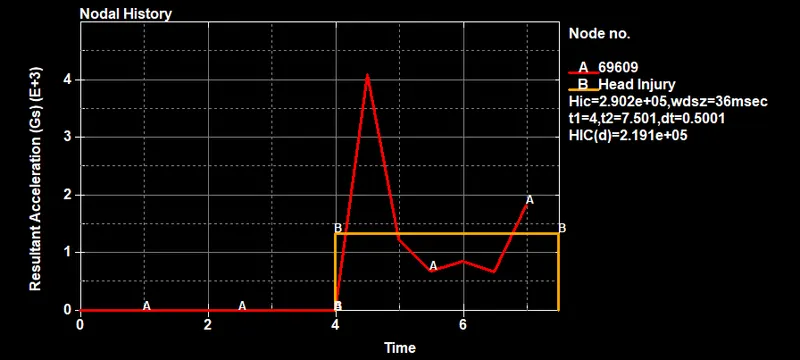
The HIC value of a node located about three fourths of the distance from the point of impact is about 2.9e5 as shown in the plot below.
CASE 2
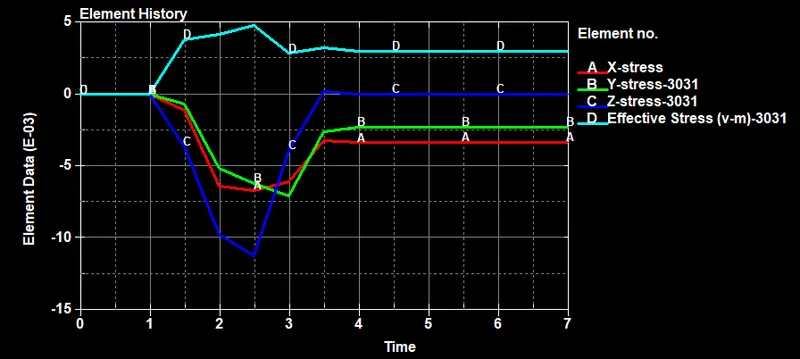
The stress plots of an element 3031 located at the point of impact is shown below. It can be seen that high stress are formed when the head impacts the rigidwall.
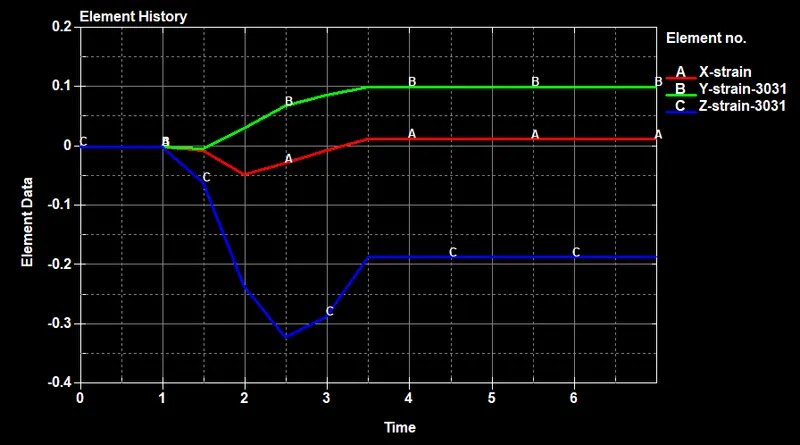
The strain plots of the same element is shown below.
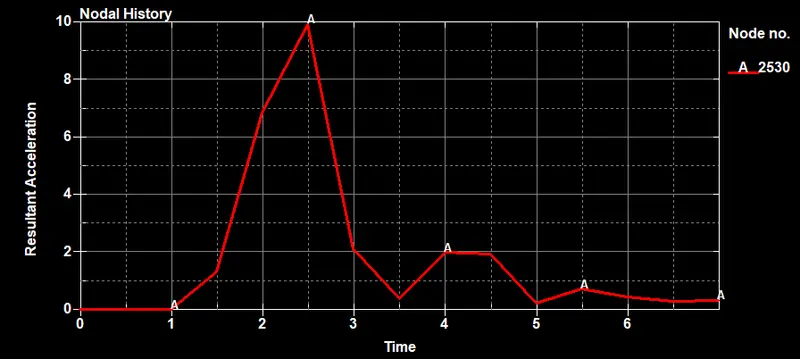
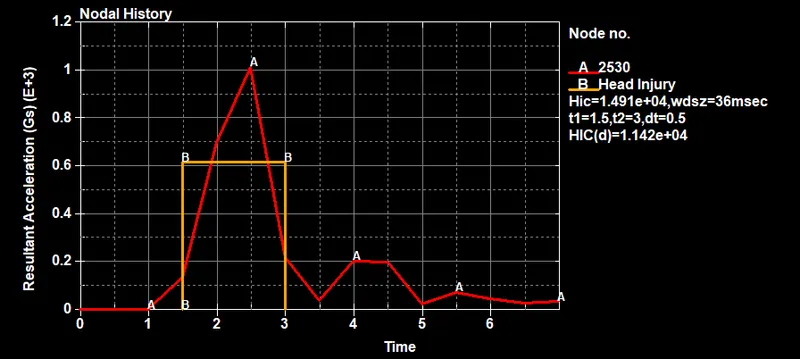
The acceleration plot of node 2530 is shown below.
The HIC of node 2530 is shown below.
CASE 3
The stress plots of an element 3031 located at the point of impact is shown below. By comparing the stress plots of the same element 3031 from case 2 we can see that the stresses developed in this case is about 30 percent lower than case 2. This is due to the fact that the hood deforms as the head hits it. Some amount of energy from impact is used to deform the hood resulting in lesser reaction forces to the head.
In case 2, as the head hits a rigidwall the reaction forces are higher resulting in high stress to the head.
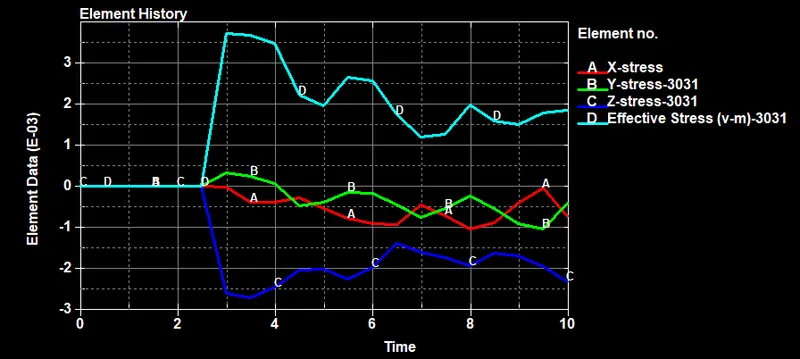
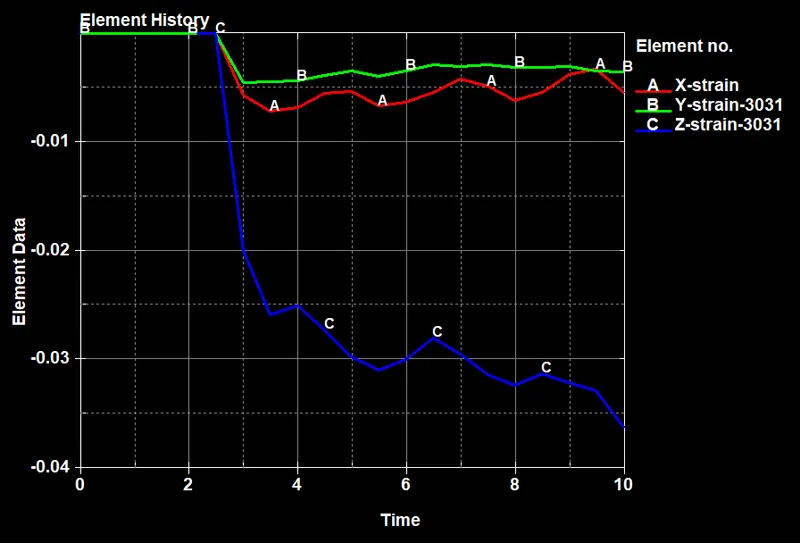
The strain plots of the same element 3031 is shown below. It can be seen that the maximum strain developed in this case is only around 10 to 15 percent of the maximum strains developed in case 2 for the same element. This is due to the fact that the hood also deforms during impact resulting in less reaction forces to the head.
The HIC of node 2530 is shown below.The hic value of the node is 1676. When we compare the HIC value of the same node in case 2 we can observe that the HIC value is one order greater than in this case. This shows us that the there is a very high possibility of a fatal injury in case 2. While in case 3 the HIC value is much much lower . This is also because the hood deforms and absorbs some energy to do some work. That is to bend the metal.
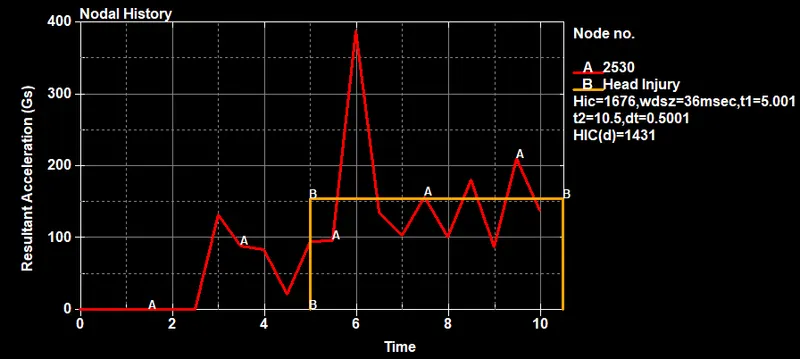
The acceleration plot of node 2530 is shown below.The peak acceleration of the node 2530 is only about 40 percent of the same node in case 2.
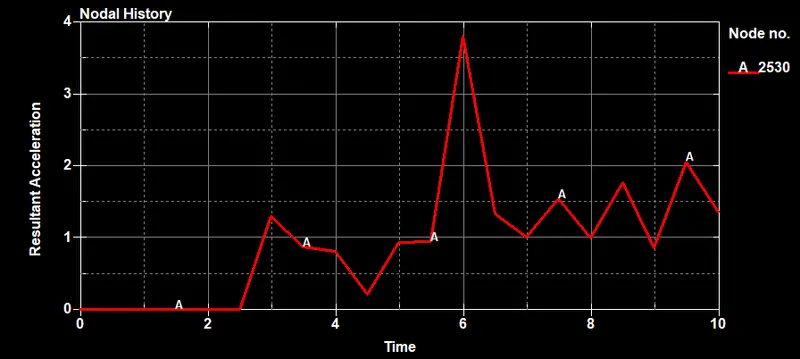
Therefore it is observed that for pedestrian safety a deformable hood is preferable as it will increase the chances of survival for the pedestrian during an imapct.