Week - 2 - Explicit and Implicit Analysis
An explicit analysis is used to find the current state of a system (which may be displacement after a force is applied or the angle of twist after a torque is applied) by using available boundary values and the constants that we may have measured for a system. Here the methord is to incrementally solve the system in finite no of steps by incrementally increasing the variable value that we have given. (i.e force in the case for finding force v/s displacement curve) and then we solve for the other variable which we want to find out with the help of boundary conditions. Here we are using explicit methord since we don’t know the relation connecting the two variables. For example the direct relation of force and displacement, in a particular system. In explicit methord, for finding the current state ,previous state is only considered.
Implicit analysis is the same as explicit analysis except that we find the current state of the system by solving equation that includes both current and previous states of the system.
In the case of a system in which a force is applied to a horizontal bar at one end, and the other end fixed , while finding the force displacement relation using explicit methord, the external and internal forces may not be necessarily in equilibrium thereby increasing error. In explicit methord of solving we correct the displacement by checking whether the residual falls in an acceptable value using newton raphsons iterations. Each iterations will be solved using the current and previous values of the variable we are trying to find out.
AIM
The aim of this challenge is to study the difference between the implicit and explicit methords of solving equations.Here we take the example of a function as `F(u) = u^3+9u^2+4u`and try to solve it using both the methords and study the difference of both the explicit and implicit methords of solving.
EXPLICIT METHORD
`F(u) = u^3 +9u^2+4u`
`K(u)= (d(F))/(du)`
step 1:
`u_0 =0` `=>``K(u_0 ) =4` ,`Delta F=1`
`Deltau_1 =(Delta F)/(k(u_0 ))=1/4=0.25` , `u_1=u_0+Deltau_1=0+0.25=0.25`
step 2:
`k(u_1)=3*0.25^2+18*0.25+4=8.6875`
`Delta u_2=(Delta F)/(k(u_1 ))=1/8.6875=0.1151`
`u_2=u_1+Deltau_2=0.1151+0.25=0.3651`
step 3:
`Delta F=1 ,k(u_2)=3*0.3651^2+18*0.3651+4=10.971`
`Deltau_3=(Delta F)/(k(u_2 ))=1/10.971=0.0911`
`u_3=u_2+Deltau_3=0.3651+0.0911=0.4562`
`F_(ext)=Delta F+Delta F+Delta F=3`
`f_i= u^3+9u^2+4u= 0.4562^3+9*0.4562+4*0.4562=3.7928`
`F_(ext)-f_i=3.7928-3=0.7928`
| step | `DeltaF_i` | `u_i` | `Deltau_i` | `(F_(ext))_i` | `(f_i)_i` | residual |
| 1 | 1 | 0.25 | 0.25 | 1 | 1.5781 | 0.5781 |
| 2 | 1 | 0.3651 | 0.1151 | 2 | 2.7087 | 0.7087 |
| 3 | 1 | 0.4562 | 0.0911 | 3 | 3.7928 | 0.7928 |
IMPLICIT METHORD
`u_0 =0`,`K(u_0)=4`,`Delta F=1`
`Deltau_1=(Delta F)/(k(u_0 ))=1/4=0.25`
`u_1=u_0+Deltau_1=0+0.25=0.25`
checking residual 1
R=`f_i-F_(ext)=0.5781`
`normR>10^-2`, therefore newton raphson iterations are necessary`
`deltau^(1)=-[k(u_1^((0)))]^-1R^(0)=-(8.6875)^-1*0.5781=-0.06654`
`u_1^((1))=u_1^((0))+deltau^((1))=0.25-0.06654=0.1834`
checking the residual again,
`R^((1))=f_i-F_(ext)=1.0424-1=0.0424`
`deltau^((2))=deltau^((1))-[k(u_1^((1)))]^-1R^(1)=-0.06654-[7.4021]^-1*0.0424=-0.0722`
`u_1^((2))=u_1^((0))+deltau^((2))=0.25-0.0722=0.1778`
`R=f_i-F_(ext)=1.00133-1=0.00133`
`normR<10^-2`,therefore no further iterations are necessary.
Therefore final value of `u_1=u_1^((2))=0.1778`
step 2:
`K(u_1)=7.2952`
`Delta F=1, Deltau_2=(Delta F)/(k(u_1 ))=1/7.2952=0.137`
`u_2=u_1+Deltau_2=0.1778+0.137=0.3148`
checking the residual,
`R=f_i-F_(ext)=2.1822-2=0.1822`
`normR>10^-2, deltau^(1)=-[k(u_2^((0)))]^-1R^(1)=-[9.9636]*0.1822=-0.01828`
`u_2^((1))=u_2^((0))+deltau^((1))=0.3148-0.01828=0.29652`
`norm(R^(2))=2.003468-2=0.003468``norm(R^(2))<10^-2`
`u_2^((1))=u_2^((0))+deltau^((1))=0.3148-0.01828=0.29652`
step 3:
`Delta F=1`
`k(u_2)=9.6011`
`Deltau_3=(Delta F)/(k(u_2 ))=1/9.6011=0.1415`
`u_3=u_2+Deltau_3=0.29652+0.10415=0.40067`
`u_3=u_3^((0))`
checking the residual,
`R=f_i-F_(ext)=3.1118-3=0.1118`
`normR>10^-2`
`deltau^(1)=-[k(u_3^((0)))]^-1R^(0)=-1/11.6936*0.1118=-0.00956`
`u_3^((1))=u_3^((0))+deltau^((1))=0.40067-0.00956=0.39111`
`R=f_i-F_(ext)=3.00097-3=0.00097`
`norm(R^(1))<10^-2`
therefore `u_3=u_3^((1))=0.39111`
| step | `DeltaF_i` | `u_i` | `(F_(ext))_i` | `(F_i)_i` | R |
| 1 | 1 | 0.1778 | 1 | 1.00133 | 0.0013 |
| 2 | 1 | 0.29652 | 2 | 2.0034 | 0.0034 |
| 3 | 1 | 0.39111 | 3 | 3.00097 | 0.00097 |
CONCLUSION
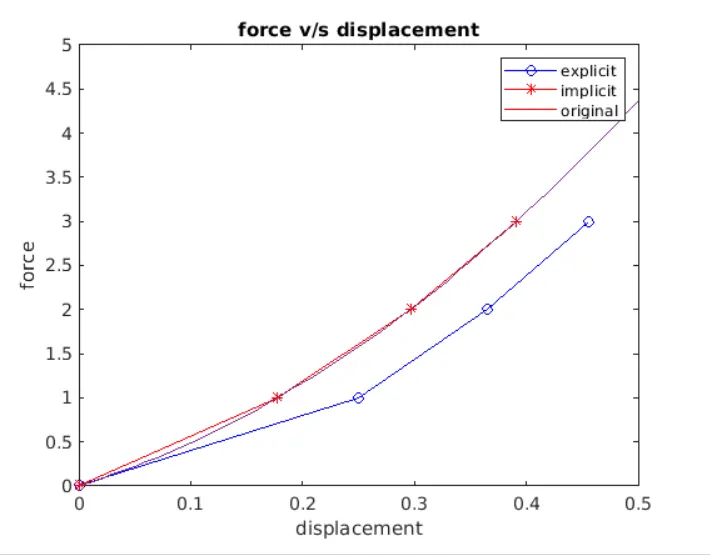
Both explicit and implicit methords of solving are important in the case of solving finite element analysis problems.The implicit methord gives more accurate results but at the cost of more computational time.The explicit methord gives results that are not nearly as good (but gives results faster due to low computation required) and can be used to get the rough idea of the solution for a problem. So both methords can be used interchangabily depending on the situation.
PLOTS
The plots have been generated using matlab and is attached below. The code used for generating it is given below.