Week-7 Head Impact
Aim:
The aim of the challenge is to perform the simulation of the head impact of a pedestrian hit by a vehicle and calculate the Head Injury Criterion (HIC). Also the aim was to learn the use of the keywords like *INCLUDE, *INCLUDE_TRANSFORM and *DEFINE_TRANSFORMATION. The challenge involved 3 cases with progressively increasing complexities in the analysis. Case 1 involves the simple head colliding with a rigidwall. Case 2 involved the impact of PEDESTRIAN_HEADFORM with a rigidwall. Case 3 involves the impact of the PEDESTRIAN_HEADFORM with a bonnet hood.
Explanation:
Case 1
Case 1 involves the impact of a simple head with a rigidwall.
For this simulation, the SIMPLE_HEAD_MODEL.k file was used directly, without the use of *INCLUDE keyword, as the the simple head was just a simple hollow sphere. THe *INCLUDE_TRANSFORM keyword would not have made any difference to the geometry of the head.
A planar rigidwall with normal along negetive X-direction was created.
The simple head was provided with the SHELL section with 1 mm thickness. The material was modelled using MAT_001_ELASTIC and using the properties of steel. The unit system used was kg-mm-ms.
As the head involved SHELL elements the HOURGLASS control was also given. The termination time was given as 10 ms.\
Ininitally the unit system used was kg-mm-us, in which the velocity was given in mm/us. But the velocity of 40kmph converted in this unit system proved to be very high. As a result the timesteps proved to be bigger and could not capture the head imapct with the rigidwall.
Hence, a new simulation was run, in which the unit system used was gm-mm-ms. The head was given an initial velocity of 21 kmph i.e. 6 mm/ms in the positive X-direction. Also the size of the timestep was reduced to 0.05 ms to better capture the head impact.
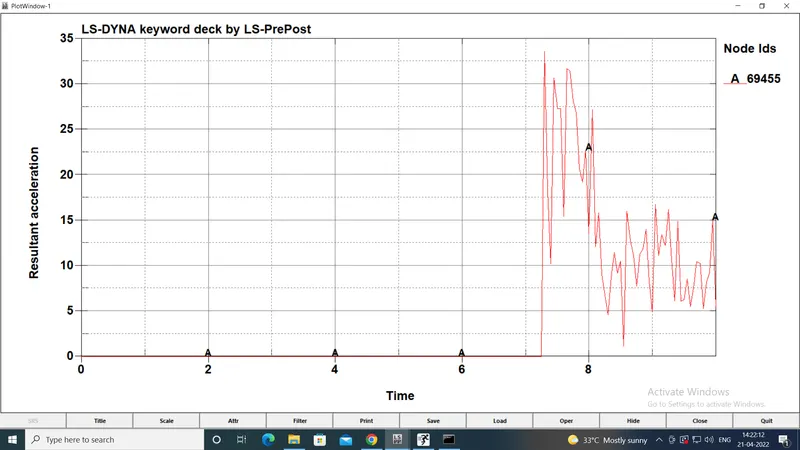
The output for stresses and strains was requested using *DATABASE_BINARY_d3plot. *DATABASE_HISTORY_NODE was used to get output of nodal acceleration and HIC values. In *DATABASE_ASCIIoption NODOUT was selected with the DT of 0.05 ms.
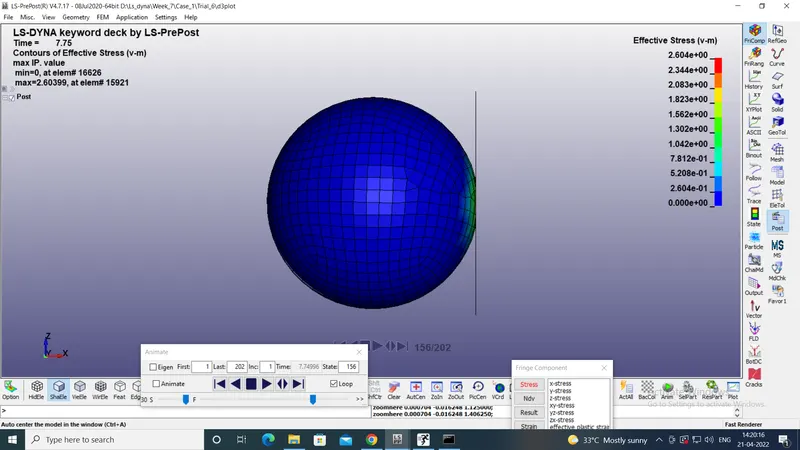
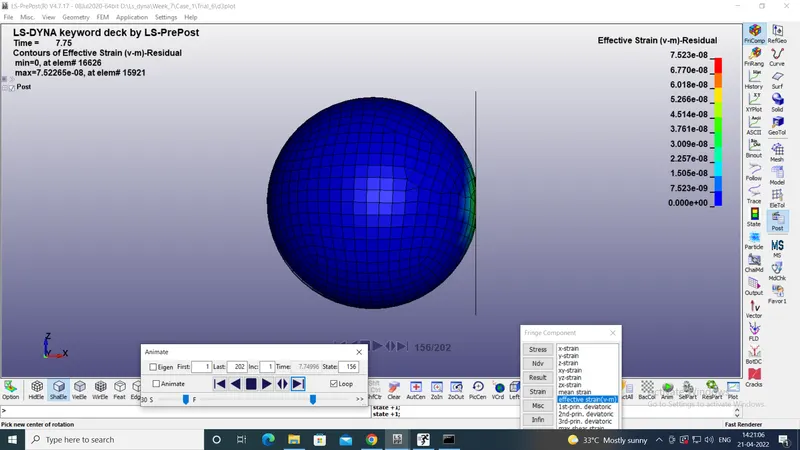
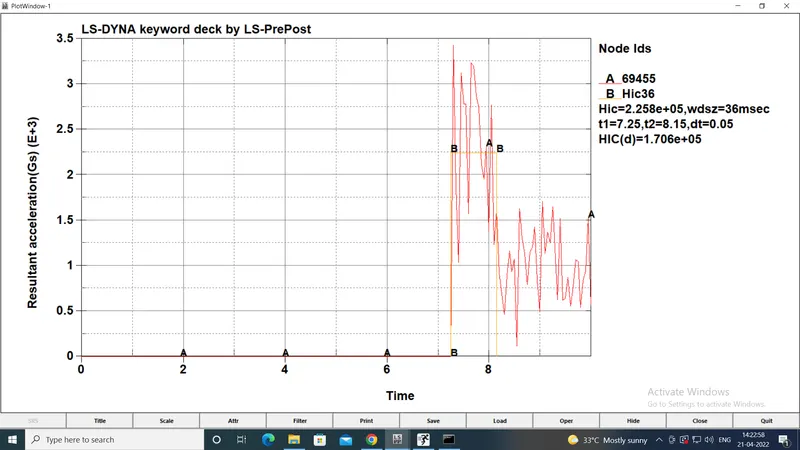
The results of the simulation are shown below as stress, strain, acceleration and HIC plots.
Case 2
Case 2 involved the impact of the use of the PEDESTRIAN_HEADFORM. This simulation was done in 2 different cases: Case 2a and Case 2b.
Case 2a
For this simulation a new .k file with a planar rigidwall was created first. The rigidwall was vertical with normal in negative x-direction.
Then the *DEFINE_TRANSFORMATION keyword was used to define the transformation criteria. The TRANID was given as 1. In this card the cos values for a line parallel to Y axis were used i.e. 0-1-0. Further the line passing through the origin was used. Thus effectively, the head was rotated around the Y-axis. The rotation angle was given as -45 degrees to rotate the head in anti-clockwise direction.
Then the *INCLUDE_TRANSFORM keyword was used to INCLUDE the PEDESTRIAN_HEADFORM.k file and the TRANID was given as 1 to use the defined transformation criteria.
The unit system used was Kg-mm-ms.
Then the pedestrian headform was given the initial velocity. The velocity was to be given in the oblique direction. Hence the X and Z components for the velocity of 6 mm/ms were calculated and provided as the Vx and Vz in the initial velocity card.
The termination time was given as 20 ms.
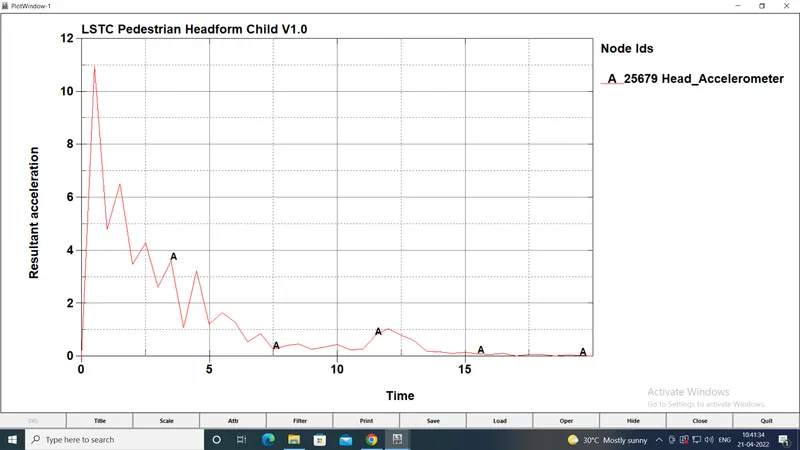
The output was requested as the d3 plot for stresses and strains with DT (timestep) of 0.5 ms. The acceleratometer was already provided in the PEDESTRIAN_HEADFORM.k file. In the *DATABASE_ASCIIoption NODOUT was used with the DT of 0.5 ms.
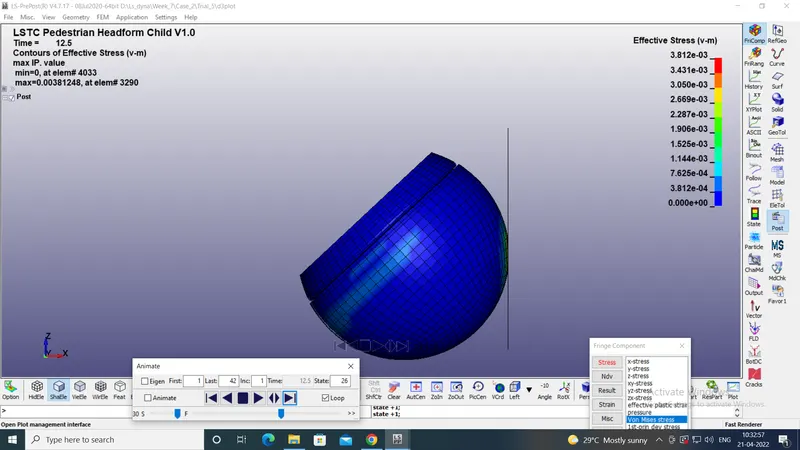
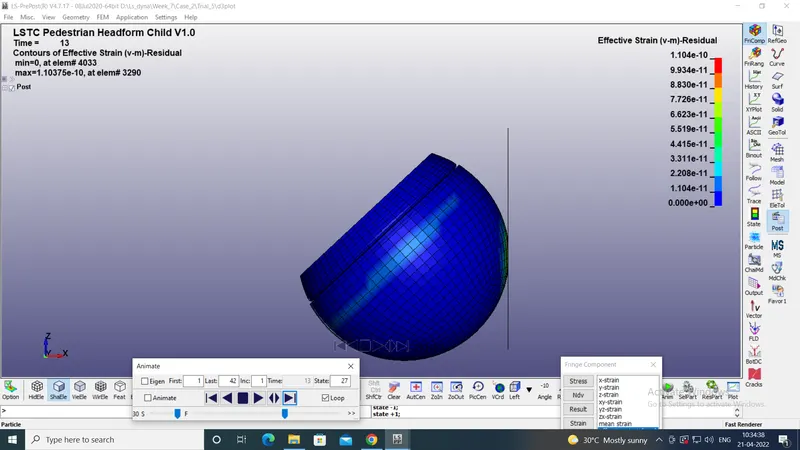
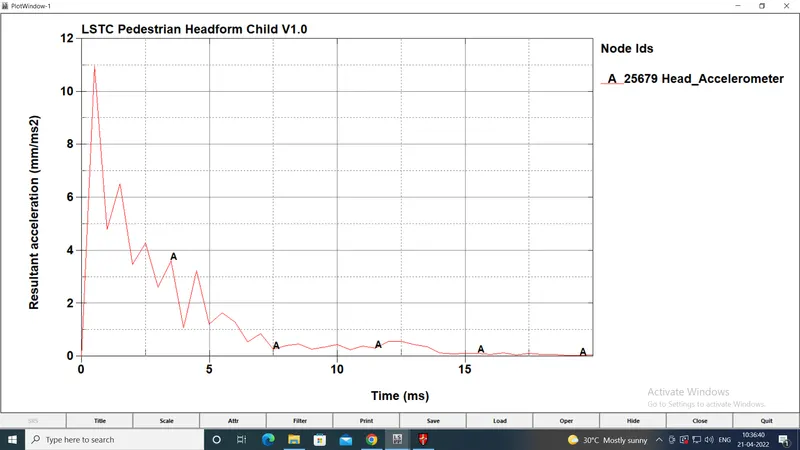
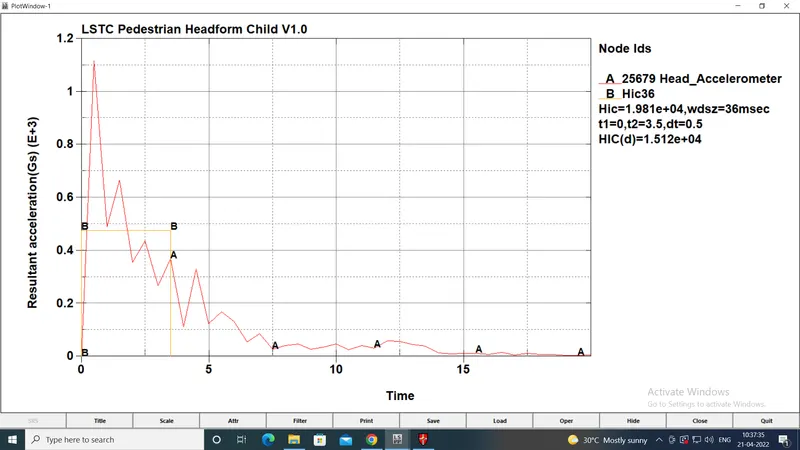
The results for stresses, strains, nodal acceleration and HIC are provided below:
Case 2b
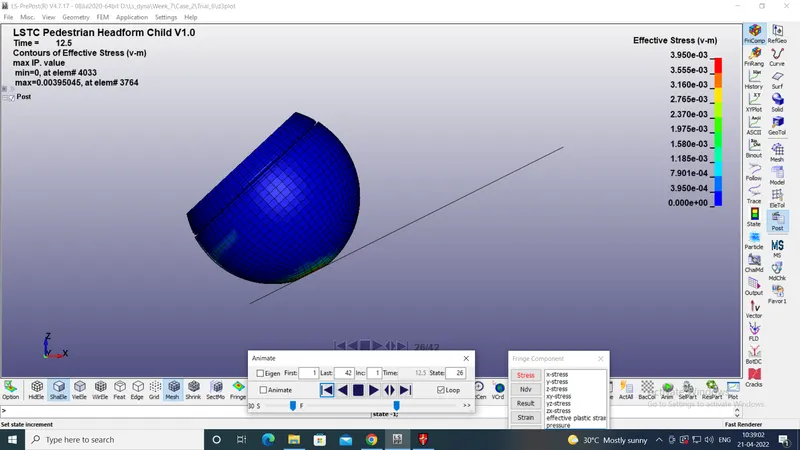
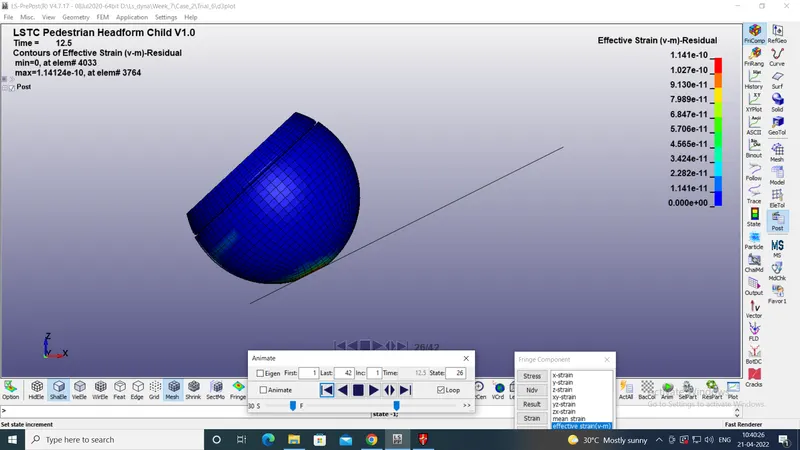
In this case, to better simulate the effect of the bonnet hood, the rigidwall was rotated so that it made an angle of 30 degrees with the horizontal plain.
All the other setup was same as in Case 2a.
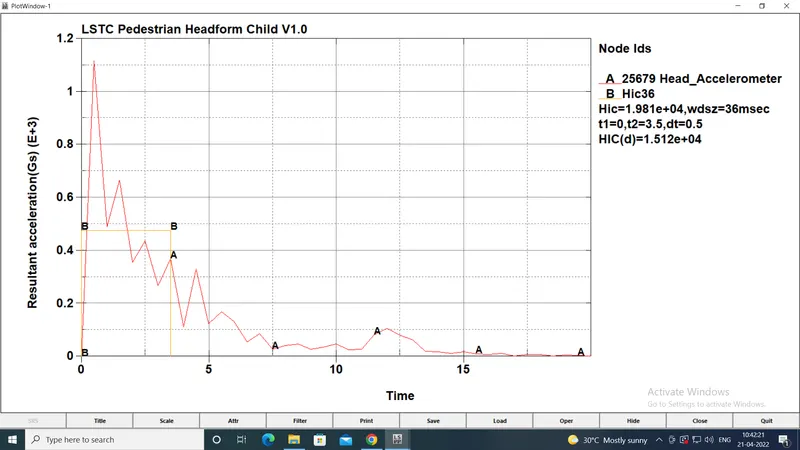
The results are shown below:
Case 3
This case involved the actual simulation using the PEDESTRIAN_HEADFORM.k file and the MESHED_HOOD.k file.
First, a new file called Main.k was created in which the *DEFINE_TRANSFORMATION keyword was used to define the transformation criteria. The TRANID was given as 1. In this card the cos values for a line parallel to Y axis were used i.e. 0-1-0. Further the line passing through the origin was used. Thus effectively, the head was rotated around the Y-axis. The rotation angle was given as 45 degrees to rotate the head in clockwise direction.
Then the *INCLUDE_TRANSFORM keyword was used to INCLUDE the PEDESTRIAN_HEADFORM.k file and the TRANID was given as 1 to use the defined transformation criteria.
Then the *INCLUDE_INCLUDE keyword was used to include the MESHED_HOOD.k file in the Main.k file.
The bonnet hood was given the SHELL section with ELform 2 and thickness of 2 mm. The hood was given a Elastic-plastic material using PIECEWISE_LINEAR_PLASTICITY card in *MAT keyword. The properties of aluminium were used. The unit system used was the kg-mm-ms.
The bonnet hood was given the fixed boundary condition using the *BOUNDARY_SPC card. The nodes were chosen using "By path" option and the nodes on the bottom edge of the hood were fixed in all 6 DOFs.
Then the pedestrian headform was given the initial velocity. The velocity was to be given in the oblique direction. Hence the X and Z components for the velocity of 6 mm/ms were calculated and provided as the Vx and Vz in the initial velocity card.
The termination time was given as 40 ms.
The output was requested as the d3 plot for stresses and strains with DT (timestep) of 0.5 ms. The acceleratometer was already provided in the PEDESTRIAN_HEADFORM.k file. In the *DATABASE_ASCIIoption NODOUT was used with the DT of 0.5 ms.
When the simulation was run, it terminated showing the error that "part ID 2000330 is repeated". To solve this error, the Main.k file was opened in Notepad and the Part ID and definition for Meshed_hood were deleted.
There was another error saying "part ID 2000330 with section ID 0 does not exist". To solve this error, the Meshed_hood.k file was opened and the material properties of aluminum and section properties using MAT ID and SECID were provided.
Also in the final d3 plot the head was seen to be passing through the hood after collision. To remedy this, the *CONTACT keyword was used to give AUTOMATIC_NODES_TO_SURFACE contact between the head and the hood. The headform was made the slave part and the hood was made the master part.
When the simulation was run, again it terminated showing the error "negative volume in solid elements". This was happening because the material properties of the hood were mistakenly entered in the gm-mm-ms unit system, while those of the headform were in kg-mm-ms system. The material properties of the hood material were converted into kg-mm-ms system and the simulation was run. It ran smoothly and there was normal termination.
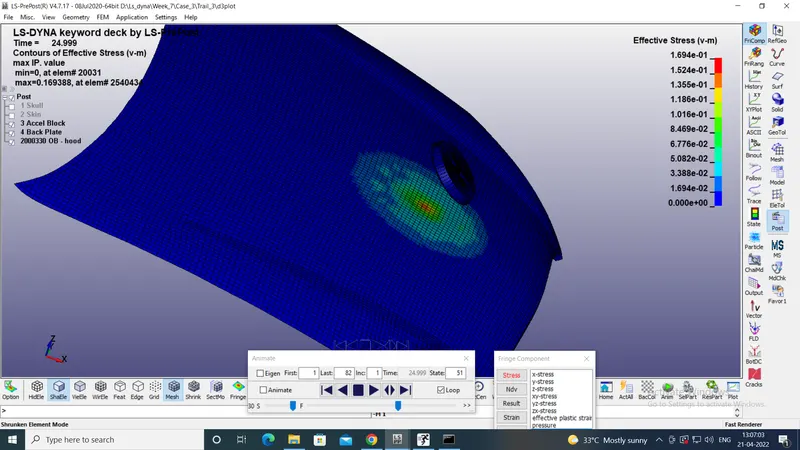
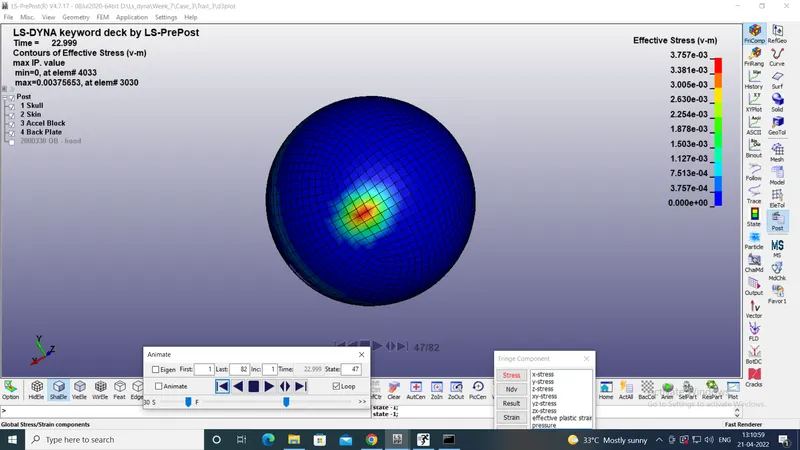
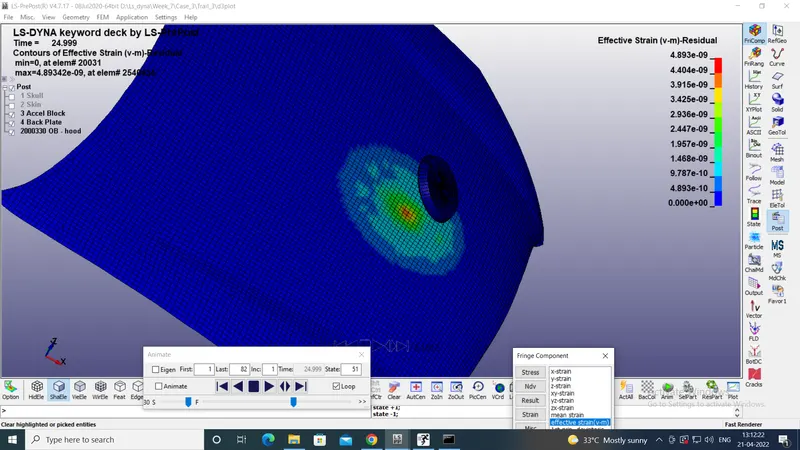
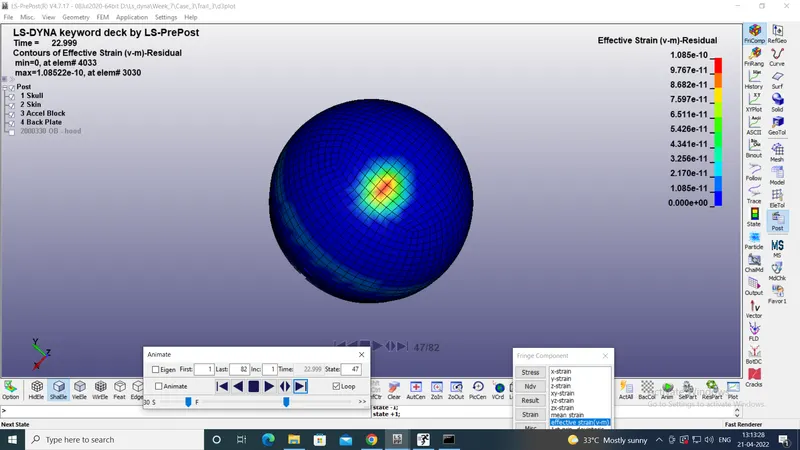
The results for stresses, strains, nodal acceleration and HIC are provided below:
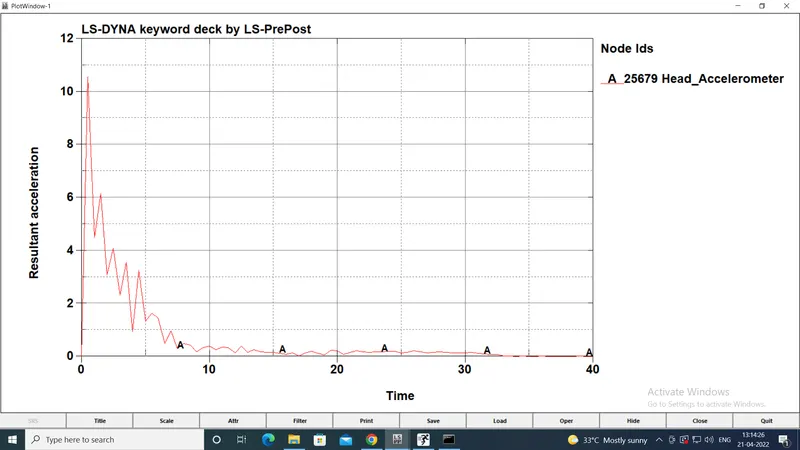
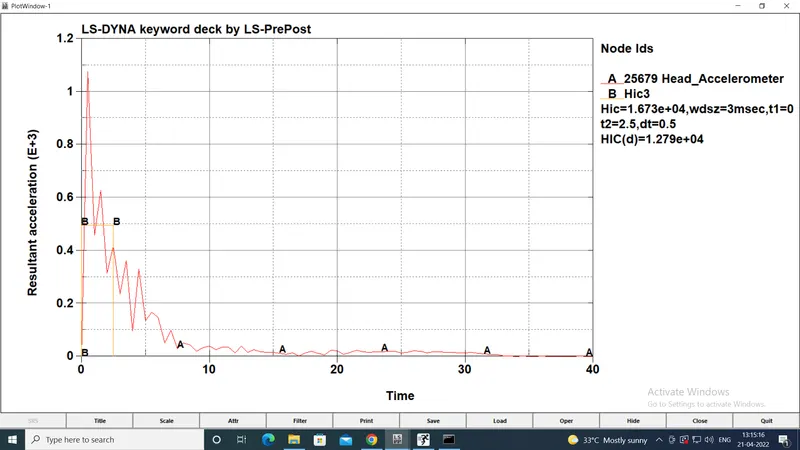
| Case | Max. von mises stress in the head | Max. von mises strain in the head | HIC (mm/ms) |
| 1 | 2.604 | 7.523e-08 | 225800 |
| 2a | 3.812e-3 | 1.104e-10 | 19810 |
| 2b | 3.950e-3 | 1.141e-10 | 19810 |
| 3 | 3.757e-3 | 1.085e-10 | 16730 |
The above table makes it clear, that the stress, strain and HIC values are the highest in the Case 1. This is because in the Case 1 the Simple Head was used and the material given for it was steel. Also the the head collided the rigidwall in the perpendicular direction. These two factors caused the high values of stress, strain and HIC.
In case 2, the stress and strain values are marginally higher in Case 2b. This is because in Case 2a the rigidwall was vertical, but the velocity was in oblique direction. But in the Case 2b, the rigidwall was also rotated. This resulted in the perpendicular impact of the head on the rigidwall, which resulted in higher values in Case 2b. But the HIC values are same in both the cases, because the acceleration plot is similar in both cases.
In case 3, the values of the stress, strain and HIC values are the lowest. This is because the bonnet hood was assigned an elastic-plastic material like aluminium, which made it less rigid than the rigidwall used in earlier 3 cases.
Conclusion:
The challenge was a good learning opporutnity to learn *INCLUDE, *INCLUDE_TRANSFORM and *DEFINE_TRANSFORMATION keywords and the concept of HIC. The challenge underscored the importance of angle of impact, velocity of the vehicle and the material of the bonnet on the value of the HIC.