Week-7 Challenge: DC Motor Control
2)
Link : https://drive.google.com/file/d/1wb9b55QpD5F02oBcohWF7gf9pPiy8Byb/view?usp=sharing
2nd-Quadrant Chopper
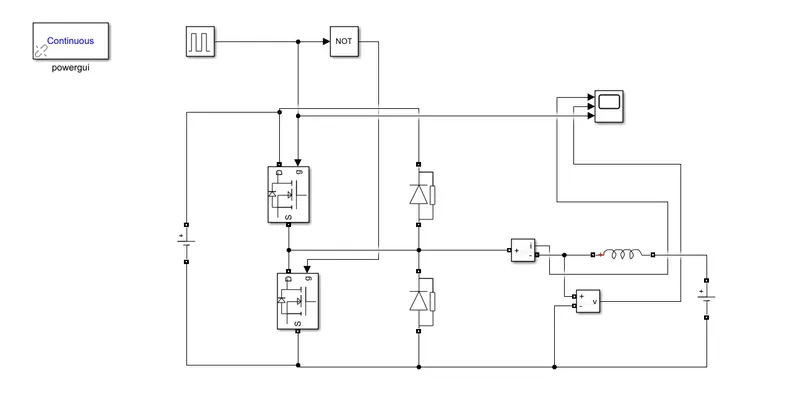
A 2-Quadrant chopper generally operates in 2 quadrants. By saying that it means voltage across the load will always be positive unlike current which may be positive or negative.As can be seen from the circuit both the MOSFETs will never be conducting at the same time as the signals inserted at the gates of the MOSFETs are such that when one is on another will be off. Duty cycle of the pulse generator is 50% that means both the MOSFETS will be on for equal amount of time.
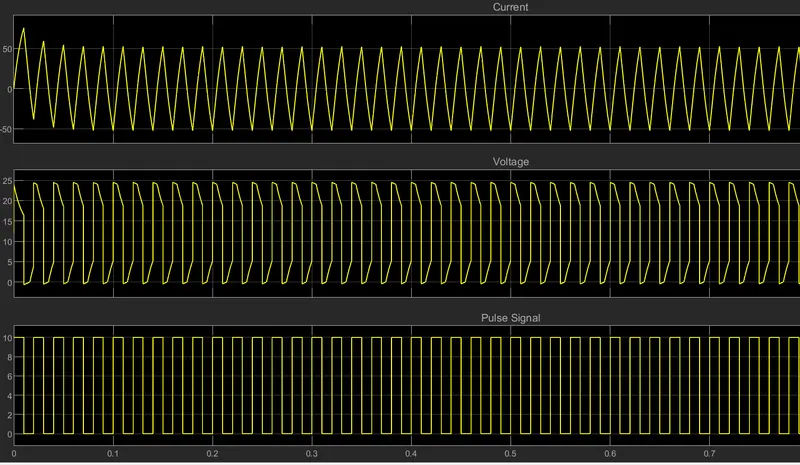
When the upper MOSFET is on ,current will be flowing through load in positive direction and the voltage measured across the load will also be positive.When the upper MOSFET is switched off current will start decreasing but will be flowing in positive direction only through the freewheeling diode (lower one).Process occurs in first quadrant with both voltage and current positive.
Now when the lower MOSFET is switched on the current will start flowing in negative direction and when the MOSFET is switched off again the current will be flowing through the upper diode in negative direction only. This happens in the second quadrant.
3) BLDC Motor
BLDC stands for Brushless DC motor. It is an electronically commuted DC motor which does not have brushes. The controller provides pulses of current to the motor windings which control the speed and torque of the synchronous motor.
These types of motors are highly efficient in producing a large amount of torque over a vast speed range. In brushless motors, permanent magnets rotate around a fixed armature and overcome the problem of connecting current to the armature. BLDC motors are known for smooth operation and holding torque when stationary.
In brushes motors, there are permanent magnets on the outside and a spinning armature which contains electromagnet is inside. These electromagnets create a magnetic field in the armature when the power is switched on and help to rotate the armature.The brushes change the polarity of the pole to keep the rotation on of the armature. The basic working principle for the brushed DC motor and for brushless DC motor are same i.e. internal shaft position feedback.
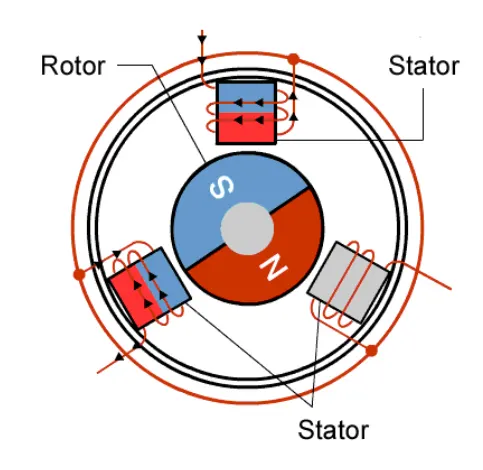
Brushless DC motor has only two basic parts: rotor and the stator. The rotor is the rotating part and has rotor magnets whereas stator is the stationary part and contains stator windings. In BLDC permanent magnets are attached in the rotor and move the electromagnets to the stator. The high power transistors are used to activate electromagnets for the shaft turns. The controller performs power distribution by using a solid-state circuit.