Week-4 Challenge WOT Condition Part-2
1)
|
Mapped Model |
Dynamic Model |
|
It uses a set of steady-state lookup tables to characterize engine ,motor or generator’s performance. |
Model decomposes the engine ,motor or generator behavior into engine, motor or generator characteristics that are separated into lower-level components. By combining components in this way, the models capture the dynamic effects. |
|
It is faster. |
It is slower. |
Model type can be changed by using Variant Subsystem.
A Variant Subsystem block contains two or more child subsystems where one child is active during model execution. The active child subsystem is referred to as the active variant. You can programmatically switch the active variant of the Variant Subsystem block by changing values of variables in the base workspace, or by manually overriding variant selection using the Variant Subsystem block dialog. The active variant is programmatically wired to the Inport and Outport blocks of the Variant Subsystem by Simulink during model compilation.
Right clicking on the block ,the following list window will appear .
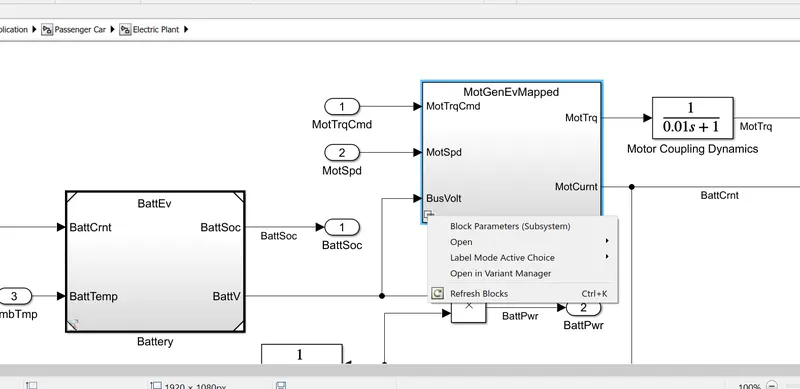
Here selecting " Label Model Active Choice", we can directly manually switch between the two :
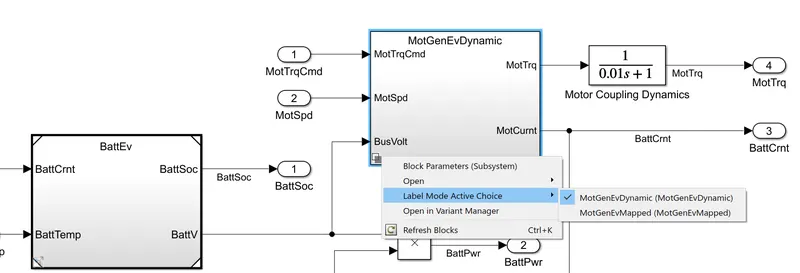
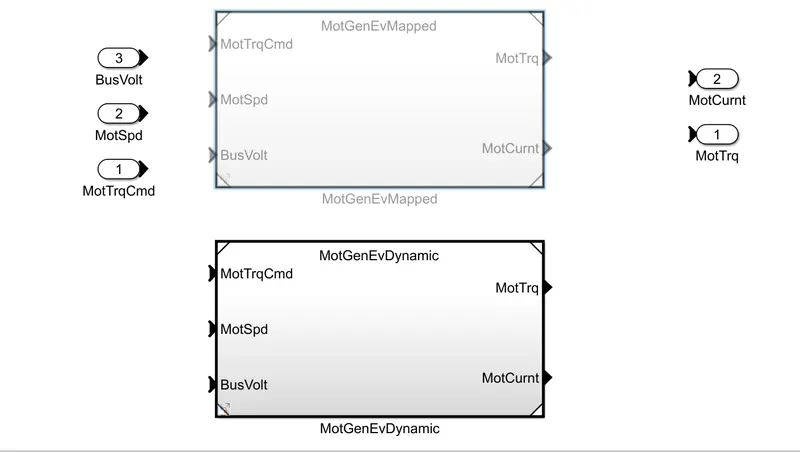
2)
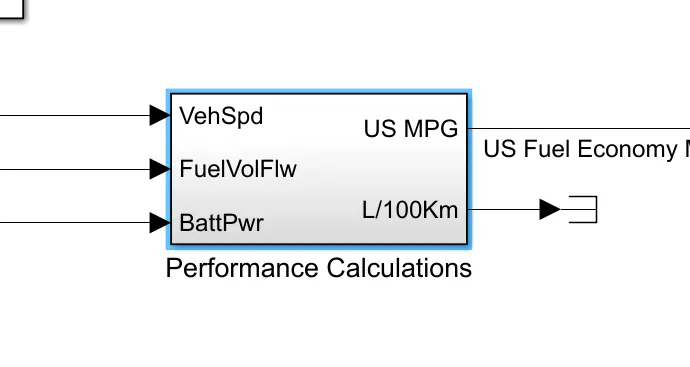
As it is visible from the block diagram , Miles per Gallon or MPG depends on the following factors :
1) Vehicle Speed
2) Fuel Vol flow
3) Battery power
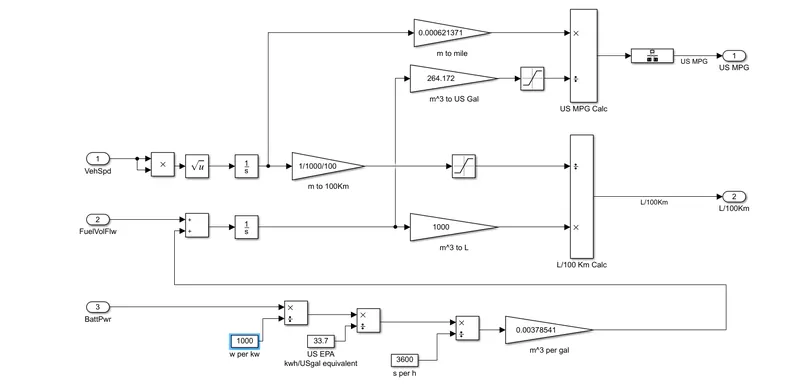
Vehicle speed is integrated to find out the distance in meters which is further multiplied with a factor 0.000621371 to convert into miles which is one of the inputs of the US MPG Calc block.
Now,this block is going to calculate the equivalent gasoline which means the amount of energy required by the battery.

Actually , there is a relation between the amount of energy provided by the battery with the amount of gasoline burnt by the engine and that is :
1 Gallon = 33 kWh ---------------- eq. 1
Focusing on the block,we are taking input as Battery power which is in Watts . This power has been converted into kW by dividing the power with 1000 . After this using eq 1, we are converting the 'kW' into 'Gallon/h'. And in the next step , hour has been converted into seconds so we will get Gallon/sec. Gain of 0.00378541 has been given to convert Galon/s into m^3/s as :
1 Gallon = 0.00378541 m^3
So with this entire implementation we are finally getting an equivalent fuel volume flow which will be added to the actual fuel volume flow of the hybrid vehicle.

The sum will then be integrated with respect to time to get the fuel volume in m^3 which is further converted into galon.
At the end using ,distance travelled in miles per gallon of gasoline is going to give the output i.e. US MPG.
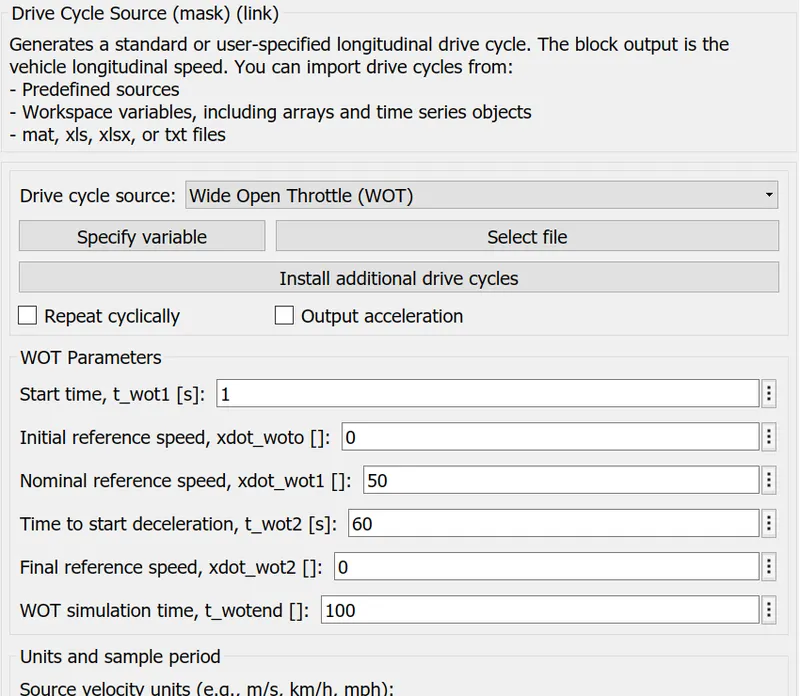
3) For the following WOT Driving Cycle :
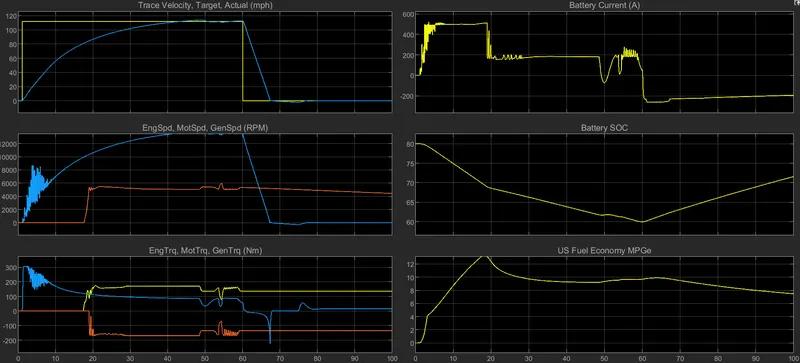
Case 1 : Grade & Wind velocity are 0. As can be seen the vehicle attains the max. desired speed of 112 mph after apprx 42-43 seconds. Reason behind this delay is the Engine Speed which also gradually increases.
Engine speed keeps on increasing but once it crosses 5000 RPM motor speed also comes into the picture.Till 60 seconds both engine and motor provides speed to the vehicle but once the vehicle starts deccelerting after 60th second,the engine speed also starts getting reduced.Due to this the battery which was getting discharged till now,starts getting charge due to regenerative force.
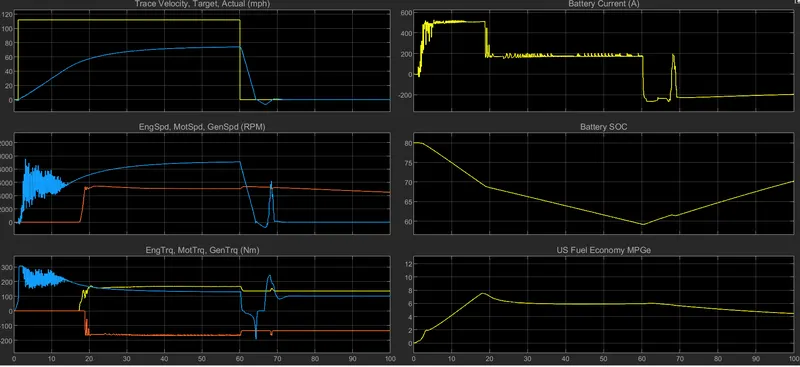
Case 2 : Gradient =8 ,Wind Velocity =0
With the introduction of gradient , speed of the vehicle reduces to 74 mph. Vehicle faces hill climbing force resistance.
Case 3 : Grade =0 ,Wind Velocity =8
With wind velocity =8, maximum speed of the vehicle reduces to 109.5 mph. Vehicle faces air-drag force resistance.
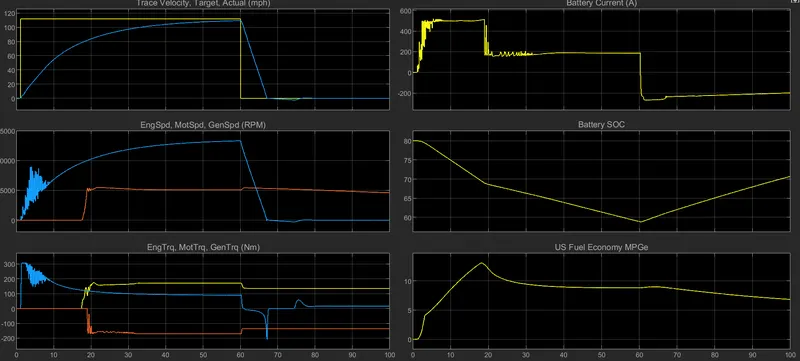
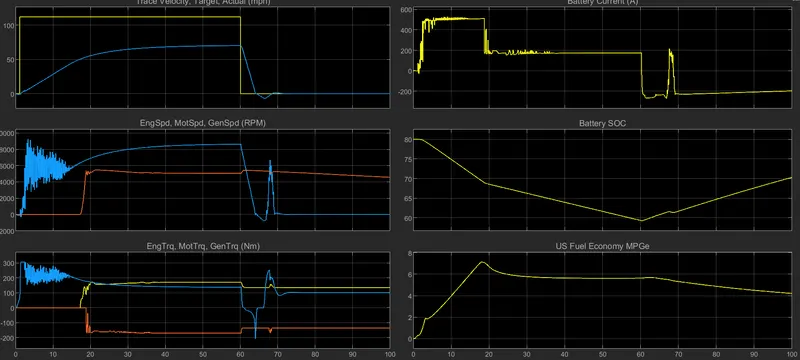
Case 4 : Gradient =8 , Wind Velocity =8
With grade & wind velocity both at 8 , speed of vehicle faces both of the hill climbing force & air-drag force resistances which as a result reduces the the speed of the vehicle to 70 mph.
4)
Given below are the results :
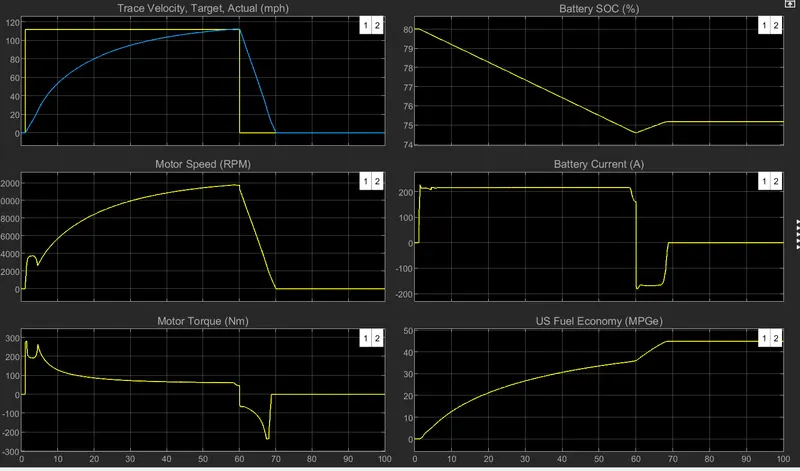
EV
Here the vehicle attains the maximum speed of 112 mph with WOT driving cycle after 55 seconds.
SOC decreases till around 74.5 %.
From 0-60 secs, battery current is arount 200.
HEV
Here the vehicle attains the maximum speed of 112 mph with the WOT driving cycle & same conditions after 42-43 seconds.
SOC decreases till 60 %.
From 0-20 sec ,battery current is around 500 A and once the motor comes into picture,battery current reduces to 200 A.