Week-6 Challenge: EV Drivetrain
1) Power converter circuits employed in electric and hybrid electric vehicles are :
i) DC-DC Converter ( Booster/Chopper)
ii) DC-AC Converter (Inverter)
iii) AC-DC Coverter (Rectifier)
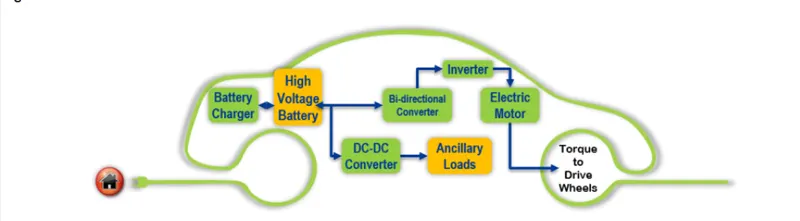
Electric Vehicle
Inverter (power electronic) takes direct current (DC) electricity from the battery and converts it to alternating current (AC) electricity and sends it to the motor. The electric motor (electric machine) uses the AC current to create torque (mechanical power) to power the wheels for propulsion.
Hybrid Electric Vehicle
HEVs use two electrical machines; one as a generator connected to the engine and another as a motor to drive the wheels. Each of these machines are connected to an inverter, and the two inverters run at a higher voltage than the battery. To achieve this high voltage, another power electronics device called a boost converter boosts the battery voltage before sending the DC electricity to the inverters.
During the regeneration mode both the vehicles generates energy and charge the batteries by converting AC to DC.
2) Vehicle speed-torque characteristics are given by the below equation :
T = 24.7 + (0.0051) w^2 -------------- eq 1
DC motor speed-torque equation can be obtained from the following :
w = (Vreq/kΦ) - (Ra /(kΦ^2))*T ------------ eq 2
Given :
Motor and Controller Parameters:
Rated Armature voltage= 72 V
Ra= 0.5Ω, KΦ= 0.7 Volt second
Duty cycle of the motor is 70% i.e. d1 = 0.7
Now required voltage by the motor is
Vreq = d1 * Rated Armature voltage = 0.7 * 72 V = 50.4 V
Putting the values in eq 2, simplified eqution would be :
w = 72 - 1.0204 T ------------- eq 3
Putting value of T from eq 1 in eq 3 ,following quadratic equation would be obtained:
0.0052 w^2 + w - 46.7961 = 0
solving this ,we wil get following 2 values
w= [-1 + sqrt(1 + 4*(0.0052) * 46.7961)]/0.0104 = 38.91
or
w= [-1 - sqrt(1 + 4*(0.0052) * 46.7961)]/0.0104 = -231.22
Hence, EV steady state speed is 38.91 rad/sec
3) Link : https://drive.google.com/file/d/1oltBHG5PL8-Z0f0WDfDRrc0Kcg3m49IV/view?usp=sharing
Input :
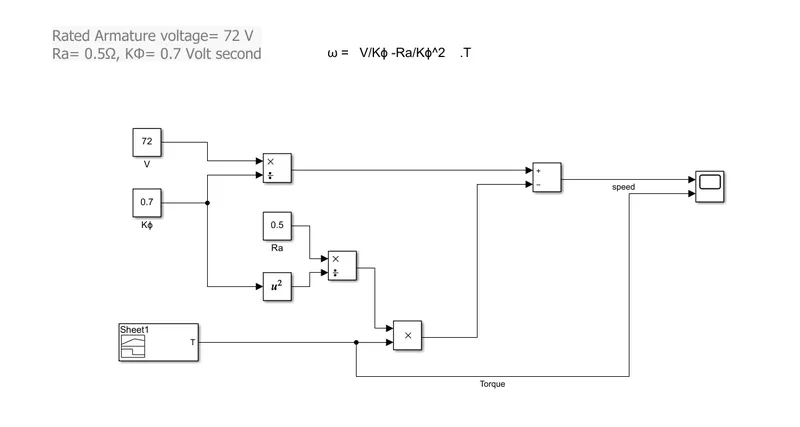
Output :
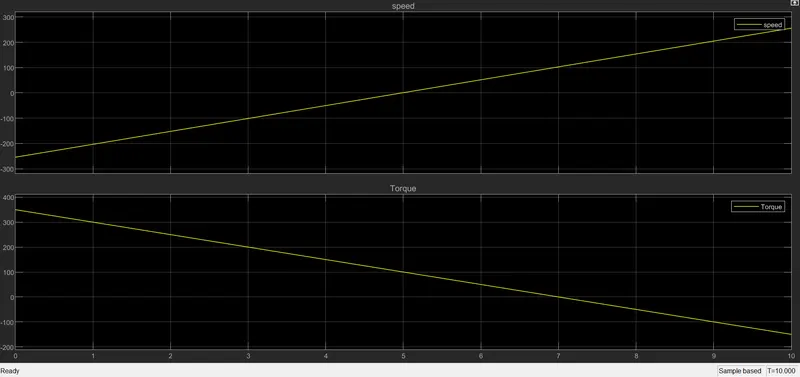
Conclusion : As the value of Torque decreases that of speed increases.
4)
Working Principle of DC brushless motor :
1) The stator is made of thin and stacked laminations. The stator interacts with the current flowing within its windings to produce a torque interaction between the stator and the rotor.
2) The Rotor here includes 2 or more permanent magneta that generate DC magnetic field. As the rotor rotates ,it is important that the magnitude and the polarity of the stator current be continuously varied so that torque remains constant and also achieving the efficiency.
3)For the functioning of DC brushless motor it is madatory to have an inverter without which it can't function.
Working Principle of Induction Motor :
1) The stator is the same as Induction motor. The only difference is that the rotor is different when compared to the BLDC motor.Induction motor does not have permanent magnets.The Induction motor does not mandatorily require an inverter to function but with the help of a small invereter, the efficiency of the Induction motor will increase.
2) Here the Rotor has stacked steel laminations with buried peripheral conductors that form a shorted structure. Currents flowing in the stator windings produce rotating magnetic fields that enter the rotor.
Pros & Cons of BLDC motor :
Pros:
Motor cn be used in flammable area as well s there is no chances of spark.Heaat generated from the rotor is less hence rotor cooling is easier .
cons:
1)Inverter(whose phase is maintained in a step with the angular position of the rotor) is mandatory without which DC Brushless motor is useless.
2) Magnetic field strength cannot be easily adjusted because of the permanent magnets.
3) In BLDC motor, as its size increases the magnetic losses also increase.
4)Permanent magnets are expensive.
Pros & Cons of Induction motor :
Pros:
1) No need for inverter, the motor has the ability to start under load.
2)Sice they do not have any magnets, controlling the magnetic field is easier.
3)Induction motors are less expensive w.r.t BLDC motor.
Cons:
1)They need to be operated on AC,DC can't run them.
2) When operated from utility power, they have limited starting torque and somewhat limited running peak torque capabilities when compared to DC type machines. Even by adding the inverter , the torque performance is low when compared to DC motor.