Week-3 Challenge: ADVISOR Tool
1)
The FTP-75 (Federal Test Procedure) has been used for emission certification and fuel economy testing of light-duty vehicles in the United States. The test is often referred to as simply ‘FTP’ (this should not be confused with the FTP test for heavy-duty engines).
The FTP-75 and the FTP-72 are two variants of the EPA Urban Dynamometer Driving Schedule (UDDS). The FTP-75 cycle is derived from the FTP-72 by adding a third phase of 505 s, identical to the first phase of FTP-72 but with a hot start. The third phase starts after the engine is stopped for 10 minutes. Thus, the entire FTP-75 cycle consists of the following segments:
- Cold start transient phase (ambient temperature 20-30°C), 0-505 s,
- Stabilized phase, 506-1372 s,
- Hot soak (min 540 s, max 660 s),
- Hot start transient phase, 0-505 s
Here the EV_defaults_in vehicle has been selected and rest all prameters have been kept constant.
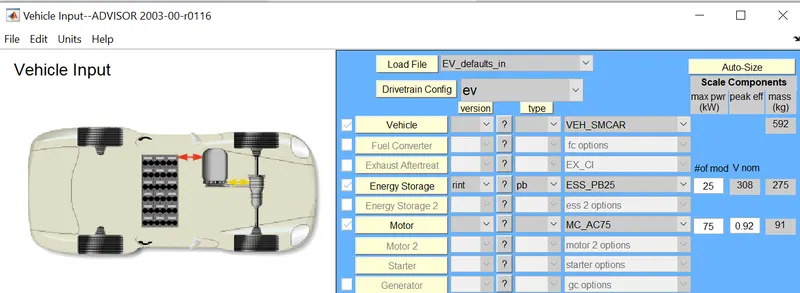
Cargo mass provided : 500 kg
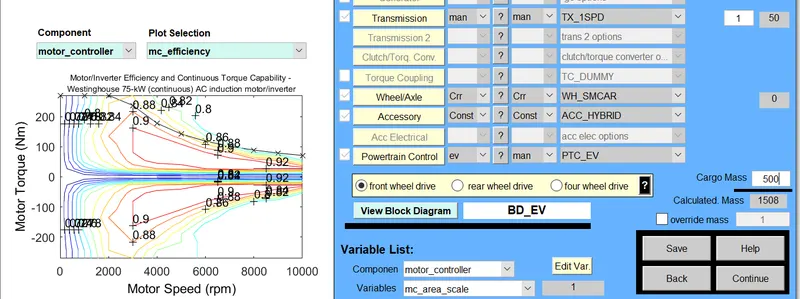
1 FTP cycle will be of total time 2477 seconds and it will cover 11.04 miles or 17.7 kms
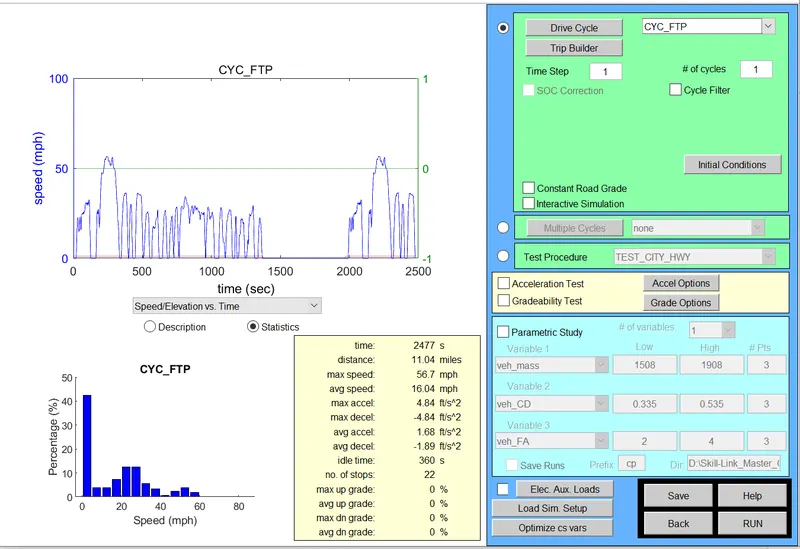
But as we have to check whether the vehicle can travel 45 kms with FTP drive cycle, we will try with the maximum number of cycles of FTP thet can be taken and i found it to be 3 cycles :
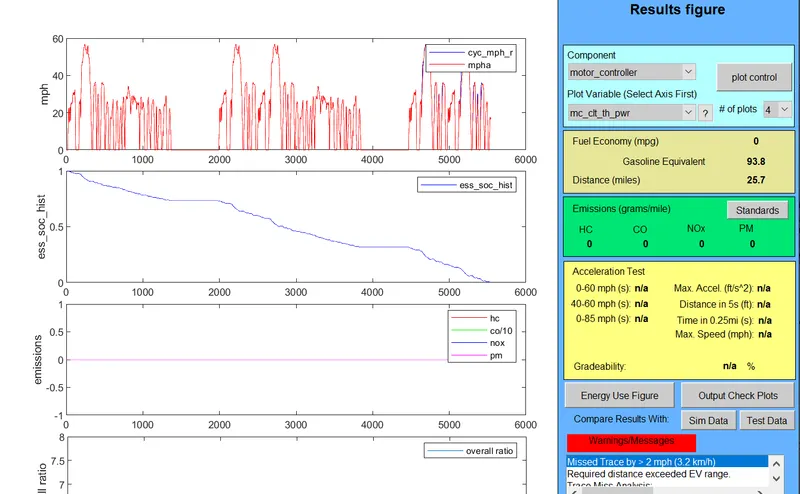
Even with maximum number of cycles vehicle can travel only 25.7 miles i.e. 41.36 kms.
2) Now we try to vary the battery capacity. By default 25 modules of battery has been provided
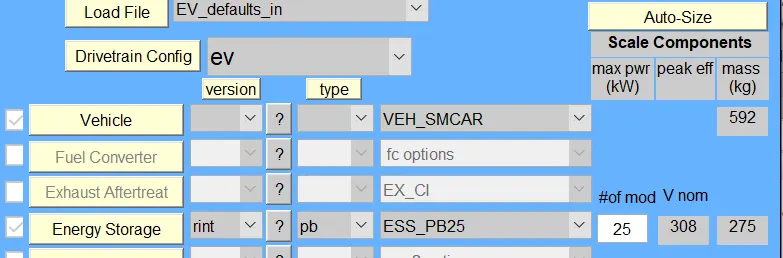
25 modules of battery provides nominal voltage of 308 V and mass of 275 kg.No if we exceed 10 more modules , we will have the following :
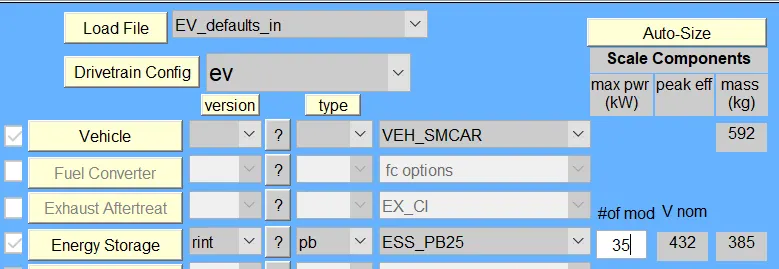
35 modules of battery will provide nominal Voltage of 432 V and mass be also increase to 385 kg.
Now keeping the same 500 kg of cargo mass as taken in the first case and with the same FTP driving cycle,we will obtain
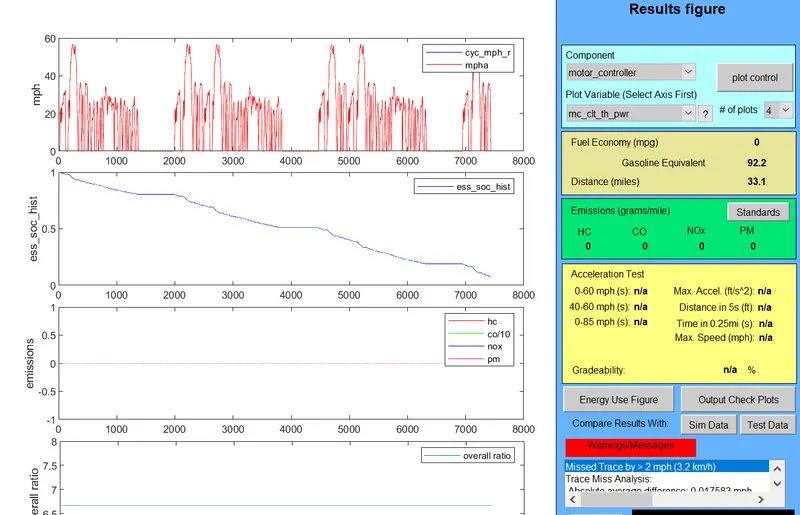
With the addition of 10 more modules ,the vehicle can travel now 33.1 miles i.e. 53.26 km.
3)
The Toyota Prius is a full hybrid electric automobile manufactured by Toyota since 1997. Initially offered as a 4-door sedan, it has been produced only as a 5-door liftback since 2003.
In 2007, the United States Environmental Protection Agency (EPA) and California Air Resources Board (CARB) rated the Prius as among the cleanest vehicles sold in the United States, based on smog-forming emissions. The 2018 model year Prius Eco ranked as the second-most fuel efficient gasoline-powered car without plug-in capability available in the US that year, following the Hyundai Ioniq Blue hybrid.
Prius Japan vehicle weight is 918 kg by default. Maximum power provided by the engine is 43 kW with a peak efficiency of 39 % and the engine has a weight of 137 kg. Also ,it has 40 modules of batteries with V nominal as 308 V and the entire weight of the battery module goes to 40 kg.
Cargo mass is 136 kg and hence the total calculated mass of the vehicle is 1332 kg.
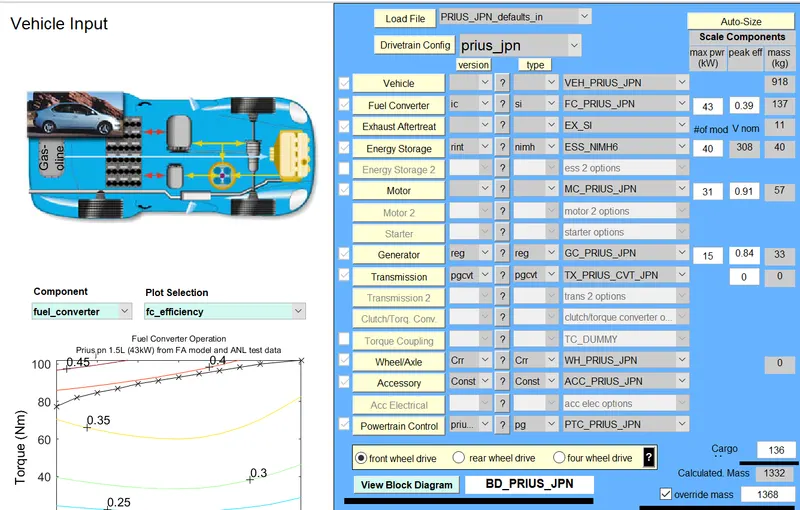
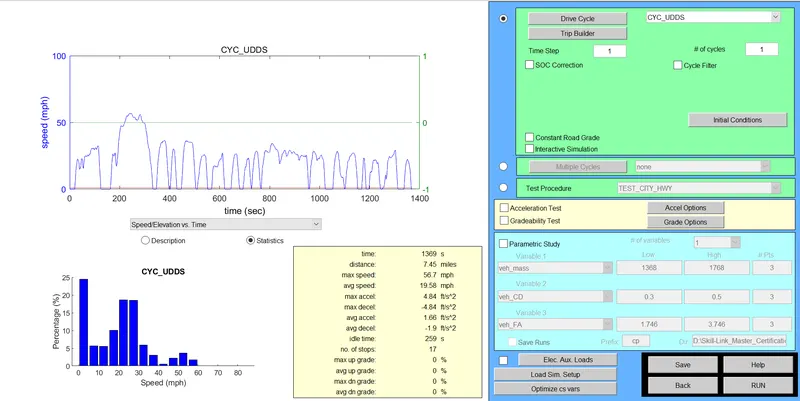
By default driving cycle taken here is UDDS :
Time taken to complete a cycle is 1369 seconds and the distance traveled with this cycle is 7.45 miles i.e. 11.98 km.
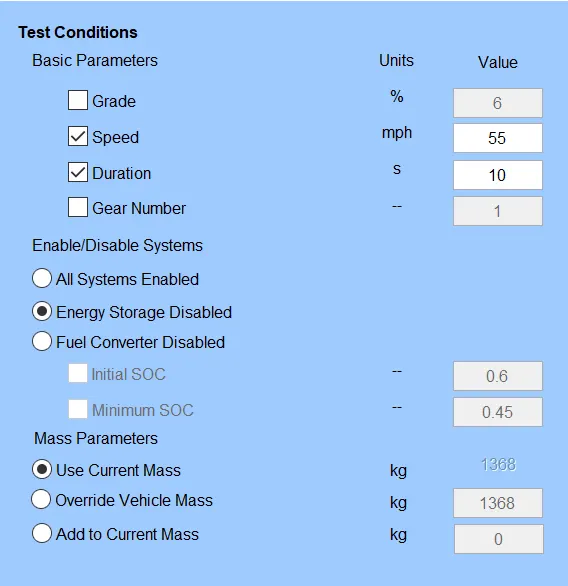
Case 1 : Speed of the vehicle is 55 mph in 10 seconds.
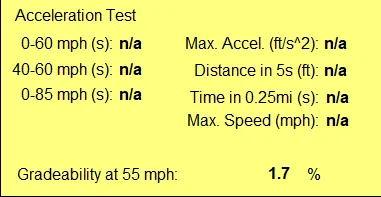
Output : Gradeability at 55 mph speed is : 1.7 %
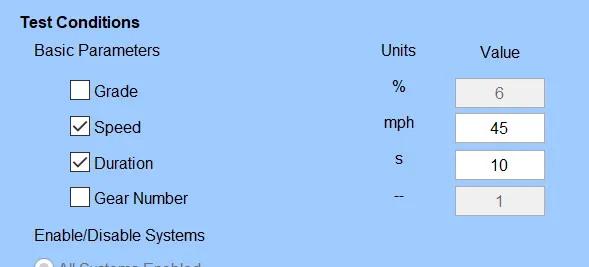
Case 2 : Speed of the vehicle is 45 mph in 10 seconds.
Output : Gradeability is 13.4 %
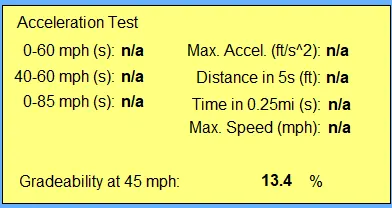
Case 3 : Speed of the vehicle is 35 mph
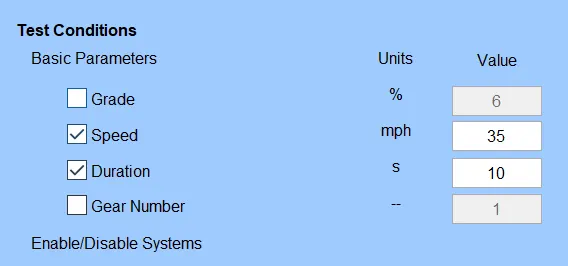
Output : Gradeability is 18.7 %
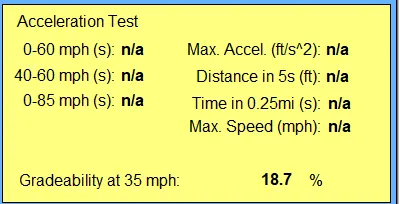
Case 4 : Speed of the vehicle is 25 mph
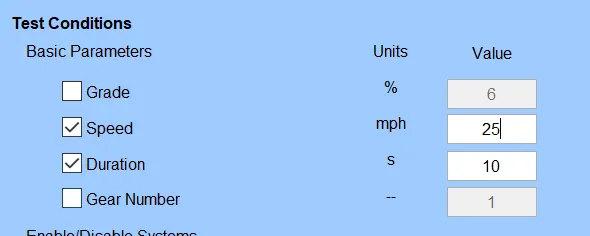
Output :Gradeability is 27.2
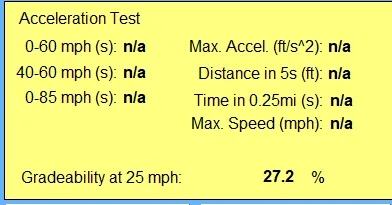
Conclusion :
We can conclude from the above cases that the gradeability increases as the speed of the vehicle decreases.
| Gradeability Table | |
| Gradeability(in %) | Speed(in mph) |
| 1.7 | 55 |
| 13.4 | 45 |
| 18.7 | 35 |
| 27.2 | 25 |