Week-7 Challenge: DC Motor Control
1.
Usually, a DC motor direction can be changed either by reversing the battery polarity or by changing the armature winding polarity. Here in this model, we observed the output where we can see the reverse direction of the motor in armature current and torque parameters.
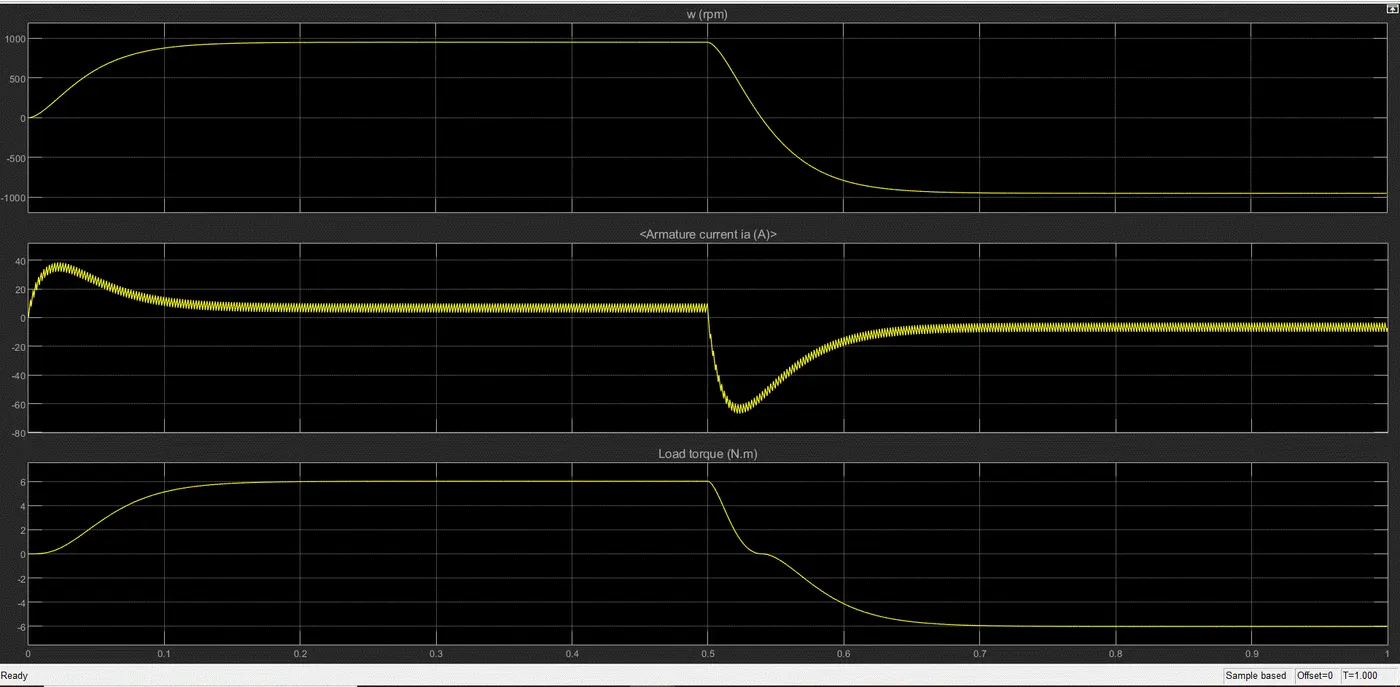
The above figure is the output at 75% duty cycle.
Here we discussing the duty cycle because it decides the input voltage to the motor( V= duty-cycle*supply voltage), if we change this duty cycle at the control signals then the motor can be operated as per our requirement.
So if we vary the duty cycle value correspondingly voltage varies which in result varies the armature current when the motor changes direction from forward to reverse. Now we will change the duty cycle to 50% i.e., 125v.
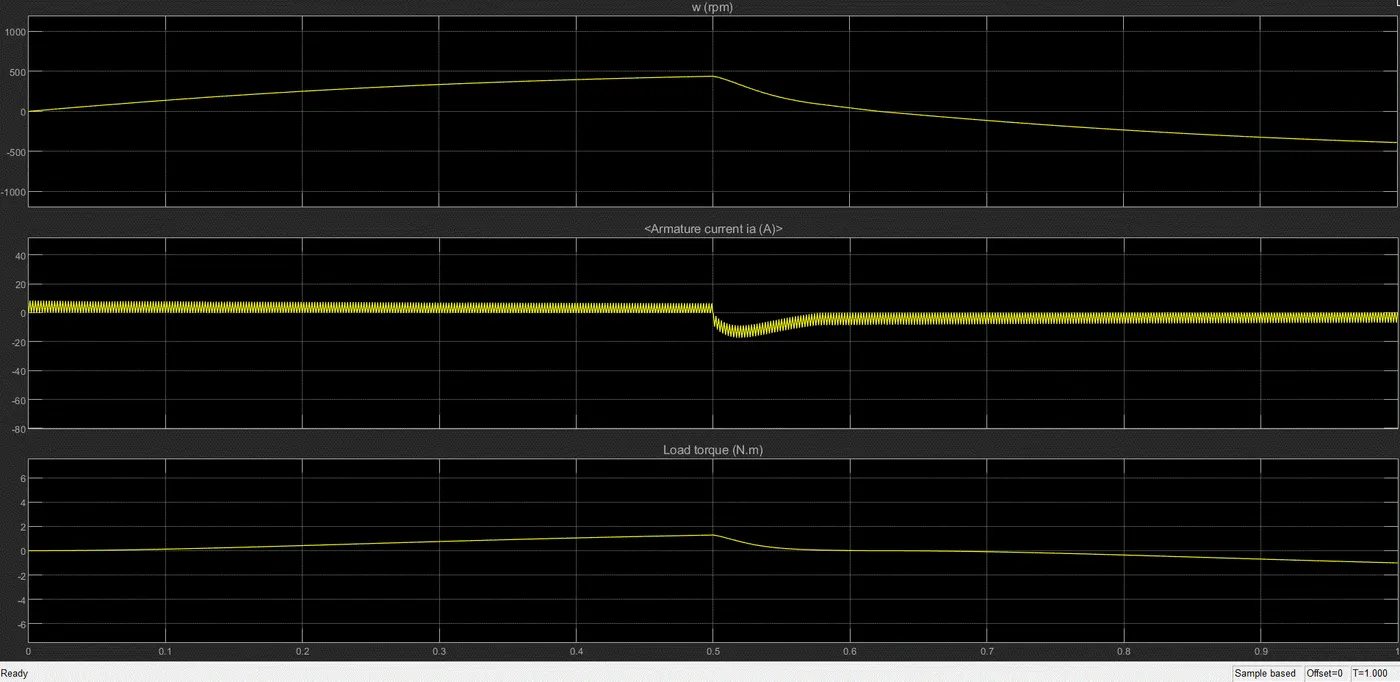
Now we try to observe when the duty cycle was set to 25% i.e., 60v
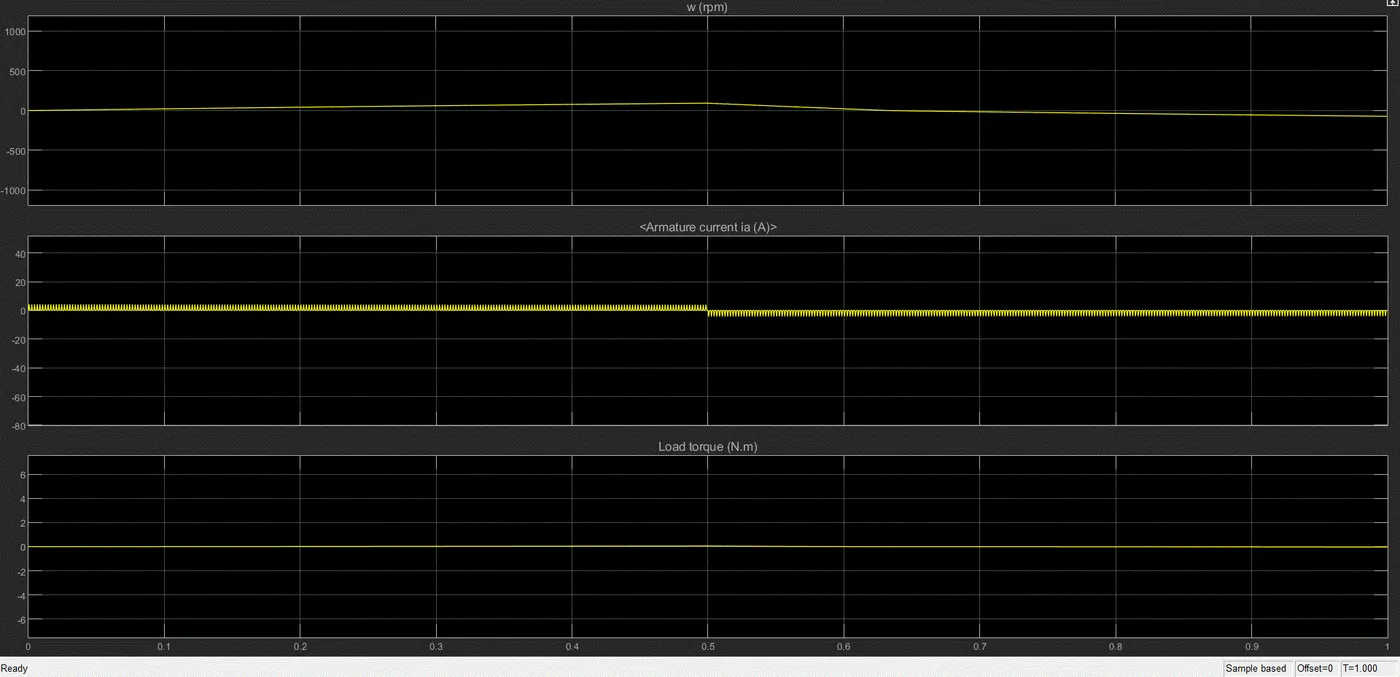
Here in the above figure, we can observe the shoot of armature current was very less when compared to above duty-cycles.
And even further if we try to reduce the cycle it won't be possible because of min. voltage is required to run the machine.
2.
If we remember we can compare "Speed control of a DC motor using BJT H-bridge" & "The Four-Quadrant Chopper DC Drive (DC7) block" models with dynamic & mapped models.
Here in (DC7), we don't have actual components but all parameters present in BJT H-bridge are available, here the circuit has less complexity in varying the parameters and analyzing.
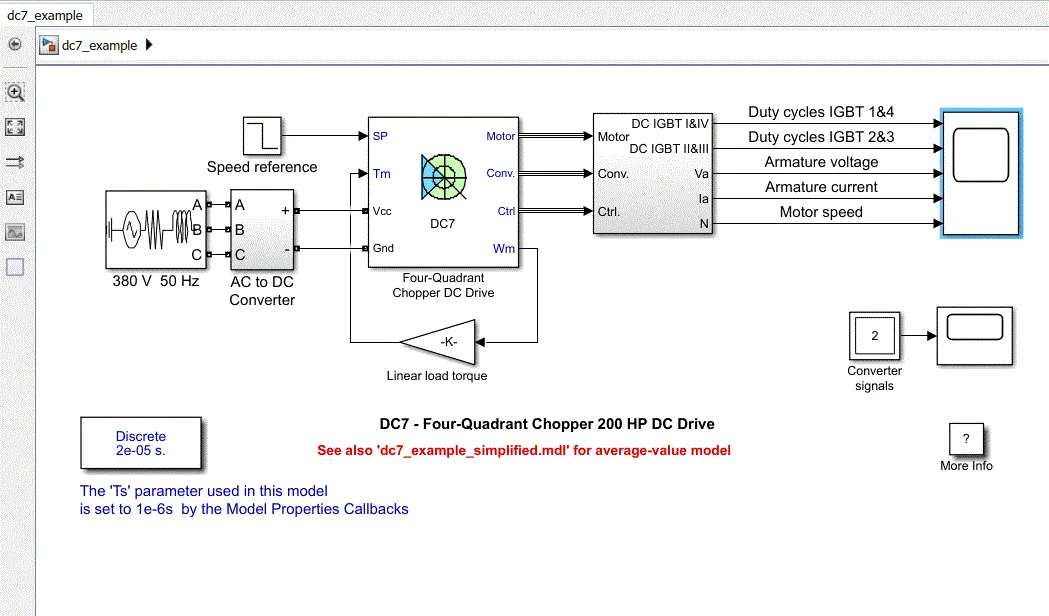
Here everything is designed as per the characteristics of the actual component but no actual component is connected, here the obtained results are optimistic.
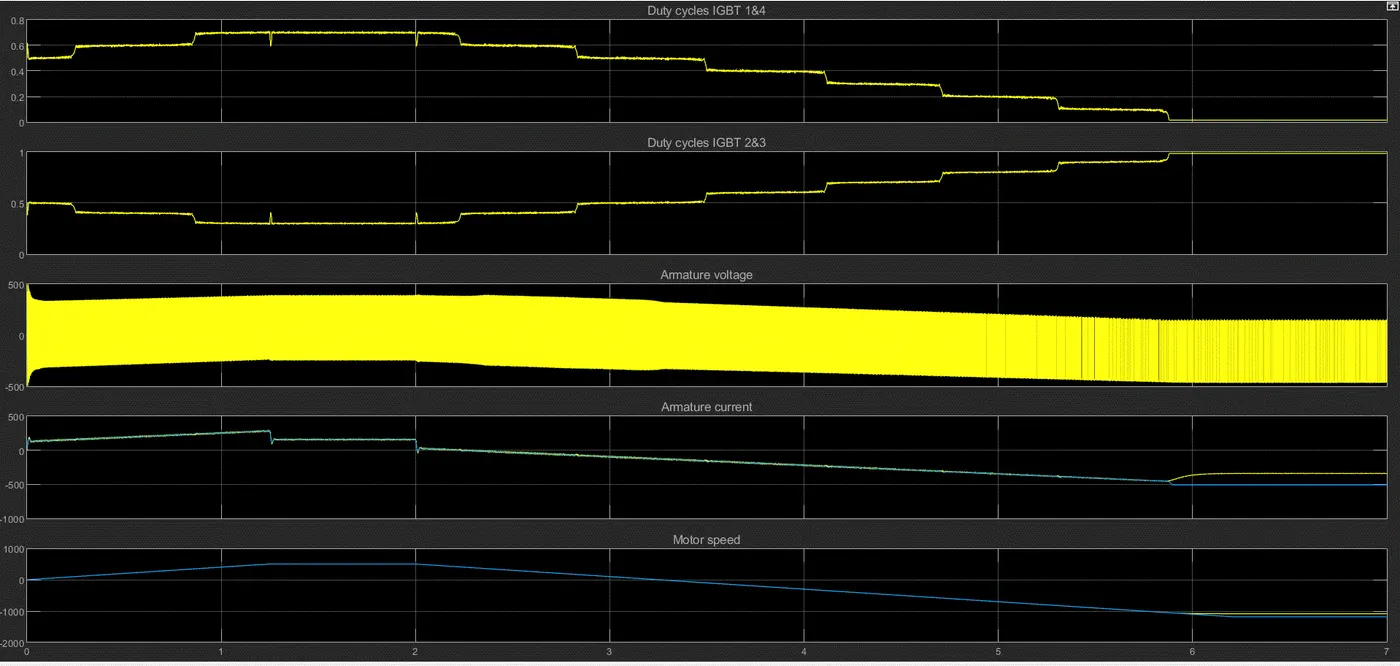
The above is the output of the DC7 chopper, IGBT duty cycles are obtained from input given by the chopper. Power handling of IGBT is better than BJT which is an added advantage. IGBT (response) >> BJT(response).
The major differences between these models are:
- In this model, we are stepping down the voltage supplied to control the motor circuit by using the DC chopper whereas in the BJT H-bridge model we are varying the duty cycle of the switch in order to vary the voltage to control the motor.
- DC7 can be operated in four quadrants (forward motoring, braking & reverse motoring, braking)whereas BJT can be worked only in two quadrants(forward & reverse motoring).
- Regenerative braking is possible in DC7 which is absent in BJT H-bridge.
- Converter cost is applicable as AC source is converted into DC whereas in BJT model direct DC is utilized.
3.
First of all, we identified that the only input given to the motor for the operation of the chopper other than supply and feedback is the speed reference. And the reference speed would be at a constant rate, so in order to change this model to an EV model, we should initialize an input that can create the real-time driving situations to the motor & chopper which can be used.
To meet the above requirements we are replacing the speed reference with a Driving cycle available locally in order to make an EV model using the DC7 block.
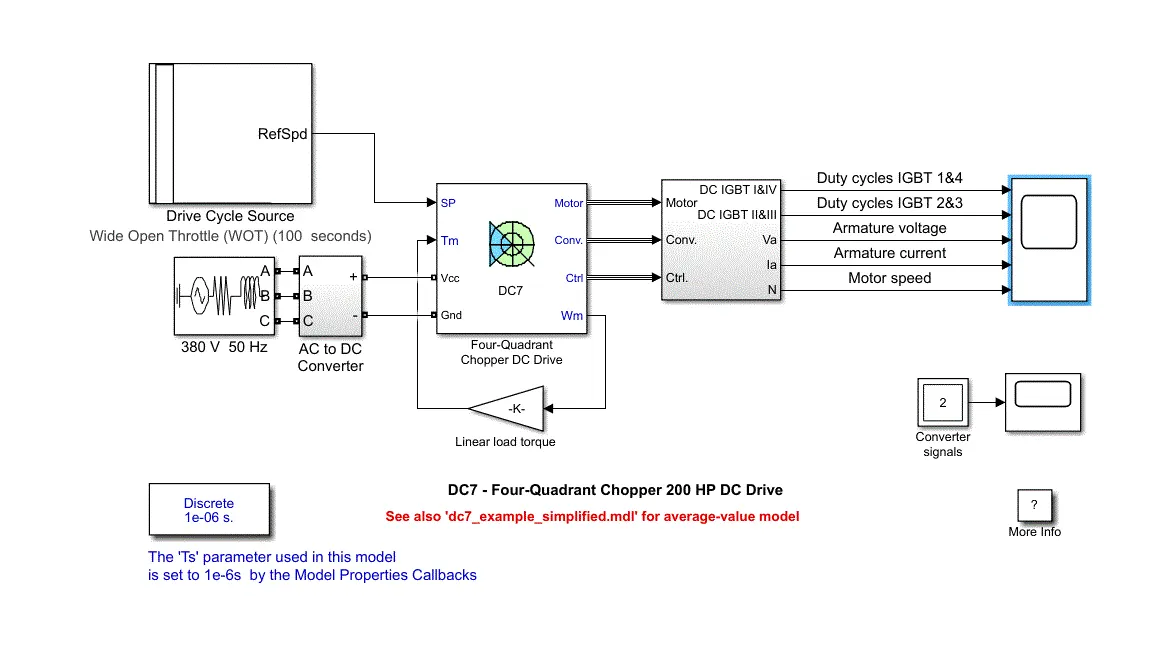
Here I considered WOT drive cycle for 100sec of simulation time. Here we can observe high armature voltage and a sudden spike of armature current at a time instant as it is a wide-open throttle that utilizes full power.
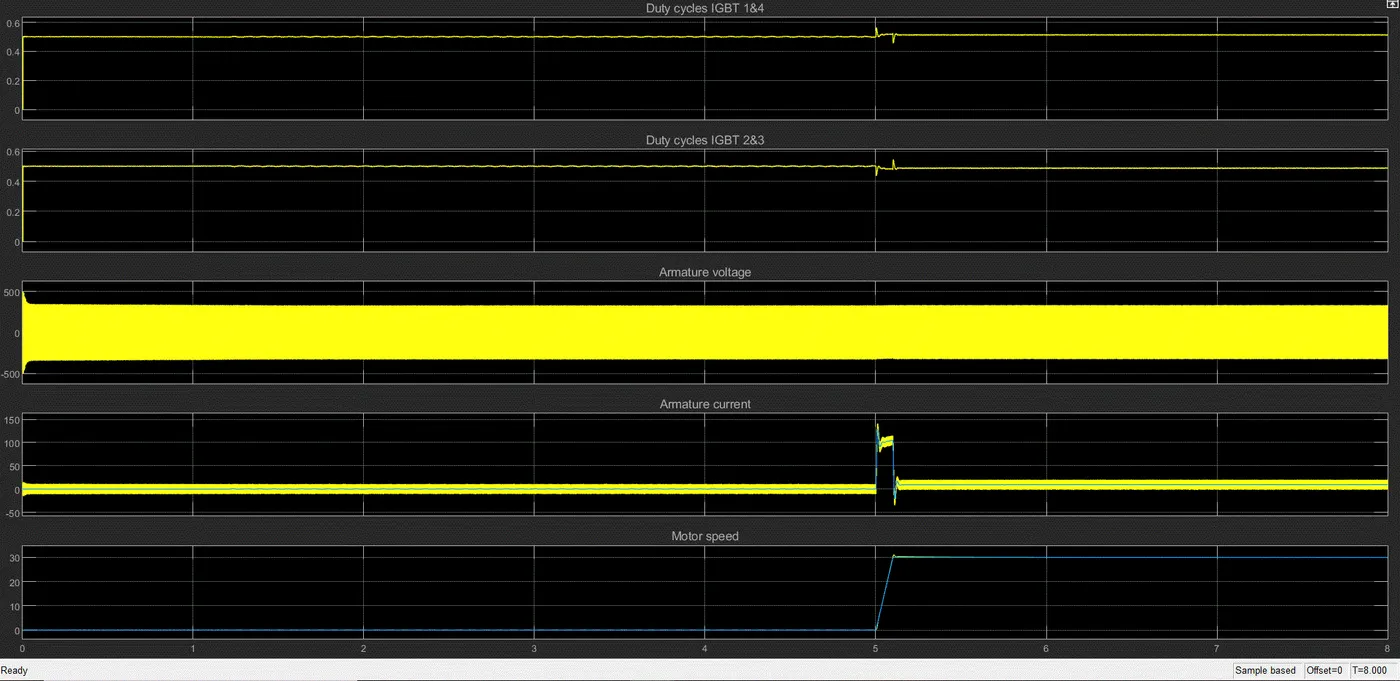
Here we experienced a sudden increase of motor speed after at an instant of time and it became constant for rest of the cycle. This denotes the high speeds of the DC motor attained for this cycle.
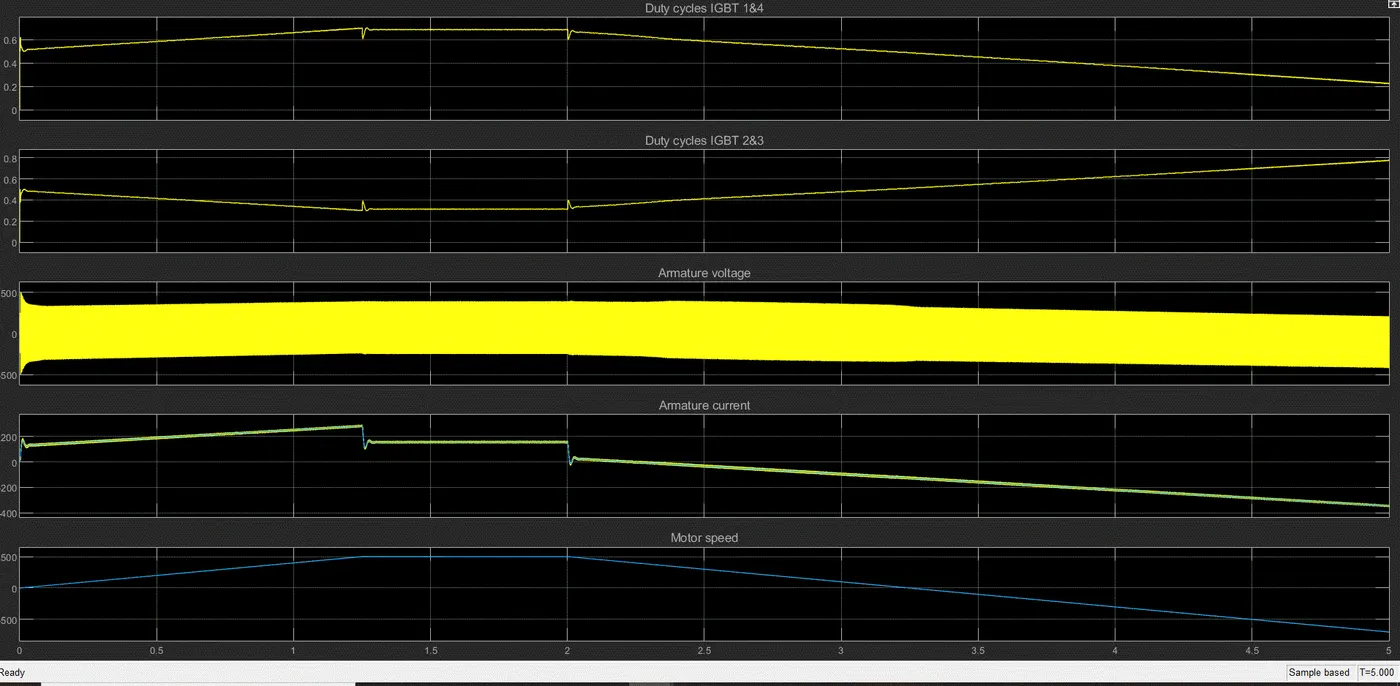
This is the output of DC7 with speed reference where we can observe a high voltage but there is a reduced armature current intake.
4.
Brushless DC motor:
The present world is running behind this motor because of its major advantages and its beneficial usage in Electric vehicles.
The brushless DC motors (BLDC) feature high efficiency and excellent controllability and are widely used in many applications. The BLDC motor has power-saving advantages relative to other motor types.
Construction: A brushed DC motor has permanent magnets on the outside of its structure, with a spinning armature on the inside. The permanent magnets, which are stationary on the outside, are called the stator and the armature, which rotates and contains an electromagnet, is called the rotor.
Operation:
It works on the same principle as the DC motor but in these types of motors, the permanent magnets are on the rotor, and the electromagnets are on the stator. A computer then charges the electromagnets in the stator to rotate the rotor a full 360-degrees.
These are majorly used in drones for smooth and high-efficiency applications and for easy regulation of speed & torque.
- As commutators are absent wear and tear of brushes, maintenance amount is reduced.
- Maximum torque can be obtained from these motors.
- With less size of magnets, it can produce high power and torque considerably.
- Superlative controllability is offered by these motors.
- BLDC motors can be controlled, using feedback mechanisms, to deliver precisely the desired torque and rotation speed.
- Brushless DC motors typically have an efficiency of 85-90%, while brushed motors are usually only 75-80% efficient.
- These motors are often used in modern devices where low noise and low heat are required, especially in devices that run continuously. This may include washing machines, air conditioners, and other consumer electronics.
- They are also the main power source for service robots, which will require very careful control of force for safety reasons.
- Approx. 35% volume and weight reduction can be observed among Brush and Brushless DC motors with the same output
- The major problem faced here is the cost of the motor, internal connections are complicated, even the speed control should be done with utmost carefulness in order to utilize to its full potential.
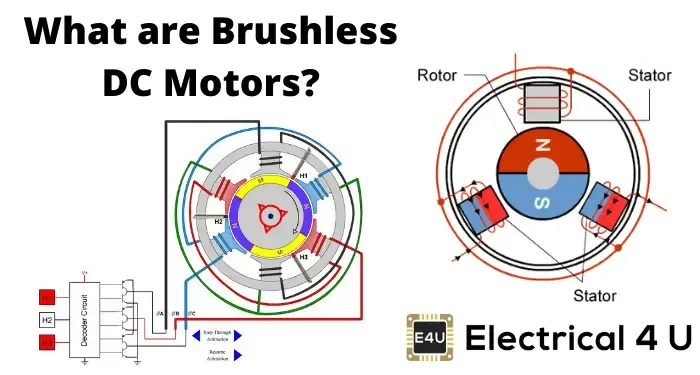
The internal structure of BLDC motors contains permanent rotor magnets and an electromagnetic rotor which eliminates the commutator and brushes arrangement.
With the decoder circuit connected, we will decide the currents supplied to electromagnets which vary the speed and torque parameters in the BLDC motor.
But there will be no significant variation in the characteristics of the BLDC motor but the peak values may vary as it has high efficiency and torque values.
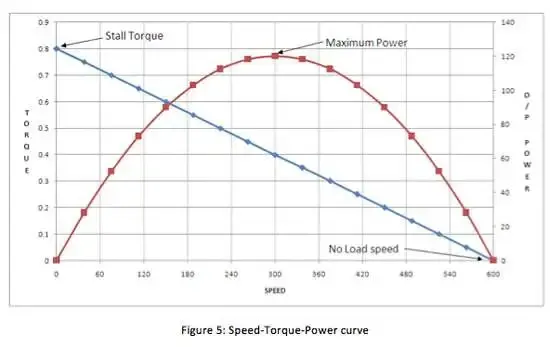
Above is the BLDC characteristics graph where high peak values are reached.