DC Motor Control (SIMULINK)
AIM: To understand the DC motor control characteristics.
OBJECTIVE:
- Run MATLAB demo ‘Speed control of a DC motor using BJT H-bridge’. Modify the model such that armature current doesn’t shoot up when motor changes direction from forward to reverse.
- Refer to the help section of ‘The Four-Quadrant Chopper DC Drive (DC7) block’. Compare it with the H-bridge model.
- Make a suitable EV model using DC7 block and make result report.
SOLUTIONS:
- Speed control of a DC motor using BJT H-bridge
The Bipolar Junction Transistor (BJT) when used for power switching applications, operates as an IGBT. When it is conducting (BJT operating in the saturated region), a forward voltage Vf is developed between collector and emitter (in the range of 1 V). Therefore, the IGBT block can be used to model the BJT device.
The IGBT block does not simulate the gate current controlling the BJT or IGBT. The switch is controlled by a Simulink® signal (1/0). The DC motor uses the preset model (5 HP 24V 1750 rpm). It simulates a fan type load (where Load torque is proportional to square of speed). The armature mean voltage can be varied from 0 to 240 V when the duty cycle (specified in the Pulse Generator block) is varied from 0 to 100%.
The H-bridge consists of four BJT/Diode pairs (BJT simulated by IGBT models). Two transistors are switched simultaneously: Q1 and Q4 or Q2 and Q3. When Q1 and Q4 are fired, a positive voltage is applied to the motor and diodes D2-D3 operate as free-wheeling diodes when Q1 and Q4 are switched off. When Q2 and Q3 are fired, a negative voltage is applied to the motor and diodes D1-D4 operate as free-wheeling diodes when Q2 and Q3 are switched off.
The image of the model is as shown below.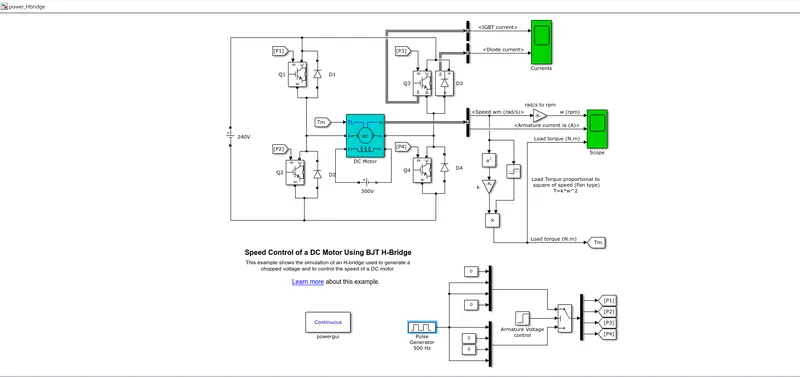
The output from the above model without changing any parameters is shown below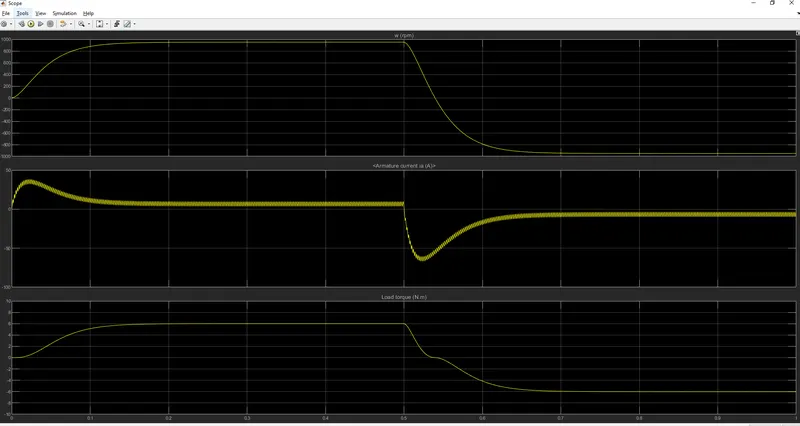
To prevent the armature current from shooting up when changing operating direction we need to change the pulse width characteristic, which can be changed in the 'pulse generator' block. the unchanged block is as shown below.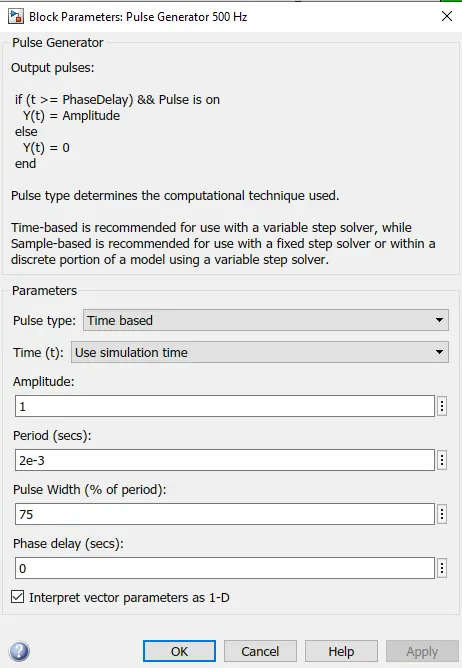
When the change to the pulse width is made as shown below, we get the following output.
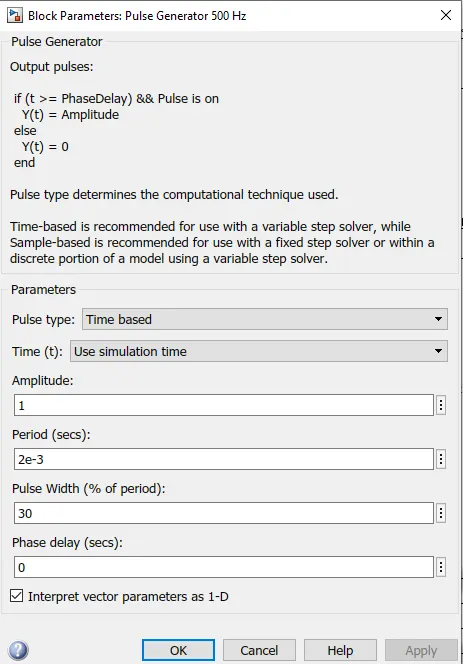
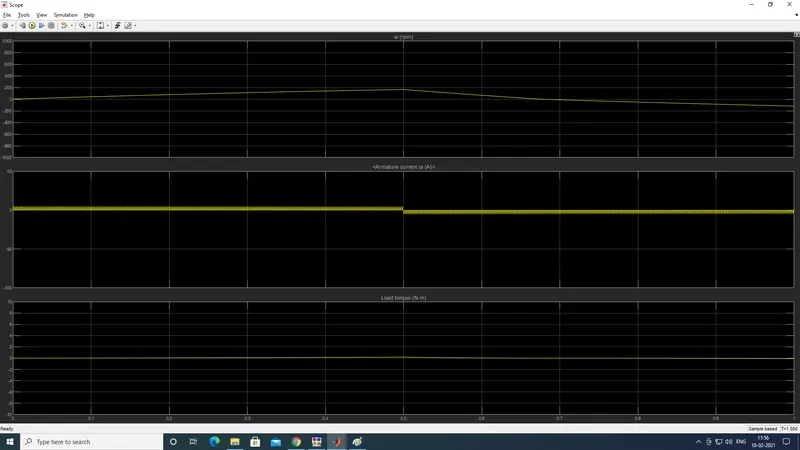
We can see that the armature current does not spike up anymore - The Four-Quadrant Chopper DC Drive (DC7) block’.
The 200 HP DC motor is separately excited with a constant 150 V DC field voltage source. The armature voltage is provided by an IGBT converter controlled by two PI regulators. The converter is fed by a 515 V DC bus obtained by rectification of a 380 V AC 50 Hz voltage source. In order to limit the DC bus voltage during dynamic braking mode, a braking chopper has been added between the diode rectifier and the DC7 block.
The first regulator is a speed regulator, followed by a current regulator. The speed regulator outputs the armature current reference (in p.u.) used by the current controller in order to obtain the electromagnetic torque needed to reach the desired speed. The speed reference change rate follows acceleration and deceleration ramps in order to avoid sudden reference changes that could cause armature over-current and destabilize the system. The current regulator controls the armature current by computing the appropriate duty ratios of the 5 kHz pulses of the four IGBT devices (Pulse Width Modulation). For proper system behaviour, the instantaneous pulse values of IGBT devices 1 and 4 are opposite to those of IGBT devices 2 and 3. This generates the average armature voltage needed to obtain the desired armature current. In order to limit the amplitude of the current oscillations, a smoothing inductance is placed in series with the armature circuit.
The image of the model is as shown below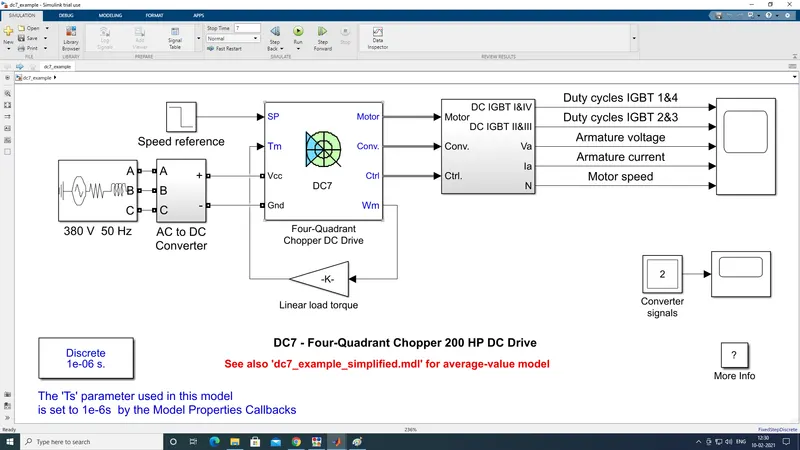
The output for the same is shown below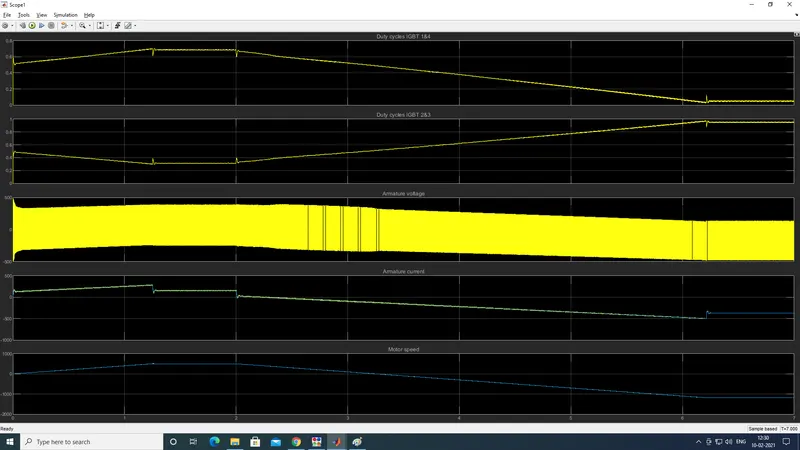
The main advantage of this drive is that it can be operated in all quadrants(forward motoring, reverse motoring, forward regeneration and reverse regeneration). Due to the high frequency of the DC-DC converter, a low armature ripple current is obtained.
Comparison with H- bridge
- H- bridge like 4 quadrant DC choppers are also capable of braking operation, without using air resistance, friction or physical brakes to bring the motor to a halt.4 quadrant DC choppers are generally used in automotive applications while BJT H-bridge is used in robotics and electromechanical applications
- Unlike 4 quadrant DC choppers, BJT H-bridge are not capable of regenerative braking, this makes them unsuitable for EV applications.
- In 4 quadrant DC choppers the current signals are interrupted with each other to change the rotation of the motor, this is done with the help of a drive cycle to change the values of the current signal which in turn changes the direction of rotation of the motor. In BJT H- bridge the polarity of the current is changed to change the direction of rotation of the motor.
- In 4 quadrant DC choppers, a PI controller is used to control the speed and the current, this is not done in BJT H-bridge.
- Make a suitable EV model using DC7 block and make result report.
To do implement an EV model we need to- Modify the energy source at the input side, since EV have a DC power source such as a battery or a fuel cell.
- Reference speed block to model the driving parameters of the motor.
- Change the load criteria to the appropriate equation as shown below
T= 24.7 +0.0051w^2
The modified blocks are shown below.
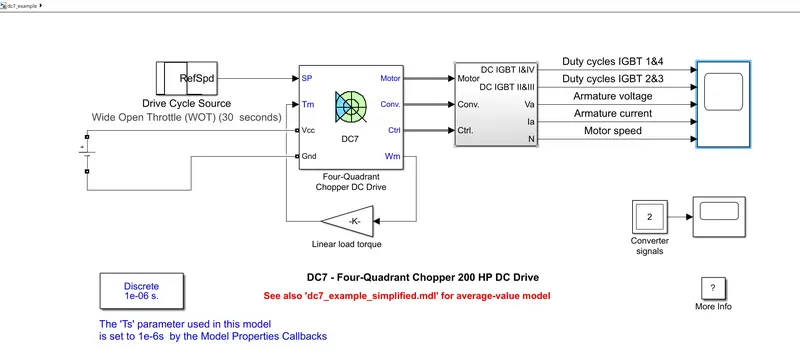
The load gain parameters were given as shown 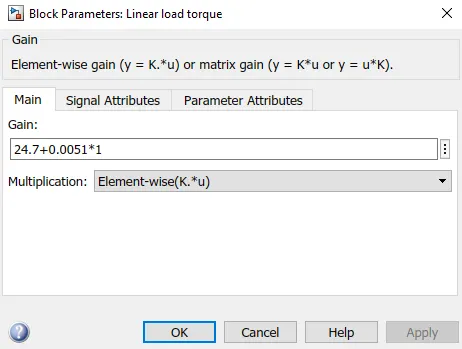
The output is as shown below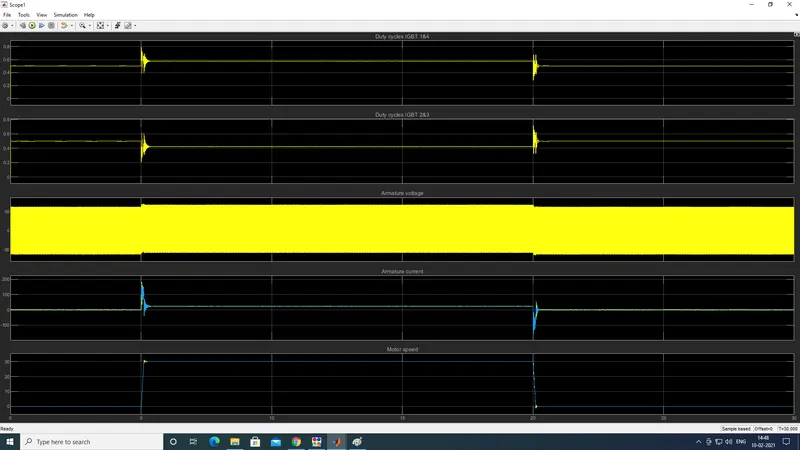
we can see that the output is in accordance with the drive cycle input.
CONCLUSION:
The concepts of DC motor drive control were thoroughly understood.