Week 7 Challenge
Load the vehicle parameters. Complete the vehicle model by modelling the remaining equations. Set simulation stop time to 598 sec. The output should be the vehicle velocity.
A.
Vehicle is a moving mechanical system that has several forces acting upon it.
Main force is the traction force provided by the engine/electric motor of the vehicle. This propels the vehicle forward. There are other lateral and longitudinal forces that act on the vehicle body which are resistive in nature and need to be overcome by the traction force. All of these together gives a 2D model of the vehicle. For the design modelled here, three opposing forces are considered.
1. Rolling resistance
Frictional force that acts on wheels while they roll on the ground.
This is implemented in the model by means of equation below-
| Rolling resistance = Vehicle mass * Gravitational acceleration * Rolling resistance coefficient * cos (angle of slope) |
2. Aerodynamic drag
As the vehicle moves forward, it leaves behind a low-pressure area. But the air has the property of moving from a high-pressure area to low pressure area, hence providing friction to the vehicle movement. This is called the aerodynamic drag and depends on the shape of the front side of the vehicle and also on the velocity of the vehicle.
implemented in the model by means of equation below-
| Aerodynamic drag resistance = 0.5 * air density *vehicle frontal area * Drag coefficient * sin (angle of slope) |
3. Gradient resistance
This is the friction faced by the vehicle while travelling on a sloped terrain. There is an increased resistance while climbing up the hill and increased assistance while going down the hill.
| Gradient resistance = Vehicle mass * Gravitational acceleration * Rolling resistance coefficient * sin (angle of slope) |
Given below are the values considered for the constants in the above equation.
- Vehicle mass = 1500 kg
- Vehicle frontal area = 2 m^2
- Rolling resistance coefficient = 0.015
- Drag coefficient = 0.3
- Air density = 1.225 [At sea level]
- Gravitational acceleration = 9.8 m/s^2
There are two inputs to the system that are given through a signal builder block
- Traction Force
- Angle of slope of vehicle
For each second, according to the value of slope of vehicle and other constants, all 3 resistive forces are calculated and subtracted from the Traction force. The remaining force move the vehicle forward.
From the remaining force (in Newton), velocity is calculated as follows-
Force = Mass * acceleration
Velocity = ∫ acceleration
= ∫ F/M
Thus, velocity is found using an integrator block.
Below are the results of the simulation.
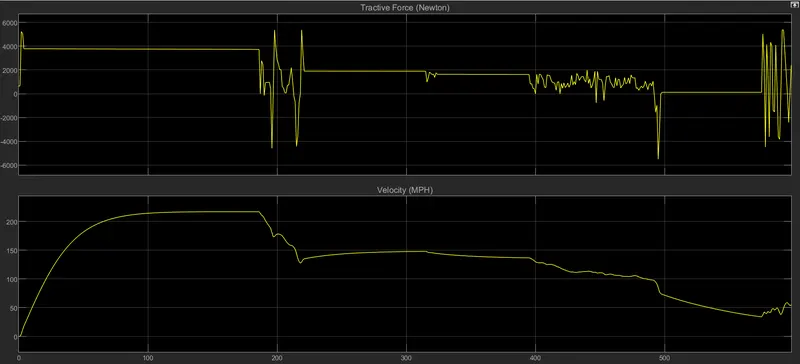
It can be seen that, initially the velocity takes time to build up and becomes a constant following a constant Traction force. Then the force gradually decreases, showing a dip in velocity as well.
When the force is zero from 500th second, driver has released the pedal from accelerating, hence we can see a gradual decline in the velocity. This indicates that vehicle has become really slow and is going to halt.
Initialization file challenge_7.mat needs to be loaded in the matlab workspace before running the simulation.