Q1.
| Sl no: |
Fuel Cell Type |
Properties |
Challenges |
Applications |
| 1. |
Proton Exchange Membrane (PEM) |
- Solid electrolyte - Avoids possibility of corrosion. Need not worry about replenishing or managing the right concentration levels unlike a liquid electrolyte.
- Works well a low-temperature
- Starts up quickly
- Best candidate for automotive applications
|
- Catalyst used is expensive
- Sensitive to fuel impurities
|
Automotive applications - Passenger cars, buses, trucks |
| 2. |
Solid Oxide Fuel Cell (SOFC) |
- Higher efficinecy than PEM
- Accept multiple fuels (Methanol, Ethanol,Methane)
- Solid electrolyte
- Suitable for power generation and heating - since the byproduct of the fuel cell is heat
|
- High temperature can corrosion and breakdown of cell components
- Long start-up time
- Limited number of shutdowns
- Can produce CO2 depending on the fuel used
|
Stationary power generation application |
| 3. |
Alkaline Fuel Cell (AFC) |
- Cheap to manufacture - low cost components made from range of materials
- Works well at low temperature
- Quick start-up
|
- Sensitive to CO2 more than PEM cells
- Liquid electrolyte
- Electrolyte conductivity
|
Used by NASA in 1960s as onboard power source for Apollo mission spacecrafts |
| 4. |
Direct Methanol Fuel Cell (DMFC) |
- Methanol used as fuel- operation cost is less
- Operates atlow temperature and pressure
|
- Emits CO2
- Not suitable for dynamic response
- Methanol crosses from anode to cathode easily, thus reducing the cell voltage
|
- Forklifts, tuggers
- Consumer goods such as mobile phone, laptops, digital cameras
|
Q2.
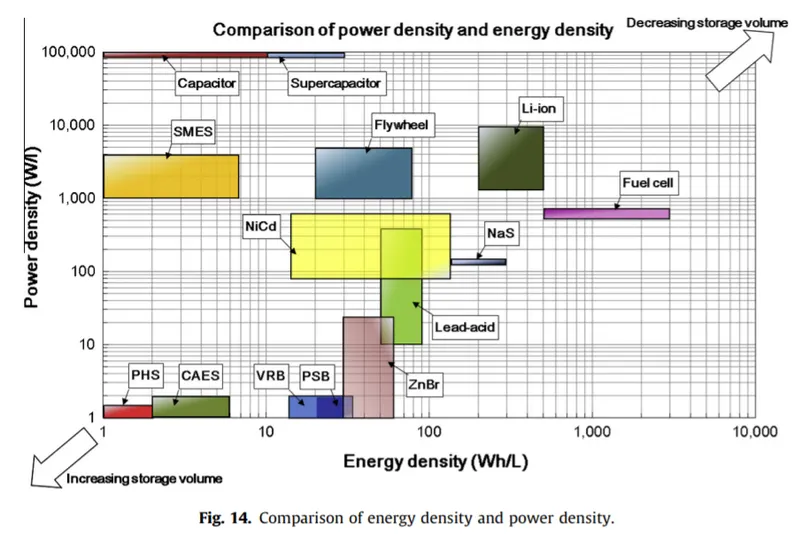
Source : http://wrap.warwick.ac.uk/63615/1/WRAP_Luo_1-s2.0-S0306261914010290-main.pdf