Week 5 Challenge
1.
False. Ultracapacitor is a better choice over battery in this scenario.
An aggressive driver in city would accelerate and brake frequently. This means that the vehicle's motor would require high amount of power each time when acceleration is applied from stop. Ultra-capacitors have higher power density compared to batteries and can discharge or charge at high currents. Therefore, they are best suited for short burst of high currents and transient power applications.
Batteries on the other hand have higher energy density and can store more charge compared to ultra-capacitors. They are good for long drives since it gives more range but have slow dynamic response compared to ultra-capacitors.
2.
|
Component |
Cell Voltages (V) |
Energy Density (Wh/kg) |
|
Lead Acid |
2 |
30-50 |
|
Nickel Cadmium |
1.25 |
45-80 |
|
Nickel Metal Hydride |
1.25 |
60-120 |
|
Lithium ion (NMC) |
3.7 |
200 |
|
Ultra-capacitor |
2.5-2.7 |
1-30 |
The graph of the above table has been plotted as below-
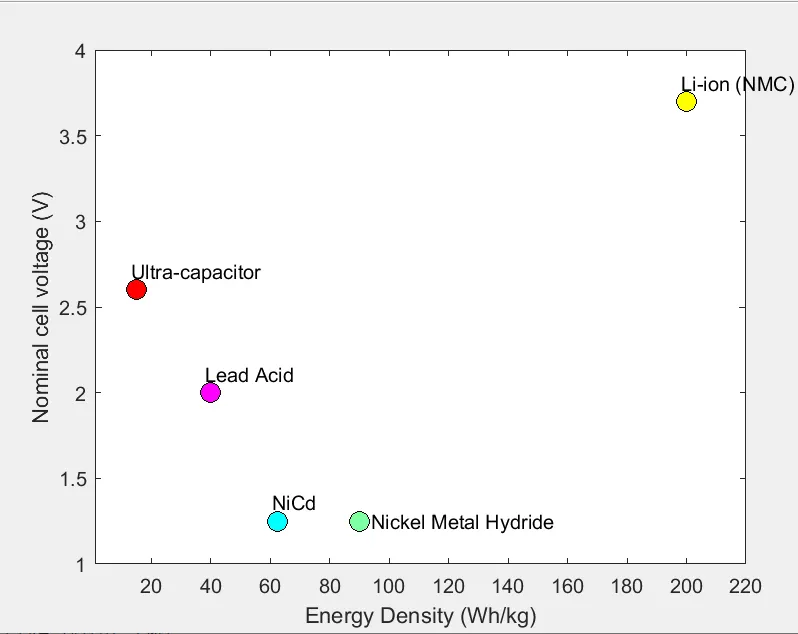
From the figure, it is clearly understood that Li-ion (NMC chemistry) batteries have the highest energy density and nominal cell voltage. It is best suited for automobile applications which require long range since an average of 200Wh can be stored per kilogram of the component. Also, it has a nominal voltage of 3.7V. This will reduce the number of cells required per vehicle for powering the motor.
Energy density is least for ultracapacitors, but they have the second highest nominal voltage after lithium batteries. This would allow them to provide high voltage for a short period of time. Lead acid batteries too provide high voltage per cell, but they can be heavier compared to any other cell chemistries. Nickel metal hydride and Nickel cadmium have higher energy density compared to Lead-acid cells, thus weigh lighter. Although, it provides less nominal voltage per cell. They can be best suited for low voltage applications like laptops, drills, digital cameras etc.
3.
|
Component |
Cell Voltages (V) |
Power Density (W/kg) |
|
Lead Acid |
2 |
300 |
|
Nickel Cadmium |
1.25 |
225 |
|
Nickel Metal hydride |
1.25 |
200 |
|
Lithium ion (NMC) |
3.7 |
2300 |
|
Ultra-capacitor |
2.5-2.7 |
10,000 |
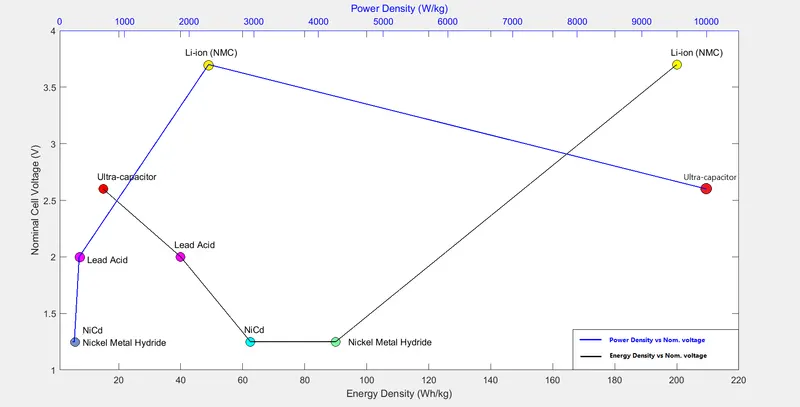
From the graph plotted for power density vs. nominal cell voltage, Ultra-capacitors have the highest power density and Lithium – ion cell has the second highest power density. A very small ultra-capacitor can provide almost five times the power that a Lithium-ion battery can provide. Thus, it can be used for transient power applications.
4.
True. The electrode marked as (1) in the figure is the negative electrode(anode) of the cell and is made of graphite(carbon).
As shown in the figure, when battery is connected to a charger for the first time after manufacturing, cathode which is made of a Lithium based compound (ex. Lithium Cobalt Oxide) with Lithium atoms intercalated in between its crystal structure release Lithium cations to the electrolyte and electrons through the load to anode. These Lithium cations in the electrolyte pass through the separator and reach the anode.
Graphite that which has the property of intercalation takes Li cations from the electrolyte, electrons from cathode and combine both of them to form Li atoms which are intercalated to it's crystal structure.
The opposite happens while discharge and all of the Li atoms at anode are collected and intercalated at the cathode by the end of discharge.