Week 7 - Auto ignition using Cantera
AIM:
- Plotting the variation of Auto Ignition time of methane with a constant temperature of 1250K and pressure varying from 1 atm to 5 atm.
- Plotting the variation of Auto Ignition time of methane with a constant pressure of 5 atm and temperature varying from 950K to 1450K.
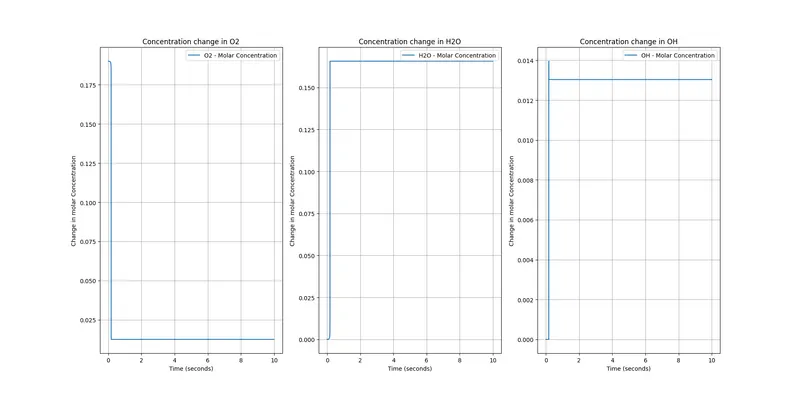
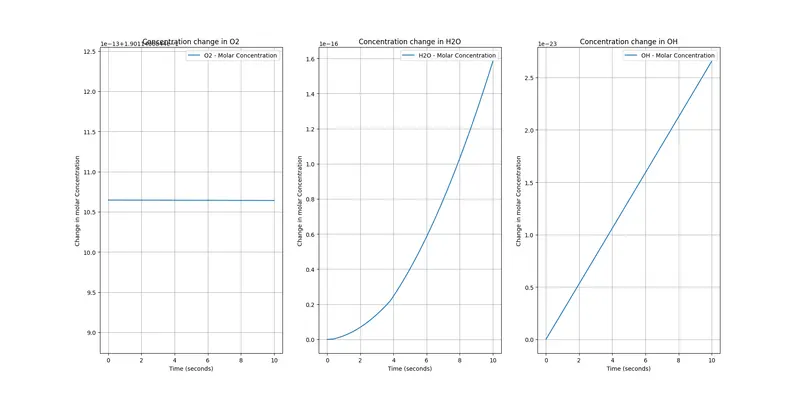
- Observing and printing the rate of change of molar concentrations of the elements " H2O, O2, OH " w.r.t time. This behaviour shown by the graph is to be explained for the 2 cases i.e. i) when temperature is 1000K and pressure is 5 atm. ii) when temperature is 500K and pressure is 5 atm.
THEORY:
What is Auto Ignition?
Auto Ignition is defined as the self-ignition of the vapours emitted by a liquid heated above its ignition temperature and that, when escaping into the atmosphere, enter into their explosive range. The lowest temperature of a substance in which it spontaneously ignites in a normal atmosphere without an external source of ignition, such as flame or spark is nothing but the auto ignition temperature or kindling point of that substance. This temperature is required to supply the activation energy needed for combustion. This auto ignition temperature can be evaluated by two ways: Experimental and Numerical methods. In case of experimental approach, there are two experiments namely, Stocktube experiment and Rapid compression machine or RCM.
Ignition delay is defined as the gap between fuel injection into the combustion chamber and the very beginning of its combustion. The ignition delay timming is the timming at which, the temperature of the reactor is initial temperature + 400K. The initial temperature has a direct effect on the ignition delay. As understood from the program preformed to study the variation of ignition delay w.r.t the initial temperature, we can conclusively say that the ignition delay varies inversely with the initial temperature, i.e. higher the initial temperature, lower is the ignition delay.
Now, a chemical reactor is an enclosed volume in which chemical reactions take place. In chemical engineering, it is generally understood to be a process vessel used to carry out chemical reaction, which is one of the classic unit operations of chemical process analysis.
Types of Reactors -
- Standard Reactor
- Constant Pressure Reactor
- Ideal Gas Reactor
- Ideal Gas Constant Pressure Reactor
Reactor Networks represent a vehicle to simulate complex processes in combustion by breaking the physics into submodels, each submodel being represented by a reactor, and combining the submodels or reactors in suitably defined networks.
Here, in this assignment, we are going to study the variation of Auto Ignition time of methane with a constant temperature with variation in pressure, and constant pressure with variation in temperature respectively. Along with this, we are also going to study the variation of molar concentration of the specified species: i.e. H2O, O2. OH.
CODE:
Part I.
1.) https://drive.google.com/file/d/1xSlZv8_xKCZOzYIhoi1Ie9OwYYGP6JfZ/view?usp=sharing => Constant pressure, varying temperature
2.) https://drive.google.com/file/d/1lahE8OycqbD97sv0onxH6w3zqVQqNKDM/view?usp=sharing => Constant temperature, varying temperature
Part II.
1.) https://drive.google.com/file/d/1xTicdHI1vR3Ua63_ANEP6OTZwi6jiSmy/view?usp=sharing => Change in Molar Concentration for 1000K
2.) https://drive.google.com/file/d/1VHhzT3NspLqefERSAVZhSgyMgpY97T8S/view?usp=sharing => Change in Molar Concentration for 500K
RESULTS:
Part II
Now for the first program in which we had to vary the temperature keeping the pressure constant, we get the result as shown in the figure below:
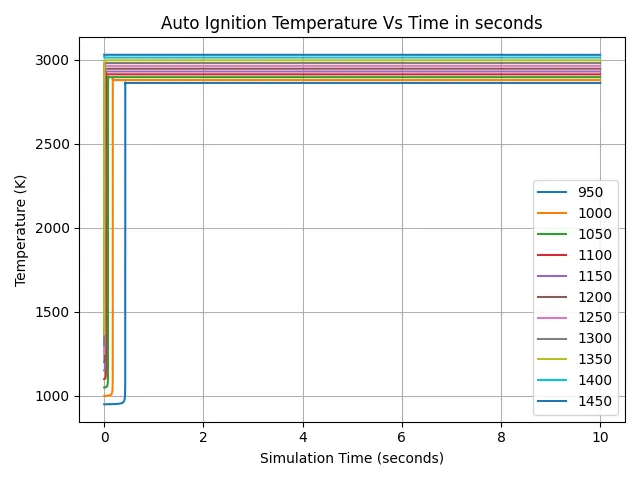
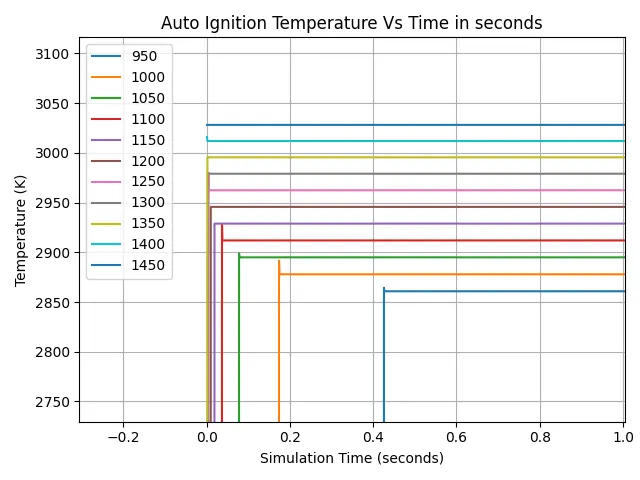
From the above figures, we can conclusively say that, for constant pressure, with increase in initial temperature the time required for auto ignition becomes reduces.
For the program in which pressure was varied keeping the initial temperature constant, the results obtained are as below:
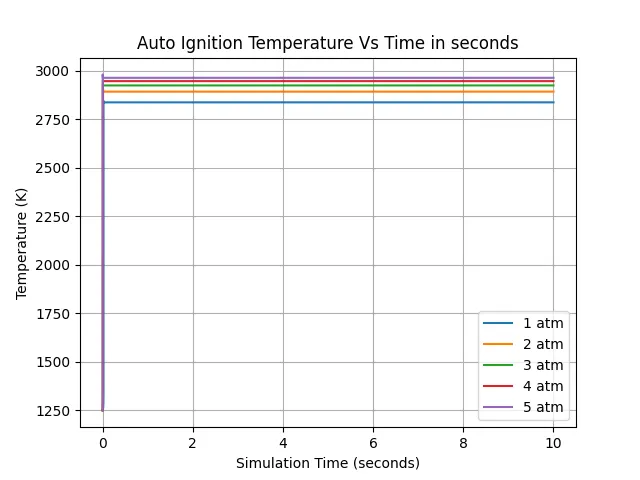
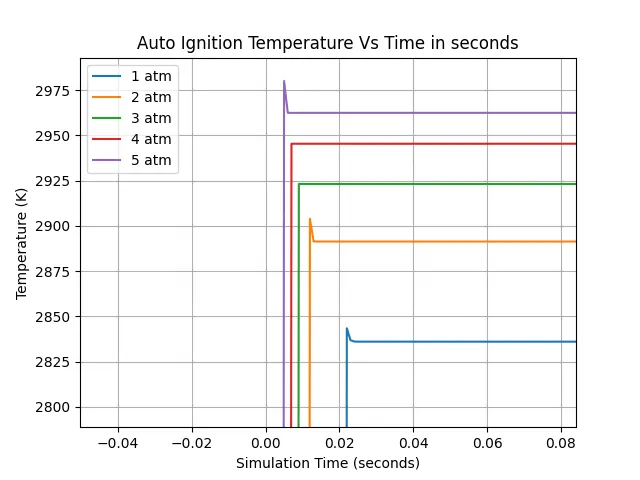
The behaviour for change in pressure at constant temperature is similar to the behaviour for change in temperature at constant pressure. Here too, with increase in pressure, the time for auto ignition or the ignition delay reduces.
Part II
Now the results of the program in which the change is molar concentration of the specified species at an initial combustion temperature is 1000K and pressure if 5 atm is shown below:
and that with an initial combustion temperature of 500K is:
For the case of initial temperature of 1000K, there is a sudden drop in the molar concentration of Oxygen (`O_2`), whereas the opposite is true for the molar concentrations of `H_2O and OH`.
And for that of 500K, the molar concentration of `O_2` remains constant throught the simulation period and that of the `H_2O and OH` increase. Here the the increase in the molar concentrations of these 2 species is a bit linear and not increase spontaneously.