Week 6 Session 13
Discuss two new trends in battery system field.
New trends in battery system fields are as follows:
- Solid State Lithium Metal Batteries.
- Sodium ion Batteries
Solid State Lithium metal Battery:
A solid-state battery is essentially battery technology that uses a solid electrolyte instead of liquid electrolytes.
The structure of a solid-state battery:
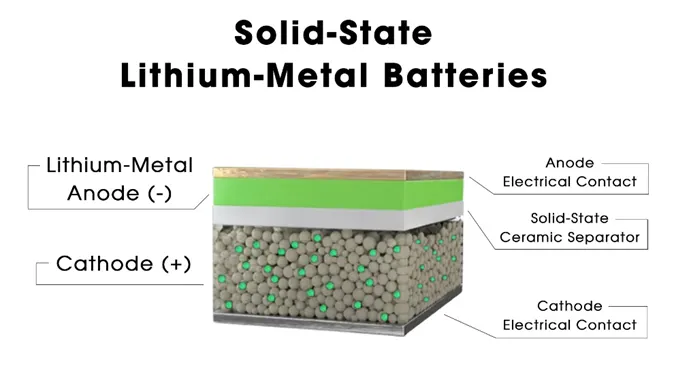
- A cathode (or positive electrode), which can be made with the same compounds as a lithium-ion battery (e.g. LFP, NMC, LMO, etc)
- A separator, generally ceramic or solid polymer, which also works as the electrolyte
- An anode made of lithium metal (pure lithium)
The grey central layer is the solid-state separator which, on its own, acts both as the separator between the anode and cathode and as the electrolyte. It, therefore, becomes the medium through which the ions move and also has electric insulating properties, and is a mechanical separator between the anode and cathode. The fact that there is this solid, resistant support allows the removal of the graphite structure on the anode part and ensures that lithium metal accumulates directly on the anode.
Sodium-ion battery:
A sodium-ion battery is a type of rechargeable battery comparable to the ubiquitous lithium-ion battery, but it uses sodium ions (Na+) as the charge carriers rather than lithium ions (Li+). The working principles behind and cell construction of a sodium-ion battery are virtually identical to those of lithium-ion batteries, but sodium compounds are used instead of lithium compounds.
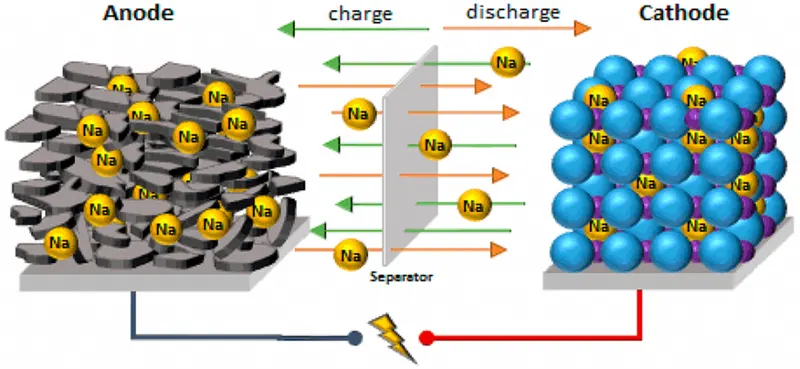
Sodium-ion batteries are currently emerging as a potential alternative to current lithium-ion battery technology due to their lower cost, higher availability, and reduced impact on the environment. Since sodium-ion batteries use cheap and abundant materials—sodium and aluminum rather than lithium and copper.
While a sodium-ion battery is discharging and providing a current, the anode releases sodium ions to the cathode, generating a flow of electrons from one side to the other. When plugging in the device, the opposite happens: Sodium ions are released by the cathode and received by the anode.
- Somaraju Vijay Kumarcourse name?