Week 6-Meshing of Hood Challenge
AIM:
To extract the mid-surface, perform geometry cleanup and meshing for the hood model components.
OBJECTIVE:
- To extract the mid-surface of each of the components separately.
- To perform the geometry cleanup for the extracted mid-surfaces.
- To create mesh on the extracted mid-surfaces.
- To correct the failure of elements for quality.
THEORY:
Hood:
Car hood mainly consists of four parts:inner bonnet, outer bonnet,latch and hinge. Inner bonnet usually provides strength for the engine, battery and other important parts in the front-end of the car. Outer bonnet provides styling and gives aerodynamic shape to the car body. Various requirements are needed while designing such as safety aspects and the quality criteria.Latch retains the hood. Locating and releasing the safety latch releases its hold on the hood and then the hood is allowed to open. The hood hinge is a mechanism that makes it possible for you to open and close your hood.
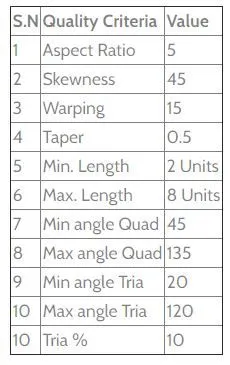
Warp Angle: It is defined as the angle between normals of two triangular planes formed by splitting the quad element along diagonals.
Aspect Ratio: It is defined as the ratio of maximum element edge length to the minimum element edge length. The ideal value is 1 but less than 5 is acceptable.
Minimum/Maximum element length: It is very important to check this error as it is used for crash analysis check.
Skewness: If the quad element is not a square and has deformation, skewness is defined as 90 minus the minimum angle between the two lines joining the opposite mid sides of the element and similarly for the triangular element it is 90 minus the line between the each node of the opposing mid side. The ideal value is less than zero but 45 degree is acceptable.
Skew angle = 90° - < 30°
Jacobian: It is the scale factor used in the transformation of a coordinated system. The ideal value is 1 but greater than 0.6 is acceptable. The value of the determinant of the Jacobian matrix is calculated for each integration point of the element according to each type: Element Type Order Number of integration points.
PARAMETERS:
PROCEDURE:
- First open the given model and delete all the solids present in the model.
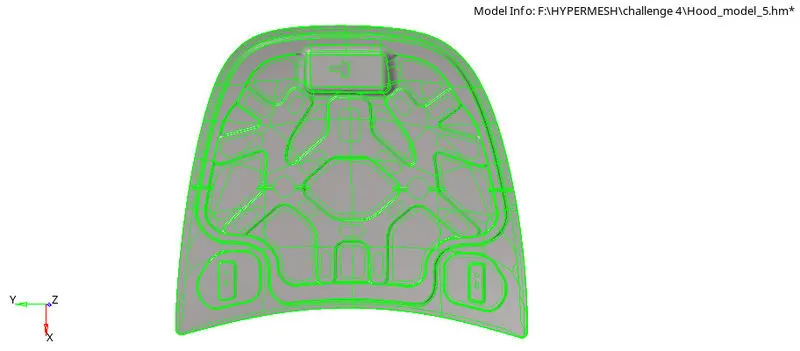
- Change into "By Topo" mode instead of "Auto" mode from "Geometry Color Mode" GUI. After changing into "By Topo" we have to view topology aspects on the component such as "Free edges, sharped edges, T-Junction edge and Suppressed edge.
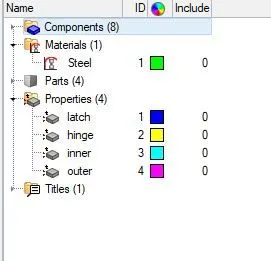
- Add material as steel and also add properties of each component and assign those to the components.
- Now, the mid-surface of each component is created separately using the ‘skin offset’ under the ‘auto extraction’ option present in the ‘midsurface’ menu.
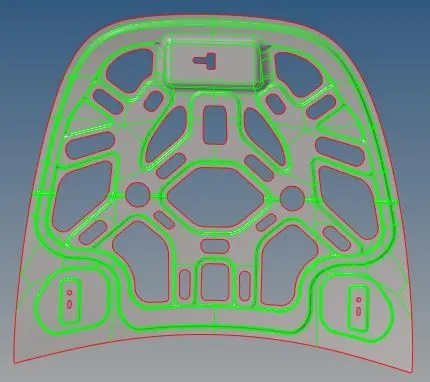
- Perform the geometry cleanup of the mid-surface manually by toggling unnecessary lines using ‘toggle edge’ option.
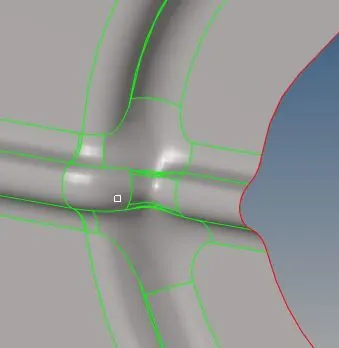
- Also, split the mid-surface using ‘split surf-node’ for the easiness and convenience during meshing.
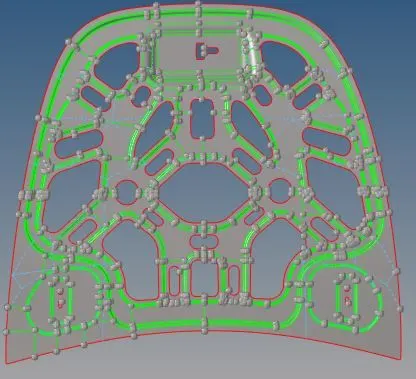
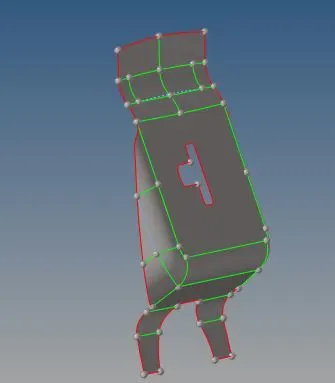
- Then, meshing of the mid-surface is performed using the ‘automesh’ option with appropriate element size and just the node numbers to get proper mesh.
- Also re-mesh small parts to avoid opposite trias and rotating elements. Use ‘smooth’ option to smooth the elements to get a better mesh.
- Finally, use ‘qualityindex’ to check for failure of elements. Also select the ‘check elems’ and check failure for each parameters and correct them.


- The correction can be done by either smoothing the mesh or by re-meshing.
- This procedure is conducted for all the four components.
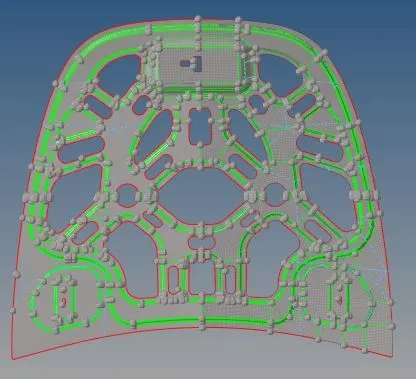
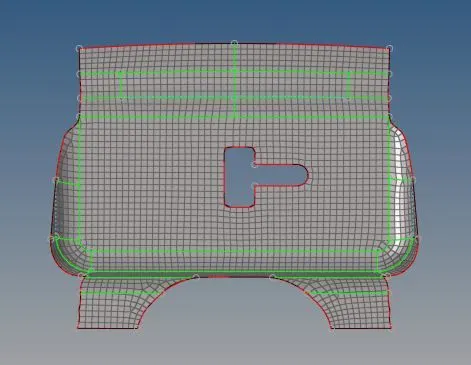
- The inner and outer are first meshed in half and after obtainning angood mesh, they are reflected.
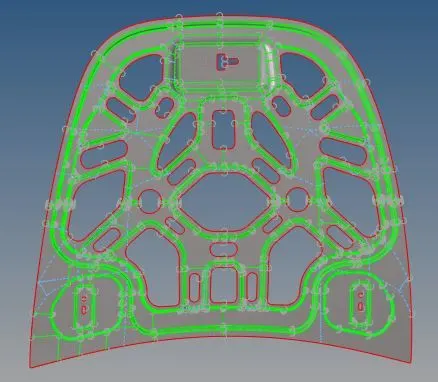
RESULT:
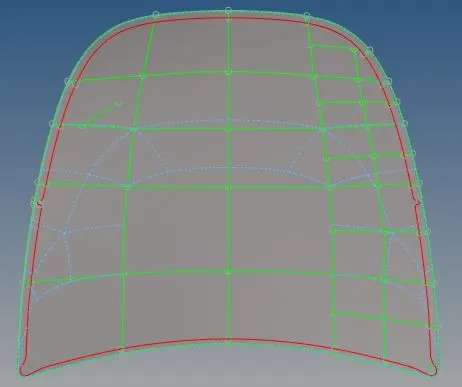
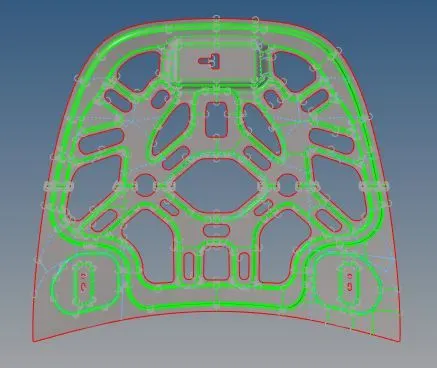
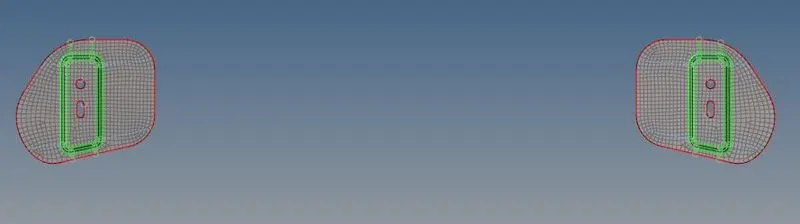
The images of components after meshing and element correction are given below.
- Outer bonnet:
- Inner bonnet:
- Latch:
- Hinge:
CONCLUSION:
- The given model has been meshed with given quality criteria. The thickness has been applied to the parts. Mesh generated has been checked for any failure in elements has been corrected.
- By completing this project, we learned to create the mid-surface, defeaturing of elements, making mesh better using various tools. mid-surface, creating mesh and removing failure in elements.