Week 6 - CHT Analysis on a Graphics card
Problem Statement
Perform a steady-state conjugate heat transfer analysis on a model of a graphics card. You can use appropriate materials of your choice for the simulation. Make sure to properly define the correct solid and fluid zones. Refer the video for further clarification and the model is provided below the video.
Run the simulation for best possible mesh with combination of coarse and refined mesh in different regions. Explain the reason for choosing the particular mesh settings.
Your Objectives:
- Run the simulation by varying the velocity from 1m/sec to 5m/sec for at least 3 velocities and discuss the results.
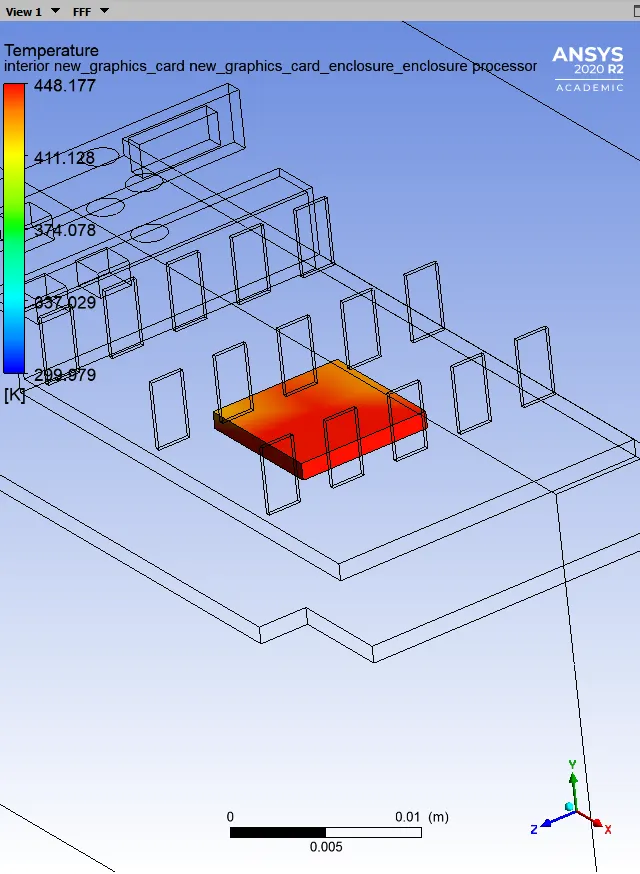
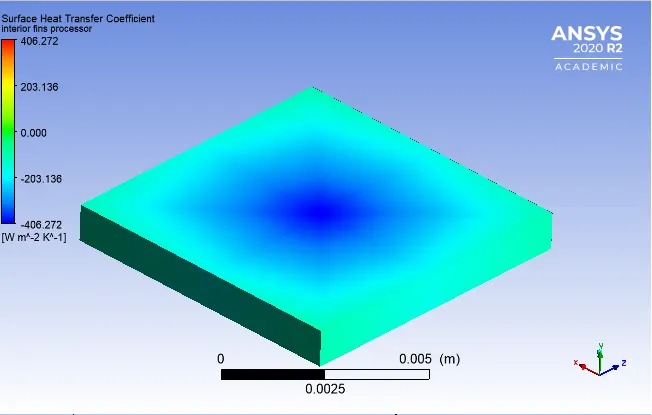
- Find out the maximum temperature and heat transfer coefficient attained by the processor.
- Prove that the simulation has achieved convergence with appropriate images and plots.
- Identify potential hotspots on the model.
Theory:
CHT analysis or Conjugate heat transfer analysis allows simulation for the simulation of heat transfer between solids and fluids by exchanging heat between them at the interfaces. The CHT approach has an advantage over FE thermal analyses in that wall heat transfer coefficients and their local variations on surfaces are directly calculated within the model rather than based on simplified empirical calculations. The CHT approach, therefore, has benefits for those applications where heat transfer is either non-uniform or difficult to calculate empirically.
Geometry Setup
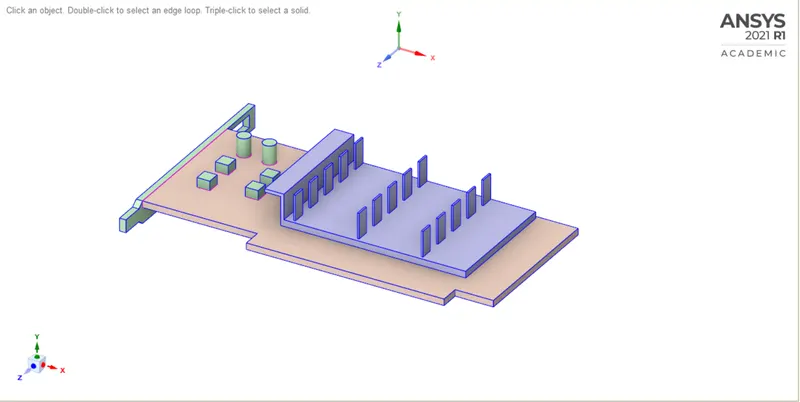
The gemotry model has to be imported in ansys spaceclaim and then go to workbench and share the topology of the model so that information can be exchnaged at the different interfaces in the model and a conformal mesh is obtained.
Meshing
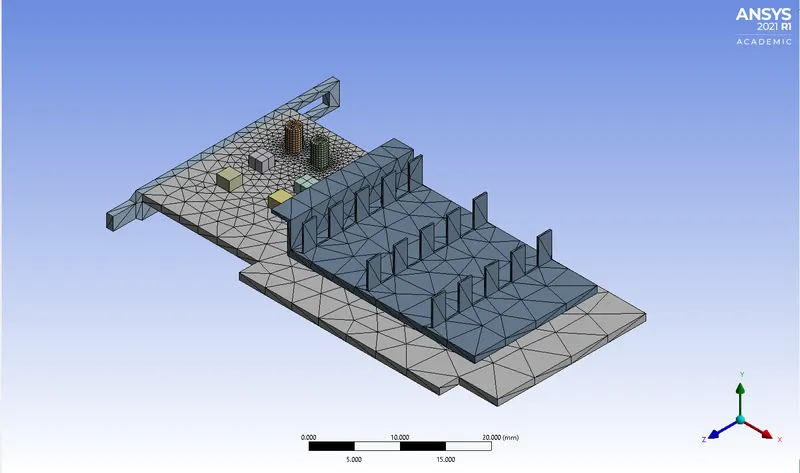
Baseline Mesh
Name selection was done for ease of access in fluent.

Fluent Setup
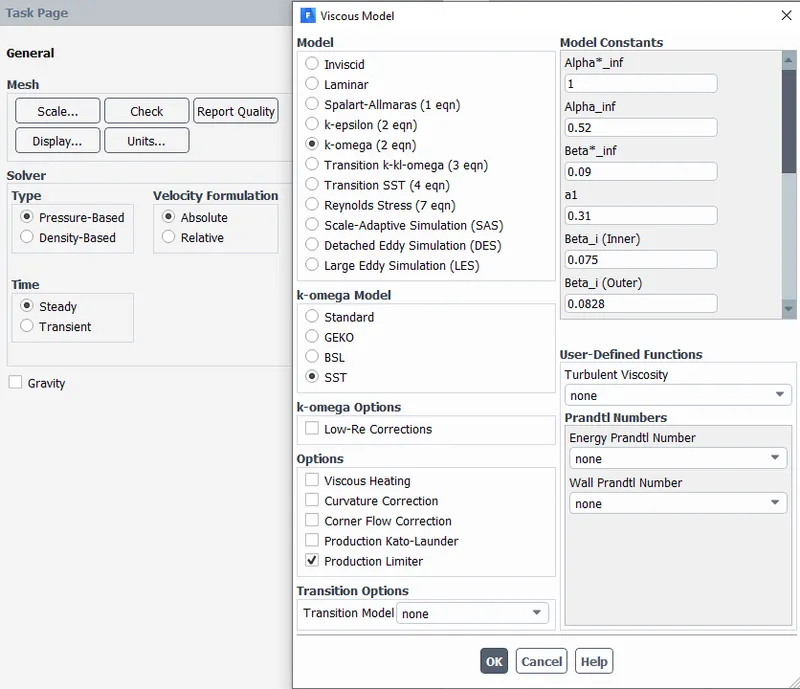
Setting up physics
Materials:
1) Air
2) Copper- Fins
3) Steel- Base
4) Gold- Processor
Setting up source terms-
Goto zones- Cell Zones - and click on the processor for editing which should be solid after that click on material gold and enable source terms and set energy sources to 1, then for calculating energy sources assume the processor consumes 80 W of power to work and the dimension of processor is 8*8*1 mm^3 so energy produced = 1280000000 W/m^3 .
Inlet conditions-
Velocity= 1 m/s
Temperature= 300 K
Solution-
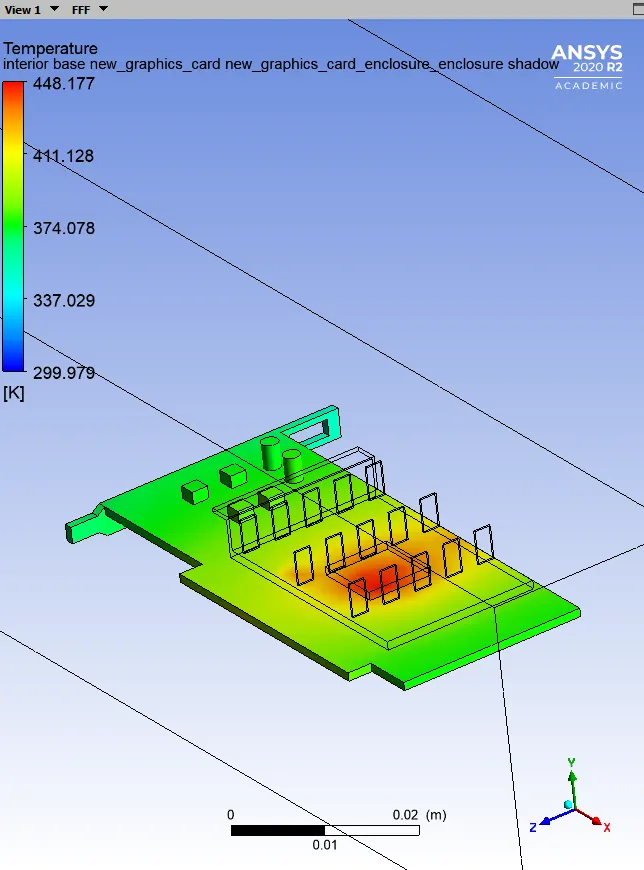
1) Base line mesh silmuation results
Temperature

Improved Mesh
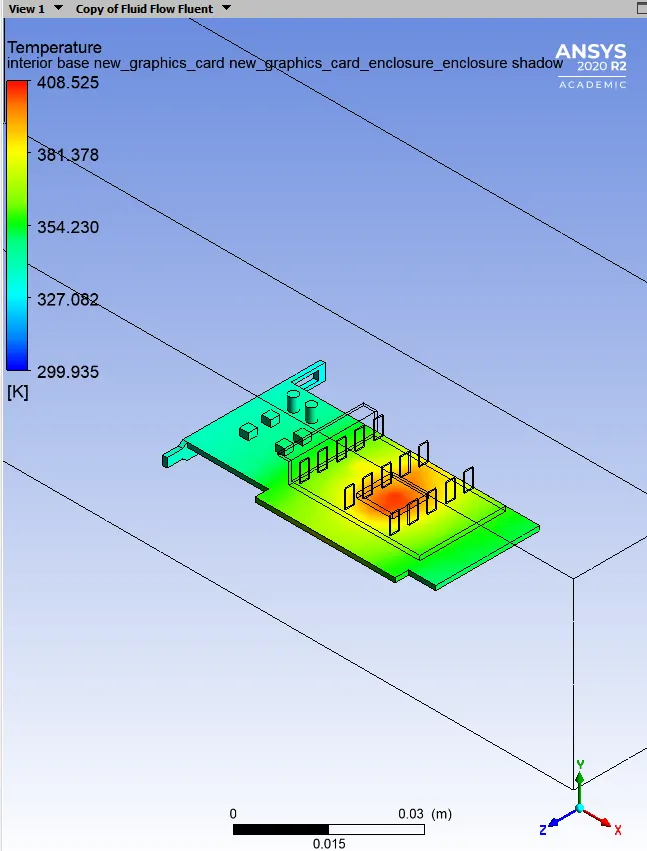
Mesh sizing- 4 mm
Results For 1m/s inlet velocity at 300k air temperature
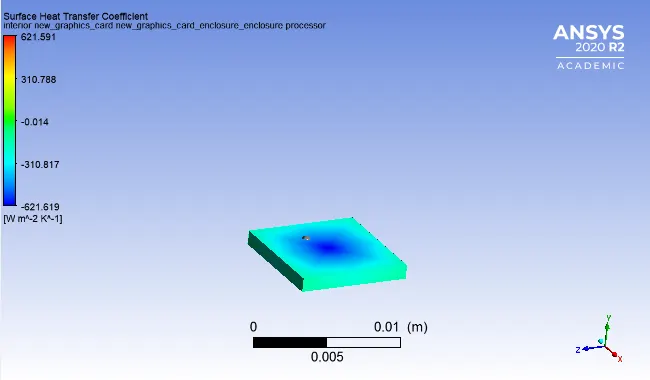

Improved Mesh
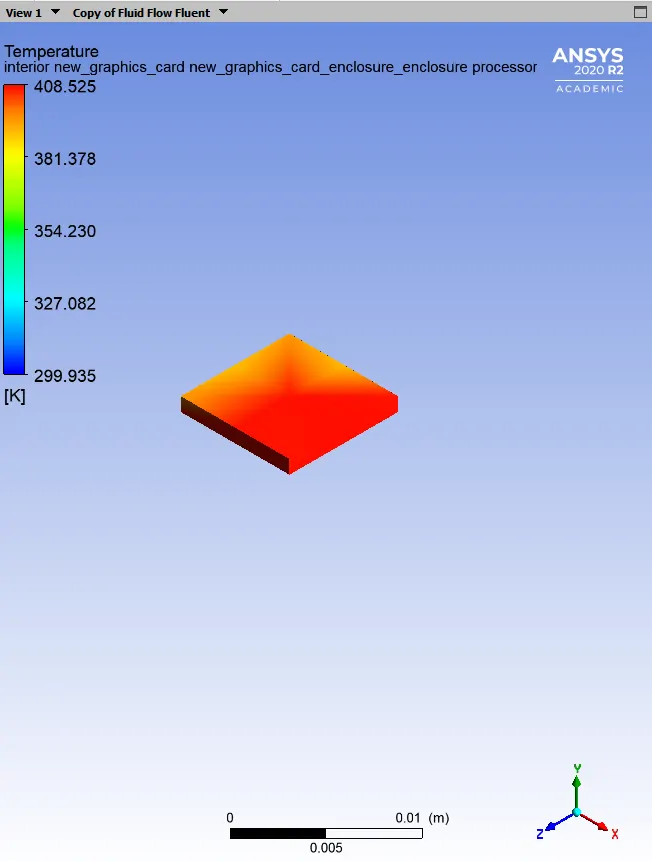
Mesh sizing- 4 mm
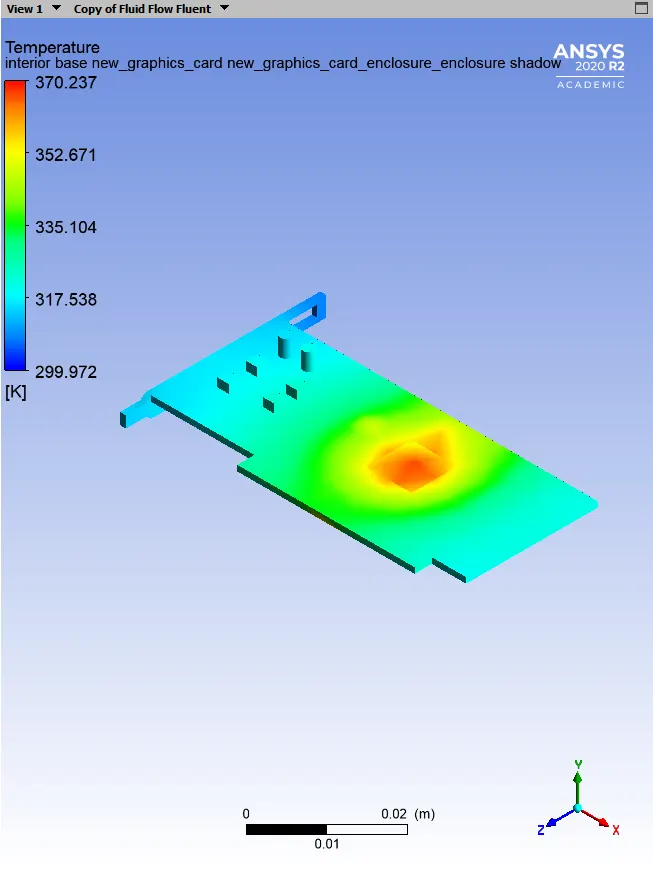
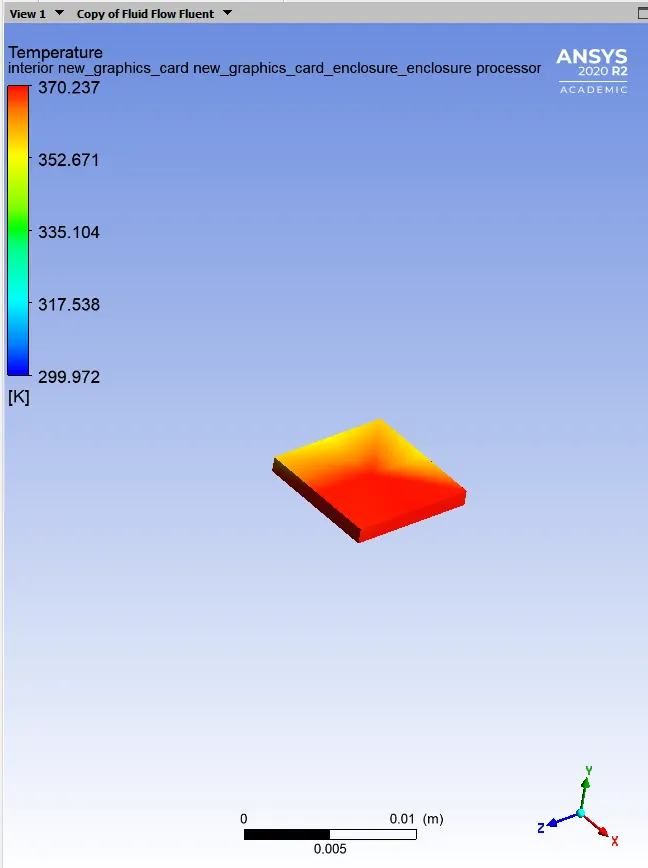
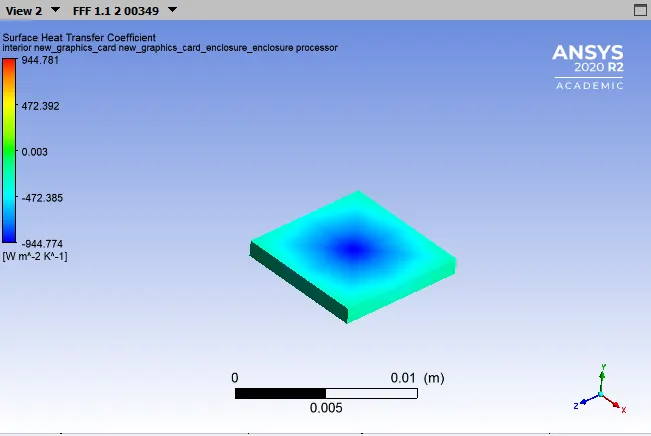
Results For 5m/s inlet velocity at 300k air temperature

Conclusion
- Max Temperature found= 408.525 K
- A converged set of solution was obtained for HTC.
- Max temperature points were found on the processor and fins.
- With an increase in inlet velocity a drop in temperature was observed.
Note- A high refined mesh was unable to be used as the computer wasn't able to handle the processing power.