Week 6 - CHT Analysis on a Graphics card
CONJUGATE HEAT TRANSFER ANALYSIS OF Graphical card.
OBJECTIVE:-
- To perform steady-state conjugate heat transfer analysis on Graphics Card
- To find the different temperature and different velocities.
INTRODUCTION:- Conjugate heat transfer is defined as the heat transfer between two domains by exchange of thermal energy. For a system the thermal energy available is defined by its temperature and the movement of thermal energy is defined by its heat flux through the outer walls. Heat transfer in solid happens through conduction and walls by convection and in liquid phase through convection. CHT provides the temperature prediction and the hotspot regions at the solid-fluid interface and we can also predict the heat transfer accurately for example- Conduction through solids, convection through fluid, and thermal radiation. It also provides the velocity and pressure distribution of fluid moving inside the solid. We can also use CHT in design optimization for improvement for heat transfer and cooling capacity.
PROBLEM STATEMENT:-
1. Simulate the conjugate heat transfer model of a graphics card and use appropriate materials.
2. simulate the varying velocites of 1m/s , 3m/s and 5m/s.
3. To find out the maximum temperature and heat transfer-co-efficients.
In this challenge we can perform 5 steps.
# Geometry.
# Mesh.
# set-up
# solution
# results.
In this challenge we can performed three general mesh cases 1. general mesh 2. general mesh. 3. refined mesh.
# GEOMETRY:-
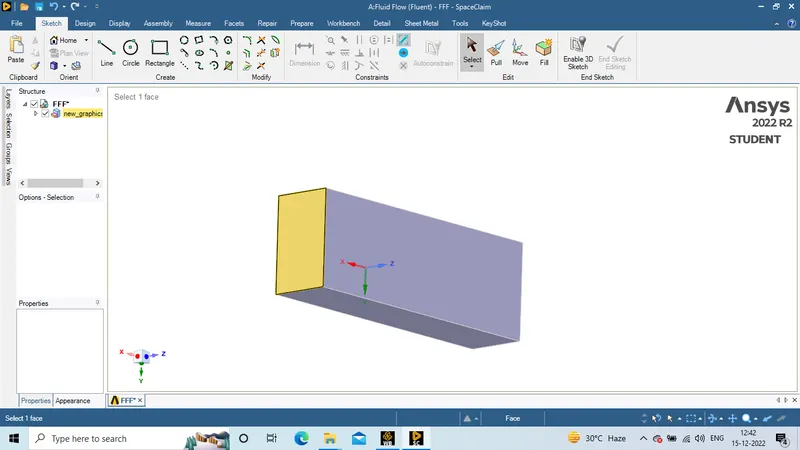
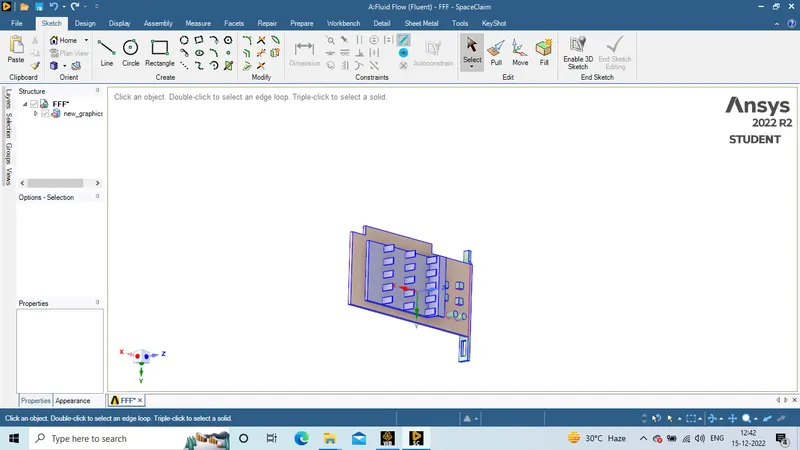
In geometry the above figure known as cht graphic card. The cht graphic card consists of base, fins, processer . in this section the fins are used tosurface that can extend the object of increase the heat transfer rate . in geometry we have used sharetropology.
share topology:- The purpose of the share topology operation is to ensure that connected bodies have shared faces, which helps facilitate the creation of a conformal mesh.
2. mesh :- [general mesh]:
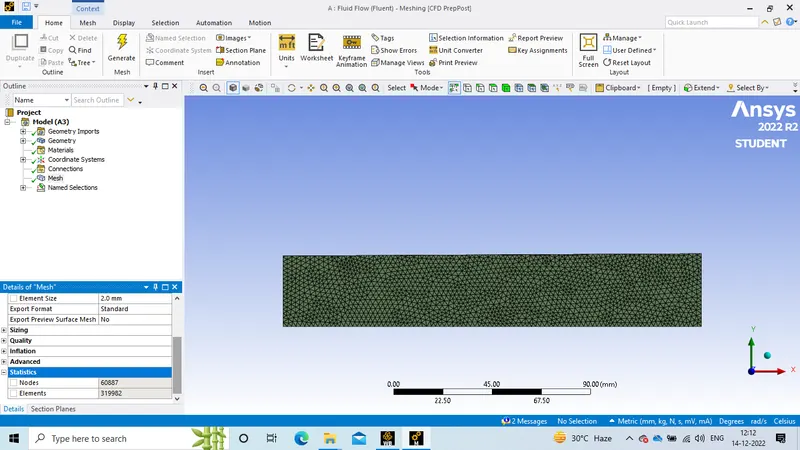
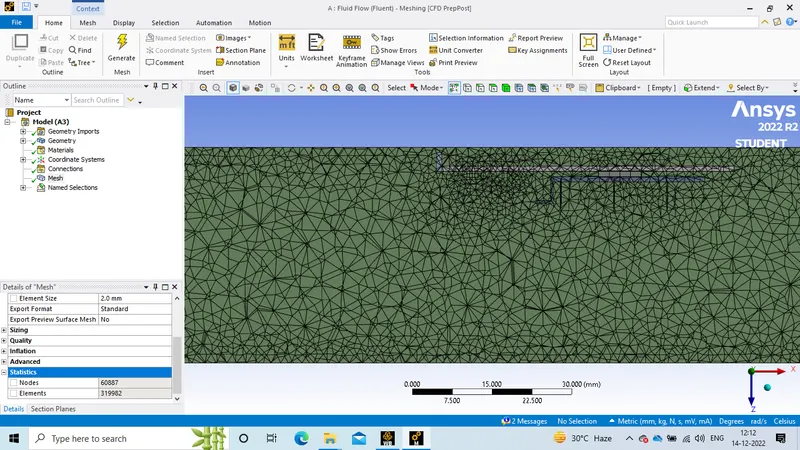
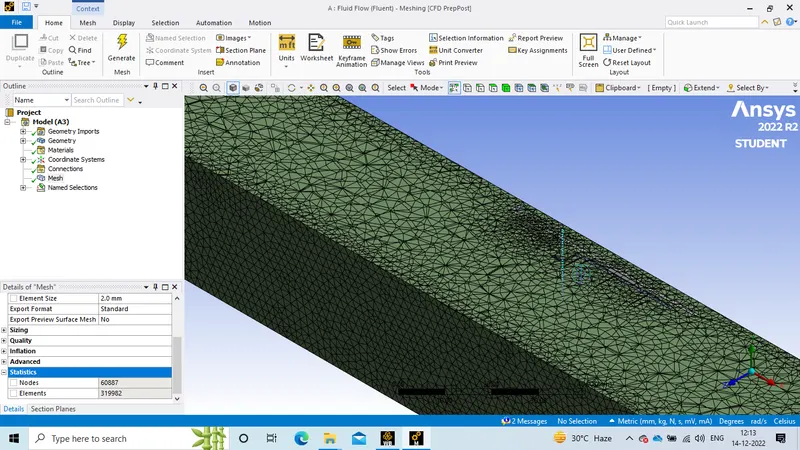
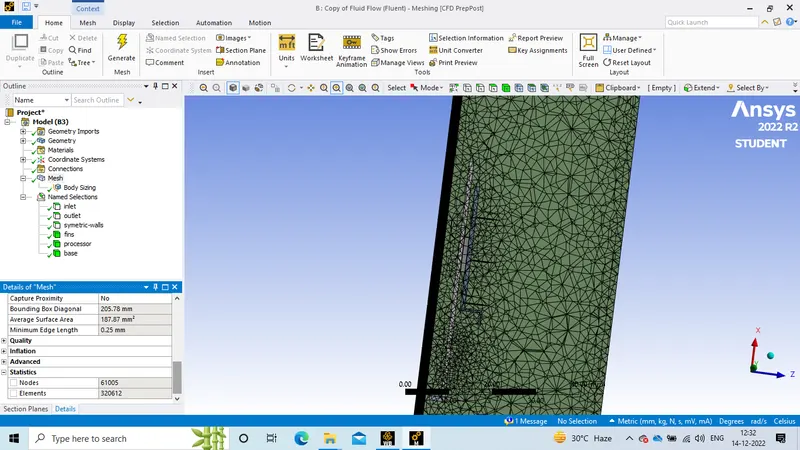
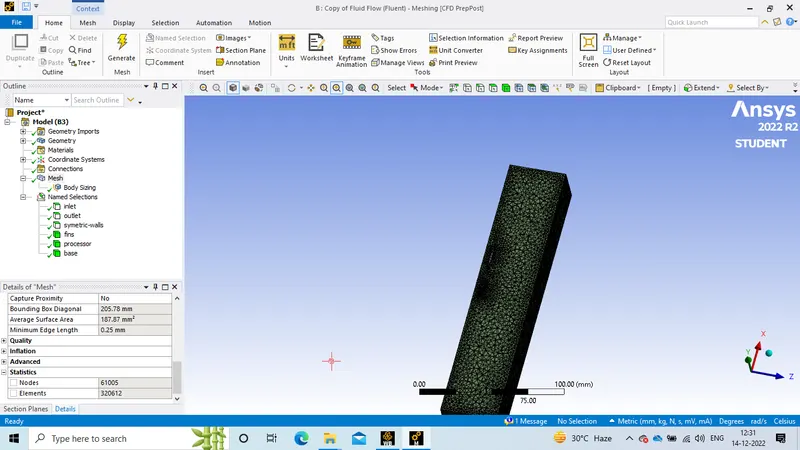
In mesh we have used general mesh of cht graphical card and used as defult mesh so in this mesh the nodes are 60887 and elements 319982. we have given the named selection also inlet and outlet symetric walls, base, fins, processer. in this challenge the inlet as taken as velocity and oulet pressure these parameters are used in this challenge.
Setup:- for velocity 1m/s
procedure:-
# physics - energy equation on
viscous - k-epsilon model
# created materials:- fluid -air, solid- alliminum-fins, wood-base, gold-processer
# fluid section - air
density- 1225 kg/m^3, cp(specific heat) - 1006.43j/kgk, thermal conductivity [w/mk]- 0.0242, viscosity - 1784e-05.
# solid-section
# alluminium[fins] - density - 2719kg/m^3, cp specfic heat j/kgk, thermal conductivity [w/mk]
# gold(processer) - density - 19320kg/m^3, cp(specific heat) [j/kgk] = 129.81, thermal conductivity [w/mk] - 297.73.
cell zones:- base-wood -solid
# fins-solid- allumium
# processer- solid- gold
# new cht graphical card -air-fluid.
# boundary conditions:-
# inlet - 1m/s , temeperature - 300k
# outlet - 0 gauge pressure
# initilize the flow
# method - coupled
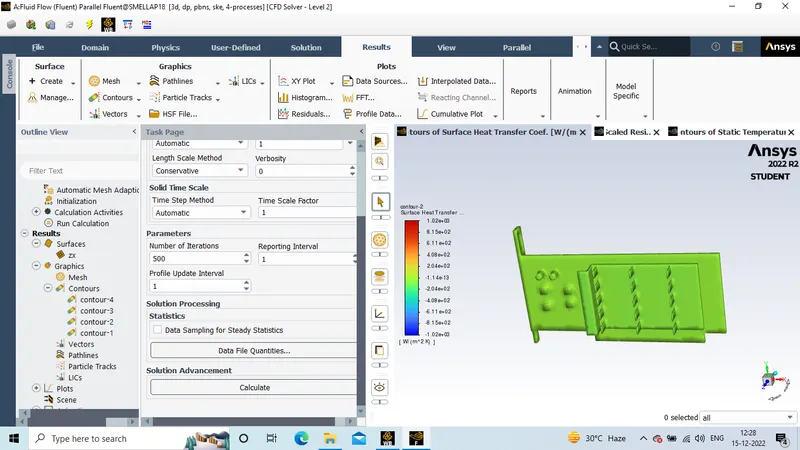
contours- temperture and surface heat transfer co-efficient
# create plane -xz
# ierations - 500
# heat generated = p/v = 1/ 6.4e-08 = 12645000
solution results of velocity - 1m/s:-
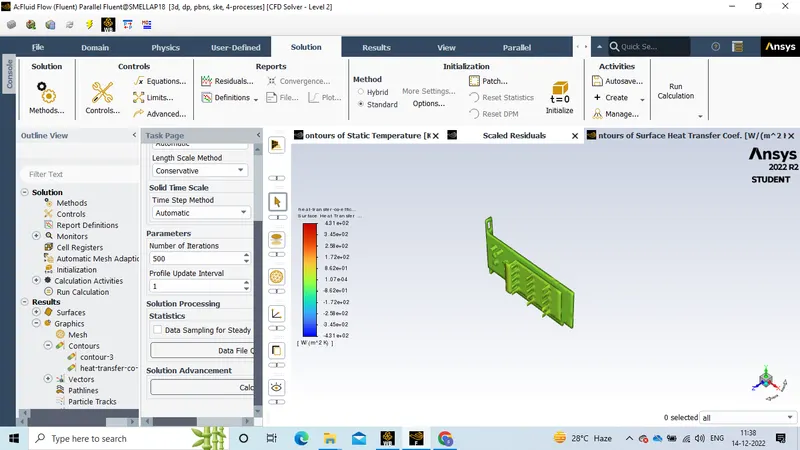
SURFACE HEAT TRANSFER CO-EFFICIENT:-
TEMPERATURE:-
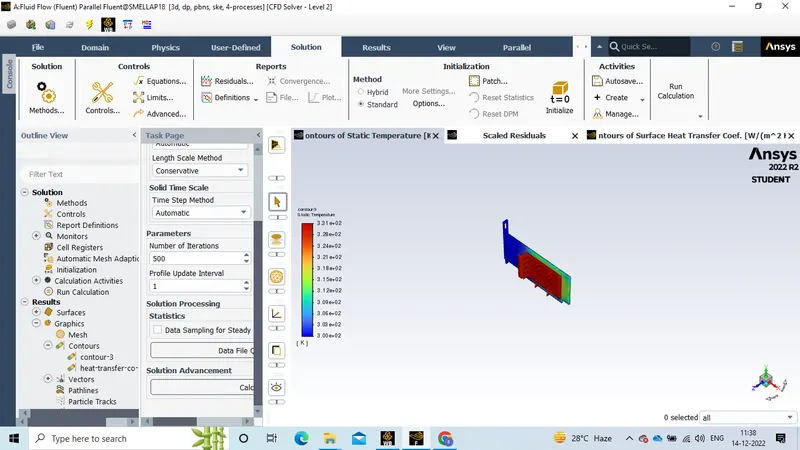
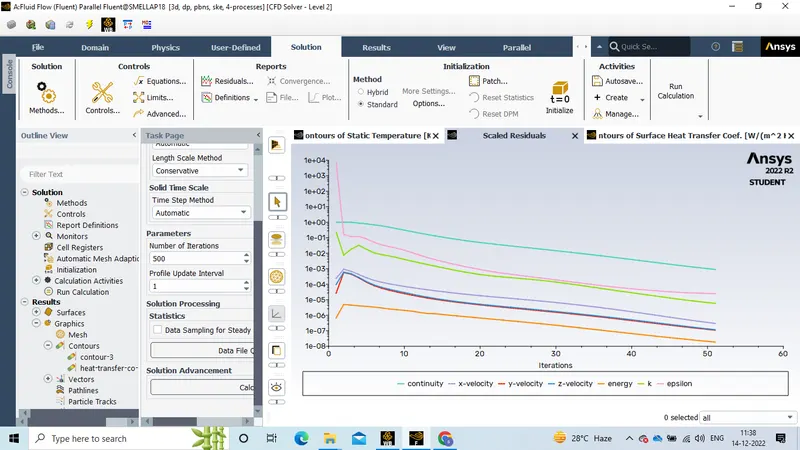
OBSERVATIONS:- The first case solution will converge at 50 iterations and the temperature reached 3.31e+02.
RESULTS:-
TEMPERATURE CONTOUR:-
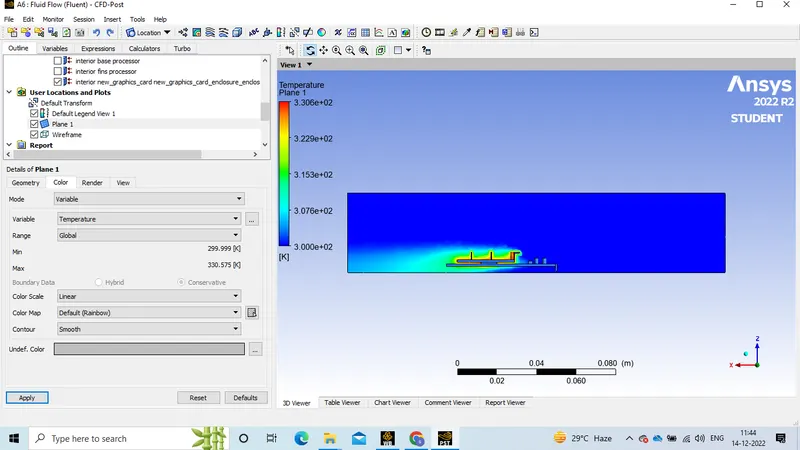
In themperature contour we have created the plane and select varble as tempreature , rangea s used global , the maximum tempearute is 299.99 and minimum tem is - 330.575.
velocity profile:-
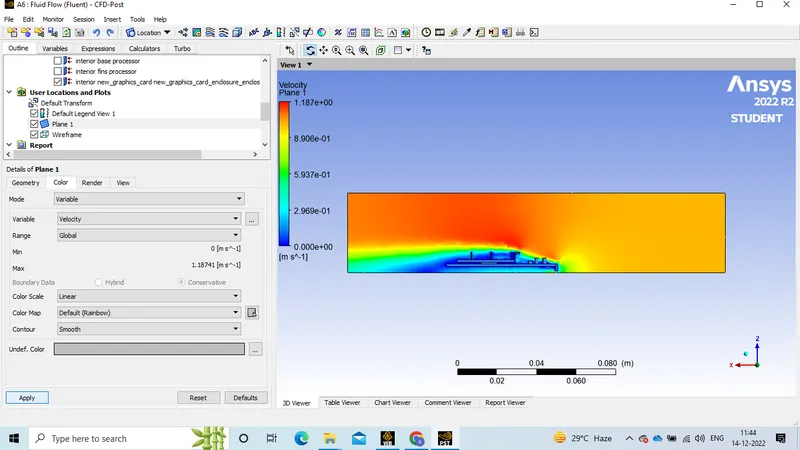
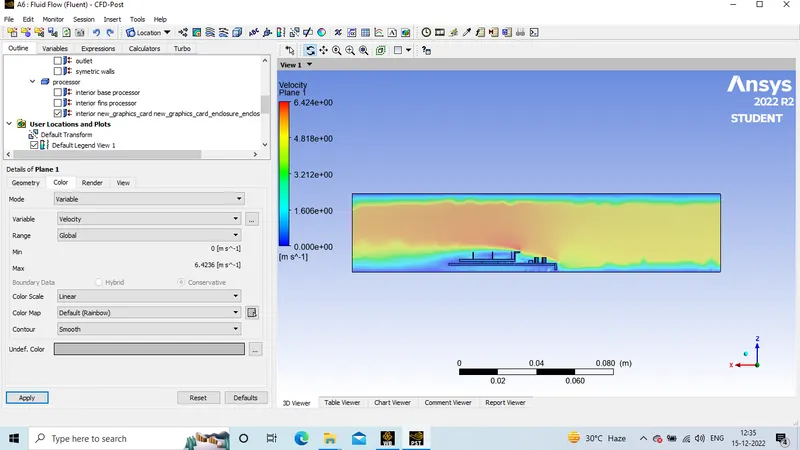
the velocity profile of the maximum velocity and minimum velocity are 0 to 1.1874m/s.
Case- 2 velocity 3m/s:-
mesh:-
setup- procedure:-
# physics - energy equation on
viscous - k-epsilon model
# created materials:- fluid -air, solid- alliminum-fins, wood-base, gold-processer
# fluid section - air
density- 1225 kg/m^3, cp(specific heat) - 1006.43j/kgk, thermal conductivity [w/mk]- 0.0242, viscosity - 1784e-05.
# solid-section
# alluminium[fins] - density - 2719kg/m^3, cp specfic heat j/kgk, thermal conductivity [w/mk]
# gold(processer) - density - 19320kg/m^3, cp(specific heat) [j/kgk] = 129.81, thermal conductivity [w/mk] - 297.73.
cell zones:- base-wood -solid
# fins-solid- allumium
# processer- solid- gold
# new cht graphical card -air-fluid.
# boundary conditions:-
# inlet - 3 m/s , temeperature - 300k
# outlet - 0 gauge pressure
# initilize the flow
# method - coupled
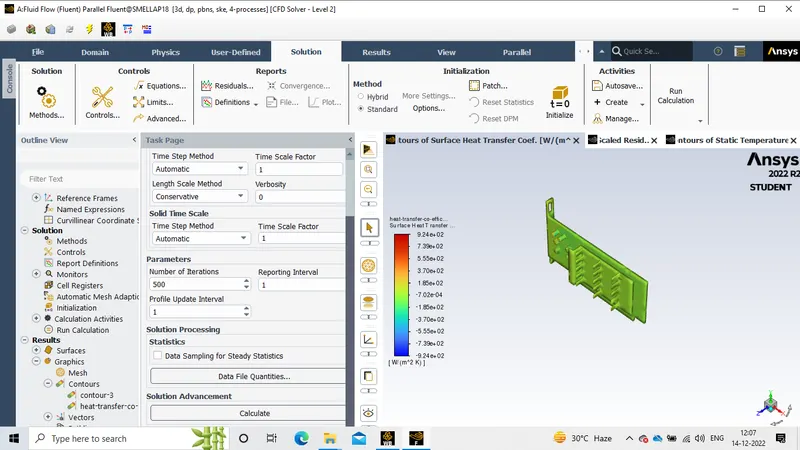
contours- temperture and surface heat transfer co-efficient
# create plane -xz
# ierations - 500
# heat generated = p/v = 1/ 6.4e-08 = 12645000
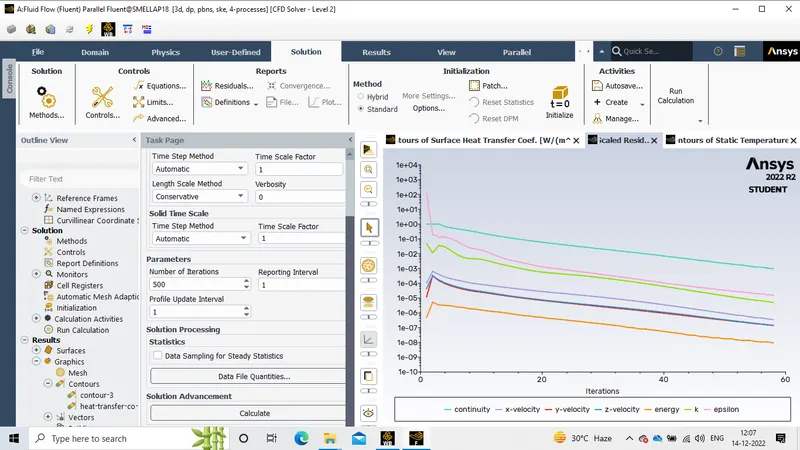
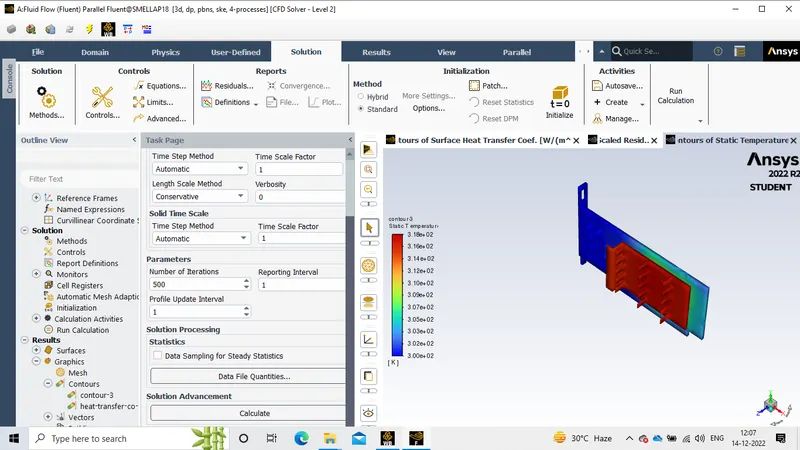
solution:-
RESULTS:-
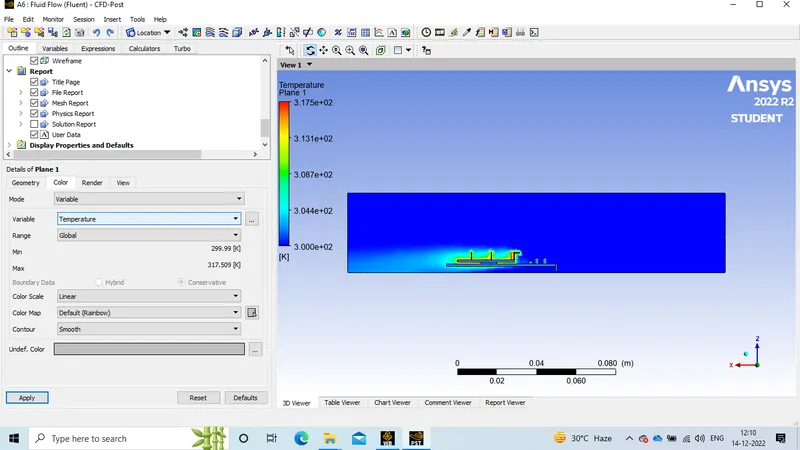
temerature profile:-
velocity:-
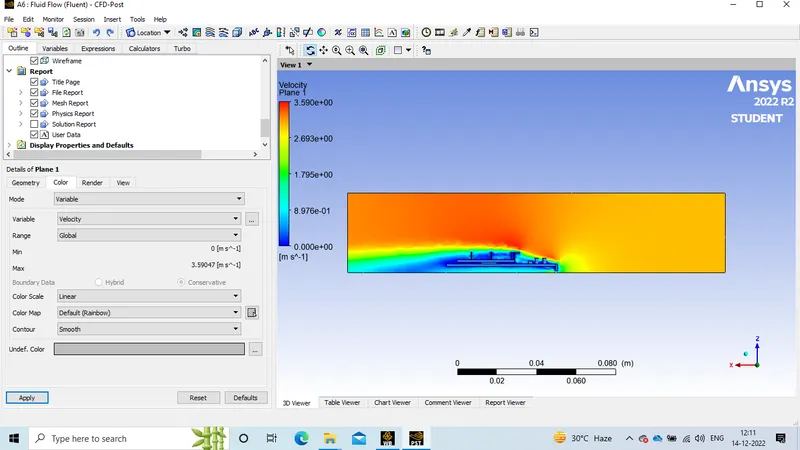
CASE-3 REFINED MESH VELOCITY 5M/S:-
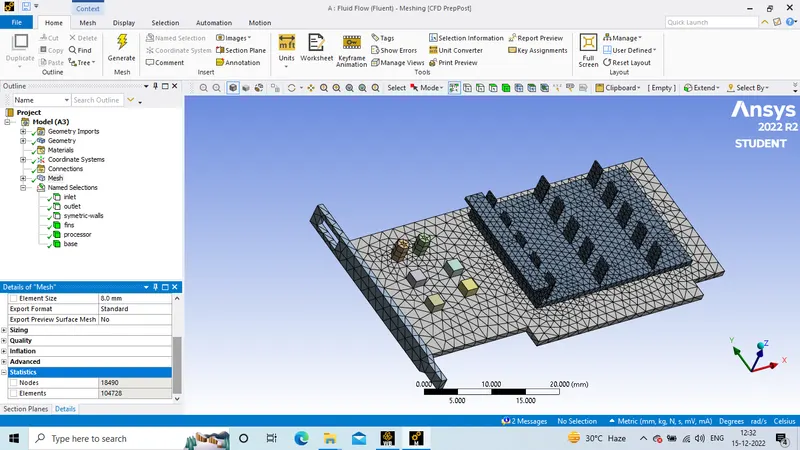
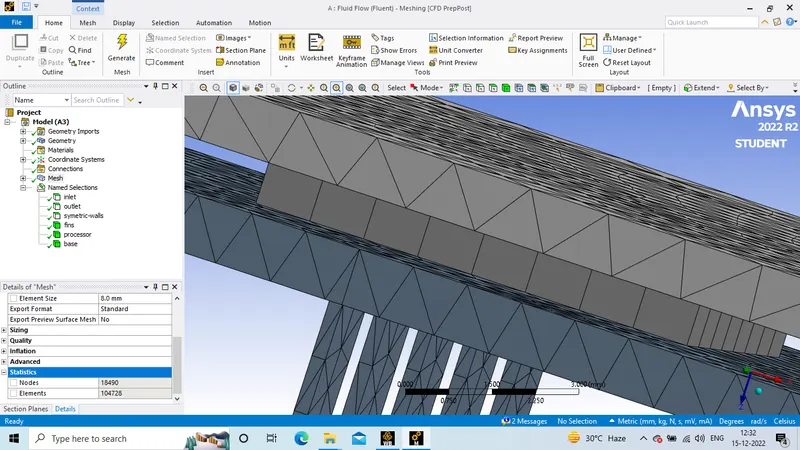
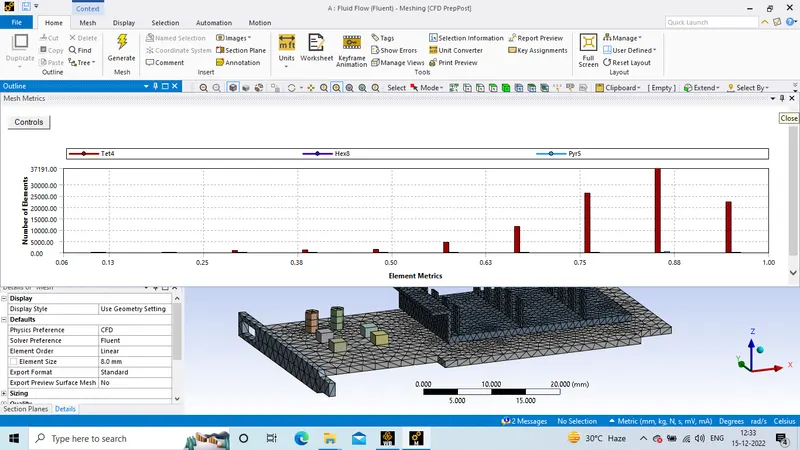
SETUP PROCEDURE:-
# physics - energy equation on
viscous - k-epsilon model
# created materials:- fluid -air, solid- alliminum-fins, wood-base, gold-processer
# fluid section - air
density- 1225 kg/m^3, cp(specific heat) - 1006.43j/kgk, thermal conductivity [w/mk]- 0.0242, viscosity - 1784e-05.
# solid-section
# alluminium[fins] - density - 2719kg/m^3, cp specfic heat j/kgk, thermal conductivity [w/mk]
# gold(processer) - density - 19320kg/m^3, cp(specific heat) [j/kgk] = 129.81, thermal conductivity [w/mk] - 297.73.
cell zones:- base-wood -solid
# fins-solid- allumium
# processer- solid- gold
# new cht graphical card -air-fluid.
# boundary conditions:-
# inlet - 5 m/s , temeperature - 300k
# outlet - 0 gauge pressure
# initilize the flow
# method - coupled
contours- temperture and surface heat transfer co-efficient
# create plane -xz
# ierations - 500
# heat generated = p/v = 1/ 6.4e-08 = 12645000.
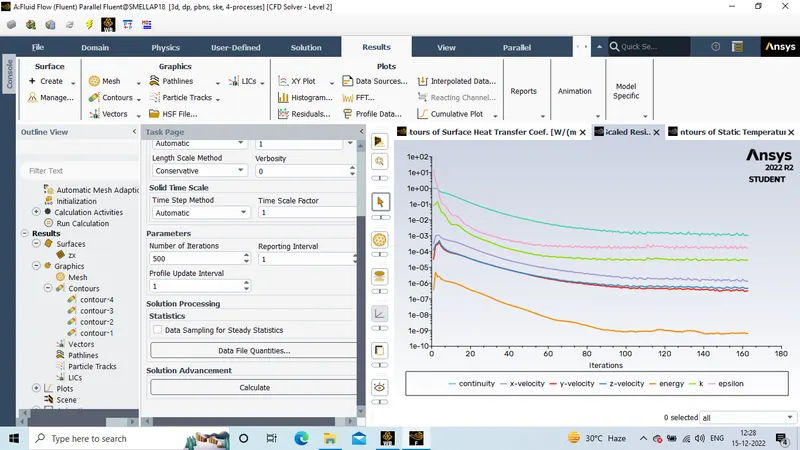
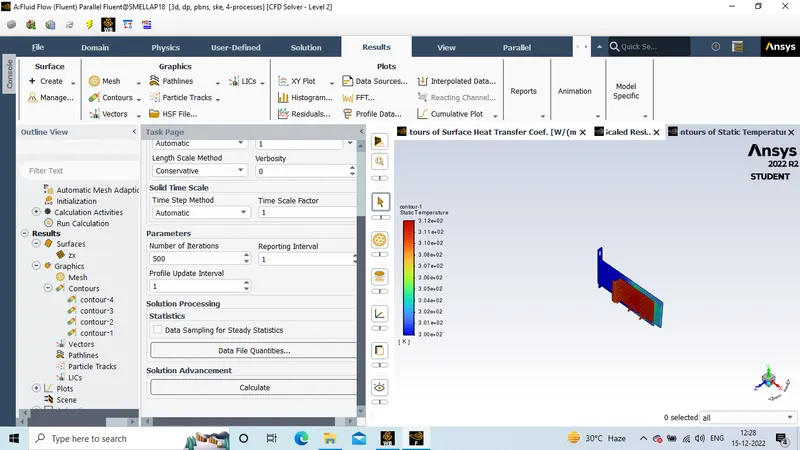
SOLUTION:-
RESULTS:-
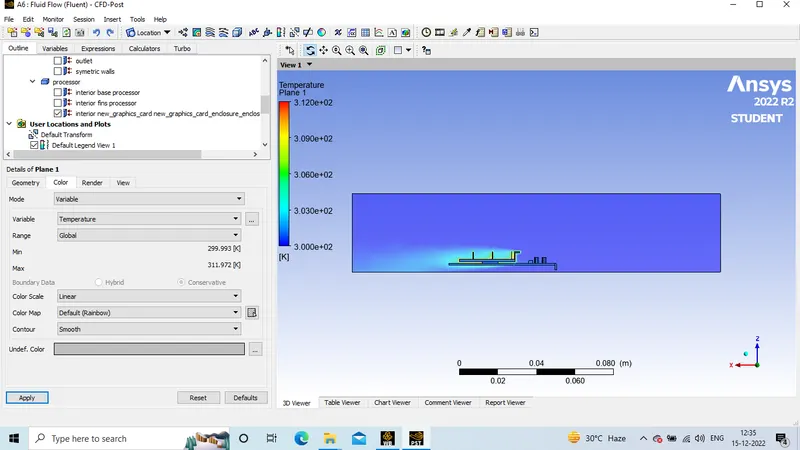
TEMPERATURE PROFILE:-
CONCLUSIONS:-
1. The first case will converged very early at the 50 iterations and the temperature reached 331
2. we have taken velocitys 1m/s , 3 m/s , 5m/s
3. second will conveeged at 58 iterations and the temperature reached 318.
3. third case will converged at 160 iterations and the temperature reached 310.
4. the first case is the best case compare to the other cases.