Week 6 Challenge-FVM Fundamentals 101
Question1. Derive the expression for the `(delf)/(delx)` for a forward difference of second order.
Solution: First let expand the term`f(x+2Deltax)` using Taylor Series
`f(x + 2Δx) ≈ f(x) + 2Δx * f'(x) + (2Δx)^2 * f''(x) / 2 + ...`
Now, let's expand `f(x + Δx)` in a similar fashion:
`f(x + Δx) ≈ f(x) + Δx * f'(x) + (Δx)^2 * f''(x) / 2 + ...`
Now, plug these into the forward difference formula:
`(∂f)/(∂x) ≈ (f(x) + 2Δx * f'(x) + ((2Δx)^2)/2 * f''(x) - 4f(x) - 4Δx * f'(x) - (2(Δx)^2)/2 * f''(x) + 3f(x)) / (2Δx).`
Simplifying the terms we get,
`(∂f)/(∂x) ≈ (f(x + 2Δx) - 4f(x + Δx) + 3f(x)) / (2Δx).`
This is the Forward Differencing 2nd Order accurate for First order derivative.
Question2. Apply Finite Volume Formulation to the equation
Solution: FVM Formulation:
Applying the Gauss Divergence theorem to the following equation `(∂ρϕ)/(∂t) + ∇ . ( ρ u ϕ ) = 0`
So by considering a small volume we get
`∫[(∂ρϕ)/(∂t)]dV + ∫∇.(ρuϕ)dV = 0.`
Applying divergence theorem we get
`∫_(V)[(∂ρϕ)/(∂t)]dV + ∫_(S)(ρuϕ)·dA = 0,`
where dA is the outward normal vector on the control volume boundary.
where the surface integral is calculate by,
`∫_(S)(ρuϕ)·dA = sum S_f * (rhoUphi)_f`
therfore the equation after the FVM formulation we get,
`del/(delt)int_(V) (rhophi)dV + sum_f S_f * (rhoUphi)_f`
Question3. Write a note on the van Leer TVD scheme
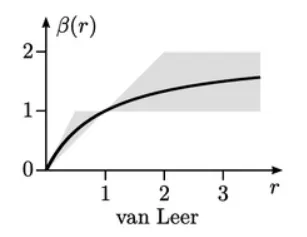
A TVD (Total Variation Diminishing) scheme in Computational Fluid Dynamics is designed to maintain stability, prevent oscillations, and limit extreme values in the solution. These schemes aim for both accuracy and control. The Sweby diagram defines the conditions for a scheme to be TVD, with the shaded area indicating the valid TVD region. However, not all limiter functions ensure second-order accuracy. High-resolution schemes are within the blue region, while low-resolution schemes fall in the grey region. Limiters can reduce local accuracy to first order in situations with sharp gradients, opposite slopes, or zero gradients (r < 0). While this decreases accuracy, it helps curb oscillations. No universal limiter works well for all problems, so the choice is often made through trial and error.
van Leer
This is a notable TVD schemes that exhibit low diffusion, maintain symmetry through some downwind interpolation,and have limiter functions which are continuous in gradient which avoids problems due to sudden changes in limiter values. Adriaan van Leer is the creator of this scheme. This scheme consider the flow direction and adjust at each grid point accordingly.
The van Leer scheme is the original limited advection scheme described by the limiter function
`β = (r + | r |)/(1 + | r |`
the van Leer scheme uses relatively strong downwind interpolation.