Week-6 Challenge: EV Drivetrain
Ans 1: There are basically 4 types of main Power COnverter circuit in Power Electronics domain. Their features and application in EV and HEV are described below:
i.) AC to DC Converter or Rectifier
This type of converters are used when we need to convert AC supply to DC.
In EV/HEV, battery pack are based on DC so for charging these batteries in EV either from external charger or internally through alternator(in HEV) or during regenerative breaking the power from the generator/External AC supply(230V, 50 hz AC supply) is in the form of AC and it need to be converted into DC in order to charge the battery. For PHEV these converters are used when charging the battery from a charging station or from home.
ii) DC to AC Converter or Inverter
In EV/HEV both, the AC motors are used mostly for drive. So the power from the battery (DC) is converted into AC for the motor to drive. These converted AC power can also be used for other Auxilliary loads in vehicle which takes AC input.
iii) DC to DC Converter or Chopper
Battery packs in EV/HEV are generally high voltage DC, 120V or higher. But there are many auxilliary equipments or measuring instruments like sensors, microcontrollers etc requires low level DC voltages like 12V, 5V etc. Thus, high DC voltages are converted/chopped down into low level of DC voltages by using different type of DC-DC converters like Buck converts, Flyback converters etc.
iv) AC to AC Converter or Cycloconverters/Regulators
In a vehicle whether EV/HEV or IC Engine, many auxilliary loads requires low AC voltages of different frequency for example to regulate the lamp(dim or bright), AC and also to control the speed of motor in EV/HEV. Thus input AC waveform with particular voltage and frequency is converted into another AC waveform with different voltage and frequency.
Ans 2: Given the EV parameters as
Rated Armature voltage= 72 V
Rated armature current= 400 A, Armature Resistance, Ra= 0.5Ω,
Motor Constant, KΦ= 0.7 V/s, Switching frequency= 400 Hz
Given vehicle speed-torque characteristics :  ...eqn1
With the duty cycle of 0.7, the armature voltage becomes=0.7*72= 50.4V
The know speed torque equation of DC motor is given as
Putting the values given, Torque equation becomes
T= (50.4*0.7/0.5) - ((0.7*0.7)/0.5)w
T= 70.56 - 0.98w ....eqn2
To find the steady state speed, we equate the eqn 1 and 2,
70.56 - 0.98w = 24.7 + 0.0051w^2
=> 0.0051w^2 + 0.98w - 45.86 = 0
Solving the above quadratic equation on Matlab:
>> roots([0.0051 0.98 -45.86])
ans =
-231.0718
38.9150
Speed cannot be negative. SO the steady state speed at 0.7 duty cycle would be 38.915 rad/s.
Ans 3: The mathematical model of basic DC motor speed-torque equation is build on Simulink as shown below:
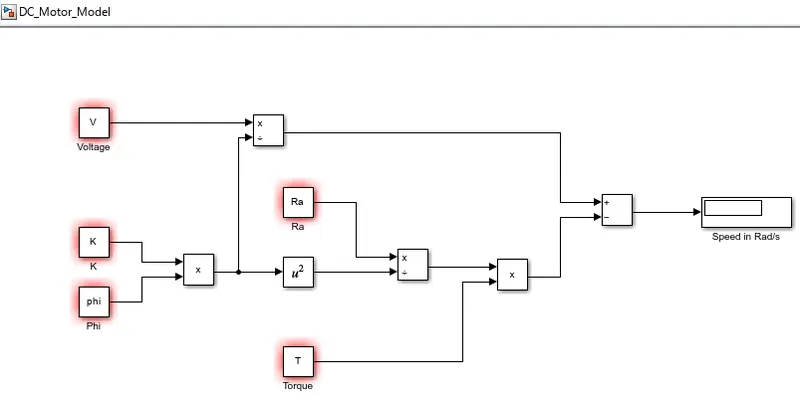
Note: Input voltage to Motor, Resistance, motor cosntant and Torque value can be defined in command window to see the corresponding speed of Motor in Rad/s.
Ans 4: In the article by Tesla, the merits and demerits of two types of machine is discussed. Induction motor’s technology has been around for decades, while a BLDC motor uses high-tech to meet our everyday needs. Millennials require fast response times and on-demand technologies provided by modern solutions.
Difference between the BLDC motor and induction motor techniques:
1. BLDC motor has different applications in hybrid vehicles, industrial robots, etc. An induction motor has applications mostly in heavy machineries for eg Lift Cranes, Crushers, Hoists, and exhaust fans (large capacity)
2. BLDC motor is compact as compared to a bigger induction motor.
3. BLDC are energy-efficient as they dont produce much heat as compared to an induction motor.
4. Motors that use permanent magnets, like BLDC motors, are more expensive than those that are induction motors.
5. The stator and rotor of the BLDC motor go hand-in-hand. An induction motor experience a gap as the rotor operates at a lower frequency than the stator. That creates a load on the motor.
6. Induction motor in EV requires inverter however BLDC can work directly from Battery in EV.
7. An induction motor does not require a controller in case of fixed speed, but a variable rate requires a controller. But a BLDC motor requires a controller at any rate.
8. The current control in BLDC is mainly done by an inverter, this is the working of BLDC motor. Coming to Induction motor it doesn't have any magnets, they are stacked laminations with buried conductors. Current through stator winding produces a rotating magnetic field that interacts with the rotor.
From the authors perspective both the motors have its own uses, BLDC will be usefull in case of HEV and PHEV whereas induction motors will be more used in high performance pure EV for an unforeseen period in the future mentioned by a golden era.