Week-6 Challenge: EV Drivetrain
QA:1 POWER CONVERTERS:
Power electronics; Branch of electrical engineering which is based on switching techniques instead of dissipative techniques or electronic signals controlling electric power in the circuit and this task is carried out by components called Power Converters.
The task of a power converter is to process and control the flow of electric energy by supplying voltages and currents in a form that is optimally suited for user loads .
The 3 types of converters which are widely used in an Electric Vehicle are:
1. AC to DC converter
2. DC to AC converter
3. DC to DC converter
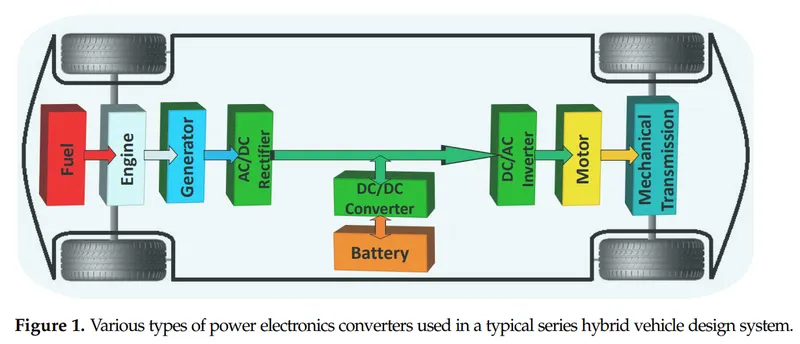
1. AC to DC converter :(On Board charger)
AC to DC converters are most commonly used in Plug-in Hybrid Electric Vehicles (PHEV) & Plug-in Electric Vehicles (PEV).These vehicles get their propulsion power from an external electricity source (charging stations) which is alternating current.The vehicles, such as PHEV and EV, have an AC/DC converter which supplies electric power from a commercial power system to an onboard high-voltage battery, in addition to a DC/DC converter which generates electric power for the accessory.The AC/DC converter is required to work more efficiently to shorten the charging time and also to reduce the size so as to be fitted in a given space.
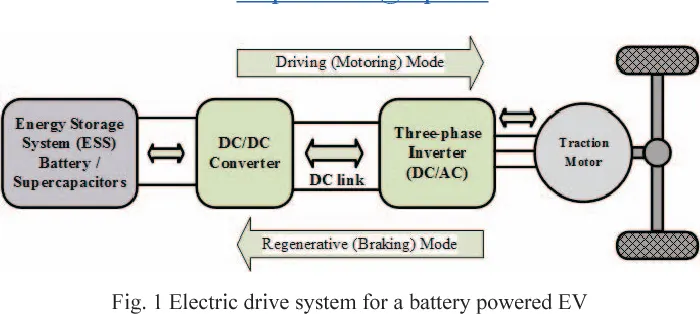
2. DC to AC converter :(inverter)
A DC-AC power inverter converts a DC input voltage to the required magnitude and frequency of AC output voltage.The inverter in an EV is also called a VFD – Variable Frequency Drive.In the battery (HEV/EV), the stored energy must be converted from DC to AC to drive AC motors using DC-AC converters. These converters are called traction inverters,
which usually transfer power in the range of tens of kilowatts up to 50 kW.Usually, the semiconductor power switches used in these inverter topologies are insulated gate bipolar transistors (IGBTs). It inverts DC charge to AC charge for driving the motor and then the opposite during regenerative braking. An equally important job of the inverter is to control the switching of the static coils in the motor to create a revolving magnetic field, like a merry-go-round, to spin the motor's rotor.
3. DC to DC converter:(Chopper)
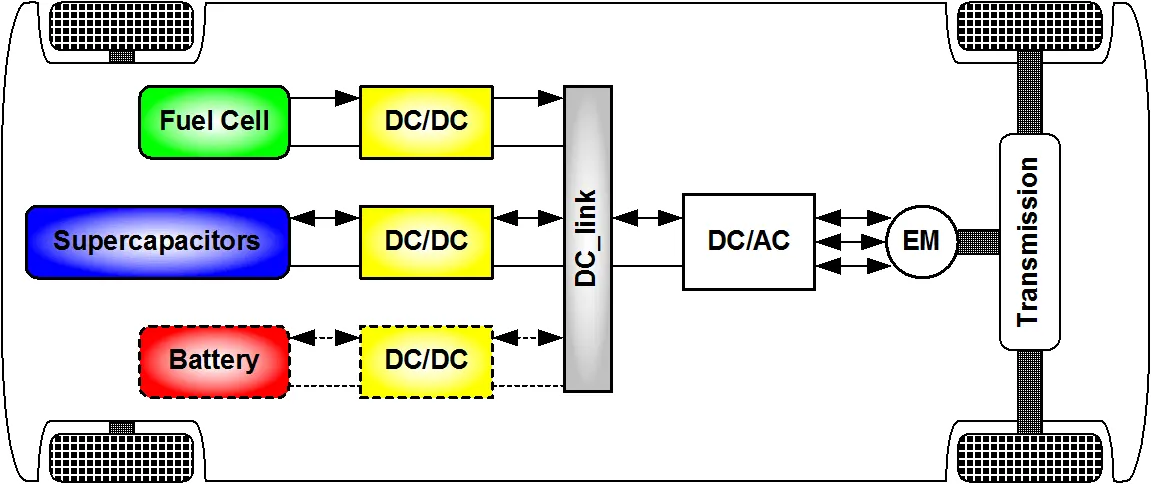
In case of interfacing the Fuel Cell, the DC/DC converter is used to boost the Fuel Cell voltage and to regulate the DC-link voltage.A DC-to-DC converter is a category of power converters, which converts a DC source from one voltage level to another . A DC-DC converter is a critical component in the architecture of a BEV, where it is used to convert power from the high voltage (HV) bus to the 12V Low Voltage (LV) bus to charge the LV battery and power the onboard electric devices.DC/DC converter topologies can be used as bi-directional. A bi-directional converter can move power in either direction, which is useful in applications requiring regenerative braking.The power of the DC/DC converter depends on the characteristics of the vehicle such as top speed, acceleration time from 0 to 100 Km/h, weight, maximum torque, and power profile (peak power, continuous power).
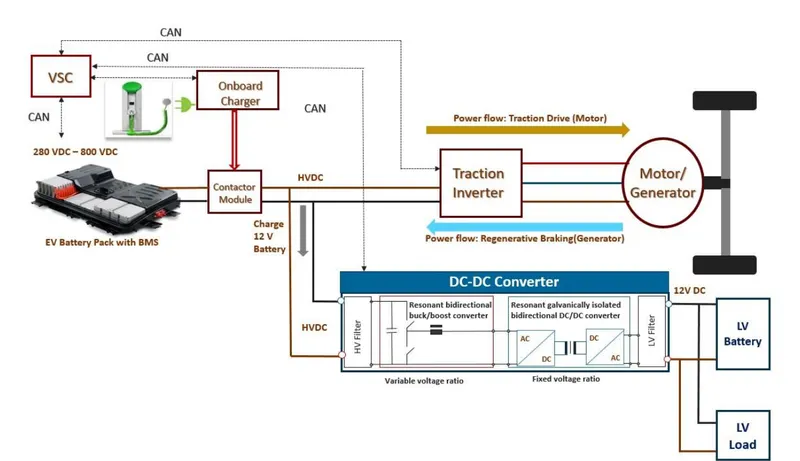
Here, the DC-DC converter is the device that converts highervoltage DC power from the traction battery pack to the lower-voltage DC power needed to run vehicle accessories and recharge the auxiliary battery.In the DC to DC converter itself there two categories such as;
* Buck converter/Step down converters (used for voltage step-down)
* Boost converter/Step up converters (used for voltage step-up)
* Buck-boost and Cuk converters (used for either step-down or step-up)
QA:2 Given model;
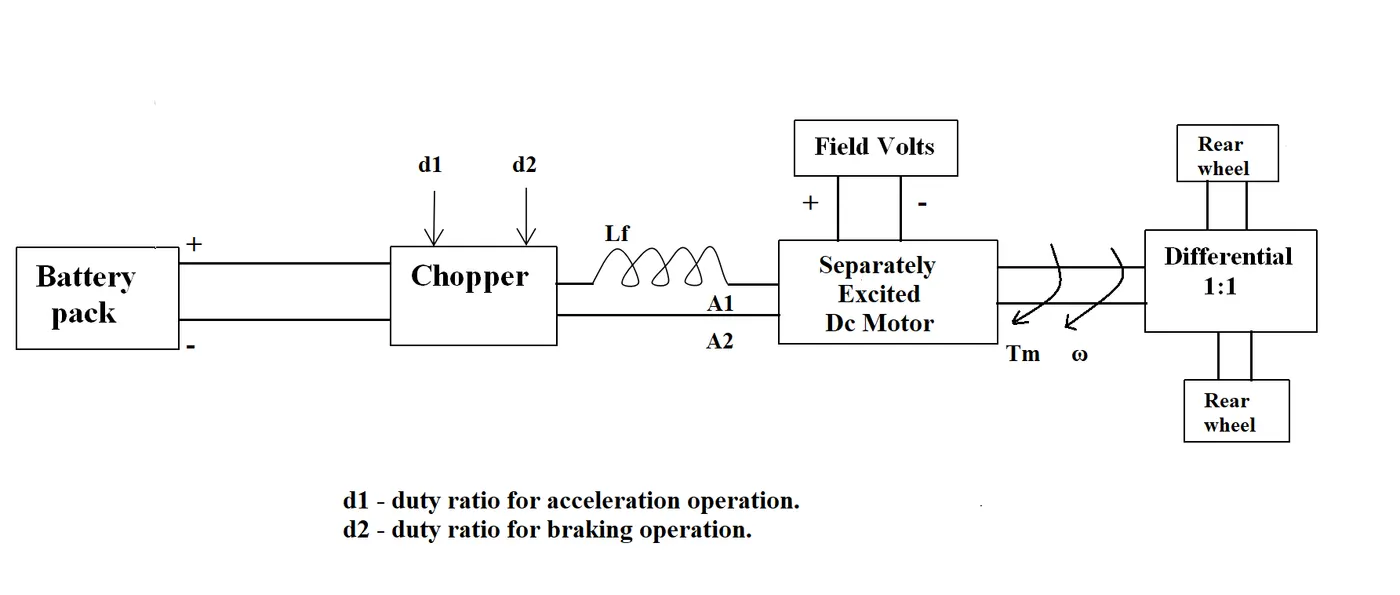
Given parameters;
The following input parameters are given: -
Battery pack voltage (V) = 72V
Rated armature current = 400 A
Armature Resistance (Ra) = 0.5Ω
Motor constant (Kphi) = 0.7
Chopper Switching frequency= 400 Hz
Duty Cycle = 70%
Solution: -
Vehicle Output Voltage (Vout) is given by: -
Vout = Battery Voltage (V) * Duty Cycle
Vout= 72 * 0.70
Thus, Vehicle voltage = 50.4V
Now, Equation for Vehicle torque is given by: -
Tv=(Vv-ω.K∅)⋅K∅Ra">Tv=((Vout*kphi)/Ra)-(70.56-0.98⋅ω=24.7+0.0051⋅ω2">ω*(kphi^2))/Ra
Where;
Tv">Tv= Vehicle Torque (N-m)
Vv">Vout = Vehicle voltage (Volts)
ω">ω= steady state speed of vehicle (rps)
K∅">Kphi= Motor constant
Ra">Ra= Armature Resistance
Substituting all these values in equation, we get:
Tv=(50.04-0.7⋅ω)⋅0.70.5">Tv=((50.4*0.7)/0.5)-(70.56-0.98⋅ω=24.7+0.0051⋅ω2">ω*(0.7)^2)/0.5
Tv=70.56-0.98⋅ω">Tv=70.56−0.98⋅ω ------------(1)
Tv=70.56-0.98⋅ω">Given vehicle speed-torque characetristics as;
Tv=24.7+0.0051⋅ω2">Tv=24.7+0.0051⋅ω^2-------------(2)
comparing equation(1) and (2)
70.56-0.98⋅ω=24.7+0.0051⋅ω2">70.56−0.98⋅ω=24.7+0.0051⋅ω^2
We get a quadratic equation:
0.0051⋅ω2+0.98⋅ω-46.94=0">0.0051⋅ω2+0.98⋅ω−45.86=0------------(3)
since equation(3) is a quadratic equation,thus finding roots of this equation we get;
ω">ω1= 38.85 rad/s and ω">ω2 = -231.07 rad/s
since negative value is not considered(-231.07rad/s)
Steady state speed of vehicle = = 38.85 rad/s
QA:3
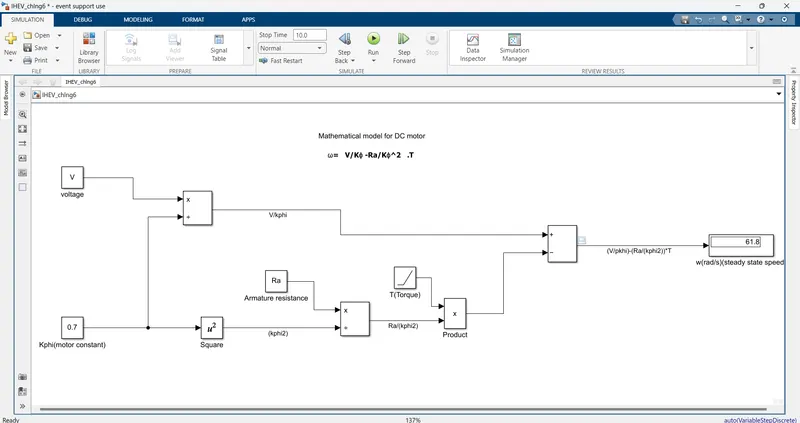
Given characteristic equation;
ω= V/Kϕ -Ra/Kϕ^2 .T
Matlab script:
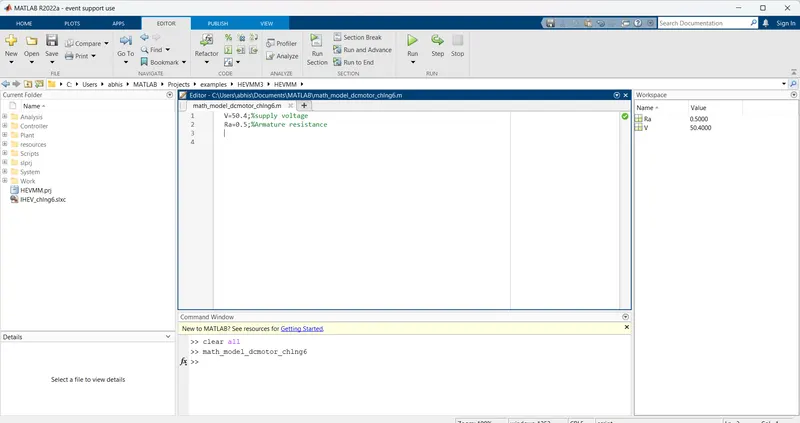
Simulink model:
Scope:
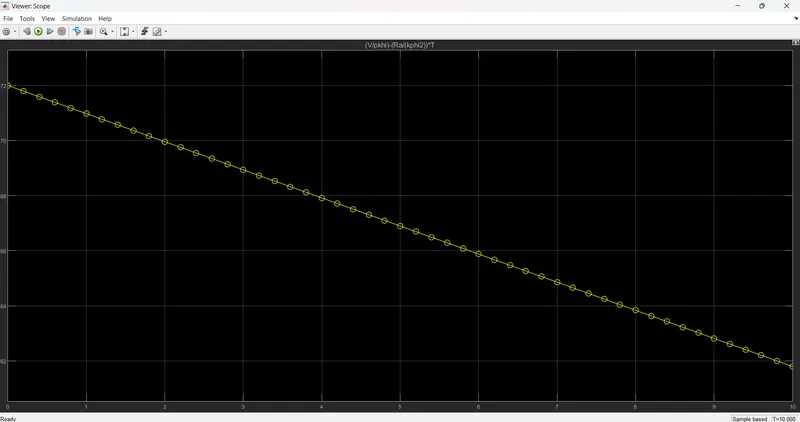
Result:
Steady state speed of motor ;61.8 rad/s
QA:4
Author, Wally Rippel (a long-time proponent of electric vehicles.) in the blog is trying to discuss the two technologies(DC brushless drives and Induction motor)with its feature in the operations.In the beginning, author describes the dominance of Internal Combustion Engines (ICE) in the world of automobile industry and also discuss different types of engines. He explains that all engines were similar and it was up to the user to select according to their requirement. He also speaks about induction motor and brushless DC motors and presents his view that these two technologies will be widely used for the coming years.Then he explains the working of both 3-phase induction motor and a brushless DC motor.
Induction motor;
Adavantages of Induction motors are:
*The induction motor does not have permanent magnets and it is connected to 3-phase utility power; torque is produced at the outset the motor can start under load, so the inverter is not needed so it can be compatible with the conventional vehicles.
*If induction motor size increases the losses will not increase.
*Induction motors do not require any ‘inverter” otherwise Tesla’s invention would have been useless.
*With the help of an induction motor drive, we can achieve the required high performance.
*Permanent magnets are expensive and permanent magnet rotors are also difficult to handle due to very large forces that come into play when anything ferromagnetic gets close to them. This means that induction motors will likely retain a cost advantage over PM machines.
*The induction drives when operated with a smart inverter has an advantage over DC brushless drives.
*The induction motor is cost-efficient and high inverter rating, especially for high-performance vehicles
Disadvantages of Induction motors are:
*They cannot operate from DC; AC is a must.
*Shaft speed is proportionate to line frequency. Hence, when used with utility power, they are constant speed machines.
*When operated from utility power, they have limited starting torque and somewhat limited running peak torque capabilities, when compared to DC type machines.
* it is difficult to control due to its complex control laws which are difficult to understand.
*For good stability over the entire torque-speed range and over temperature is more difficult with induction than with DC brushless motors.
Brushless DC motor ;
Adavantages of brushless DC motor:
*much less rotor heat is generated with the DC brushless drive.
*The heat generation factor is low in DC brushless drives
*The peak point energy efficiency for a DC brushless drive will typically be a few percentage points higher than for an induction drive.
* It can also operate at a unity power factor, whereas an induction drive has a power factor of about 85%.
*As motor size increases, the magnetic loss does not increase
Disadvantages of brushless DC motor:
*DC brushless motor produces no starting torque when directly connected to fixed frequency utility power. They really need the aid of an inverter whose “phase” is maintained in step with the angular position of the rotor.
*As machine size grows, the magnetic losses increase proportionately and part load efficiency drops.
*Permanent magnets are expensive and difficult to handle due to very large forces that come into play when anything ferromagnetic gets close to them.
Conclusion:
The author has given light to different aspects in which he compared DC brushless and induction motor drives with pros, cons and limitations.At last the author couldn’t choose which drive is better than the other but makes it clear that DC brushless drives will likely continue to dominate in the hybrid and coming plug-in hybrid markets, and that induction drives will likely maintain dominance for the high-performance pure electrics. "The fact that so much of the hardware is common for both drives could mean that we will see induction and DC brushless live and work side by side during the coming golden era of hybrid and electric vehicles."