Week-6 Challenge: EV Drivetrain
1.Which types of power converter circuits are employed in electric and hybrid electric vehicle?
ANS:
now a days genarally BLDC motors are used in traction ,have traction characteristics like high starting torque, high efficiency around 95-98%, etc. BLDC motors are suitable for high power density design approach. The BLDC motors are the most preferred motors for the electric vehicle application due to its traction characteristics
but still some electric vehicle have induction motor whatever it may buy we can"t store the energy in the form of AC.storege is possible only in the form of DC .i.e battary
and power grid avaliable at only in the AC so we need to convert power AC to DC (rectifer) and DC to AC (inverter) and DC to DC also that mean to achive requeire quality and voltage level
for onboard charging vehicle have inbuild rectifer circuit and for some vehicle have using commercial charging stations too so that need to charing with DC
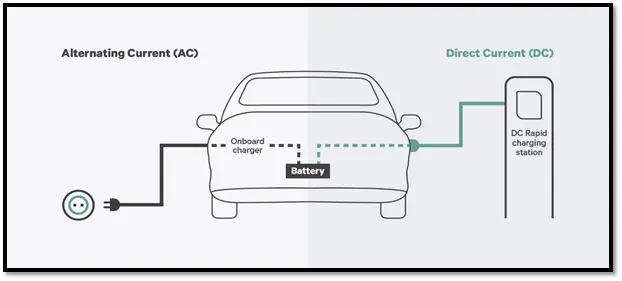
and after the storege vehicle cosumes that dc power from battaryy so we need give quality at require voltage level.
show that dc to dc power converter are used(boost convetres)
dc to dc conveters have many type
boost converter : low level volage to high level voltage(example 12v to 200V )
buck converts : small power can used mean high power to low power( for small motor application)
that show in the fig below again inverter are used to conter the dc to ac power suppose the moter id induction motor
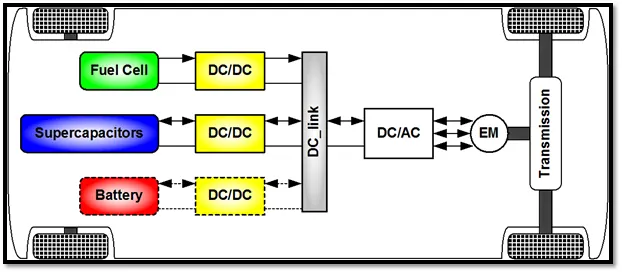
2.An Electric Vehicle's powertrain with 72V battery pack in shown in the diagram below. The duty ratio for acceleration operation is 'd1' and for the braking operation the duty ratio is 'd2'.
ANS:
given Motor and Controller Parameters:
Rated Armature voltage= 72 V
Rated armature current= 400 A
Ra= 0.5Ω, KΦ= 0.7 Volt second
Chopper Switching frequency= 400 Hz
The vehicle speed-torque characteristics are given by the below equation

duty cycle is 70 %
Output Voltage (Vv) is given by: -
Vv = Battery Voltage (V) * Duty Cycle
Vv = 72 * 0.70=50.4
Vehicle voltage = 50.4V
Vehicle torque is given by: -
Tv=(Vv−ω.K∅)⋅K∅RaTv=(Vv-ω.K∅)⋅K∅Ra
here, Tv= Vehicle Torque (N-m)
Vv = Vehicle voltage (Volts)
ω= steady state speed of vehicle (rps)
K∅= Motor constant
Ra= Armature Resistance
Substituting all these values in equation, we get:
Tv=(50.04−0.7⋅ω)⋅0.70.5Tv=(50.04-0.7⋅ω)⋅0.70.5
Tv=70.56−0.98⋅ωTv=70.56-0.98⋅ω
Tv=24.7+0.0051⋅ω2Tv=24.7+0.0051⋅ω2
Solving these two equations,
70.56−0.98⋅ω=24.7+0.0051⋅ω270.56-0.98⋅ω=24.7+0.0051⋅ω2
We get a quadratic equation:
0.0051⋅ω2+0.98⋅ω−46.94=00.0051⋅ω2+0.98⋅ω-46.94=0
Since quadratic equation, we get two values of ;
ω= 38.85 and ω = -230.95
We take the positive value;
Steady state speed of vehicle = = 38.85