Project
To Prepare a technical report explaining the model properties & comments on the results.
As per given link This submission contains a set of models created with Simulink, Simscape, and Simscape Driveline.
These models show how to build an ATV with CVT which is mostly used in BAJA competitions. Simscape and Simscape Driveline have been used to complete the system. The engine data used in the model is provided as an image which shows the Engine Speed (RPM) Vs Torque curve.
Transmission is which transmits the power from engine to the wheels through the shafts. It consists of 4 types mainly,
A continuously variable transmission, or CVT, is a type of automatic transmission . it has more useable power, better fuel economy and a smoother driving experience than a traditional manual transmission.
The CVT is a system that makes it possible to vary stepless the transmission ratio without interruption of the torque flow. Therefore an infinite number of ratios are possible. It is an automatic, single speed, and gearless transmission that can shift through an infinite number of gear ratios. This ability to seamlessly shift through these different gears provides a number of benefits including extremely smooth shifts and exceptional fuel economy. A CVT draws top engine power from a small engine, which gives drivers quicker acceleration than standard automatic transmissions. CVTs produce fewer emissions. CVTs are also lighter weight than traditional automatic transmissions.
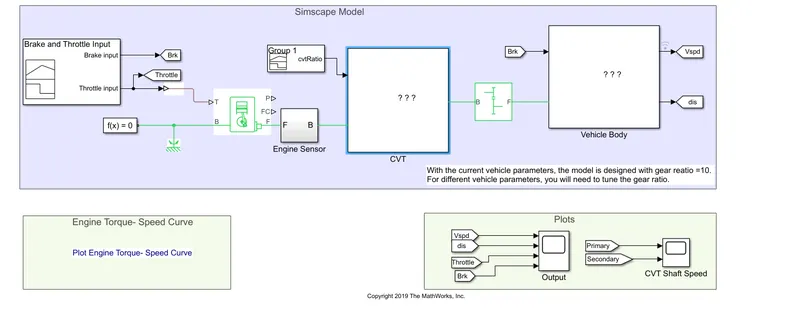
from the above model we go through CVT block first
CVT consists of Signal builder, generic engine, motion sensors, vehicle transmission, vehicle body,tyres and solver configuration blocks etc., as shown in fig. The CVT subsystem includes Transmission block, input and output shaft inertia and motion sensors. The vehicle body subsystem includes vehicle body block, double drum brake and tyres . The initial engine speed is given as 2100 rpm, mechanical rotation for driven pulley and driver pulley as 0.8 & 0.7 respectively. The mass of the vehicle as 250kg and 2 axles which connects 4 wheel accordingly.
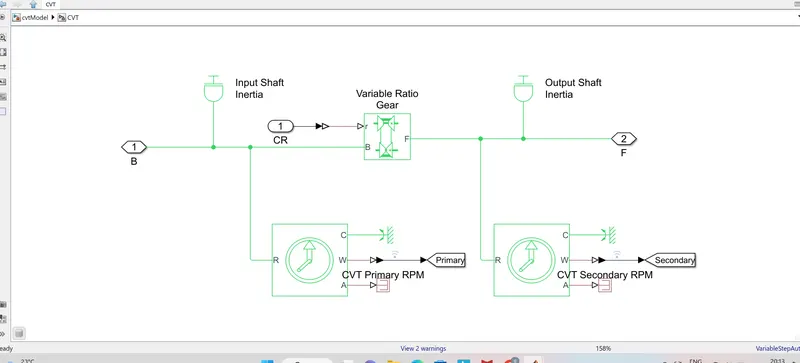
here given CVT subsystem
and vehicle body subsystems is given here
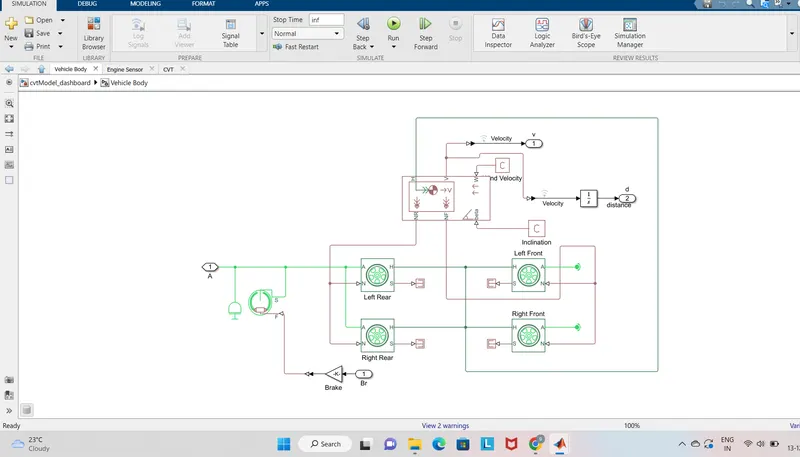
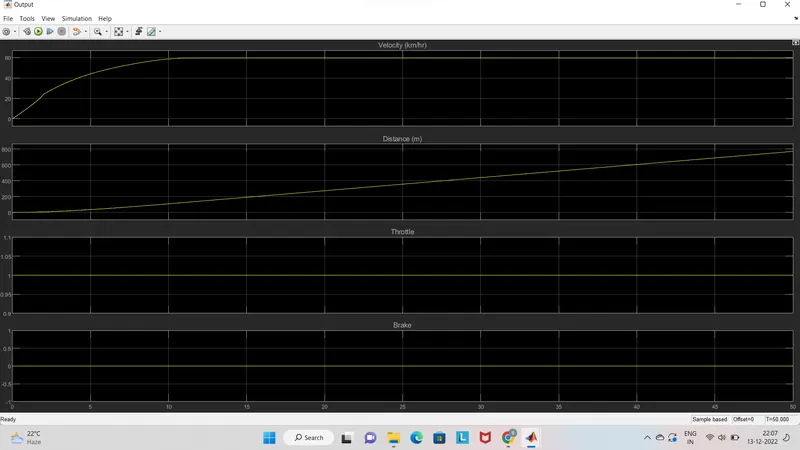
Rest of the blocks and subsystems are common in the above baja ATV model without dash board. The main concept of using dash board is study the result by varying the input of brake and throttle, which shows that the velocity and speed of the engine. The gear ratio is maintained as 2.3 for 5 secs and linearly decreases to 1.8 and maintained constant for overall simulation . As the brake input varies from 0 - 0.5, the velocity and speed decreases accordingly. By increasing the throttle, the velocity and speed of the engine & shaft increases.
By using simulink model of CVT consists of step time, generic engine, motion sensors, vehicle transmission, vehicle body,tyres and solver configuration blocks etc.. The CVT subsystem includes look up table, Transmission block, input and output shaft inertia and motion sensors as shown in fig. The vehicle body subsystem includes vehicle body block, double drum brake and tyres . The initial engine speed is given as 2100 rpm, mechanical rotation for driven pulley and driver pulley as 0.8 & 0.7 respectively. The mass of the vehicle as 250kg and 2 axles which connects 4 wheel accordingly.
A lookup table is an array of data that maps input values to output values, thereby approximating a mathematical function. Given a set of input values, a lookup operation retrieves the corresponding output values from the table. If the lookup table does not explicitly define the input values, simulink can estimate an output value using interpolation, extrapolation, or rounding
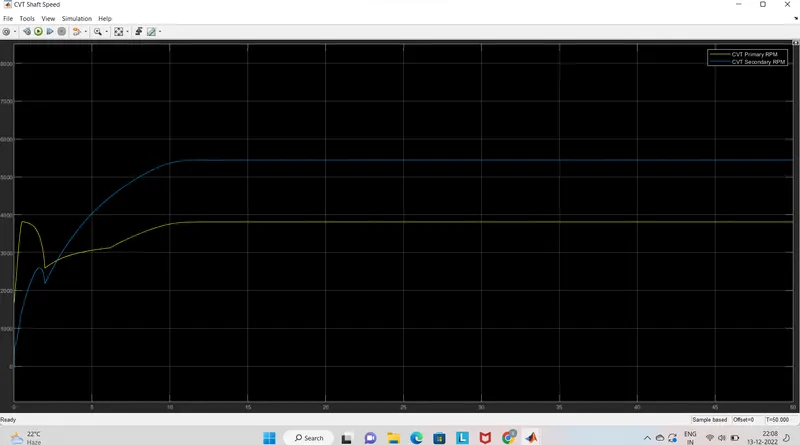
result are show in below.
and here simulation time kept 50 sec
also speed and RPM can shown in fig