Week-6 Challenge: EV Drivetrain
1. Types of power converter circuits employed in electric and hybrid electric vehicle:
The power electronic converters are the key elements to interface energy sources to the drivetrain of the EVs in electric and hybrid electric vehicle. Advanced DC/DC and DC/AC converters are the type of power converter circuits employed in electric vehicle. This high efficient power converters are designed to adapt high quality output voltage and current levels of the system.
Types of power converter used in EV are
AC-DC Converter:
This type of power converter is employed as an on-board charger in Plug-in HEV and EV. Using this converter, the energy sources in EV/PHEV is charged from an external alternating current (AC) electricity sources. The on-board charger used power converter converts the alternating current source into an direct current.
DC-DC Converter:
A DC-to-DC converter is a category of power converters, which converts a DC source from one voltage level to another. It can be unidirectional, which transfers power only in one direction, or bidirectional, which can transfer power in either direction. Moreover, a DC-DC converter is a critical component in the architecture of a BEV, where it is used to convert power from the high voltage (HV) bus to the Low Voltage (LV) bus to charge the LV battery and power the onboard electric devices.
DC-AC Converter:
An inverter is a device that converts DC power to the AC power used in an electric vehicle motor. The inverter can change the speed at which the motor rotates by adjusting the frequency of the alternating current. It plays a significant role in capturing energy from regenerative braking and feeding it back to the energy storage system. The key component is that it has a direct impact on on-road performance, driving range, and reliability of the vehicle also as a consequence of their weight and size.
2.
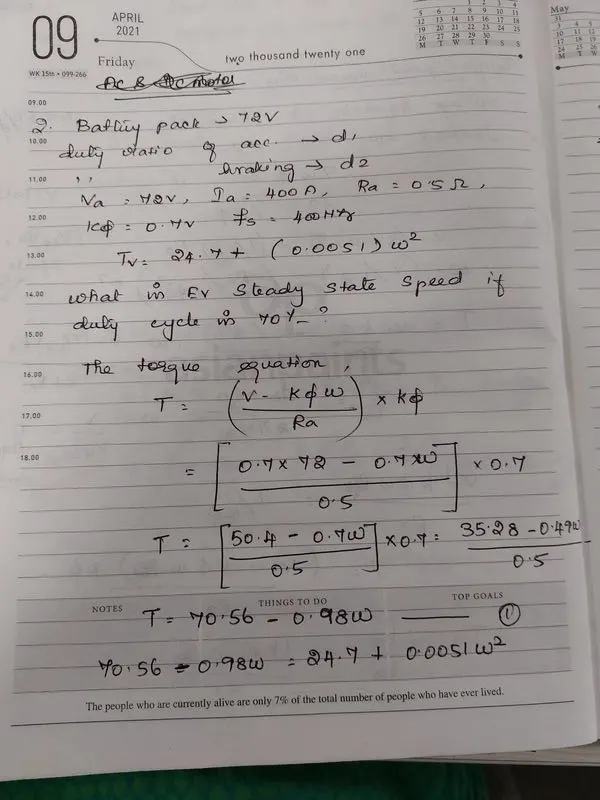
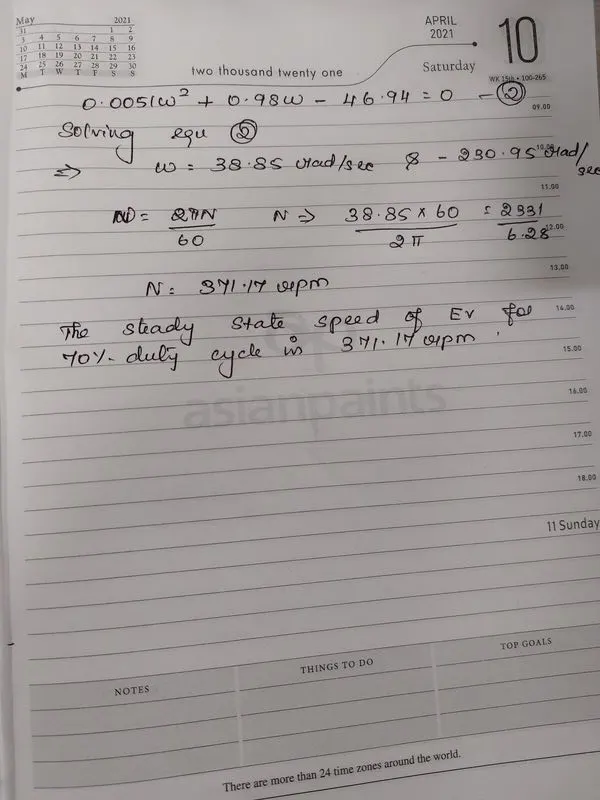
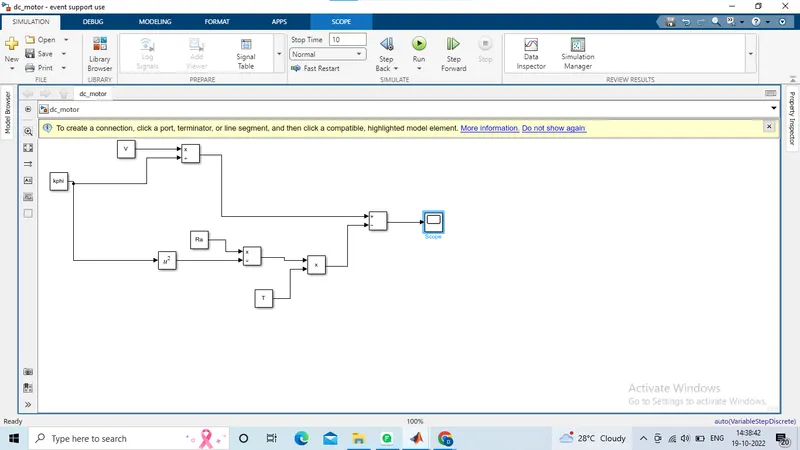
3. Mathematical model of a DC Motor:
4. The author of the blog post "Induction versus DC Brushless motor by Wally Rippel, Tesla" states that he wishes to draw attention to issues surrounding EV technology, particularly those pertaining to DC brushes and motors.Author claims that either DC Brushless motors or Induction motors are used to replace DC. For EVs, lithium-ion batteries also take the place of lead-acid batteries. According to him, the future of both induction and brushless DC motors would rely on consumer desire and application.
Brushless DC Motor:
The DC Brushless motor's technology is based on the fact that it includes more than two permanent magnets, which produce a DC magnetic field. The magnetic field near the stator causes a current to flow in the winding for improved torque generation in the rotor and stator. The brushless motor needs a suitable flow of current into the rotor and stator in order to create current; otherwise, torque would decrease. Smooth current flow is necessary to maintain electrical to mechanical conversion; otherwise, the brushless motor is useless. An electric motor with no brushes produces no starting torque.
The benefit of a DC brushless motor is that it has superior cooling capabilities than an induction motor drive and produces less heat in the rotor. Its peak power efficiency is also higher. The best induction drives have a power factor of about 85%, but DC Brushless drives can operate at unity. As a result, the peak point energy efficiency of a DC Brushless drive will normally be a few percentage points better than that of an Induction drive.
INDUCTION MOTOR:
The induction motor's technology primarily makes use of a three-phase induction motor that Nikola Tesla discovered in 1889. Instead of magnets, steel laminated devices are used in induction motors. A revolving magnetic field is created by currents flowing in the stator windings and enters the rotor. To create the force needed for rotor torque in an induction motor, current interacts with the magnetic field produced by the stator. A power source is compatible with the induction motor. An induction motor needs AC electricity to work; it cannot operate on DC voltage.
Since there are no magnets in the induction motor, the B field can be changed. B field in an induction motor is proportional to V/f (Voltage to frequency). By lowering magnetic and conduction losses, this technique allows efficiency to stay at its highest possible level. All of these factors contribute to increased performance; an induction motor is very practical and effective for high performance. Although the peak efficiency of an induction motor is lower, it operates more smoothly. Induction motor or mechanism control is more difficult. Additionally, when a motor operates at a fast speed, little torque is produced, and the temperature of the motor rises.
What is the better brushless DC motor or induction motor? In the 1990s, the General Motors EV-1 and Tesla Roadster used induction motors, while the other HEVs used brushless DC motors. Both drives use 3-phase modulating inverters with DC and induction motors. The motors' rotors and inverter controllers are the only components that differ.
According to Sensors, induction motors just require speed sensors while DC Brushless motors require absolute position sensors.Another factor is the price of permanent magnets, which is expensive per kilogramme. Additionally, the permanent magnet rotor is challenging to handle and requires more careful maintenance. Therefore, induction motors are less expensive.
The author comes to the conclusion that induction motor drives are only optimal for Pure High Performance EVs, whereas DC Brushless drives are advantageous for all hybrid and Plug-In Hybrid Vehicles.